The National Critical Mineral Mission (NCMM) is highly relevant for UPSC as it aligns with India’s strategic goals for clean energy transition and self-reliance. The mission supports critical sectors like solar, wind, and electric vehicles, which are central to sustainable development. It also addresses key issues in national security and economic resilience by securing vital mineral resources. Additionally, the mission’s focus on technological advancements and international cooperation enhances India’s global competitiveness in mineral exploration and processing.
Table of Contents
Launch & Purpose
- Launched: The Government of India launched the National Critical Mineral Mission (NCMM) in 2025 to establish a robust framework for self-reliance in the critical mineral sector. Under this mission, the Geological Survey of India (GSI) has been tasked with conducting 1,200 exploration projects from 2024-25 to 2030-31.
- Goal: Establish self-reliance in critical mineral sector and secure supply for clean energy technologies
- Lead Agency: Geological Survey of India (GSI) – responsible for 1,200 exploration projects (2024-25 to 2030-31)
- Strategic Importance:
- Essential for economic development and national security
- Reduces supply chain vulnerabilities due to limited global availability
Critical Minerals Definition
Critical minerals are essential for a country’s economic development and national security, and their lack of availability or concentration in a few geographical locations can lead to supply chain vulnerabilities.
Critical Minerals – List
- Minerals essential for clean energy, defense, electronics, EVs, and energy storage
- Committee (Ministry of Mines, 2022) identified 30 critical minerals
- 24 included in Part D of Schedule I, Mines and Minerals Development and Regulation Act, 1957 (MMDR Act, 1957)
- Meaning: Central Government has exclusive rights to auction mining leases/ composite licenses for these specific minerals.
- Centre of Excellence on Critical Minerals (CECM) to:
- Update mineral list
- Guide strategy
Usage of Critical Minerals
- Solar Energy
- Minerals: Silicon, Tellurium, Indium, Gallium
- Application: Photovoltaic (PV) cells for solar panels
- India’s current solar capacity: 64 GW
- Wind Energy
- Minerals: Neodymium, Dysprosium (Rare Earth Elements)
- Application: Permanent magnets for wind turbines
- India’s current wind capacity target: 42 GW → 140 GW by 2030
- Electric Vehicles (EVs)
- Minerals: Lithium, Nickel, Cobalt
- Application: Lithium-ion batteries
- National Electric Mobility Mission Plan (NEMMP) Target: 6–7 million EVs by 2024
- Energy Storage
- Minerals: Lithium, Cobalt, Nickel
- Application: Advanced energy storage systems, grid storage

Objectives of NCMM
- Secure Supply Chain
- Ensure availability of critical minerals from domestic & foreign sources
- Strengthen Value Chains
- Enhance technological, regulatory, and financial ecosystems
- Promote innovation, skill development, R&D, and recycling
- Encourage global competitiveness in mining, beneficiation, processing, and recycling
Mission Targets (2024-25 to 2030-31)
| Component | Key Heads | Target |
| Domestic & Foreign Sourcing | Domestic Exploration Projects | 1,200 |
| Foreign Mines – PSUs | 26 | |
| Foreign Mines – Private | 24 | |
| Recycling Scheme | 400 kt | |
| Strengthening Value Chains | Patents in Mineral Value Chain | 1,000 |
| Skill Development | 10,000 trained workforce | |
| Mineral Processing Parks | 4 | |
| Centre of Excellence | 3 | |
| Mineral Stockpile | 5 strategic reserves |
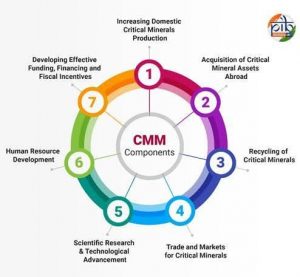
Components of the National Critical Mineral Mission (NCMM)
Exploration Efforts in India
- GSI Exploration Programs: Under NCMM mission, GSI has intensified its exploration programs. In the 2024-25 field season, GSI has taken up 195 projects, including 35 in Rajasthan, focused on identifying and assessing critical mineral deposits.
- Past Surveys:
- 2021–23: REE reconnaissance surveys in Sirohi & Bhilwara (Rajasthan)
- Department of Atomic Energy: 1,11,845 tonnes in-situ REO in Balotra, Rajasthan
- The mission seeks to minimize import dependency by enhancing domestic exploration and mining efforts.
- Key Initiatives:
- Fast-track regulatory approvals
- New Exploration Licence (EL) for private participation
- Recovery from secondary sources (fly ash, tailings, red mud)
- Offshore exploration for polymetallic nodules
Acquisition of Assets Abroad
- Objective: Secure critical mineral reserves overseas
- Support via: Funding, guidelines, inter-ministerial coordination, PPPs, MEA support
- Key Initiatives:
- KABIL & Argentina (Catamarca): Lithium exploration, 15,703 hectares (Jan 2024)
- KABIL & Australia (CMO, DISER): MoU for lithium & cobalt strategic investments
- Due diligence ongoing for lithium & cobalt projects in Australia
IREL (India) Limited – Role in Critical Minerals
- Processing Capacity: 6 lakh tons per annum
- Minerals: Ilmenite, Rutile, Zircon, Sillimanite, Garnet
- Rare Earth Units:
- Chatrapur, Odisha – Extraction
- Aluva, Kerala – Refining
- Key Focus:
- Expand production capacity
- Support value chain industries
- Advance R&D (Kollam facility)
- Financials: Peak turnover ₹14,625 million (2021–22), ₹7,000 million from exports
Strategic Importance & Climate Goals
- India’s climate targets:
- Reduce emissions intensity by 45% (from 2005 levels) by 2030
- 50% electric power from non-fossil sources by 2030
- Net-zero emissions by 2070
- NCMM Contribution:
- Build resilient, self-reliant ecosystem for critical minerals
- Encourage private sector participation and international partnerships
- Streamline regulations for uninterrupted mineral supply
- Support clean energy technologies: EVs, solar, wind, energy storage
Conclusion
- India aims to reduce the emissions intensity of its GDP by 45% by 2030 (from 2005 levels), achieve 50% of its electric power capacity from non-fossil sources by 2030, and reach net-zero emissions by 2070. To achieve these climate goals, the National Critical Mineral Mission (NCMM) plays a vital role by building a resilient and self-reliant ecosystem for critical minerals. The mission focuses on boosting domestic production, encouraging private sector participation, strengthening international partnerships, and streamlining regulations to ensure a steady supply of minerals essential for clean energy technologies.

UPSC Prelims Multiple Choice Questions
Ques 1. Which of the following statements about the National Critical Mineral Mission (NCMM) is/are correct?
- The mission aims to ensure self-reliance in critical minerals and supports India’s clean energy transition.
- The Geological Survey of India (GSI) is responsible for conducting domestic exploration projects under the mission.
- All critical minerals identified by the Ministry of Mines are now included in Part A of the MMDR Act, 1957.
- 1 and 2 only
- 2 and 3 only
- 1 and 3 only
- 1, 2 and 3
Ques 2. Consider the following pairs regarding critical minerals and their primary uses:
| Critical Mineral | Usage |
|---|---|
| 1. Neodymium | a. Lithium-ion batteries |
| 2. Lithium | b. Permanent magnets in wind turbines |
| 3. Gallium | c. Solar photovoltaic cells |
Which of the pairs given above is/are correctly matched?
- 1-a, 2-b, 3-c
- 1-b, 2-a, 3-c
- 1-a, 2-b, 3-c
- 1-c, 2-b, 3-a
Ques 3. Which of the following initiatives are part of NCMM’s international collaboration efforts?
- KABIL signed a lithium exploration agreement with Argentina covering 15,703 hectares.
- MoU with Australia’s Department of Industry, Science and Resources for strategic investments in lithium and cobalt.
- India signed a strategic partnership with Chile to develop rare earth element (REE) refining units.
- 1 and 2 only
- 2 and 3 only
- 1 and 3 only
- 1, 2 and 3
Ques 4. With reference to NCMM, which of the following statements is/are correct?
- NCMM promotes recovery of critical minerals from secondary sources like fly ash, tailings, and red mud.
- GSI follows the UNFC classification and MEMC rules, 2015 for exploration activities.
- NCMM has proposed setting up more than 10 Centres of Excellence for critical minerals.
- 1 and 2 only
- 2 and 3 only
- 1 and 3 only
- 1, 2 and 3
Ques 5. Consider the following objectives of the National Critical Mineral Mission (NCMM):
- Ensure domestic and foreign sourcing of critical minerals.
- Strengthen technological, regulatory, and financial value chains for innovation and competitiveness.
- Achieve net-zero emissions in India by 2050.
Which of the statements given above is/are correct?
- 1 and 2 only
- 2 and 3 only
- 1 and 3 only
- 1, 2 and 3
Answers
Ans 1. (a) 1 and 2 only
- Statement 1 is correct: NCMM aims to secure critical minerals and support clean energy technologies like solar, wind, EVs, and energy storage.
- Statement 2 is correct: GSI conducts domestic exploration projects (1,200 projects from 2024-25 to 2030-31).
- Statement 3 is incorrect: Only 24 out of 30 critical minerals are included in Part D of Schedule I of the MMDR Act, 1957, not Part A.
Ans 2. (b) 1-b, 2-a, 3-c
- Neodymium → used in permanent magnets for wind turbines.
- Dysprosium → used in permanent magnets for wind turbines.
- Gallium → used in solar photovoltaic cells.
- Lithium is used in lithium-ion batteries, not Neodymium.
Ans 3. (a) 1 and 2 only
- Statement 1: Correct → KABIL & Catamarca, Argentina agreement for lithium exploration.
- Statement 2: Correct → MoU with Australia for strategic investments in lithium and cobalt.
- Statement 3: Incorrect → No official partnership with Chile for REE refining is mentioned in NCMM initiatives.
Ans 4. (a) 1 and 2 only
- Statement 1: Correct → NCMM incentivizes recycling and recovery from secondary sources.
- Statement 2: Correct → GSI follows UNFC classification and MEMC Rules, 2015.
- Statement 3: Incorrect → Only 3 Centres of Excellence are proposed under NCMM.
Ans 5. (a) 1 and 2 only
- Statements 1 & 2: Correct → Core objectives of NCMM include supply security and strengthening value chains.
- Statement 3: Incorrect → India targets net-zero emissions by 2070, not 2050.

UPSC Mains Basic Questions
Ans 1. Discuss the significance of the National Critical Mineral Mission (NCMM) for India’s clean energy transition.
✔ Answer Framework:
- Introduction:
India’s commitment to a sustainable and low-carbon future has made clean energy a national priority. Critical minerals such as lithium, cobalt, neodymium, and gallium are essential for technologies like solar panels, wind turbines, electric vehicles (EVs), and energy storage systems. Recognizing the strategic importance of these minerals, the Government of India launched the National Critical Mineral Mission (NCMM) in 2025 to ensure domestic and global security of supply and to strengthen India’s clean energy infrastructure.
- Body:
- Securing Domestic and Foreign Supply:
- NCMM aims to identify and exploit domestic mineral resources through 1,200 exploration projects (2024–25 to 2030–31) conducted by the Geological Survey of India (GSI).
- The mission also facilitates acquisition of overseas critical mineral assets by Public Sector Undertakings (PSUs) and private firms, with agreements in resource-rich countries like Argentina (lithium exploration in Catamarca) and Australia (lithium and cobalt projects).
- This reduces India’s dependence on imports and ensures strategic autonomy in mineral supply.
-
- Supporting Clean Energy Technologies:
- Solar Energy: Gallium, indium, tellurium, and silicon are used in photovoltaic (PV) cells for solar panels. With India’s solar capacity at 64 GW, securing these minerals is crucial.
- Wind Energy: Rare earth elements like neodymium and dysprosium are used in permanent magnets for wind turbines. India aims to increase wind energy capacity from 42 GW to 140 GW by 2030.
- Electric Vehicles and Energy Storage: Lithium, nickel, and cobalt are vital for lithium-ion batteries powering EVs and energy storage systems. Deployment of millions of EVs under the National Electric Mobility Mission Plan (NEMMP) depends on these minerals.
-
- Strengthening the Value Chain and Innovation:
- NCMM promotes the establishment of processing parks, centres of excellence, and skill development programs to improve domestic mineral processing and technological capabilities.
- Recovery of minerals from secondary sources like fly ash, tailings, and red mud is incentivized to enhance sustainability and efficiency.
- Conclusion:
The NCMM is a strategic initiative that addresses India’s critical mineral needs, supports the transition to clean energy, and strengthens economic and energy security. By integrating domestic exploration, international partnerships, and value chain development, the mission ensures India is better equipped to meet its renewable energy and climate targets while reducing import dependency.
Advanced UPSC Mains Questions
Ques 2. Critically analyze the National Critical Mineral Mission (NCMM) in the context of India’s energy security, industrial development, and global geopolitical positioning. Provide examples and suggest measures to enhance its effectiveness.
✔ Answer Framework:
- Introduction:
In the global race for clean energy leadership, critical minerals have emerged as strategic resources akin to oil in the 20th century. Minerals such as lithium, cobalt, rare earth elements (REEs), gallium, and tellurium are indispensable for solar panels, wind turbines, EVs, and advanced energy storage systems. Recognizing their strategic and economic importance, India launched the National Critical Mineral Mission (NCMM) in 2025, aiming to secure mineral supply chains, strengthen value chains, and promote technological and industrial self-reliance.
- Body:
-
- Energy Security and Clean Energy Transition:
- Critical minerals are essential for renewable energy deployment and reducing carbon emissions.
- Example: Lithium, nickel, and cobalt are required for lithium-ion batteries powering EVs and energy storage systems. India aims to deploy 6–7 million EVs under NEMMP by 2024–25.
- Example: Neodymium and dysprosium are vital for wind turbine magnets, supporting the increase of wind energy capacity from 42 GW to 140 GW by 2030.
- By securing both domestic and foreign mineral resources, NCMM reduces dependence on imports from geopolitically sensitive regions, enhancing India’s energy security.
-
- Industrial Development and Economic Growth:
- NCMM promotes mineral processing parks, R&D centres, and skill development programs, fostering domestic technological capabilities and industrial value chains.
- Recovery of minerals from secondary sources like fly ash, red mud, and tailings aligns with sustainable industrial practices.
- Example: IREL (India) Limited produces ilmenite, rutile, zircon, and sillimanite while operating rare earth extraction units in Odisha and Kerala, demonstrating the potential for profitable domestic mineral industries.
- Geopolitical and Strategic Significance:
- Control over critical minerals enhances India’s strategic autonomy and bargaining power in international negotiations.
- Example: KABIL’s lithium exploration agreement in Catamarca, Argentina, and MoU with Australia’s Critical Mineral Office enables India to diversify supply sources and secure long-term access to lithium and cobalt.
- Developing strategic stockpiles and acquiring foreign assets ensures resilience against global supply chain disruptions, similar to China’s dominance in rare earth markets.
- Challenges and Recommendations:
-
- Challenges: Regulatory bottlenecks, limited domestic reserves for certain minerals, and technological gaps in extraction and processing.
- Recommendations:
- Fast-track approvals for exploration projects and private sector participation.
- Increase investment in R&D for extraction, processing, and recycling technologies.
- Expand international collaborations in mineral-rich countries with transparent off-take agreements.
- Integrate climate-friendly mining practices to minimize environmental impacts.
- Conclusion: The National Critical Mineral Mission is pivotal for India’s clean energy ambitions, industrial growth, and strategic positioning in the global mineral economy. While significant progress has been made in exploration, acquisition, and value chain development, addressing regulatory, technological, and geopolitical challenges is essential. A holistic approach integrating domestic production, international partnerships, and innovation-driven industrialization will ensure India achieves energy security, economic resilience, and leadership in the global clean energy sector.
India aims to reduce the emissions intensity of its GDP by 45% by 2030 (from 2005 levels), achieve 50% of its electric power capacity from non-fossil sources by 2030, and reach net-zero emissions by 2070. To achieve these climate goals, the National Critical Mineral Mission (NCMM) plays a vital role by building a resilient and self-reliant ecosystem for critical minerals. The mission focuses on boosting domestic production, encouraging private sector participation, strengthening international partnerships, and streamlining regulations to ensure a steady supply of minerals essential for clean energy technologies.

UPSC Interview-Based Questions
Ques 1. How does the National Critical Mineral Mission (NCMM) contribute to India’s energy security?
✔ Answer:
NCMM ensures domestic and international supply of critical minerals like lithium, cobalt, and rare earth elements, which are essential for renewable energy technologies, electric vehicles, and energy storage. By reducing dependence on imports, it strengthens India’s strategic autonomy and energy security.
Ques 2. What are the main challenges India faces in securing critical minerals?
✔ Answer:
Challenges include limited domestic reserves of some minerals, technological gaps in extraction and processing, regulatory bottlenecks, and dependence on geopolitically sensitive countries for supply, which may cause disruptions in the clean energy transition.
Ques 3. Explain the strategic importance of India acquiring critical mineral assets abroad.
✔ Answer:
Overseas acquisitions diversify supply sources, reduce import dependence, and secure long-term access to essential minerals like lithium and cobalt. This enhances India’s bargaining power in global markets and mitigates risks from geopolitical tensions.
Ques 4. How does the NCMM support industrial growth and employment in India?
✔ Answer:
The mission promotes domestic mineral processing, R&D, skill development, and establishment of processing parks, creating employment opportunities and strengthening the value chain in industries related to clean energy, EVs, and advanced materials.
Ques 5. In what ways can India ensure sustainable and environmentally friendly mining of critical minerals?
✔ Answer:
By adopting modern mining techniques, promoting recovery from secondary sources (fly ash, tailings), enforcing strict environmental regulations, and investing in research on sustainable extraction, India can minimize ecological impact while securing its critical minerals.