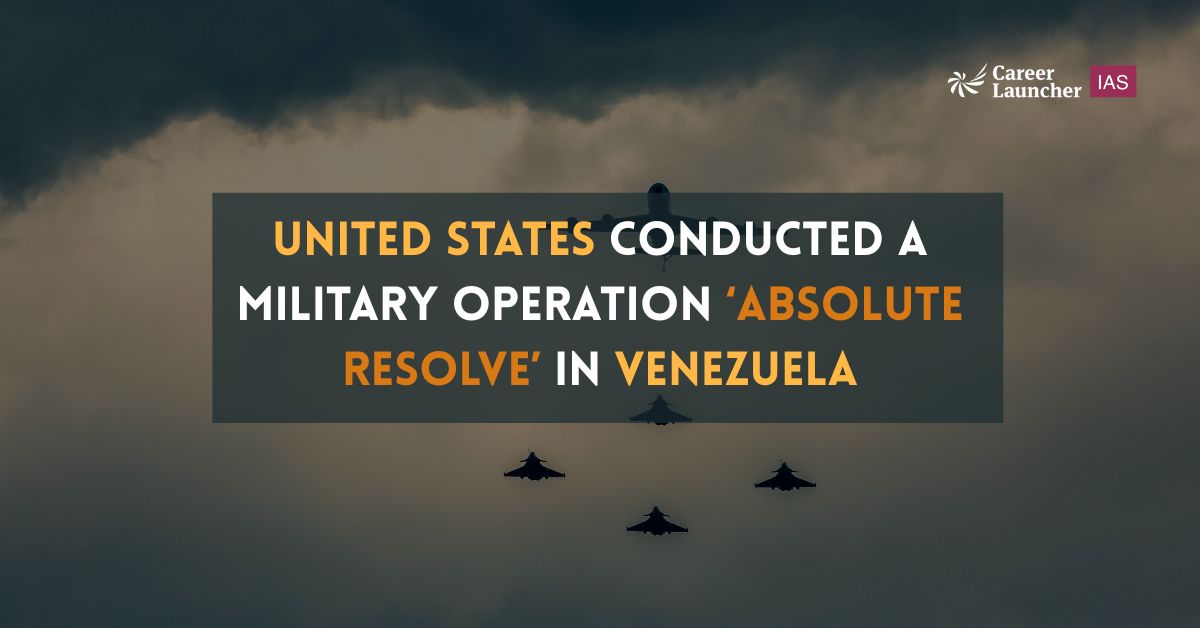
The United States carried out a military operation in Venezuela, codenamed Operation Absolute Resolve, leading to the detention of President Nicolas Maduro, his wife Cilia Flores, and several senior officials. Justified under a projected “Trump Corollary” to the Monroe Doctrine (1823), the move represents a significant intensification of US interventionist policy in Latin America.
Table of Contents
What is the Monroe Doctrine?
Origin (1823)
- Articulated by President James Monroe to assert US primacy in the Western Hemisphere.
Core Principles
- Non-colonisation: No new European colonies in the Americas.
- Non-interference: External interference in the Western Hemisphere would be viewed as hostile to the US.
- US restraint: Non-intervention in European conflicts.
Evolution
- Roosevelt Corollary (1904): Asserted US right to intervene as an “international police power” in Latin America.
- Cold War phase: Used to counter Soviet influence (Cuba, Central America).
- Post-Cold War: De-emphasised in favour of multilateralism.
- Contemporary revival: Selective reassertion to counter China, Russia, Iran—Venezuela being a key case.
“Trump Corollary”
- Projects restoration of US power.
- Emphasises unilateral action to protect security, energy, and strategic interests in the Western Hemisphere.
Why Did the US Intervene in Venezuela?
-
Security & Narco-terrorism Narrative
- Maduro and officials indicted (2020) for narco-terrorism and drug trafficking.
- Regime linked to US fentanyl crisis to provide legal-political justification.
-
Energy & Resource Geopolitics
- Venezuela holds world’s largest proven crude oil reserves (~300 bn barrels).
- Produces <1% of global oil due to sanctions, economic crisis and infrastructure decay.
- Control over oil infrastructure viewed as vital for energy security and price stability.
-
Countering Extra-Regional Powers
- Venezuela’s close ties with China, Russia, Iran challenge US dominance.
- Revival of Monroe-style framework to reassert hemispheric primacy.
-
Strategic Minerals
- Significant reserves of gold, bauxite, rare earths.
- Access seen as crucial to compete with China in high-tech supply chains.
-
Regional Stability & Migration
- Venezuela’s collapse triggered one of the world’s largest migration crises.
- US argues intervention is necessary for regional stabilisation.
-
Human Rights & Democratic Deficit
- Allegations of repression, suppression of opposition, and fraudulent elections (2013, 2018, 2024).
-
Economic Ideology
- Nationalisation of US corporate assets (ExxonMobil, GM) created long-standing rift.
- Intervention framed as reopening markets and correcting the economic model.

Use of Military Force Under International Law
UN Charter Provisions
- Article 2(4): Article 2(4) of the United Nations Charter prohibits states from using or threatening military force against another state’s territorial integrity or political independence.
- Article 51: Article 51 of the UN Charter allows force only in response to an armed attack, subject to necessity and proportionality, and actions must be reported to the UN Security Council.
- Articles 24 & 25: Under Articles 24 and 25, the UN Security Council may authorise collective military action to address threats to international peace.
- Article 107: Obsolete provision relating to WWII enemy states.
- Humanitarian Operations: The UN Security Council can authorise limited force in peacekeeping or humanitarian missions.
Key Issue
- US action lacks clear UNSC authorisation → raises concerns of unilateralism and erosion of sovereignty norms.
Consequences of US Intervention in Venezuela
-
Political Instability
- Leadership vacuum after Maduro’s capture.
- Risk of factionalism between military, opposition, and remnants of regime.
-
Civil Conflict
- Armed resistance by colectivos and loyalist forces.
- Possibility of prolonged insurgency.
-
Geopolitical Polarisation
- Condemnation by China, Russia, Iran.
- Risk of legitimising unilateral force elsewhere (Taiwan, Iran).
-
Energy Market Impact
- Long-term potential increase of 2-3 mbpd.
- Short-term volatility due to sabotage risks.
-
Humanitarian & Refugee Crisis
- Fresh migration flows into Colombia and Brazil.
- Strain on regional resources.
Impact on India’s Interests
-
Trade Impact: Minimal
- Bilateral trade already subdued due to sanctions.
- FY2025 exports: ~USD 95 million (mainly pharmaceuticals).
-
Energy Exposure: Limited (Short Term)
- Crude imports from Venezuela fell by 81.3% in FY2025.
- Venezuela accounts for ~0.3% of India’s oil imports.
-
Medium- to Long-Term Opportunities
- Indian refineries (e.g., Reliance) suited for heavy-sour crude.
- Sanctions easing could allow discounted imports.
- Enhances bargaining power vis-à-vis West Asia and Russia.
-
Indian Investments at Stake
- ~$1 billion in stuck dividends and payments.
- ONGC Videsh and Oil India assets (San Cristóbal, Carabobo-1) could revive under a new regime.
-
Strategic Autonomy Challenge
- India supports non-intervention and sovereignty.
- Balancing Global South solidarity with US strategic partnership becomes harder.
Broader Strategic Implications
- Signals a conditional sovereignty world order.
- Reinforces fears of selective rule-based order.
- Challenges multipolarity and Global South agency.
Way Forward
For the US & International Community
- Provisional oversight with clear exit framework.
- Debt restructuring using oil revenues.
- Counter-insurgency without permanent occupation.
- UN-led humanitarian surge.
For India
- Maintain principled stance on sovereignty.
- Engage multilaterally via UN, BRICS, G20.
- Safeguard overseas energy assets.
- Exploit future energy diversification opportunities cautiously.
Venezuela: Quick Facts (Prelims Ready)
- Location: Northern South America; Caribbean & Atlantic coast.
- Borders: Colombia, Brazil, Guyana.
- Capital: Caracas.
- Political system: Federal multiparty republic; unicameral legislature.
- Resources: Oil, gas, gold, bauxite, iron ore, diamonds.
- OPEC: Founding member.
- Geography: Andes, Llanos, Guiana Highlands, Orinoco basin.
- Highest peak: Pico Bolivar.
- UNESCO: Canaima National Park, Angel Falls.
- Disputes: Essequibo (Guyana), maritime dispute with Colombia.
Conclusion
The US intervention in Venezuela represents a decisive revival of the Monroe Doctrine in a contemporary form, prioritising strategic dominance over multilateral restraint. While framed as a corrective to authoritarianism and instability, the action risks deepening regional volatility, weakening international legal norms, and unsettling the multipolar balance. For India, the episode underscores the need to defend strategic autonomy, protect overseas assets, and navigate an increasingly power-centric global order.
UPSC Prelims Multiple Choice Questions

Ques 1. With reference to the Monroe Doctrine, consider the following statements:
- It opposed the establishment of new European colonies in the Americas.
- It authorised the United States to intervene militarily in European internal affairs.
- It originally committed the United States to non-interference in European wars.
Which of the statements given above is/are correct?
- 1 and 3 only
- 1 only
- 2 and 3 only
- 1, 2 and 3
Ans 1. (a) 1 and 3 only
- Statement 1 is correct: Non-colonisation was a core principle of the Monroe Doctrine (1823).
- Statement 2 is incorrect: The doctrine explicitly avoided interference in European affairs; military intervention authority emerged later under the Roosevelt Corollary.
- Statement 3 is correct: The US promised restraint from European conflicts.
Ques 2. Consider the following statements about Venezuela’s political system and strategic importance:
- Venezuela is a federal republic with a unicameral legislature.
- Caracas is both the political and economic capital of Venezuela.
- Venezuela is a founding member of OPEC and holds the world’s largest proven crude oil reserves.
Which of the statements given above is/are correct?
- 1 and 3 only
- 2 and 3 only
- 1 only
- 1, 2 and 3
Ans 2. (a) 1 and 3 only
- Statement 1 is correct: Venezuela is a federal multiparty republic with a unicameral legislature.
- Statement 2 is incorrect: While Caracas is the political capital, major oil and economic activities are spread across regions like Lake Maracaibo; UPSC avoids labeling Caracas as an exclusive “economic capital.”
- Statement 3 is correct: Venezuela is a founding member of OPEC and possesses the largest proven crude oil reserves globally.
Ques 3. With reference to the use of military force under international law, consider the following statements:
- Article 2(4) of the UN Charter prohibits the use of force against the territorial integrity of states.
- Article 51 permits the use of force only in response to an armed attack.
- The UN General Assembly can independently authorise collective military action.
Which of the statements given above is/are correct?
- 1 and 2 only
- 1 and 3 only
- 2 and 3 only
- 1, 2 and 3
Ans 3. (a) 1 and 2 only
- Statement 1 is correct: Article 2(4) establishes the general prohibition on the use of force.
- Statement 2 is correct: Article 51 allows self-defence only after an armed attack and subject to proportionality.
- Statement 3 is incorrect: Only the UN Security Council, not the General Assembly, can authorise collective military action.
Ques 4. With reference to Venezuela’s physical geography, consider the following statements:
- The Guiana Highlands in Venezuela are the location of the world’s highest waterfall.
- Lake Maracaibo lies in the Llanos plains region of the country.
- The Orinoco River system plays a major role in shaping Venezuela’s ecology and economy.
Which of the statements given above is/are correct?
- 1 and 3 only
- 2 and 3 only
- 1 only
- 1, 2 and 3
Ans 4. (a) 1 and 3 only
- Statement 1 is correct: Angel Falls, the world’s highest waterfall, is located in the Guiana Highlands.
- Statement 2 is incorrect: Lake Maracaibo is located in the northwestern part of Venezuela, not in the Llanos plains.
- Statement 3 is correct: The Orinoco River system is central to Venezuela’s ecology, transport, and resource economy.
Ques 5. With reference to the geographical location of Venezuela, consider the following statements:
- Venezuela has coastlines along both the Caribbean Sea and the Atlantic Ocean.
- Venezuela shares land borders with Guyana, Brazil, and Colombia.
- Venezuela shares a land boundary with Peru.
Which of the statements given above is/are correct?
- 1 and 2 only
- 2 and 3 only
- 1 and 3 only
- 1, 2 and 3
Ans 5. (a) 1 and 2 only
- Statement 1 is correct: Venezuela is located at the northern end of South America and has coastlines along the Caribbean Sea and the Atlantic Ocean.
- Statement 2 is correct: It shares land borders with Guyana (east), Brazil (south), and Colombia (west and southwest).
- Statement 3 is incorrect: Peru does not share a border with Venezuela; Peru lies further south and is separated by Brazil and Colombia.
Ques 6. Consider the following statements:
Statement-I: Recently, Venezuela has achieved a rapid recovery from its economic crisis and succeeded in preventing its people from fleeing/emigrating to other countries.
Statement-II: Venezuela has the world’s largest oil reserves.
Which one of the following is correct in respect of the above statements?
- Both Statement-I and Statement-II are correct and Statement-II explains Statement-I
- Both Statement-I and Statement-II are correct, but Statement-II does not explain Statement-I
- Statement-I is correct, but Statement-II is incorrect
- Statement-I is incorrect, but Statement-II is correct
Ans 6. (d) Statement-I is incorrect, but Statement-II is correct
- Statement-I is incorrect. Venezuela has not recently achieved a rapid recovery from its economic crisis. The country has faced a prolonged socioeconomic collapse, with hyperinflation, shortages of basic goods, and widespread poverty persisting for years. As a result, millions of Venezuelans continue to flee the country in one of the largest migration crises in the world, with millions seeking refuge in neighbouring countries due to economic hardship and insecurity.
- Statement-II is correct. Venezuela is recognised as having the world’s largest proven crude oil reserves, estimated at around 300+ billion barrels, surpassing those of Saudi Arabia and other major oil producers. These vast reserves are a key part of Venezuela’s resource base, although production has fallen significantly due to mismanagement and sanctions. Conclusion: The correct option is (d) because the country has not recovered economically nor halted emigration (Statement-I is incorrect), but it does indeed possess the largest oil reserves globally (Statement-II is correct).
Ques 7. Which of the following lists correctly ranks countries by proven oil reserves from highest to lowest?
- Saudi Arabia – Venezuela – Iran – Canada
- Venezuela – Saudi Arabia – Iran – Canada
- Iran – Venezuela – Saudi Arabia – Iraq
- Venezuela -Canada – Saudi Arabia – Iran
Ans 7. (b) Venezuela – Saudi Arabia – Iran – Canada
- The correct descending order is: Venezuela (~303 billion bbl) > Saudi Arabia (~267 billion bbl) > Iran (~209 billion bbl) > Canada (~163 billion bbl). Venezuela sits at the top of the global list of proven crude oil reserves, with about 303 billion barrels, followed by Saudi Arabia, Iran, Canada, Iraq, the UAE, Kuwait, Russia, the United States, and Libya in descending order of reserves. Venezuela’s vast resource base accounts for nearly one-fifth of the world’s total proven oil reserves, underlining its strategic importance in global energy geopolitics, and most of the leading reserve-holding countries are members of OPEC.
Ques 8. Consider the following statements:
Statement-I: The United States is the world’s largest oil producer.
Statement-II: It is primarily due to technological advancements like shale oil extraction (fracking).
Which one of the following is correct in respect of the above statements?
- Both Statement-I and Statement-II are correct and Statement-II explains Statement-I
- Both Statement-I and Statement-II are correct, but Statement-II does not explain Statement-I
- Statement-I is correct, but Statement-II is incorrect
- Statement-I is incorrect, but Statement-II is correct
Ans 8. (a) Both Statement-I and Statement-II are correct and Statement-II explains Statement-I
- The United States is the world’s largest oil producer, consistently leading production ahead of Saudi Arabia and Russia, primarily due to technological advancements like shale oil extraction (fracking). The U.S. produces around 22% of global oil, followed by Saudi Arabia and Russia, which each contribute about 11%.
UPSC Mains Basic Question

1. The recent US intervention in Venezuela is seen as a revival of the Monroe Doctrine. Explain the Monroe Doctrine and examine how the intervention reflects its contemporary application.
✔ Answer Framework:
- Introduction
The Monroe Doctrine, articulated in 1823, was a foundational principle of US foreign policy asserting American primacy in the Western Hemisphere. The recent US military intervention in Venezuela, justified through a projected “Trump Corollary,” has revived debates about the relevance and implications of this doctrine in the 21st century.
- Body
The Monroe Doctrine was based on three core ideas: opposition to European colonisation in the Americas, rejection of external interference in hemispheric affairs, and US restraint from involvement in European conflicts. Over time, it evolved from a defensive posture into a tool for intervention. The Roosevelt Corollary (1904) expanded it by asserting the US right to act as an “international police power” in Latin America, legitimising interventions in countries such as Cuba and Nicaragua.
In the contemporary context, the US intervention in Venezuela reflects this interventionist legacy. The capture of President Nicolás Maduro under Operation Absolute Resolve indicates a unilateral assertion of US authority in the region. The justification—countering narco-terrorism, restoring democracy, and preventing the influence of China, Russia, and Iran—mirrors the Monroe Doctrine’s original objective of excluding extra-regional powers from the Western Hemisphere. However, unlike the 19th century, the action occurs within a global order governed by international law and multilateral institutions, making unilateral intervention more controversial.
- Conclusion
Thus, the US intervention in Venezuela represents a modern reinterpretation of the Monroe Doctrine, prioritising strategic dominance over multilateral norms. While it underscores enduring US security concerns, it also raises serious questions about sovereignty, international law, and the future of hemispheric relations.
Advanced UPSC Mains Question
1. Unilateral interventions under doctrines such as the Monroe Doctrine pose a challenge to international law and the emerging multipolar world order. Critically analyse this statement with reference to the US intervention in Venezuela and its implications for countries like India.
✔ Answer Framework:
- Introduction
The US intervention in Venezuela has renewed global scrutiny of unilateral foreign policy doctrines, particularly the Monroe Doctrine. In a world increasingly defined by multipolarity and rule-based order, such actions raise fundamental questions about sovereignty, legality, and strategic autonomy.
- Body
International law, under Article 2(4) of the UN Charter, prohibits the use of force against the territorial integrity or political independence of states, except in self-defence or with UN Security Council authorisation. The US action in Venezuela lacks clear multilateral approval, thereby challenging established legal norms. By invoking a revived Monroe Doctrine, the US asserts a sphere-of-influence approach that conflicts with contemporary principles of sovereign equality.
Geopolitically, the intervention reinforces polarisation, as China, Russia, and Iran view it as a return to gunboat diplomacy. This risks setting precedents for unilateral actions elsewhere, potentially destabilising regions such as East Asia or West Asia. For the Global South, it signals a world where sovereignty may become conditional on alignment with major powers.
For India, the implications are nuanced. Economically, the immediate impact is limited due to reduced trade and oil dependence on Venezuela. Strategically, however, India’s long-standing advocacy of non-intervention and respect for sovereignty comes under pressure as it balances relations with the US and solidarity with the Global South. Moreover, such precedents heighten concerns about the security of India’s overseas assets in volatile regions.
- Conclusion
The US intervention in Venezuela illustrates how unilateral doctrines undermine international law and strain the multipolar order. For countries like India, it reinforces the need to uphold multilateralism, defend strategic autonomy, and prepare for a global environment increasingly shaped by power rather than rules.
UPSC Interview-Based Questions

1. Do you think the US intervention in Venezuela is justified under international law?
✔ Answer:
Under international law, the use of force is permitted only in self-defence or with UN Security Council authorisation. The Venezuela intervention lacks clear multilateral approval, making its legality questionable. It reflects power-based politics rather than a rules-based order.
2. How does the revival of the Monroe Doctrine affect the Global South?
✔ Answer:
It reinforces the idea of spheres of influence, where smaller states face conditional sovereignty. This weakens multilateralism and creates asymmetry in global governance. Many Global South countries see it as a return to interventionist geopolitics.
3. What lessons should India draw from the Venezuela crisis?
✔ Answer:
India must strengthen protection of overseas assets and diversify energy sources. The episode highlights the need to uphold strategic autonomy amid great-power rivalry. Multilateral engagement remains India’s safest long-term approach.
4. Despite having the largest oil reserves, why is Venezuela in crisis?
✔ Answer:
Resource abundance alone cannot ensure prosperity without sound governance. Sanctions, mismanagement, and institutional decay crippled oil production. This illustrates the classic ‘resource curse’ phenomenon.
5. Could such interventions destabilise the emerging multipolar world order?
✔ Answer:
Yes, unilateral interventions undermine trust in international norms. They encourage power politics over rule-based conduct. This increases instability in an already fragmented global order.