If you have spent weeks shortlisting UK universities, refining your Statement of Purpose, and collecting recommendation letters, but you are still unsure whether your academic CV is “good enough”, you are not alone. For many study-abroad applicants, the academic CV for UK applications is the most misunderstood yet most decisive document in the admission process.
UK universities do not read your application the way employers read job resumes. They look closely at how you think, how you have progressed academically, and whether your background truly aligns with the programme you are applying for. Often, your academic CV is the first document an admissions tutor scans to decide whether to read the rest of your application in detail.
This is exactly where most students go wrong. They either submit a generic CV, follow the wrong format, or fail to present their academic journey in a way UK universities expect. A small mistake here can cost you an interview call or an offer letter, even if your grades are strong.
At this stage, having the right guidance matters. The Career Launcher Study Abroad team works closely with UK-bound students every year and sees firsthand how a well-written academic CV can significantly improve admission outcomes. With a clear understanding of UK university expectations, your CV can become a strength rather than a risk.
In this guide, you will learn exactly how to write an academic CV for UK applications, what format UK universities prefer, how to structure each section correctly, and how to use samples effectively. More importantly, you will understand how to present your academic story in a way that feels authentic, confident, and aligned with your future goals.
Table of Contents
1. What Is an Academic CV for UK University Applications?
An academic CV is a structured document that highlights your education, academic achievements, research experience, skills, and intellectual interests. In the context of UK university admissions, it serves as an academic snapshot of your profile.
UK universities use academic CVs to assess your preparedness for higher education, your alignment with the programme, and your potential to contribute to academic discussions, research projects, or future doctoral work. This is especially important for postgraduate, research-based, and PhD programmes, although many undergraduate programmes also request a CV.
According to guidance published by several UK universities and careers services, including the University of Oxford and the University of Cambridge, an academic CV focuses more on learning outcomes, research exposure, and subject relevance than on generic employment history. You can explore official guidance from UK universities through their careers pages or through the UK Council for International Student Affairs at the official website.
2. Why an Academic CV Matters for UK Admissions?
When you apply to a UK university, your academic CV works alongside your Statement of Purpose and Letter of Recommendation. While the SOP explains your motivations and future goals, the academic CV proves that your background supports those ambitions.
Admissions tutors use your CV to quickly understand your academic progression, the subjects you have studied, the skills you have developed, and the seriousness of your interest in the discipline. A well-written academic CV helps them see consistency between your grades, research exposure, skills, and career plans.
UK universities place strong emphasis on academic readiness. According to admissions guidelines published by institutions such as University College London and Imperial College London, applicants are expected to demonstrate subject knowledge, analytical ability, and research awareness, all of which are reflected clearly in a strong academic CV.
CTA: If you are preparing both SOP and CV together, you can work with Career Launcher to align your academic CV, SOP and referee inputs into one coherent, UK‑ready profile.

3. Academic CV vs Resume for UK Applications
Many students confuse an academic CV with a professional resume. In the UK context, these are not the same.
A resume is typically short, job-oriented, and focused on professional achievements. An academic CV is longer, more detailed, and centred on education, research, academic skills, and intellectual interests. While a resume may highlight sales targets or corporate outcomes, an academic CV highlights coursework, research projects, dissertations, publications, and teaching or academic internships.
UK universities generally expect an academic CV, especially for postgraduate courses. Submitting a job-style resume instead can weaken your application because it does not reflect the academic depth universities are looking for.
4. Standard Academic CV Format for UK Applications
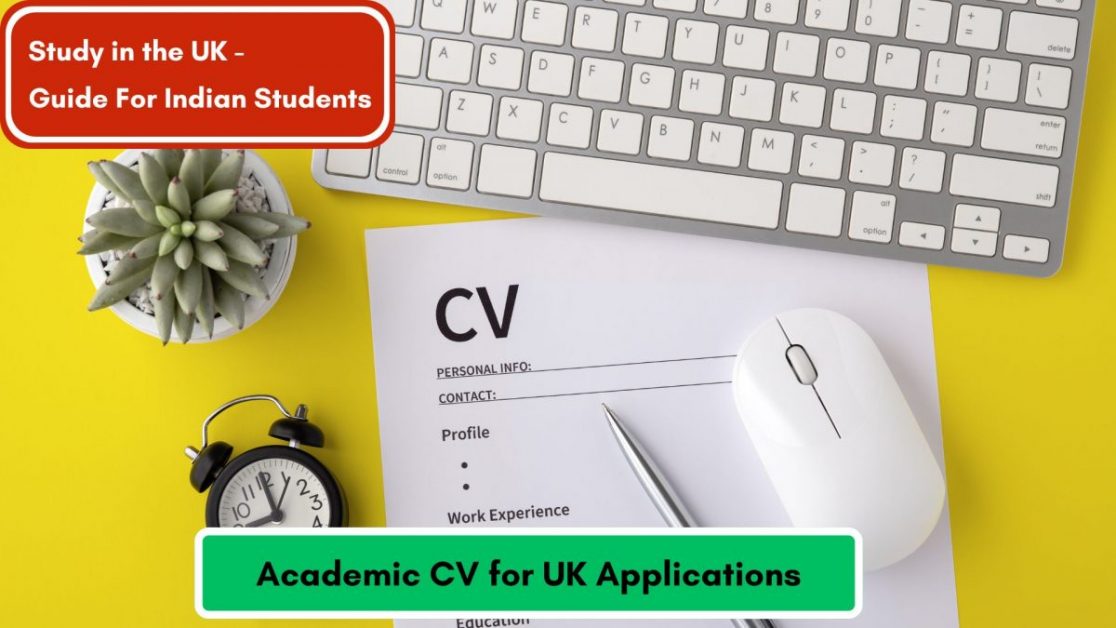
The UK academic CV format is structured, clean, and easy to read. Universities value clarity over creativity, so overly designed layouts or graphical elements should be avoided.
Most UK universities prefer a reverse chronological order, meaning your most recent academic qualifications appear first. This allows admissions officers to immediately see your current level of study and recent academic exposure.
Regarding length, the academic CV has to be at most one to two pages long for undergraduate and master’s students. PhD students or candidates with research experience may go up to three pages, only when relevant.
Font styles like Times New Roman, Arial, or Calibri can easily be accepted. The document should be properly double-spaced with professional formatting for easy scanning. According to the University of Manchester Careers Service in the UK, the following personal information should not be included: age, gender, marital status, and photographs.
4.1. Contact Details in an Academic CV (UK Standards)
Your academic CV should begin with clear contact details. This includes your full name, a professional email address, your phone number with country code, and your current location. You may include a LinkedIn profile if it reflects academic or research engagement.
UK universities expect professional communication standards. Using a formal email address and ensuring all contact information is accurate helps create a positive first impression.
4.2. Academic Profile or Personal Statement Section
While not always mandatory, many applicants benefit from including a short academic profile at the beginning of their CV. This is a concise paragraph summarising your academic background, research interests, and the direction of your studies.
For example, if you are applying for a master’s in data science, your academic profile might briefly mention your undergraduate degree, key analytical skills, and interest in applied research or industry-aligned projects. This section helps admissions tutors immediately understand your academic focus.
4.3. Education and Academic Background
The education section is the core of your academic CV. Here, you should list your academic qualifications in reverse chronological order. Each entry should include the degree name, institution, location, dates of study, and final grades or GPA.
If you are an international student, it is helpful to mention how your grading system compares to UK standards, especially if your university uses a different evaluation method. Some applicants include relevant coursework, particularly when applying for specialised programmes.
Official UK guidance from universities such as King’s College London encourages applicants to clearly present academic progression and subject relevance, which strengthens application credibility.
4.4. Research Experience and Research Skills
Research experience is one of the strongest elements of an academic CV, particularly for postgraduate and PhD applications. If you have worked on research projects, assisted faculty members, completed a thesis, or participated in academic studies, this section deserves careful attention.
When describing research experience, focus on what you worked on, the methods you used, and what you learnt. This shows research skills such as critical thinking, data analysis, academic writing, and problem-solving.
UK universities value research readiness, especially for research-led institutions. According to information published by UK Research and Innovation on their official website, students with prior research exposure often adapt more effectively to postgraduate academic environments.
4.5. Research Projects, Dissertation, and Thesis
If you have completed a dissertation, thesis, or major research project, include it as a separate section or within your research experience. Mention the topic, objectives, methodology, and key findings where appropriate.
This section helps admissions tutors understand your ability to engage deeply with a subject over an extended period, which is a key requirement for UK postgraduate education.
4.6. Publications, Conferences, and Academic Writing
If you have published papers, presented at conferences, or contributed to academic journals, these achievements should be highlighted clearly. Use proper academic citation formats relevant to your field.
Even undergraduate applicants can include conference posters, research symposium presentations, or co-authored work. These experiences demonstrate academic engagement and commitment beyond classroom learning.
4.7. Teaching Experience and Academic Roles
If you have assisted with teaching, mentoring, tutoring, or academic workshops, this experience is valuable, particularly for PhD or academic job applications. Teaching experience reflects subject mastery, communication skills, and leadership within academic environments.
UK universities often value applicants who show potential to contribute to teaching and academic communities, especially in research-led programmes.
4.8. Work Experience and Internships
While an academic CV focuses on education, relevant work experience should not be ignored. Internships, research assistant roles, academic consulting, or industry placements related to your field add depth to your profile.
The key is relevance. Your work experience should connect logically with your academic goals and the programme you are applying for. This alignment shows maturity and clarity of purpose.
4.9. Skills Section in an Academic CV
The skills section of your academic CV should highlight academic, technical, and research-related skills. These may include laboratory techniques, statistical software, programming languages, academic writing, or language proficiency.
UK universities look for skills that support academic success. Listing skills without context should be avoided. Instead, ensure your skills are reflected through your education, research, or experience sections.
4.10. Certifications, Training, and Online Courses
Certifications and online courses from recognised platforms can strengthen your academic CV, especially if they complement your chosen field. Courses from university-backed platforms or professional bodies are particularly valuable.
When listing certifications, ensure they are relevant and recent. This shows continuous learning and academic curiosity.
4.11. Extracurricular Activities and Volunteering
UK universities value well-rounded students. Extracurricular activities, leadership roles, volunteering, or academic societies show transferable skills such as teamwork, time management, and responsibility.
These experiences help universities understand you beyond grades and research, especially for undergraduate and taught master’s programmes.
4.12. References in a UK Academic CV
Most UK academic CVs include references or mention that references are available upon request. Academic referees should ideally be professors, lecturers, or supervisors who know your academic work well.
According to guidance from UK university admissions offices, providing academic referees adds credibility to your application and supports the information presented in your CV.
5. Academic CV Samples for UK Applications
Using academic CV samples can help you understand structure and tone. However, samples should be used as guidance rather than templates to copy directly.
Undergraduate academic CV samples focus on education, skills, and projects. Master’s samples include research experience and academic focus. PhD samples are research-heavy and include publications, teaching experience, and detailed research work.
6. Common Mistakes in Academic CVs for UK Universities
Many applicants weaken their CVs by including irrelevant personal information, using poor formatting, or failing to highlight their academic focus. Others submit the same CV to every university without tailoring it.
UK universities expect applicants to customise their academic CV to match the programme requirements. Failing to do so may signal a lack of preparation or interest.
7. Does the UK Use the Europass CV Format?
The UK does not require the Europass CV format. While Europass is used in some European countries, UK universities prefer customised academic CVs that follow UK standards.
Official UK university careers services consistently recommend using institution-appropriate formats rather than generic Europass templates.
8. Can You Use the Same Academic CV for Different UK Applications?
You can use the same base structure, but you should tailor your academic CV for each application. Adjusting research focus, skills emphasis, and academic profile helps align your CV with each programme’s strengths.
Tailoring your CV shows commitment and increases your chances of shortlisting.
9. Final Checklist Before Submitting Your Academic CV
Before submitting your academic CV, do a quick final check.
- Ensure accuracy and alignment with UK standards
- Check grammar and formatting consistency
- Include only relevant academic details
- Cross-check with your Statement of Purpose for consistency in academic goals and experience
Conclusion
Writing an academic CV for UK applications is not about listing achievements randomly. It is about telling a clear academic story that shows who you are, what you have studied, and where you are headed.
When you structure your academic CV correctly, follow UK formatting standards, and tailor it thoughtfully for each university, you significantly improve your chances of admission. Start early, revise carefully, and seek expert guidance if needed.
If you are preparing to study in the UK, a strong academic CV is not just a document. It is your academic introduction to the university.
How Career Launcher Helps Build a UK‑Ready Academic CV
The Career Launcher Study Abroad team supports UK aspirants by going beyond templates. Mentors review your academic journey, projects, internships, and goals to structure a CV that matches UK careers‑service guidelines and your target courses.
From deciding what to include or exclude to prioritising research, projects and skills for specific programmes, Career Launcher helps transform a generic CV into a focused, UK‑ready academic document.
Want Help With Your Application?
Complete UK Study Guide- Explore Detailed Topics
Looking for specific information about studying in the UK? Use the table below to access our detailed guides on different aspects of the UK study journey.
FAQs
How long should an academic CV be for UK master’s applications?
For most taught master’s applications, a 1–2 page academic CV is recommended; it should be long enough to cover your education, projects, and relevant experience without unnecessary detail.
Should I include a photo or personal details like age or marital status on my UK academic CV?
No. UK guidance advises against including photos, age, marital status, or similar personal details, as they are not relevant to academic evaluation. Focus on academic and professional content instead.
Do UK universities require a specific CV template (like Oxford or Europass)?
Most universities do not mandate a single template; they expect a clear, UK‑style academic CV. Oxford‑style layouts and other UK careers‑service formats are acceptable, but Europass is generally not necessary.
What if I have limited research experience for my UK academic CV?
If you have limited formal research, highlight strong coursework, major assignments, projects, academic writing, and any independent study or online courses related to your field. UK universities look for potential and alignment, not only publications.
Related Blogs
- UK Study Guide for Indian Students (2026)
- Understanding UK University Credits
- UK Intakes: September vs January vs May
- UCAS vs Direct Applications: What Indian Students Should Know Before Applying to UK Universities