Table of Contents
What is CFA?
The CFA (Chartered Financial Analyst) is a globally recognized professional credential awarded by the CFA Institute, USA. It is the gold standard qualification in investment management, covering financial analysis, portfolio management, ethics, and wealth planning across three progressive exam levels.
The CFA course is not a degree — it is a professional certification recognized in 160+ countries, pursued by analysts, portfolio managers, and finance professionals worldwide. In 2026, over 190,000 active CFA charterholders work across the world’s leading financial institutions. India is now the 3rd largest CFA market globally, with 32,000+ candidates registering every year.
Also Read – CFA Course Fees in India 2026
CFA Course Overview – Key Takeaways
| Factor | Details |
| Full Form | Chartered Financial Analyst |
| Awarding Body | CFA Institute, USA |
| Total Levels | 3 (Level I, II, III) |
| Duration | 2–4 years (average) |
| Study Hours | ~300 hours per level |
| Exam Fee (2026) | $1,140–$1,590 per level (no enrollment fee) |
| Pass Rate | ~40–50% per level |
| Global Recognition | 160+ countries |
| India Salary Range | Rs. 4 LPA (entry) to Rs. 1 Crore+ (senior) |

Why Pursue the CFA Course in 2026?
The case for pursuing the CFA course has never been stronger. Here is why 2026 is a great year to start:
- No Enrollment Fee — Starting from 2026 exams, the one-time USD 350 enrollment fee has been eliminated, reducing the total cost of the program.
- India’s Booming Finance Sector — With equity AUM crossing Rs. 60 lakh crore and India becoming a global investment hub, demand for CFA professionals is surging.
- Specialized Pathways at Level III — Since 2025, CFA Level III allows candidates to choose a specialized pathway (Portfolio Management, Private Wealth, or Private Markets).
- Salary Premium — CFA charterholders in India earn 20–40% more than peers without the credential, according to CFA Institute’s 2024 Compensation Survey.
- Global Mobility — Recognized in 160+ countries, the CFA credential gives you unmatched career portability across financial markets worldwide.
- AI & Fintech Integration — The 2026 curriculum includes practical skills modules in Python for finance and financial modeling, aligning the CFA with modern investment roles.
Also Read – CFA Level 1 Syllabus 2026
CFA Eligibility Criteria 2026
Who Can Apply for the CFA Course?
To register for CFA Level I in 2026, candidates must meet at least one of the following conditions:
- Graduate Route: Hold a bachelor’s degree (or equivalent) from a recognized institution
- Final Year Route: Be in the final year of a bachelor’s degree program, with the exam window falling within 23 months of graduation
- Work Experience Route: Have 4,000 hours of relevant professional work experience or higher education accumulated over at least 3 years
Important eligibility details:
- Candidates from any discipline (commerce, engineering, science, arts, law) are eligible
- A valid international passport is mandatory for registration and exam entry
- Internships and articleships are accepted if they are paid
- A maximum of 2 attempts per year and 6 total attempts per level are allowed
Level-wise Eligibility for Indian Students
| Level | Eligibility Requirement |
| Level I | Exam window within 23 months of graduation |
| Level II | Exam window within 11 months of graduation |
| Level III | Bachelor’s degree must be completed |
CFA Exam Structure: 3 Levels Explained
The CFA Program consists of three progressive exam levels, each building on the knowledge and skills from the previous one.
CFA Level I — Foundation
CFA Level I is the first and most foundational stage of the CFA course. It tests candidates’ knowledge and understanding of investment tools, financial concepts, and ethical standards across 10 core topic areas.
- Format: 180 multiple-choice questions (MCQs), divided into two sessions of 90 questions each
- Duration: 4.5 hours total (2 x 135 minutes)
- Frequency: 4 exam windows per year — February, May, August, November
- Negative Marking: None
- Pass Rate (Feb 2026): 45%
CFA Level II — Application
CFA Level II shifts from comprehension to application. It tests candidates’ ability to analyze financial data, value assets, and apply investment models in real-world scenarios using item set (vignette) questions.
- Format: 22 item sets with 88 multiple-choice questions (vignette-based)
- Duration: ~4.5 hours total (2 x 132 minutes)
- Frequency: 3 exam windows per year — May, August, November
- Pass Rate (Nov 2025): 42%
CFA Level III — Synthesis & Specialization
CFA Level III is the most advanced stage. It focuses on portfolio management, wealth planning, and strategic investment decision-making. Candidates choose one of three specialized tracks:
- Portfolio Management — Institutional and individual portfolio construction
- Private Wealth — Managing high-net-worth individual (HNI) wealth
- Private Markets — Private equity, infrastructure, and real assets
- Format: Item sets + constructed-response (essay) questions based on vignettes
- Duration: ~4.5 hours total (2 x 132 minutes)
- Frequency: 2 exam windows per year — February, August
- Specialized Pathway Weight: ~30% of total exam
- Pass Rate (Feb 2026): 50%
CFA Syllabus 2026 — Complete Topic-wise Breakdown
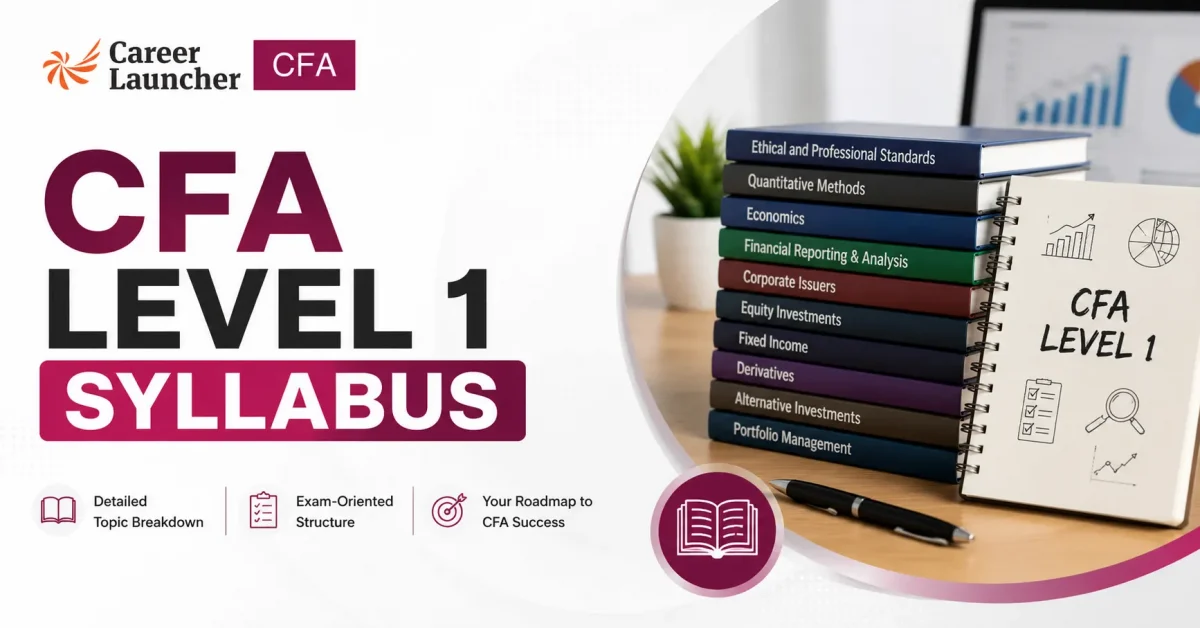
The CFA syllabus 2026 spans 10 core topic areas across all three levels. The 2026 curriculum is largely unchanged from 2025; candidates who have 2025 study materials can safely reuse them.
CFA Level I — Topic Weights 2026
| Topic | Weight |
| Ethics & Professional Standards | 15–20% |
| Financial Statement Analysis | 11–14% |
| Equity Investments | 11–14% |
| Fixed Income | 11–14% |
| Portfolio Management | 8–12% |
| Alternative Investments | 7–10% |
| Quantitative Methods | 6–9% |
| Economics | 6–9% |
| Corporate Issuers | 6–9% |
| Derivatives | 5–8% |
The 10 Core CFA Subjects Explained
- Ethics & Professional Standards (15–20%) — The most heavily weighted topic at Level I. Covers the CFA Institute Code of Ethics, Standards of Professional Conduct, and GIPS. Ethics plays a crucial role in borderline pass/fail decisions at all three levels.
- Quantitative Methods (6–9%) — Statistical techniques, probability, time value of money, regression analysis, and financial mathematics used in investment decision-making.
- Economics (6–9%) — Micro and macroeconomic principles, supply and demand, market structures, business cycles, monetary policy, and their impact on financial markets.
- Financial Statement Analysis (11–14%) — Covers financial reporting standards (IFRS and US GAAP), income statements, balance sheets, cash flow analysis, and ratio analysis.
- Corporate Issuers (6–9%) — Corporate governance, capital budgeting, working capital management, and the impact of ESG factors on corporate decisions.
- Equity Investments (11–14%) — Equity markets, valuation models (DCF, P/E, EV/EBITDA), industry analysis, and equity portfolio construction.
- Fixed Income (11–14%) — Bond markets, yield analysis, duration and convexity, credit analysis, and fixed-income portfolio management.
- Derivatives (5–8%) — Forwards, futures, options, and swaps. Covers pricing, hedging strategies, and risk management using derivative instruments.
- Alternative Investments (7–10%) — Hedge funds, private equity, real estate, commodities, and infrastructure.
- Portfolio Management (8–12%) — Portfolio planning, asset allocation, capital market theory (CAPM), behavioral finance, and risk-adjusted performance measurement.
CFA Exam Dates 2026
| Level | Exam Windows | Frequency |
| Level I | February, May, August, November | 4 times/year |
| Level II | May, August, November | 3 times/year |
| Level III | February, August | 2 times/year |
The CFA exam is conducted at Hundreds of CBT test centers worldwide and multiple cities across India, including Mumbai, Delhi, Bengaluru, Hyderabad, Chennai, Pune, and Kolkata.
CFA Exam Fees 2026 — Complete Breakdown
One of the biggest 2026 updates is the elimination of the USD 350 one-time enrollment fee for new candidates. However, per-level registration fees have increased by USD 150–200 compared to 2025.
Registration Fees Per Level
| Level | Early Registration | Standard Registration |
| Level I | USD 1,140 (~Rs. 95,000) | USD 1,490 (~Rs. 1.24 Lakh) |
| Level II | USD 1,140 (~Rs. 95,000) | USD 1,490 (~Rs. 1.24 Lakh) |
| Level III | USD 1,240 (~Rs. 1.03 Lakh) | USD 1,590 (~Rs. 1.32 Lakh) |
Total Program Cost Estimate
| Scenario | Total Fees (USD) |
| All 3 levels (early registration) | ~USD 3,520 |
| All 3 levels (standard registration) | ~USD 4,570 |
| Total including coaching & materials (India) | ~Rs. 4.5–5 Lakhs |
CFA Scholarships Available
- Access Scholarship: For candidates with financial need — reduces fee to USD 250
- Student Scholarship: For university students at affiliated institutions — reduces fee to USD 600
- Professor Scholarship: For full-time faculty at qualifying institutions — reduces fee to USD 600
How Long Does It Take to Complete the CFA Course?
The CFA Program does not have a fixed duration. The time required depends on how quickly you pass each level.
- Minimum timeline: ~18–24 months (passing each level on the first attempt)
- Average timeline: ~3–4 years (as reported by CFA Institute)
- Study hours required: ~300 hours per level (900+ hours total)
Typical Completion Timeline
| Stage | Timeline |
| Pass Level I | Month 0–12 |
| Pass Level II | Month 12–24 |
| Pass Level III | Month 24–36 |
| Complete Work Experience & Charter | Month 36–48 |
CFA Pass Rates & Exam Difficulty
| Level | Pass Rate (2026) | Historical Average |
| Level I | 45% (Feb 2026) | 41% |
| Level II | 42% (Nov 2025) | 45% |
| Level III | 50% (Feb 2026) | 50% |
Why is the CFA Exam Difficult?
- Breadth: 10 topic areas requiring 300+ hours of study per level
- Depth: Progressive complexity from Level I to Level III
- Application: Level II and III test real-world decision-making, not just memorization
- Ethics: A borderline fail in ethics can result in an overall fail even if other scores are strong
CFA Career Scope in India 2026
India is the 3rd largest CFA market globally, with 32,000+ annual registrations and growing at 30% year-on-year for the past 7 years. The rapid expansion of equity markets, mutual funds, private equity, and fintech has created strong demand for CFA professionals.
Top Job Roles After CFA in India
| Job Role | Typical Employer | Salary Range |
| Equity Research Analyst | Kotak, Axis Capital, Edelweiss | Rs. 8–20 LPA |
| Portfolio Manager | HDFC AMC, ICICI Pru AMC, UTI | Rs. 10–30 LPA |
| Investment Banking Analyst | JP Morgan, Goldman Sachs, Morgan Stanley | Rs. 15–35 LPA |
| Wealth Manager | Kotak Wealth, IIFL, Nuvama | Rs. 6–25 LPA |
| Risk Analyst | HDFC Bank, ICICI Bank, Axis Bank | Rs. 8–18 LPA |
| Quantitative Analyst | Fintech firms, hedge funds | Rs. 12–30 LPA |
| Private Equity Analyst | KKR India, Carlyle, Blackstone | Rs. 15–40 LPA |
CFA Salary in India 2026
According to the CFA Institute’s 2024 Compensation Survey, India led year-on-year salary growth at 9.6% — the highest among all major markets tracked, outpacing the US (2.7%), UK (3.6%), and Germany (3.0%).
Level-wise CFA Salary in India
| Stage | Average Salary (India) |
| CFA Level 1 Candidate | Rs. 4-6 LPA |
| CFA Level 2 Candidate | Rs. 8-14 LPA |
| CFA Level 3 Candidate | Rs. 9-20 LPA |
| CFA Charterholder (New, ~6 yrs exp) | Rs. 25-30 LPA |
| Senior Analyst / VP (10–15 yrs) | Rs. 30–50 LPA |
| Top Buy-Side / IB (15+ yrs) | Rs. 1 Crore+ (with bonus) |
How to Prepare for the CFA Exam: Study Strategy
Recommended Study Plan
- Start 6 months before the exam for Level I; 5–6 months for Level II and III
- Study 15–20 hours per week consistently (300+ hours total)
- Use the official CFA Institute curriculum — it is free for registered candidates
- Complete at least 3 full mock exams in the last 4–6 weeks
- Prioritize Ethics — it can make or break borderline candidates
- Use the TI BA II Plus calculator — most CFA candidates prefer it over HP12C
Hardest Topics by Level
- Level I: Financial Statement Analysis, Fixed Income, Derivatives
- Level II: Equity Valuation, Fixed Income (FRA), Derivatives
- Level III: Essay questions, Behavioral Finance, Private Markets Pathway
CFA Exam Centers in India 2026
The CFA exam is conducted at 23 exam centers across India in the following cities: Ahmedabad, Bengaluru, Bhubaneswar, Chennai, Delhi, Gurgaon, Hyderabad, Indore, Jaipur, Kochi, Kolkata, Lucknow, Mumbai, Nagpur, Noida, Patna, Pune, Surat, Vadodara, and more.
Candidates can select their preferred test center during the exam registration process on the CFA Institute website. Computer-based testing (CBT) allows for flexible scheduling within the exam window.
Frequently Asked Questions (FAQs)
What is the full form of CFA?
CFA stands for Chartered Financial Analyst. It is a professional credential awarded by the CFA Institute, USA. The CFA designation is the most globally recognized and respected qualification in the investment management industry, held by over 190,000 professionals in 160+ countries.
What is the eligibility for the CFA course in India?
To register for the CFA exam in 2026, candidates must hold a bachelor’s degree, be in the final year of a bachelor’s program (with the exam within 23 months of graduation), or have 4,000 hours of professional work experience or higher education over at least 3 years. Students from any academic background are eligible.
How much does the CFA course cost in India?
CFA exam fees in 2026 are USD 1,140–1,590 per level (no enrollment fee from 2026 onwards). The total cost for all three levels, including coaching and study materials, is approximately Rs. 4.5–5 Lakhs in India. Early registration saves up to USD 1,050 across all three levels.
How long does it take to complete the CFA course?
On average, it takes 2–4 years to complete all three levels of the CFA course. The absolute minimum is 18–24 months if you pass every level on your first attempt. The CFA Institute recommends approximately 300 hours of study per level.
What is the CFA pass rate in 2026?
The CFA pass rates for 2026 are approximately 45% for Level I, 42% for Level II, and 50% for Level III. Only about 20% of candidates who begin the CFA program ultimately earn the CFA charter.
What is the CFA salary in India?
According to the CFA Institute’s 2024 Compensation Survey, CFA charterholders in India earn between Rs. 28.6 LPA (new charterholder) to Rs. 44+ LPA on average. Entry-level candidates (Level I cleared) typically earn Rs. 4–6 LPA, while senior professionals with 15+ years of experience earn Rs. 50 LPA to Rs. 1 Crore+.
Is CFA better than MBA?
The CFA course is better than an MBA if your goal is a specialized career in investment management, equity research, or portfolio management. The CFA costs Rs. 4.5–5 Lakhs vs. Rs. 25–30 Lakhs for a top-tier MBA, is globally portable in 160+ countries, and provides deep technical finance expertise. An MBA is better for general management, consulting, or corporate leadership roles.
What are the job opportunities after CFA in India?
After completing the CFA course, top job roles in India include equity research analyst, portfolio manager, investment banking analyst, wealth manager, risk analyst, quantitative analyst, and private equity analyst. Top recruiters include JPMorgan, Goldman Sachs, HDFC AMC, ICICI Prudential AMC, Kotak Institutional Equities, Axis Capital, and Edelweiss.
Conclusion
The CFA course in 2026 remains the definitive credential for anyone serious about a career in investment management, financial analysis, or portfolio management. With no enrollment fee for new candidates, a globally aligned curriculum featuring specialized pathways, and India’s rapidly growing finance sector creating unprecedented demand for CFA professionals, there has never been a better time to pursue the Chartered Financial Analyst designation.
Whether you are a fresh graduate, a working finance professional, or someone pivoting into investment management, the CFA Program offers a structured, globally recognized pathway to career success. The journey is demanding — 300+ hours of study per level, a 40–50% pass rate, and a 2–4 year commitment — but the rewards, both financia