The world of work is changing fast. New technologies are emerging, job roles are evolving, and the skills employers look for today may look very different a few years from now.
That naturally raises an important question:
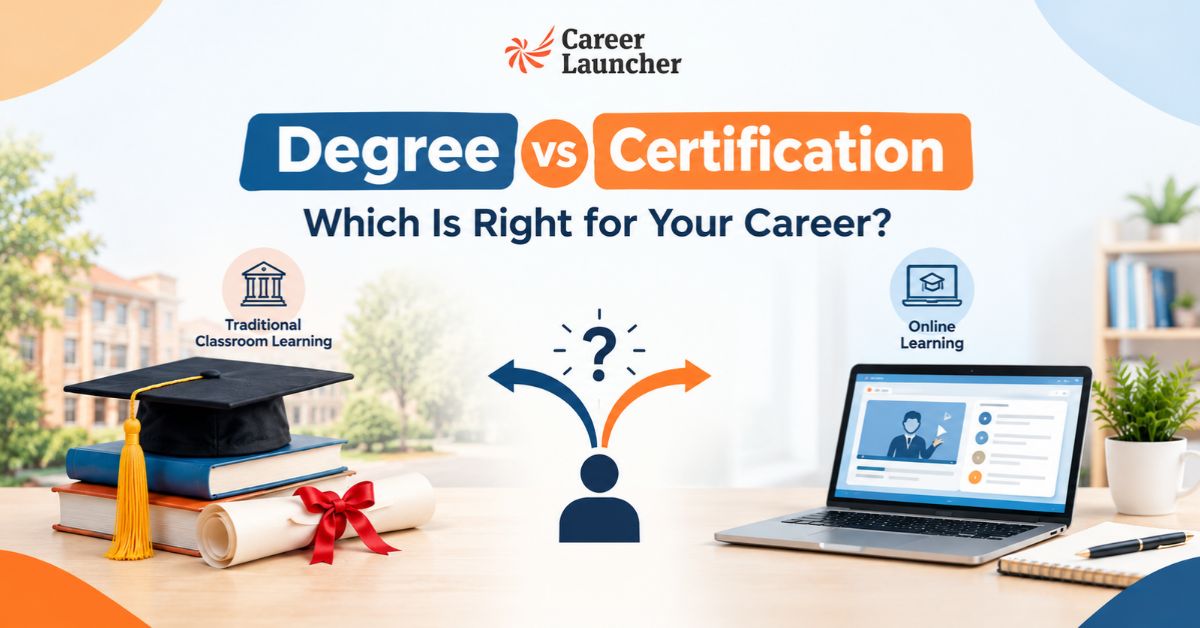
Should you pursue a degree, earn a professional certification, or simply learn a new skill through a short-term course?
There is no universal answer.
A degree can provide a broad academic foundation and open doors to careers that require formal qualifications. A certification can help you develop a specialized skill, strengthen your resume or transition into a new area. For someone already working, a certification may be a practical way to upskill without stepping away from a career for several years.
So, the real question isn’t “Degree or certification?”
It is:
“What do I want to achieve, and which learning path will help me get there?”
If you’re unsure which option makes sense for your career goals, get 1:1 Free Counselling and speak with a career expert before making a major education or career decision.
Table of Contents
Degree vs Certification: Understanding the Difference
The terms degree, certificate and certification are often used interchangeably, but they are not necessarily the same thing.
- A degree is an academic qualification awarded by a recognized university or higher-education institution after completing a structured program of study. Bachelor’s, master’s, and doctoral degrees are examples.
- A certificate generally indicates that you have completed a focused educational or training program.
- A professional certification typically validates your knowledge or competency in a specific skill or professional area, often through an examination, assessment or defined set of requirements.
The distinction is important because each serves a different purpose. A degree generally provides breadth and academic depth, while certificates and certifications are usually more focused on specific knowledge or skills.
In simple terms:
- Degree: Broad academic and subject knowledge
- Certificate: Completion of a focused learning program
- Certification: Demonstrated competency or proficiency in a defined area
The value of each depends heavily on the institution, provider, industry and career you are targeting.
Degree or Certification: At a Glance
| Factor | Degree | Certification / Certificate |
| Learning scope | Broad and comprehensive | Focused and specialized |
| Typical duration | Several years | Usually weeks or months |
| Primary purpose | Academic foundation and long-term career development | Skill development, specialisation or validation |
| Time commitment | Higher | Usually lower |
| Cost | Generally higher | Generally lower, but varies |
| Career flexibility | Often broader | Usually focused on a particular skill/domain |
| Further education | Usually provides an academic progression pathway | Depends on the program |
| Best suited for | Foundational education, career entry or academic progression | Upskilling, reskilling, specialisation or career transition |
Neither option is automatically better. The right choice depends on where you are now and where you want to go next.

Why Do People Still Pursue Degrees?
With the growth of online learning, bootcamps, professional certifications and short-term courses, you might wonder whether a degree is still worth the investment.
For many careers, the answer is yes.
1. A degree provides a broader foundation
A degree typically takes you beyond one specific tool or skill.
For example, a business degree may expose you to finance, marketing, economics, operations, strategy and organizational behaviour. Similarly, a computer science degree can provide foundational knowledge across programming, algorithms, databases, systems and computing concepts.
This breadth can be particularly useful when you’re still exploring your career direction.
2. Some careers require formal academic qualifications
Not every career can be entered through a certification.
Certain professions and specialized roles require specific academic qualifications, licences or professional pathways.
Even in industries becoming more skills-focused, employers may continue to use degrees as one of their screening criteria.
So, before replacing a degree with a certification, check the actual qualification requirements of your target profession.
3. A degree can support long-term career mobility
Your first career isn’t necessarily your last.
You may start in marketing and eventually move into management. You may begin in technology and later move into consulting, product management or entrepreneurship.
A degree can provide a broader foundation that supports such transitions and may also be required for certain postgraduate programs.
4. It can provide access to further education
If you plan to pursue a master’s degree, doctorate, research program, or another advanced academic qualification, a recognized undergraduate degree may be essential.
This makes a degree particularly relevant for people who want to keep an academic or specialized higher-education pathway open.
Why Are Certifications Becoming More Popular?
At the same time, the popularity of professional certifications has grown considerably.
Why?
Because careers don’t stop evolving after graduation.
The skill you learned five years ago may no longer be enough for the role you want today.
A professional certification or focused course can help bridge that gap.
1. Certifications focus on specific skills
Suppose you already have a business degree but want to move into digital marketing. You don’t necessarily need to start another three-year degree. A focused program in areas such as SEO, analytics, performance marketing or content strategy may help you develop the skills relevant to your intended role.
Similarly, someone working in finance may explore data analytics, while a technology professional may pursue a certification in cloud computing or cybersecurity. The learning is targeted towards a particular skill or domain.
2. They take less time
One of the biggest advantages of certifications is their relatively shorter duration.
A working professional may not be able to take several years away from work to pursue another degree.
A certification or professional course can allow them to learn alongside their existing responsibilities.
This makes certifications particularly relevant for:
- Working professionals
- Graduates
- Career changers
- Entrepreneurs
- Freelancers
- Professionals returning to work
- People looking to move into emerging domains
3. They can help you stay relevant
Learning shouldn’t necessarily stop when you graduate.
Industries evolve. Tools change. Job descriptions change.
Certifications can provide a structured way to keep developing relevant skills throughout your career.
This is where continuous learning, upskilling and reskilling become important.
Degree vs Certification: What Should You Choose at Different Career Stages?
The answer can change depending on your current situation.
If You Are Starting Your Higher Education
If you’re entering higher education and don’t yet have a professional qualification, a degree can provide a stronger foundation.
You can then supplement it with certifications, internships, projects and other forms of practical learning.
Think of it as:
- Degree → Foundation
- Certification → Specialization
- Experience → Application
Together, these can create a stronger professional profile than any one of them alone.
If You Are a Recent Graduate
If you already have a degree but haven’t yet found the right career direction, another degree may not always be necessary.
A focused certification can help you explore a domain, build specific skills and improve your understanding of a potential career path.
For example, a graduate with a general business degree might explore:
- Data analytics
- Digital marketing
- Financial modelling
- Business intelligence
- Product management
- Human resources
The right choice depends on the career you’re targeting.
If You Are a Working Professional
This is where certifications can become particularly valuable.
You already have education and work experience. What you may need now is a specific skill that helps you move forward.
You could be looking to:
- Get promoted
- Move into a new role
- Change industries
- Learn a technology
- Move into management
- Build a specialized skill
- Increase your earning potential
A certification can sometimes solve a much narrower problem than another degree. However, if your desired career requires a specific academic qualification, a degree or postgraduate program may still be the better investment.
If You Want to Change Careers
Career switching is one of the most common reasons people consider certifications.
Suppose you’re working in sales but want to explore data analytics.
Going back to university for another undergraduate degree may be unnecessary.
A structured data analytics program, combined with projects and practical experience, may provide a more efficient starting point.
But don’t assume a certification automatically qualifies you for a new career.
Research the field first.
Look at job descriptions. Identify the qualifications employers expect. Understand the skills required. Then decide what learning pathway fills your gaps.
Degree or Certification for Career Change: Which Is Better?
There is no single answer. Consider two situations.
Scenario 1: You want to learn a new skill.
You already have a relevant degree and work experience but want to add a new capability – A certification may be ideal.
Scenario 2: You want to enter a profession that requires a specific academic qualification.
A short certification may not be enough. You may need a formal degree or qualification. This is why choosing a credential before identifying your career goal can lead to wasted time and money.
Start with the destination. Then choose the route.
Are Certifications Enough to Get a Job?
This is one of the most common questions people ask. The answer is: sometimes, but not automatically. A certification can demonstrate that you have studied a particular subject or developed knowledge in a specific area. But employers may also look at:
- Practical experience
- Projects
- Problem-solving ability
- Communication skills
- Portfolio
- Relevant degree
- Previous work experience
- Interviews and assessments
A certification is therefore best viewed as one part of your professional profile, rather than a guaranteed job ticket.
For example, a digital marketing certification becomes much more meaningful when you can also demonstrate campaigns, content, analytics reports or other practical work.
Degree vs Certification: Why You Don’t Always Have to Choose
The biggest misconception in this debate is that you must choose one. The truth is, often you don’t. A degree and certification can complement each other.
For example:
- Business degree + Data Analytics certification
- Commerce degree + Financial Analytics certification
- Technology degree + Cloud certification
- Marketing degree + SEO/Performance Marketing certification
- Design degree + UX/UI certification
The combination allows you to develop both broad knowledge and specialized skills. But don’t turn this into a race to collect certificates. One relevant certification with practical application can be more valuable than several unrelated certificates.
How to Decide Between a Degree and Certification
If you’re still confused, use these five questions.
1. What is my end goal?
Are you trying to enter a profession, get promoted, change careers, explore a new domain or simply learn something interesting?
Your objective should determine the learning pathway.
2. What does the industry require?
Search current job descriptions for the roles you want. Look for recurring requirements. Do employers ask for a degree? A particular certification? Specific software skills? Experience?
3. What do I already have?
Consider your current:
- Degree
- Work experience
- Technical skills
- Soft skills
- Industry knowledge
- Portfolio
Your next qualification should ideally fill a gap rather than duplicate what you already know.
4. How much time can I realistically invest?
A degree requires a significant long-term commitment. A certification may fit better if you are working full-time or have other responsibilities.
But don’t choose a short course solely because it’s convenient. Choose it because it solves the problem you’re trying to solve.
5. What is the return on investment?
Consider more than the course fee.
Think about:
- Time invested
- Career opportunities
- Salary potential
- Skill relevance
- Industry recognition
- Networking
- Further education opportunities
The cheapest option isn’t necessarily the most valuable one.
What Should You Choose: Degree or Certification?
Here’s the simplest way to look at it.
- Choose a degree when you need a broad academic foundation, a formal qualification, access to further education or entry into a profession where a degree is expected.
- Choose a certification when you already have a foundation and want to develop, validate or update a specific skill.
- Choose both when your career requires broad knowledge as well as specialized expertise.
And if you’re considering a career change, don’t begin by asking, “Which certification should I buy?” Begin with: “What role do I want next, and what do I need to become qualified for it?” This one change in thinking can save you considerable time, money and effort.
Also Read: Online or Offline – Which is the Best Fit for You?
Explore Learning Opportunities with Career Launcher
Choosing the right learning pathway starts with understanding your goals.
Whether you are considering an online degree to build your academic foundation, a professional certification to develop specialized knowledge, or a combination of both, the right choice depends on your current qualifications and future aspirations.
Career Launcher brings together learning opportunities across online degree programs, global certifications, professional certifications and profile-building programs in areas such as Finance, Management, AI & Data Science, Marketing and Technology.
Explore the available programs to understand your options and identify a pathway that aligns with your goals.
The Bottom Line – Conclusion
There is no universal winner in the degree-versus-certification debate. A degree provides a broader academic foundation and may be essential for certain career and higher-education pathways. A certification can help you develop specialized skills, explore a new domain or update your knowledge.
For some learners, a degree will be the right choice. For others, a certification may better address their immediate needs. Many will benefit from combining formal education, specialized learning and practical experience.
The best investment is the one that aligns with your goals, meets the requirements of your intended pathway and offers meaningful value for the time and money involved.
Still unsure whether you need a degree, certification or a combination of both? Get 1:1 Free Counselling and discuss your career goals, existing qualifications and next learning step with an expert.
Frequently Asked Questions
- Is a degree better than a certification?
Neither is universally better. A degree provides broader academic knowledge and can be essential for certain careers, while a certification focuses on specific professional skills. The right choice depends on your career goals, existing qualifications and industry requirements.
- What is the difference between a degree and a certification?
A degree is a formal academic qualification awarded by a recognized higher-education institution. A certification generally validates knowledge or competency in a specific skill or professional area. A degree is typically broader, while certification is more specialized.
- Can a certification replace a degree?
In some skill-based roles, employers may accept relevant skills, experience or certifications instead of a degree. However, many professions and job roles still require a formal degree. Always check the qualification requirements of your target career before deciding.
- Should I get a certification if I already have a degree?
Yes, if the certification develops a skill relevant to your career goals. Certifications can help graduates and working professionals specialize, upskill, reskill or learn emerging technologies without pursuing another full degree.
- Is a certification worth it for working professionals?
A relevant certification can be valuable for working professionals who want to develop new skills, qualify for new responsibilities, switch domains or stay updated with industry changes. Its value depends on its relevance, credibility and practical application.
- Can I change careers with a certification?
A certification can be a useful starting point for a career change, particularly when you already have transferable skills or a relevant academic background. However, some professions require formal degrees or licences, so research your target role before choosing a certification.
- Is it better to have a degree or professional certification for getting a job?
It depends on the job. Some employers require a degree, while others place greater emphasis on specific skills, experience and professional certifications. In many fields, combining a recognized degree with relevant certifications and practical experience can strengthen your profile.
- Can I do a certification while working full-time?
Yes. Many professional certifications and online courses are designed for working professionals and can be completed alongside employment. Before enrolling, consider the program’s duration, schedule, workload and assessment requirements.
- Should I choose a certification or another degree to upskill?
If you need a specific skill, a certification or focused course may be more efficient. If your desired career requires a new academic qualification or a broader change in discipline, another degree or postgraduate program may be more appropriate.
- How do I choose the right certification for my career?
Start by identifying your target role and reviewing current job descriptions. Then identify the skills employers commonly require and choose a credible certification that teaches or validates those skills. Consider the curriculum, assessment method, industry recognition, practical components and overall cost before enrolling.