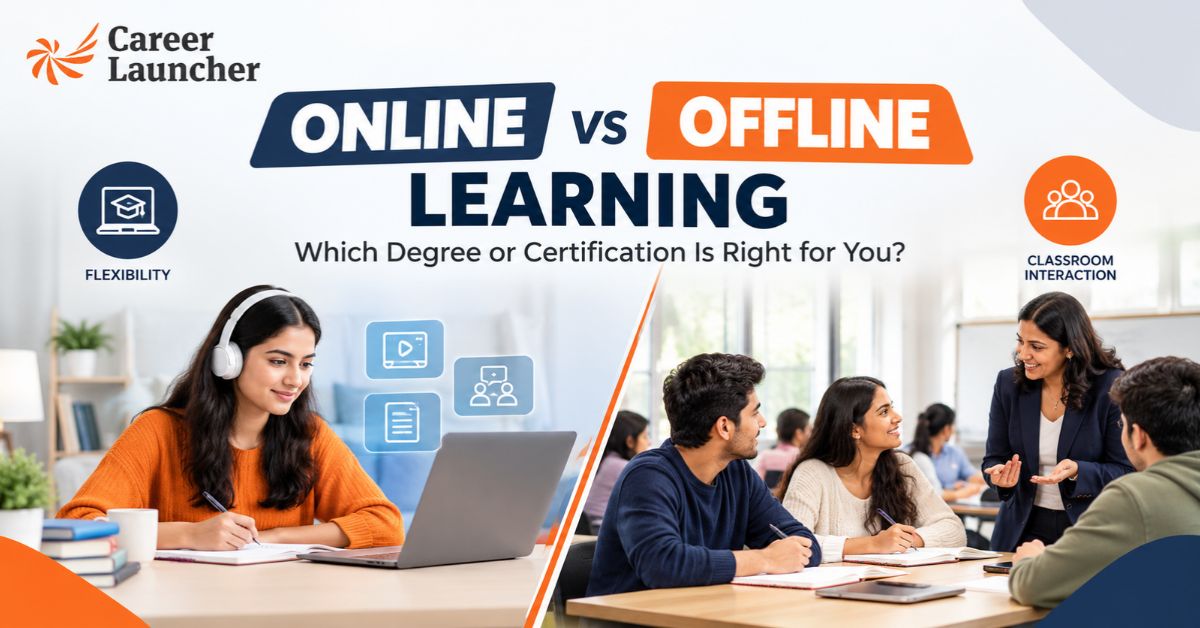
Choosing a degree or certification is only one part of an education decision. You also need to consider how you want to learn. Today, students and working professionals can choose between online programs and traditional classroom-based learning. Both formats offer opportunities to build knowledge, develop skills and work towards academic or professional goals, but the learning experience can differ.
Online learning may offer greater flexibility, while offline learning can provide more face-to-face interaction and a structured classroom environment. So, which format should you choose? The answer depends on your learning style, career goals, schedule, budget and the requirements of the program.
Table of Contents
Online vs Offline Degree: What is the Difference?
The biggest difference is the learning environment.
- An online degree allows you to access lectures, study material, assessments and other learning resources digitally. Depending on the program, classes may be live, recorded or a combination of both.
- An offline degree typically requires you to attend classes physically at a college, university, institute or training centre. Learning happens through scheduled classroom sessions, face-to-face discussions and in-person activities.
Neither format automatically provides better learning. The quality of the institution, curriculum, faculty, assessment, practical exposure and recognition matters just as much.
Online vs Offline Degree: At a Glance
| Factor | Online | Offline |
| Flexibility | Usually higher | Usually lower |
| Location | Can study from anywhere | Requires physical attendance |
| Interaction | Digital/live sessions | Face-to-face |
| Schedule | Often more flexible | Usually fixed |
| Self-discipline | Requires more | External structure helps |
| Networking | Primarily digital | Naturally face-to-face |
| Commute | None | Required |
| Learning environment | Self-managed | Structured classroom |
| Working professionals | Often convenient | Can be difficult to manage |
| Practical learning | Depends on program | Often easier for physical activities |
The important point is that these are general differences. Individual programs can vary significantly.

When Is an Online Degree a Better Choice?
Various scenarios in which an online degree becomes a better choice are briefly explained below.
1. You need flexibility
Online learning can be particularly useful when you cannot commit to a fixed classroom schedule.
Students managing internships, jobs, competitive exam preparation or other responsibilities may benefit from being able to study from home and organize their learning around their existing routine.
2. You are a working professional
If you already have a job, relocating or attending classes every day may not be practical. An online program can allow you to continue working while developing a new qualification or skill. This can make online learning useful for upskilling, reskilling and career transitions.
3. You are comfortable learning independently
Online learning gives you greater control, but that also means greater responsibility. You may need to manage deadlines, watch lectures, revise independently and stay consistent without someone physically reminding you to attend class.
If you are organized and comfortable managing your own schedule, this can be an advantage.
4. The program is primarily knowledge- or skill-based
For subjects that rely heavily on lectures, reading, discussions, assignments, software or digital projects, online learning can work particularly well.
However, always check whether the program provides adequate opportunities for interaction, feedback and practical application.
When Is an Offline Degree a Better Choice?
Numerous circumstances in which an offline degree becomes an ideal choice are briefly explained below.
1. You learn better through face-to-face interaction
Some learners understand concepts more effectively when they can ask questions immediately, participate in classroom discussions and interact directly with faculty.
If personal interaction is central to how you learn, an offline program may offer a more natural environment.
2. You need external structure
An offline classroom creates a defined routine. Fixed class timings, attendance requirements, regular assessments and direct faculty interaction can make it easier to stay accountable, particularly if you struggle with self-directed learning.
3. Networking is important to your goals
Education is not only about coursework. Offline programs can create regular opportunities to interact with classmates, faculty, guest speakers and industry professionals. These relationships can sometimes lead to collaborations, internships, mentorship or professional opportunities.
Online programs can also offer networking, but it may require more deliberate effort through discussion forums, virtual events, communities and professional platforms.
4. The program requires physical or hands-on learning
Some areas benefit significantly from laboratories, workshops, studios, equipment or other physical environments.
For such programs, an offline format may provide a more suitable learning experience, depending on the course design.
Also read: Degree vs Certification, What You Should Choose?
Online vs Offline: What Should Students Consider?
Instead of asking “Which format is better – online or offline degree?”, ask these five questions.
- What is my learning style?
- Do you learn well independently, or do you need classroom interaction and a fixed routine?
- What is my current schedule?
- A full-time student may have fewer scheduling constraints than a working professional. Your daily responsibilities should influence the format you choose.
- What does the program actually offer?
- Don’t judge a program only by whether it is online or offline degree. Check the curriculum, faculty, assessments, projects, practical exposure, student support, career services and opportunities for interaction.
- How credible is the qualification?
- Before enrolling, verify the institution, program recognition and the qualification’s relevance to your intended career. A convenient format cannot compensate for a qualification that does not meet your academic or professional requirements.
- What is the total cost?
- Look beyond tuition fees. For an offline program, consider commuting, accommodation, food and other campus-related expenses. For an online program, consider technology requirements, internet access and any additional learning resources.
The cheaper option is not automatically the better investment. Consider the overall value and career relevance.
Can You Combine Online and Offline Learning?
Yes. You do not necessarily have to choose one format for everything.
A student might pursue an offline degree while completing online degrees in data analytics, digital marketing or another specialized area. Similarly, someone pursuing an online degree may supplement it with offline workshops, internships, projects or networking events.
This creates a useful combination:
Formal education → Online specialization → Practical experience
The objective should not be to collect qualifications. It should be to build knowledge and skills that support your career direction.
Online or Offline: Which One Should You Choose?
- Choose online learning if flexibility, accessibility and self-paced study are important to you and you are comfortable managing your learning independently.
- Choose offline learning if you value face-to-face interaction, structured routines, campus exposure and in-person networking.
- Choose a combination of both when you want the flexibility of online learning along with practical or social experiences that are easier to build offline.
Ultimately, the best format is the one that fits your career goal, learning style, schedule and circumstances. Start with what you want to achieve, understand what the program requires and then select the format that helps you learn most effectively.
Explore Learning Programs with Career Launcher
The right learning format depends on your goals, schedule and preferred way of learning. Equally important are the programs curriculum, credibility, faculty, practical exposure and overall value.
Career Launcher brings together online degree programs, offline learning opportunities, global certifications, professional certifications and profile-building programs across multiple domains.
Explore the available options to compare programs and identify a learning pathway that fits your needs.
Explore Programs | Speak with a Counsellor
Frequently Asked Questions
- Is an online degree better than an offline degree?
Neither is universally better. The right choice depends on your learning style, schedule, career goals, program quality and need for flexibility or face-to-face interaction.
- Is an online certification as useful as an offline certification?
Its usefulness depends more on the certification’s relevance, credibility, curriculum and practical value than simply its delivery format. Check whether it is recognized and valued in your target field.
- Are online degrees suitable for working professionals?
Yes. Online programs can be particularly convenient for working professionals because they may provide greater flexibility around work schedules.
- Who should choose an offline degree or certification?
Offline learning may suit students who prefer classroom interaction, fixed schedules, direct faculty support, campus exposure and face-to-face networking.
- Is online learning more affordable than offline learning?
It can be, but not always. Compare the complete cost, including tuition, commuting, accommodation, technology, study materials and other program expenses.
- Which format is better for networking?
Offline learning can make face-to-face networking more natural, but online programs can also provide networking through virtual communities, events, alumni networks and professional platforms.
- Does an online degree require more self-discipline?
Usually, yes. Online learners often need to manage their own schedules, complete coursework independently, and stay consistent without the physical structure of a classroom.
- Can I pursue an online certification while studying offline?
Yes. An online certification can complement an offline degree by helping you develop a specialized skill alongside your broader academic education.
- How do I decide between online and offline learning?
Start with your career goal and learning style. Then compare the program’s curriculum, recognition, faculty, practical exposure, schedule, support, cost and networking opportunities.
- Can online and offline learning be combined?
Yes. Combining formats can help you gain the flexibility of online learning while developing practical experience, networking and other benefits through offline activities.