

If you are in the middle of your IPMAT preparation journey, you must have seen “take mock tests” being recommended at every turn. While this is solid advice and should be followed- taking the mock is only half the job done. The other half, which most aspirants ignore- is to analyse the mocks you are taking. Now the question arises, how to analyse IPMAT mocks?
Read on to find a step-by-step breakdown of how you should be analysing IPMAT mock tests, along with other tips toppers use to improve their scores!
Table of Contents
Why Mock Analysis Matters?
You may be learning new information daily, giving mocks regularly but if you are not analysing them and simply moving on after taking the mock, then it’s an opportunity for improvement wasted. By taking the mock test, you learn time management and test yourself- but analysis is what makes the real difference. You need to review the test taken afterwards, find out the hurdles you are encountering, that are costing you marks and fix them.
By analysing mocks, you learn how to:
- Improve Question Selection
- Spot accuracy and speed issues
- Identify weak areas
- Build exam temperament
- Avoid repeating the same errors
These factors are monumental in improving your scores over time. If you want to know how toppers analyse their IPMAT mock tests, read on.
How to analyse mocks for IPMAT: Step-by-Step Method
Step 1: Assess Your Score & Attempt Pattern
After every mock, evaluate your performance systematically. Pay attention to your score, your attempts and accuracy. These numbers will tell you exactly what to fix. Your performance should fall into one of these three categories.

1. High Attempts + Low Accuracy
What this means: You’re rushing through questions and choosing the wrong ones.
What to do: Slow down, improve question selection, and prioritise accuracy.
2. Low Attempts + High Accuracy
What this means: You know the concepts but need to improve speed.
What to do: Solve easy/medium-level questions faster; practise timed sets, learn shortcuts to solve questions faster.
3. Balanced Attempts + Good Accuracy
What this means: You’re on the right path.
What to do: Keep refining, and aiming to do better.
By doing this, you will have a good starting point for your mock analysis.
Step 2: Categorise Questions
The next step in your analysis is to review and categorise all questions into one of the 3 categories.
Category 1: Correct but Took Too Long
If you got a question correct but it took too long, this can be an easy score booster. You got it right- but you need to increase your efficiency.
What to do?
Learn shortcuts, find quicker methods- elimination, approximations, mental math, shortcuts.
Category 2: Incorrect Answers
Wrong answers reveal your real weaknesses.
The questions you are getting wrong reveal your real weaknesses. Why did you get the question wrong?
- If you got it wrong because of a conceptual mistake: Revisit the concept to understand it better, and revise theory.
- If you got it wrong because of a silly mistake: Focus on catching calculation errors and careless mistakes, and maintain a silly-mistake record, to avoid repeating mistakes again and again.
Category 3: Unattempted Questions
If you left a certain question unattempted, ask yourself why you left them. Was it a:
- Concept gap?
- Lack of confidence?
- Poor time allocation?
Many questions left unattempted are just easy marks waiting to be scored. Whatever the reason, you can take corrective action to gain these missed marks.
Step 3: Identify Strong & Weak Areas
Another important thing to do is identify your strengths and weaknesses.
- Your strengths are the topics where you consistently score well.
- Your weaknesses are topics where you repeatedly make mistakes or skip questions.
After each mock, ask:
- Did I attempt the easy questions first?
- Did I get stuck on one question for too long?
- Which section took the most time?
- What should I change in the next mock?
These are simple questions- but they shift your preparation from random to strategic.
Step 4: Implement Learnings Before the Next Mock
All this assessment is just the start, now your real work begins. This is where most students fail- they identify mistakes but do nothing before the next mock. These are the steps you must take before the next mock:
- Revise weak topics
- Practise the type of questions that troubled you
- Adjust your question-selection strategy
- Fix your time allocation
- Consciously avoid repeating previous errors
Mock → Analysis → Improvement → Repeat
This is the routine you must follow for success.
Step 5: The Progress Check
Every 5 mocks, compare your performance.
- Are your weak topics improving?
- Is accuracy rising?
- Is time management getting better?
- Are unattempted questions decreasing?
If the scores aren’t improving, it’s time to see what’s not working and change your approach.
Why a good test series matters?
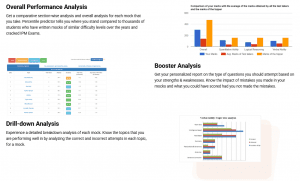
A good test series is one that makes your analysis process easier. Career Launcher’s IPMAT Test Series does just that. With detailed solutions, drill-down analysis and more, here’s what it has to offer.

Conclusion
Mock tests don’t improve scores- mock analysis does. Follow this simple but powerful 5-step framework, and every mock will take you one step closer to your target score.
Study smart, analyse well, and refine continuously, and find your performance improving over time!