
Honest question. How many hours did you spend on Quantitative Ability this week?
Now how many did you spend on Verbal?
Yeah. That’s what we thought.
And honestly? We get it. Math feels harder. It feels more urgent. When you can’t solve a quadratic, it stares back at you. When your vocabulary is weak, it’s invisible- until the paper is in front of you and you’re burning through seconds on a question you should’ve answered in 30.
Here’s the uncomfortable truth nobody tells you early enough:
Verbal Ability is worth 180 out of 360 marks. That’s literally half your paper.

Table of Contents
Here’s What the Paper Actually Looks Like
Forget what you’ve heard. Just look at the numbers:
| Section | Questions | Marks |
| QA – MCQ | 30 | 120 |
| QA – Short Answer | 15 | 60 |
| Verbal Ability | 45 | 180 |
45 questions. 180 marks. That’s 50% of your entire paper.
And here’s the part that genuinely stings- VA is not the hard section. It’s not the section with tricky formulas or concepts you’ve never seen before. It’s English. Reading. Language. The kind of stuff you’ve been doing your whole life.
Which means if you’re not scoring well in VA, it’s not a talent problem. It’s a preparation problem. And preparation problems have solutions.
Doing Well in QA is Not Enough
IPMAT Indore has sectional cutoffs. This is the rule that ends more IPMAT journeys than anything else.
You don’t just need a good total score. You need to cross a minimum in each section independently. The 2025 VA cutoff for the General category was 112 out of 180.
Sit with this scenario for a second.
Imagine you’ve put in months of QA prep. Your mocks are showing strong quantitative scores. You feel good. You walk into the exam, you handle QA well — and then VA happens. You hadn’t trained it seriously. The 40 minutes feel chaotic. You finish with 98.
Total score? Decent. VA score? Below cutoff.
Result? No PI call. Not because you weren’t good enough — but because of one section you kept telling yourself you’d get to.
This happens every year, to numerous students. Don’t let it be you.

The 53-Second Problem
Here’s the other thing about VA that catches people off guard. 45 questions in 40 minutes = 53 seconds per question.
That RC passage with five questions attached? You have about 4 minutes — to read the whole thing and answer everything. That parajumble with five scrambled sentences? You need to sequence them correctly in under a minute.
VA in IPMAT is a speed game as much as it’s a language game. And speed is not something you can cram the night before. It’s built, slowly, through weeks of timed practice, until the pace becomes natural.
The good news is that VA is the fastest section to improve in all of IPMAT. QA gaps can take months to close. VA gaps, with the right approach, can close in 50 days. Not perfectly. But enough to cross that cutoff comfortably and actually score well above it.
Here’s how.
How to Ace IPMAT Verbal Ability in 50 days
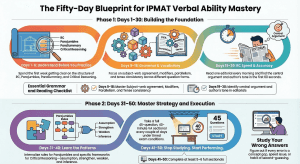
Days 1–8: Understand Before You Practice
Don’t open a question bank on Day 1. Seriously.
The biggest mistake students make with VA is jumping straight into practice without understanding what IPMAT is actually testing. Spend the first week getting clear on the structure- RC, Parajumbles, ParaSummary, Critical Reasoning, Grammar, Vocabulary- and what a high-scoring approach looks like for each. Think of this as calibrating before you start running.
Days 9- 18: Grammar & Vocabulary- The Boring Stuff That Isn’t Actually Boring
IPMAT doesn’t test all of grammar. It tests about 8- 10 patterns, repeatedly, across different question forms. Subject-verb agreement. Modifiers. Parallelism. Tense consistency. That’s your list. Not the entire grammar syllabus- just these.
For vocabulary, stop making word lists. Start reading. When you encounter a new word in context- in an article, in a passage- it sticks differently than a flashcard. Context is everything.
Days 19–30: RC Is Where This Exam Is Won or Lost
If you only had time to get good at one thing in VA, it would be RC. It’s the most question-dense part of the section and the place where speed and accuracy collide most brutally.
Here’s your daily habit for these 12 days: read one editorial or opinion piece every morning. Not for pleasure- read it like an IPMAT question is coming. Find the central argument in the first 60 seconds. Identify the author’s tone. Summarise the passage in one sentence before you finish it.
Do this every day and by Day 30, your RC speed will feel different. Not perfect- but different.
Days 31-40: Parajumbles, ParaSummary & Critical Reasoning- Learn the Patterns, Then Trust Them
These three question types are where students either gain a massive edge or bleed marks needlessly.
Parajumbles have rules- opening sentences don’t begin with pronouns without antecedents, contrast signals like “however” flag a turn, conclusion sentences are broader than the body. Once you internalise these, jumbles become almost mechanical. ParaSummary is about finding the main idea and eliminating answers that are too extreme or too narrow. Critical Reasoning — assumption, strengthen, weaken, inference — has a specific framework for each type.
The key with all three: stop solving by feel. Students who solve these by instinct get inconsistent results. Students who apply a method get consistent ones. Take the time to learn the method properly, even if it feels slower at first.
Days 41–50: Stop Studying. Start Performing.
No new concepts in this window. Close the notes. What you know, you know.
This phase is entirely about simulation. One full 45-question, 40-minute VA sectional every couple of days — timed, no pausing, no mid-test solution-checking. Exam conditions every time.
After each test, don’t celebrate your correct answers. Study your wrong ones. Every error is a signal — a concept gap, a speed issue, a habit of second-guessing correct instincts. Figure out which it is. That’s what you fix.
By Day 50, you should have taken at least 5–6 full sectionals. Your pace will have settled. Your error patterns will be familiar. And you’ll walk into the VA section on exam day having already sat through it more times than most students ever will.
Pro- Tip 💡
For aspirants who want this entire journey structured, sequenced, and guided — Career Launcher’s IPMAT 2026 VA Sprint is built for exactly that. 30 recorded sessions across 6 modules take the preparation from ground zero to exam-ready, covering every VA topic that matters in the order that makes sense. Three full sectional tests with detailed feedback make sure the final stretch isn’t just practice- it’s a clear picture of what to fix and how much time to fix it in.
Leading every session is Siddharth Mehta- XLRI Jamshedpur alumnus and one of Career Launcher’s most respected VA mentors, with 18 years of coaching experience across IPMAT, CAT, and CLAT. The program is fully self-paced. No fixed schedule, no missed sessions, no falling behind. Enroll now and get started whenever ready.