


Table of Contents
1. What Are the M7 Business Schools?
The M7, standing for ‘Magnificent Seven’, refers to a group of one of the most elite and globally recognised business schools in the United States. These institutions are known for their exceptional faculty, strong alumni network, and high job salaries. These schools have built their reputation as leaders in consulting, finance, and tech roles.
1.2. Why the Group is Called “M7”
The term M7 was created by the deans of these 7 business schools as an informal alliance. Instead of being based on any official rankings, it was a result of mutual recognition of each other as leaders in management education. Over time, the term ‘M7’ started being used by applicants, recruiters, and MBA ranking platforms.
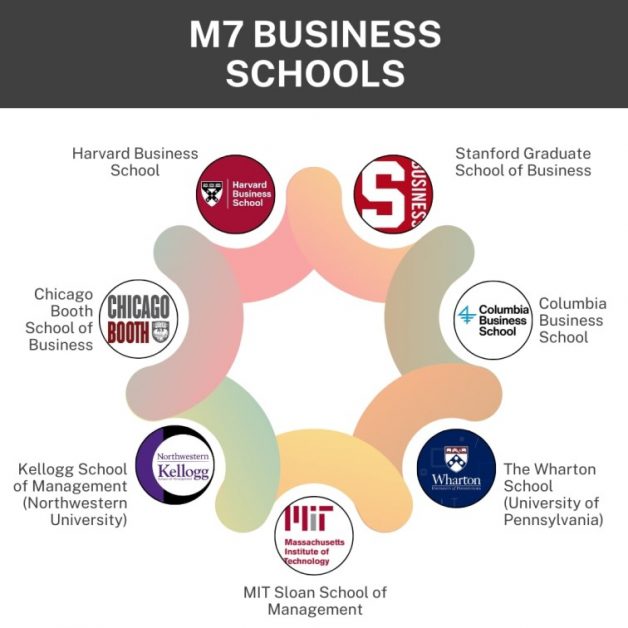
1.3. List of M7 Business Schools
Acceptance Rate: 10%
Average GPA: 3.76
Average GMAT score: 735
Women: 44%
HBS, ranked as one of the best B-schools in the world, admits around 1000 students in their MBA program. As of 2025, Harvard has a strong alumni network with 90,662 students across 173 countries.
As noted by many students, HBS is known for case method teaching, wherein each session begins with a cold call around the case.
-
Stanford Graduate School of Business
Acceptance Rate: 5.8%
Average GPA: 3.76
Average GMAT score: 738
Women: 45%
Stanford is known for its small batch size, having roughly half the class strength when compared to Harvard. This creates an intimate academic atmosphere, helping many students. Being in close proximity to Silicon Valley, Stanford is known for its focus on entrepreneurship and technology.
Acceptance Rate: 10%
Average GPA: 3.6
Average GMAT score: 736
Women: 41%
Chicago Booth is renowned for its data-driven approach and a strong emphasis on analytical thinking. With a flexible MBA course, students can customise nearly every aspect of their coursework. Strong in fields of finance, economics and quantitative fields, Booth has a faculty that includes multiple Nobel Prize winners.
Acceptance Rate: 12%
Average GPA: 3.6
Average GMAT score: 732
Women: 44%
Located in New York City, Columbia has strong ties to Wall Street, thereby giving students an unbeatable access to finance, consulting and media industries. They have an industry-focused curriculum, making it a top choice for students targeting roles in finance and entrepreneurship.
Columbia’s J-Term (January intake) is another advantage, allowing students with significant work experience to finish their MBA faster without a summer internship.
Acceptance Rate: 21%
Average GPA: 3.6
Average GMAT score: 733
With a collaborative culture, leadership focus, and strength in marketing, general management, and strategy, Kellogg is known for its diverse student community. It places a strong focus on teamwork and communication skills.
Acceptance Rate: 11%
Average GPA: 3.7
Average GMAT score: 735
Women: 44%
Wharton is an analytically rigorous business school, offering more than 18 MBA majors. They have a large class size with around 800+ students. Wharton graduates mostly excel in consulting, finance and tech. Its strong alumni network and dual-degree options make it a popular choice for Indian applicants.
Acceptance Rate: 14%
Average GPA: 3.6
Average GMAT score: 720
Women: 47%
MIT is the ideal school for students who want a highly quantitative and problem-solving-oriented MBA experience. With its ‘Action Learning’ plan, Sloan encourages students to take what they learn in the classroom and apply it to a real business challenge. Being close to MIT’s engineering and technology ecosystem further creates opportunities for students in tech and entrepreneurship.
Real M7 Success Story:
Indian applicants often feel disadvantaged due to intense competition, but Career Launcher’s personalised mentoring consistently turns strong profiles into global admits.
Here’s one such example:
“I am grateful to Career Launcher for helping me secure admissions to my dream schools in the US. I was consulted by Mr. Anubhav Seth, who helped me throughout the application process to identify career goals and select programs that best fit my skill set. I applied to MIT Sloan, Columbia University, and Georgia Tech and was fortunate to receive offers from all three. The iterative essay reviews, mock interviews, and personalised guidance helped me present the strongest version of my profile”
Arpit Jain – MIT Sloan School of Management
(Also admitted to: Columbia University & Georgia Institute of Technology)
2. How is M7 Different From T10?
The primary difference between M7 and T10 business schools is that M7 is an unofficial group based on the connection between the deans and is not based on any ranking. On the other hand, T10 refers to those top schools based on a specific ranking system, which can change from year to year and by publication. Nonetheless, both have some of the best business colleges in the world, known for their top-notch education.
According to the QS Global MBA Rankings 2026, the top 10 schools (T10) are:
- Penn (Wharton)
- Harvard Business School
- MIT (Sloan)
- Stanford Graduate School of Business
- HEC Paris
- London Business School
- Cambridge (Judge)
- INSEAD
- Northwestern (Kellogg)
- Columbia Business School
It’s important to note that these rankings are usually based on several criteria, while some might focus more on student satisfaction, while others on graduation rates.
At Career Launcher, our M7 Admission Consultants believe that relying on ranking too much can be misleading. Based on our 29+ years of experience, we suggest that students focus more on what they want out of their college experience and look for schools that align with these goals.

3. How Hard Is It to Get Into an M7 School?
Receiving a huge number of applications, around 48,000 for the class of 2026, getting admitted into these 7 business schools is highly challenging. Programs here attract the strongest candidates worldwide, including top performers from the field of consulting tech, finance, entrepreneurship, and the Indian applicant pool, which is one of the most competitive globally.
Here are some of the reasons why getting into M7 is so hard:
- Low acceptance rates: With a typical acceptance range of 5-20%, all these B-schools have high competition where students compete for limited seats. And these numbers drop even further for the Indian applicants due to a saturated applicant pool.
- High GMAT/GRE expectations: As mentioned above, the average GMAT score for most of the programs falls around 730. A GRE score of 325+ is generally considered competitive.
- Work experience required: Most of the applicants have a work experience of 3-6 years, showcasing measurable results, promotions, or leadership experience.
- Highly competitive applicant pool: Classes at M7 are filled with highly qualified people who have held positions of consultants, investment bankers, tech professionals at big MNCs like McKinsey, BCG, Bain, Goldman Sachs, JP Morgan, Google, Amazon, among others. Therefore,
- Holistic evaluation: These schools evaluate applicants not just on an academic basis but on several other aspects, like professional impact, leadership qualities, clarity of career goals, essays, recommendations, and interview performance. In order to get admission, an individual has to perform strongly in every area, not just one.
Career Launcher’s M7 Admission Experts see this competition reflected every year. Out of the Indian applicants we mentor, over 70% score above 700 on the GMAT, and a large percentage receive interview invites from M7 and T10 schools, even with highly competitive pools. Our data shows that strategic planning and targeted preparation can significantly improve your chances in a tough applicant pool.
Our data shows that strategic planning and targeted preparation can significantly improve your chances in a tough applicant pool.
Get Help With Your Application →4. M7 Admissions Requirements for Indian Students (What Schools Expect)
| Requirements | Details |
| Academic Qualification (GPA) |
|
| GMAT Score |
|
| GRE Score |
|
| Work Experience |
|
| Leadership Potential |
|
| MBA Essays |
|
| Recommendations |
|
| Interview Experience |
|
| Career Goals |
|
| Extracurricular/Community Impact |
|
Feeling overwhelmed by the complexities of M7 admissions? You’re not alone. Our M7 consultants at Career Launcher simplify the entire process and guide you step-by-step, from test scores and essays to selecting the right schools for your profile.
With a team that has mentored over 2 million students, Career Launcher uses a data-backed admissions strategy to help Indian applicants enter the world’s top business schools.
With a team that has mentored over 2 million students, Career Launcher uses a data-backed admissions strategy to help Indian applicants enter the world’s top business schools.
Get in Touch →Want to understand exactly how to strengthen your chances for an M7 admit? Check out our full step-by-step guide on How to Get Into an M7 School, where we’ve explained the entire process in an easy, actionable format.
Career Launcher’s admissions team has spent 29+ years analysing MBA admit patterns, and our insights show that Indian applicants who succeed at M7 usually share three common traits:
- Early planning (9 – 12 months before deadlines)
- GMAT/GRE score in the school’s top 10-20% band
- Work profiles with quantifiable impact rather than job title
These insights come from helping thousands of Indian applicants build competitive profiles for global MBAs, including M7.
Start your journey with Career Launcher today.
Get a Free Personalised Consultation Call →FAQs
How do I get into an M7 school?
Getting into an M7 requires a strong combination of academic performance, a competitive GMAT score of 730+, an overall GRE score of 32-255+, and impactful work experience. Most candidates have around3-6 years of experience with clearly defined goals and leadership examples.
Why isn’t NYU Stern part of the M7?
The M7 group is an informal alliance formed by the deans of 7 schools in the US: Harvard, Stanford, Wharton, Booth, Kellogg, Columbia, and MIT Sloan. NYU Stern is one of the top schools in the world and is highly respected, but was simply not part of this original group. Irrespective, NYU Stern is an exceptional school providing a great academic experience.
Is a 710 GMAT good enough for Harvard or Wharton?
710 is a good GMAT score, but it is below average for Harvard and Wharton. Both these schools have an average GMAT score of 730+. A student with exceptional work experience and strong leadership can be admitted with a 700-720 score, but the environment is highly competitive, especially for Indian candidates.
Can I get into an M7 MBA program with a GPA under 3.0?
Yes, it is possible to enter an M7 MBA program with a GPA under 3.0. But it is important to have a high GMAT/GRE score, strong career progression, leadership impact, and excellent recommendations and compelling essays explaining your journey and growth.
Is INSEAD equal to the M7 schools in the USA?
INSEAD is one of the top MBA programs globally and is often considered the European equivalent of the M7 group. With an overall ranking of 8, according to the QS Global MBA Rankings 2026, INSEAD is especially strong in consulting and global management and provides students with exceptional international career opportunities.
Which is a better B-school: Kellogg or MIT Sloan?
Kellogg and MIT Sloan are both part of the M7 group and excel in different areas. Kellogg is best known for marketing, general management, leadership, and collaborative culture. MIT Sloan, on the other hand, stands out for tech, analytics, entrepreneurship, and innovation. The better school, therefore, depends on what you are aiming to achieve from your school.
What is the easiest top 10 MBA program to get into?
There are no easy top MBA programs as such, but some schools are slightly less competitive, especially when compared to M7. Schools like Duke Fuqua, Michigan Ross, Cornell Johnson, and UCLA Anderson are considered relatively less competitive when compared to Harvard, Stanford, Wharton, or Sloan. However, this does not mean admission to these schools is ‘easy’ as they also have strong applicant pools and require well-rounded applications.
Which M7 has the highest acceptance rate?
Out of the 7 business schools, the Kellogg School of Management has the highest acceptance rate, ranging around 20%, making it more accessible to the students when compared to other schools like Harvard or Stanford.
What is the average GPA for M7 business schools?
The average GPA for M7 business schools is usually around 3.6, with candidates having at least a 3.5 GPA.
Do M7 MBA programs offer scholarships?
Yes, M7 MBA programs offer several scholarships on the basis of merit and financial need. Though it is difficult to waive off the entire tuition fees, students do get some relief as the fees can be especially high in the M7 schools. The students can get to know about these scholarships on the official university websites.