
With a less than 15% acceptance rate, for many students, Oxbridge feels like a dream within reach, yet impossibly hard to secure. What makes this institute so intimidating, even for the brightest minds? Let’s unpack.
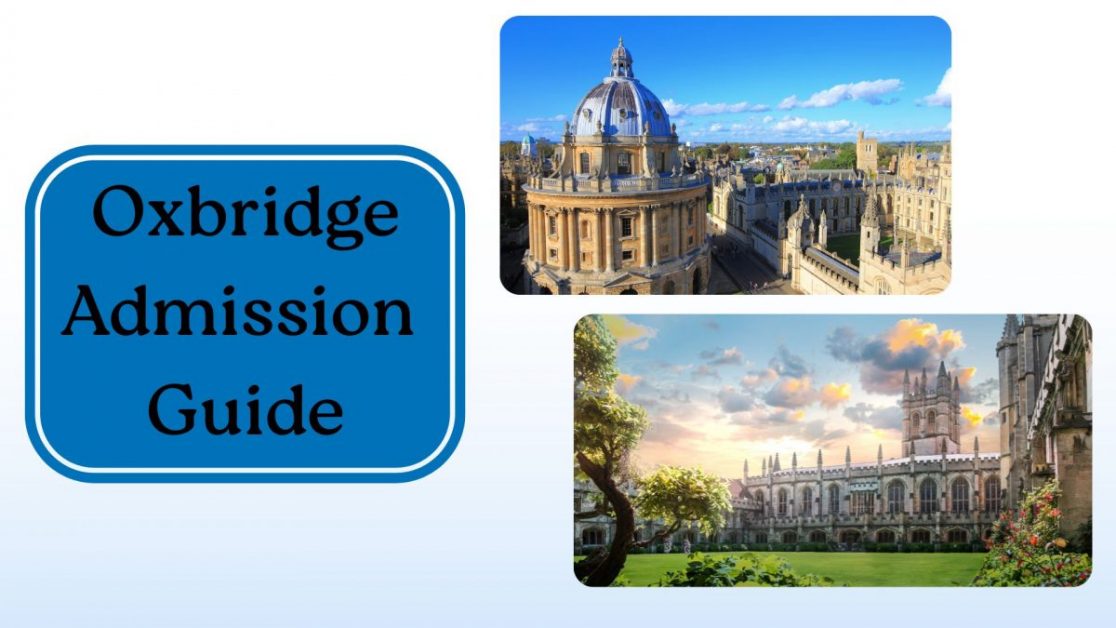
Oxbridge, a combined term coined for the Universities of Oxford and Cambridge, refers to two of the most prestigious and oldest universities in the world. Both these institutions are known for their highly selective admissions, academic excellence, and rigorous teaching systems.
Oxbridge attracts a high number of ambitious applicants every year, with over 44,000 applicants in 2023 alone. Because of this, many Indian students wonder what really makes these two universities so difficult to get into and how they can stand apart from the rest of the applicants.
In this Oxbridge Admission Guide for Indian Students, we break down what Oxbridge really is, why its admission process is so competitive and what you can do to strengthen your application from the beginning.
Table of Contents
1. Why Is It So Difficult to Get Into Oxbridge?
The difficulty lies not only in the competition but also in the highly selective nature of the admission process at Oxbridge.
Receiving thousands of applicants every year from highly qualified students for a limited number of seats, both universities can choose from the best of the best. The competition is so high that in some courses, up to 6 applicants compete for just one place. This creates an intense selection process.
But what separates Oxbridge from other universities is its focus on academic potential. These places are not merely looking at your past performance, but their admissions are based on a multilayered evaluation method, which includes assessing multiple things, such as achieved grades, performance in admission tests, assessed written work, and a challenging academic interview that mirrors the real Oxbridge teaching.
Despite the competitive landscape, our experience at Career Launcher shows that strategic preparation works. Over the past few years, 99% of students who applied through our counselling team received at least one admit from their selected universities, including highly competitive UK institutions. Structured guidance, early planning, and academic alignment consistently make a measurable difference.
Want to know more about the process?
Book a free consultation call →
2. Understanding the Oxbridge College System
One of the things that sets Oxbridge apart from others is how its collegiate system operates, and it might appear confusing at first glance to many students.
Instead of getting admitted to a single university, students join both a college and a department. There are over 40 colleges at Oxford and more than 30 at Cambridge.
Oxbridge colleges are, simply put, a collection of historic buildings which form a mini-community, having common rooms, accommodation for students, cafes, and libraries. This way, students get access to a healthy student community, making it easier to settle, especially for international students.
All the lectures, exams, and course content are handled by the central department, while the college becomes an academic home for the student. This is where the individual will have supervisions/tutorials, get academic guidance and build day-to-day relationships with other students.
2.1. Do You Have to Choose a College?
A student has to choose a college when they’re applying to Oxbridge, but this does not heavily affect the chances of admission. Since both these universities use a “pooling system”, they redirect strong applicants to other colleges if their first choice is not available. This way, both ensure a fair and balanced system for students.
Choosing the right college can have a huge impact on your university experience. They are responsible for your admission process, accommodation, teaching, catering, libraries and other formal events. Therefore, it is important to do your research before applying.
2.2. Academic Programmes at Oxford & Cambridge
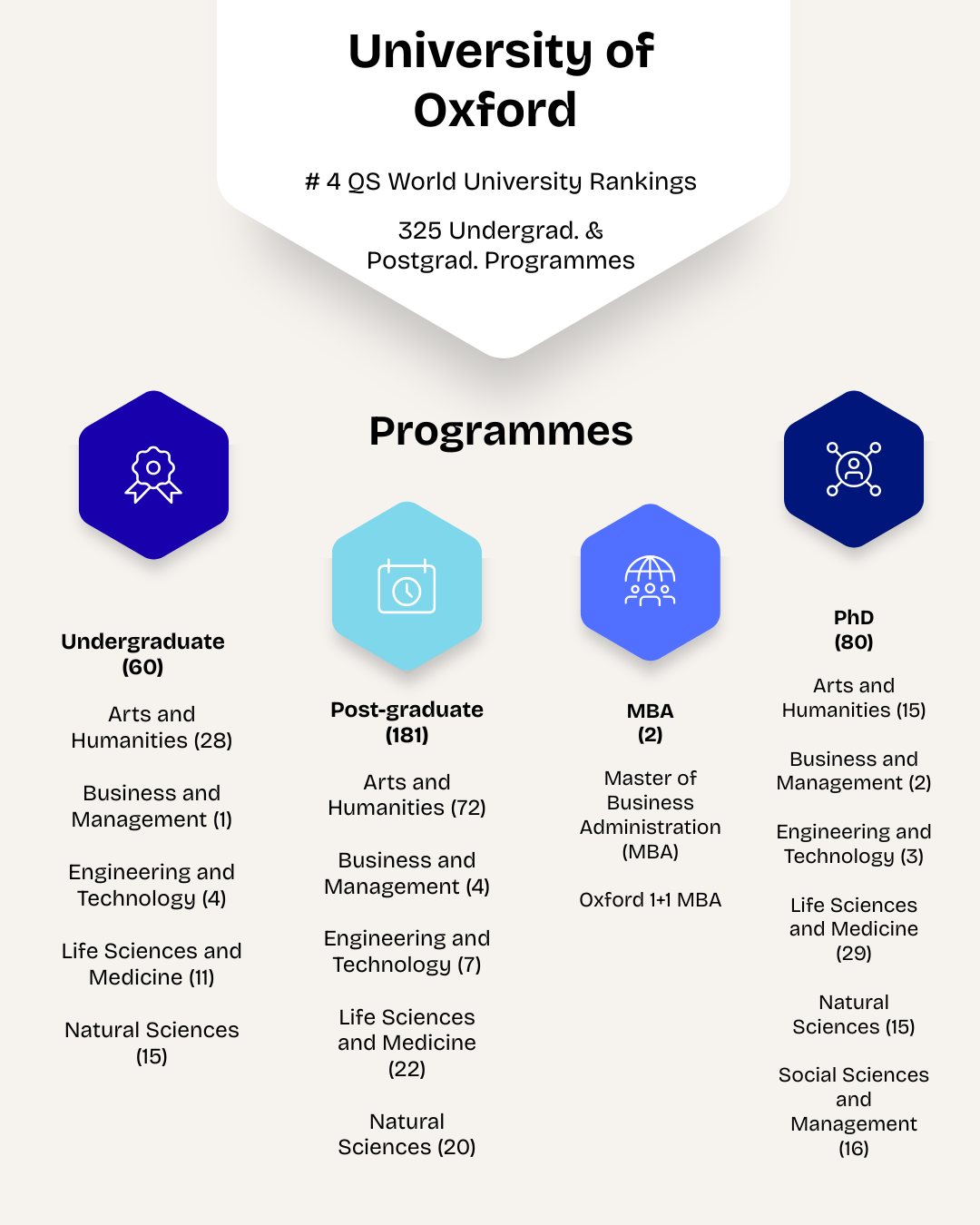
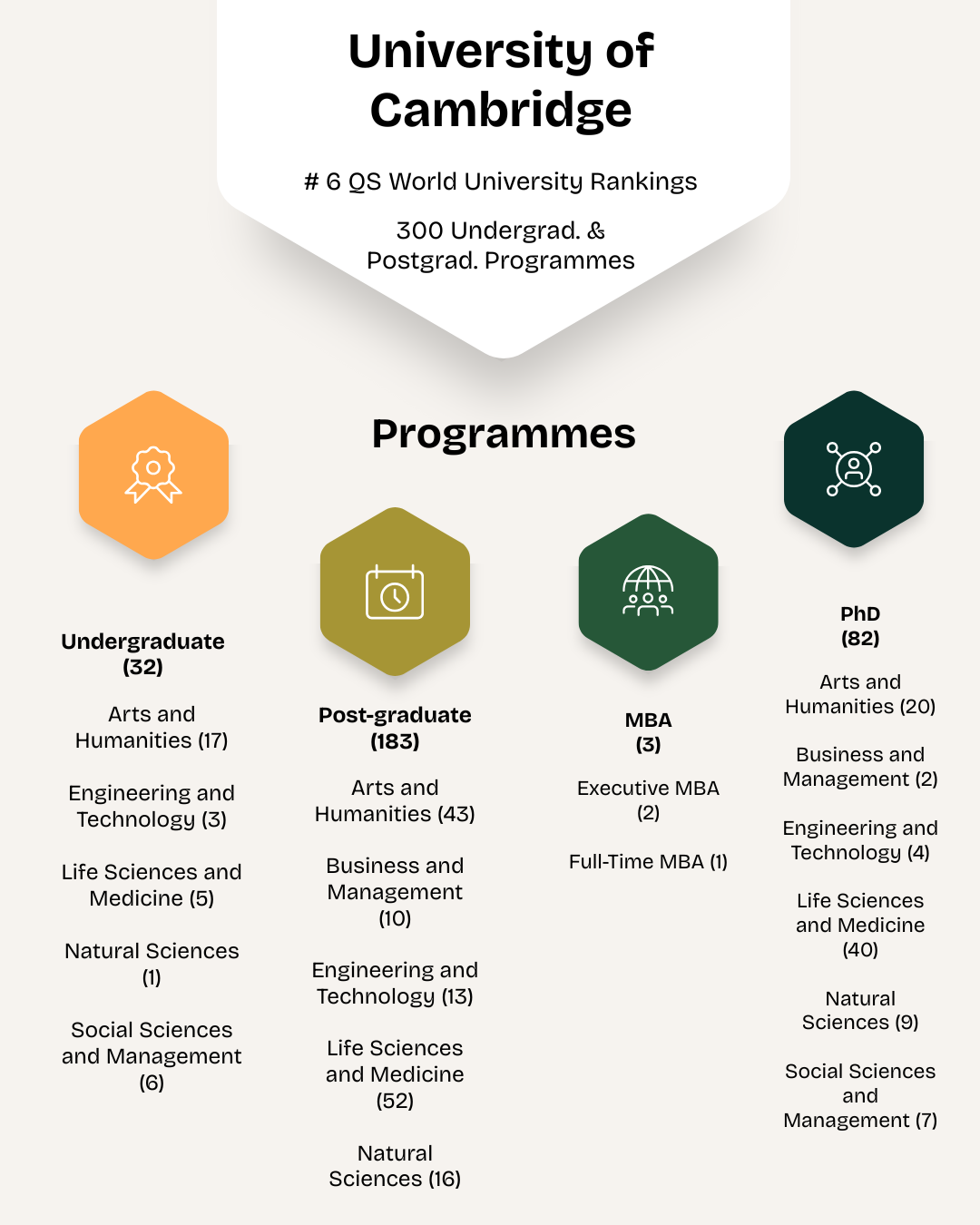
Both Oxford and Cambridge offer more than 300 undergraduate and postgraduate programs across various fields, including humanities, sciences, engineering, and business.
Refer to the images below to see primary programme categories and the typical number of courses in each group:
Undergraduate and postgraduate programmes at the University of Oxford
Undergraduate and postgraduate programmes at the University of Cambridge
2.3. Which Oxbridge Colleges Are the Best?
According to the ranking by the Telegraph, below are the top 10 colleges assessed across four key areas that is, namely financial assets, academic performance, lifestyle and accommodation. The individual areas are ranked on a scale of one to 10, and these are added together to achieve an overall score out of 40.
| Rank | Name of the College | Name of the University | Total Score
(out of 40) |
| 1 | St John’s | Oxford | 36.7 |
| 2 | Trinity | Cambridge | 35.9 |
| 3 | Magdalen | Oxford | 35.6 |
| 4 | Christ Church | Oxford | 35.5 |
| 5 | Merton | Oxford | 35.4 |
| 6 | Queen’s | Oxford | 35.3 |
| 7 | Corpus Christi | Oxford | 35.1 |
| 8 | St John’s | Cambridge | 35 |
| 9 | Trinity | Oxford | 34.1 |
| 10 | University | Oxford | 33.9 |

3. Admission Timeline for Oxbridge
Having an understanding of how the admission process works at Oxbridge colleges is important so that you can plan accordingly.
While both Oxford and Cambridge follow the same UCAS deadline, their admission assessments, documentation requirements and timelines differ significantly.
Refer to the table below to view a side-by-side comparison of the complete 2026 entry process. Although specific dates have passed, the timeline will still offer a reliable overview of how the Oxford and Cambridge process typically works for students planning to apply for 2027 admissions.
| Stage | Oxford | Cambridge |
| Course Research | Start researching courses from June 2025 | Courses go live on UCAS on 29 April 2025; research begins from this date |
| UCAS Application Opens | Early September 2025 | You can start filling out UCAS from 13 May 2025, but you can submit from 2 September 2025 |
| Final UCAS Deadline | 15 October 2025 (6 pm BST) | 15 October 2025 (6 pm UK time) |
| College Choice | Choose a college or apply open college | Choose a college or submit an open application |
| Personal Statement & Reference | Prepare from June; submit by 15 October | Same timeline as UCAS submission |
| Admission Test Registration | Register 18 June – 19 September 2025 (6 pm BST) | Various deadlines:
• UCAT opens 17 June • ESAT/TMUA access arrangements open 24 June • ESAT/TMUA booking opens 31 July • LNAT registration opens 1 August |
| Admission Test Deadlines | Book test(s) 18 August (1 pm BST) – 26 September (6 pm BST) | • ESAT/TMUA access deadline: 8 Sept
• LNAT registration: 15 Sept • UCAT access deadline: 16 Sept • UCAT registration: 19 Sept • ESAT/TMUA registration: 29 Sept |
| Admissions Tests (Test Date) | All tests held 21-27 October 2025 (online via Pearson VUE centres) | • ESAT: 9-10 Oct 2025
• TMUA: 13-14 Oct 2025 • UCAT: Completed by 26 Sept 2025 • LNAT: Taken by 15 Oct 2025 |
| Written Work | Submit written work (if required) by 10 November 2025 to your college | Written work deadlines usually mid-November (varies by course) |
| Additional Forms | None (except course-specific items) | My Cambridge Application due 22 October 2025
Transcript due 22 October 2025 Graduate Medicine applicants submit the additional form by this date |
| Shortlisting | November 2025 | Invitations sent in November, some early December |
| Interviews | December 2025 for shortlisted applicants | 1-19 December 2025 (core interview period) |
| Decision Release | January 2026 | January 2026; possible pooling for strong candidates |
| Foundation Year Deadline | – | 14 January 2026 |
| Mature Applicant Deadlines | Check course rules | • Mature UCAS deadline 15 Oct OR January, depending on course
• My Cambridge Application for mature applicants due 21 January 2026 |
| Second Round Interviews (Mature Colleges) | – | 23 March – 3 April 2026 |
| Exams | A-levels/IB June-July 2026 | A-levels/IB and STEP (if required) in May-June 2026 |
| Final Confirmation | After the exam results in August 2026 | After the exam results in August 2026 |
| Deferral Rules | Not always allowed; check the department | Varies by college and course |
At Career Launcher, we always recommend that students review previous Oxbridge admissions cycles. Even if the exact dates have passed, the structure remains consistent each year, giving students a clear understanding of when to prepare, when to register for tests, and how the interview and decision stages unfold.
Applying to Oxbridge can be highly competitive, but you don’t have to do it alone
With Career Launcher’s Admission Consulting, you can plan early, avoid mistakes, and build a strong, academically focused application.
Get in Touch →
4. Scholarships at Oxbridge for Indian Students
Studying at Oxford or Cambridge can be a significant investment for Indian students. The good news is that both universities offer plenty of scholarships, bursaries and fully funded awards.
(A bursary is a financial award given based on need, while a scholarship is typically based on merit or achievement.)
4.1. Oxford Scholarships for Indian Students
| Scholarship | Details | Covers |
| Rhodes Scholarship |
|
(₹2,39,55,495 per annum) (₹1,99,629 per month)
|
| Oxford-Weidenfeld and Hoffmann Scholarships |
|
|
| Clarendon Scholarships |
|
|
Many Oxford colleges offer targeted funding, such as:
| College-Specific Scholarships | Details |
| Somerville India Scholarships |
|
| Balliol College Graduate Scholarships |
|
| Exeter College Graduate Scholarships |
|
4.2. Cambridge Scholarships for Indian Students
| Scholarship | Details | Covers |
| Gates Cambridge Scholarship |
|
|
| Cambridge Trust Scholarships |
|
(Some scholarships under this trust cover the entire fee, visa cost, and fare, and provide a grant as well) |
Several colleges in Cambridge offer India-focused or international scholarships:
| College-Specific Scholarships | Details |
| St John’s College Studentships |
|
| Trinity College Bursaries |
|
| King’s College Graduate Awards |
|
4.3. Things to keep in mind for Indian students when applying for Oxbridge scholarships:
- Students should consider funding offered both within Oxford and Cambridge, like scholarships, studentships and Research Council funding, and outside the Universities, like charities, employer support and loans.
- For almost all Oxbridge scholarships, the deadline is usually around December or January, so it is important to apply before the deadline.
- Check the course page to see which deadline you need to apply for.
- Your external funding deadline can be different from your course deadline, so double-check.
- Students can usually expect to hear back from their college 8-10 weeks after the deadline date.
With so many scholarship options, navigating which one to choose can be a difficult and tiresome process, especially with varying deadlines, eligibility criteria and college-specific requirements.
At Career Launcher, our admissions consultants simplify the entire process for you by helping you shortlist the right scholarships that match your profile.
Your description goes here.
Get our free GMAT Study Plan →
5. What Oxbridge Looks for in Applicants
Getting into Oxbridge is not merely about having top grades, as almost every applicant will have those. What truly sets a candidate apart from others would be their academic potential, intellectual curiosity and ability to think independently.
Oxbridge selects those who will thrive in their unique system, where learning is fast-paced, discussion-based and deeply analytical.
Here’s what the admission tutors value the most:
While there is no guaranteed formula for getting into Oxbridge, there are certain strategies that students can employ to improve their odds significantly.
- Build strong subject fundamentals early
Tests and interviews held by both Oxford and Cambridge assess how well you understand the core concepts. They will focus on deep learning, how you understand processes, and connect theories across topics.
- Engage in meaningful super-curricular activities
This is where most applicants stand out. They pursue activities that deepen their knowledge, such as:
- Reading research papers
- Online courses
- Academic summer schools
- University lectures/seminars
- Reading academic journals or advanced books
- Prepare strategically for admissions tests
Almost all the courses at Oxbridge require a test that heavily influences shortlisting. To maximise performance:
- Start early, ideally 4-5 months before the test
- Practice past papers under timed conditions
- Learn reasoning techniques and question patterns
- Get expert guidance if needed
- Create a compelling personal statement
A personal statement should be mostly academic in tone, focusing on areas including what you have read, explored, researched and what precisely sparked your interest.
It is best to avoid generic qualities such as “leadership” or unrelated extracurricular activities.
- Choose the right college
While the pooling system at Oxbridge balances admission, selecting a college strategically and realistically, which is aligned with your strengths and subjects, can highly improve your chances of not only getting admission but is also highly beneficial for scholarship.
- Seek expert guidance early
The entire process can be quite complex. Focusing on multiple tests, written work, college choices, interviews and early deadlines is overwhelming.
Expert mentoring can save time, reduce mistakes and improve your chances of getting admission into Oxbridge.
At Career Launcher, our Oxbridge experts help students:
- Identify their strongest academic angle
- Prepare strategically for admissions tests
- Build a strong super-curricular and academic profile
- Understand college selection and scholarship options
Hear what our student has to say:
“Career Launcher helped me with all my essays and finding the right universities for myself. Without the guidance of CL, I would not have been able to get any admits. They were very nice to me and helped me throughout the process.”
– Akanksha Gupta, Brown University
Want to get into Oxbridge?
Get a Call From Us →FAQs
What makes it so difficult to get into Oxbridge?
Since Oxbridge receives thousands of highly qualified applicants, getting into the college can be difficult. Almost every applicant has high grades, so real competition comes down to admission tests, interviews and the ability to think differently and critically under pressure.
Why are Oxford and Cambridge’s acceptance rates so low?
Both Oxford and Cambridge have low acceptance rates, around 15%, as they maintain small-group teaching, which limits their cohort sizes.
What are Oxbridge colleges?
Oxbridge colleges are individual academic communities with their own building, tutors, libraries, dining halls, and student support systems. They are not really separate universities, but are part of Oxford and Cambridge and offer a personalised academic environment to the students.
Which colleges at Oxbridge have the best reputation?
There is no official ranking for the best Oxbridge colleges, and it depends on individual student preferences. Though some colleges under Oxford and Cambridge are traditionally viewed as prestigious due to their history, academic performance and notable alumni. At Oxford, the best colleges are considered to be Christ Church, Magdalen, Balliol, and Merton. At Cambridge, Trinity, King’s, St John’s, and Peterhouse are among the best.
Is going to Oxbridge actually worth it?
Yes, absolutely. Oxbridge provides students with an enriching academic experience, is globally respected and opens multiple career opportunities. Students benefit immensely from small-group teaching, world-class faculty and a powerful alumni network.
What can you do to stand out and get into Oxbridge?
To get into Oxbridge, students should focus on academic depth, read widely and extensively, engage in research and explore subjects beyond the curriculum. Along with this, students can benefit from strong interview preparation and having a clear subject motivation.
How can I get into Oxbridge?
You can increase your chances of getting into Oxbridge by starting early, building strong subject fundamentals, practising with past admissions test papers, and developing super-curricular activities. Understanding the application timeline and college system also helps. With expert guidance, students can significantly strengthen the quality of their application.