
Economic reforms in 2025 reflect a maturing phase of India’s governance, where the emphasis shifted decisively from “expanding regulatory frameworks” to “delivering measurable outcomes”. The focus moved towards simplifying systems, reducing compliance burdens, and improving predictability for citizens and businesses. Across taxation, GST, labour regulation, and business compliance, reforms were designed to make every day economic interactions smoother, faster, and more transparent, strengthening trust in institutions and policy certainty.
Table of Contents
1. Overview of India’s 2025 Economic Vision
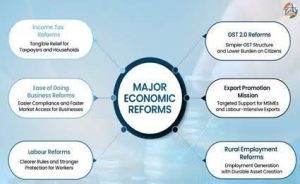
India’s 2025 Economic Reforms focus on simplifying systems, reducing compliance burdens, and enhancing predictability. The reforms emphasize ease of living, ease of doing business, and inclusive growth. Key sectors such as taxation, GST, labour regulation, and business compliance are being restructured to ensure smoother, faster, and more transparent economic interactions. These reforms are aligned with India’s long-term growth and Aatmanirbhar Bharat vision, improving trust in institutions and policy certainty.
2. Key Economic Reforms
Income Tax Reforms:
- Tax Exemption: In a major relief for Indian families and individual taxpayers, the Union Budget 2025-26 introduced substantial reforms in direct taxation, ensuring that annual incomes up to Rs. 12 lakh are exempt from income tax under the new regime, with the effective exemption rising to Rs. 12.75 lakh for salaried taxpayers on account of the standard deduction. This change reaffirmed the Government’s commitment and left millions of middle-class households with higher disposable income, boosting consumption, savings, and investment.
- In July 2024, the Government announced a comprehensive overhaul of the Income-tax Act, 1961 leading to New Income Tax Act, 2025 – a landmark development to simplify language, remove obsolete provisions and consolidate & restructure provisions. An internal Departmental Committee, constituted by Central Board of Direct Taxes (CBDT) for comprehensive review of the existing Act, undertook the reform with three guiding principles:
- Textual and structural simplification, improved clarity and coherence.
- No major tax policy changes, ensuring continuity and certainty.
- No modifications of tax rates, preserving predictability for taxpayers.
- New Income Tax Act (2025): The Income Tax Act, 2025 modernizes India’s direct tax framework by simplifying and streamlining tax legislation, making it more accessible, transparent, and less prone to litigation. A key reform is the introduction of a unified “Tax Year – the twelve-month period of the financial year commencing on the 1st April”, replaces the earlier concepts of Assessment Year and Previous Year. It not only improves clarity and makes it easier for taxpayers to understand the financial period their income and tax filings, but also reduces ambiguity in compliance and interpretation.
- Faceless Tax Administration: Strengthens digital-first enforcement and simplifies compliance, with clear tax filing timelines.
- Taxpayer Security: No major tax rate changes; preserves predictability for taxpayers.
Impact:
- These reforms improve taxpayer clarity, transparency, and reduce friction in tax compliance, encouraging investment, savings, and economic growth.

3. Labour Reforms
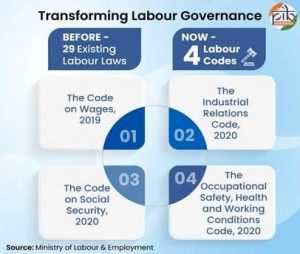
- In a landmark reform, the Government of India consolidated 29 existing labour laws into four Labour Codes- the Code on Wages, 2019, the Industrial Relations Code, 2020, the Code on Social Security, 2020 and the Occupational Safety, Health and Working Conditions Code, 2020.The new framework enhances ease of doing business while expanding wage security, social protection, and workplace safety for workers, including women, migrant, gig, and platform workers.
- Consolidation into 4 Labour Codes:
- Code on Wages (2019)
- Industrial Relations Code (2020)
- Code on Social Security (2020)
- Occupational Safety, Health, and Working Conditions Code (2020)
- Focus Areas: Expands wage security, social protection, and workplace safety, especially for women, migrant, gig, and platform workers.
- Outcome-Based Governance: Simplifies compliance and introduces digital systems for increased efficiency.
- The reforms expand the safety net for India’s workforce, with nearly 10 million Gig and Platform workers receiving annual social security support. Women workers benefit from assured leave provisions, maternity benefits and improved workplace safety. Overall, the Labour Codes mark a decisive shift from rule-heavy regulation to outcome-based governance, creating one unified framework for over 50 crore workers across sectors. Additionally, the codes lay a strong foundation for a future-ready workforce and resilient industries aligned with India’s long-term growth aspirations.
Impact:
- Expansion of social safety nets and improved welfare for nearly 50 crore workers.
- Shift from rule-heavy regulation to outcome-based governance, making India’s workforce more future-ready.
4. Rural Employment Reforms
- Rural employment reforms anchored in the enactment of the Viksit Bharat – Guarantee for Rozgar and Ajeevika Mission (Gramin) Act, 2025, replaces the Mahatma Gandhi National Rural Employment Guarantee Act (MGNREGA) with a modern statutory framework that enhances livelihood security and integrates employment with community development.
- Extended Employment Guarantee: 125 days of wage employment per rural household in a financial year.
- Integrated Provision for Agriculture and Rural Employment: facilitate adequate availability of agricultural labour during peak sowing and harvesting seasons while ensuring a calibrated balance that supports both agricultural productivity and worker security.
- Timely Wage Payments: timely payment of wages on a weekly basis or, in any case, within fifteen days of completion of work, reinforcing wage security and protecting workers from delays.
- Asset Creation Focus: Work contributes creation of durable public assets across four priority thematic domains – water security & related works, rural infrastructure, climate-resilient projects, and livelihood enhancement.
- Decentralized Planning: All works flow from Viksit Gram Panchayat Plans (VGPPs), prepared through participatory processes at the Gram Panchayat level and approved by the Gram Sabha. These plans are digitally integrated with national platforms including PM Gati Shakti, enabling convergence across Ministries while retaining decentralised decision-making.
- Financial Architecture: The Act is implemented as a Centrally Sponsored Scheme, notified and operationalised by State Governments in accordance with its provisions.
- Strengthened Administrative Capacity: The administrative expenditure ceiling has been increased from 6% to 9%, strengthening staffing, training, technical capacity, and field-level support to improve institutional delivery and outcomes..
Impact:
- Enhanced livelihood security and community development in rural areas.
- Focus on resilience-building through climate-resilient projects and integrated rural infrastructure.
5. Ease of Doing Business Reforms
- Quality Control Orders (QCOs): Implemented in a phased manner to ensure domestic production is not disrupted.
- Relaxations provided for micro and small enterprises.
- BIS Support Measures: Flexible processes for product certification, testing, and inspection.
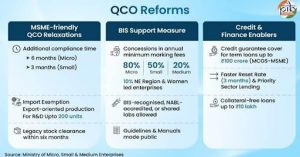
- Credit Flow to MSMEs:
- Collaterally-free loans for micro and small enterprises, simplifying the credit process.
- Under Improving Credit Flow to MSMEs, loans have been linked to external benchmarks with shorter reset periods (3 months), the Mutual Credit Guarantee Scheme for MSMEs (MCGS-MSME) now provides cover up to Rs. 100 crore for equipment and machinery, Priority Sector Lending targets are enforced, collateral-free loans up to Rs. 10 lakh are available for micro and small enterprises, and working capital requirements for MSEs are set at a minimum of 20% of projected annual turnover for credit limits up to Rs. 5 crore.
- Impact:
- Promotes growth and competitiveness among MSMEs.
- Reduces transaction costs, and simplifies the regulatory environment for businesses.
6. MSME Reforms
- The Budget 2025-26 expanded the MSME definition, raising investment and turnover limits to enhance confidence and generate employment for our youth, while credit guarantee cover for Micro and Small Enterprises doubled from Rs. 5 crore to Rs. 10 crore, improving access to formal finance for expansion and modernization, with higher limits and term loans for startups and exporters boosting growth and competitiveness.
- Enhanced Definition of MSMEs:
- Micro: Investment up to Rs. 2.5 crore, turnover up to Rs. 10 crore.
- Small: Investment up to Rs. 25 crore, turnover up to Rs. 100 crore.
- Medium: Investment up to Rs. 125 crore, turnover up to Rs. 500 crore.
- Financial Support: Doubling credit guarantee cover for MSMEs to Rs. 10 crore, providing collateral-free loans, and facilitating easier access to finance for startups and exporters.
- Simplified Taxation: MSME-friendly GST reforms, including faster refunds and simplified registration.
Impact:
- Provides financial support for expansion and modernization.
- Encourages entrepreneurship, especially among youth and women in rural areas.
7. GST Reforms (GST 2.0)
- The Goods and Services Tax (GST) reforms, represent another landmark step in reshaping India’s indirect tax framework to align with the aspirations of a young, entrepreneurial, and consumption-driven economy. The latest Next-Generation GST reforms, mark a decisive step towards simpler taxation, lower burden on citizens, and improved ease of doing business. They significantly strengthen GST’s role as a citizen-centric, business-friendly, and growth-oriented tax system.
- Simplified Tax Structure: Transition to a two-slab system (5% and 18%) to reduce complexity and ease compliance for MSMEs.
- Lower Cost of Living: Rate reductions on essential goods and services to alleviate inflationary pressures.
- MSME Enablement: Simplified registration, returns, and access to affordable trade finance for MSMEs and startups.
- Increased Revenue Base: Expanded taxpayer base, gross GST collections rose to Rs. 22.08 lakh crore in FY 2024-25.
Impact:
- Simplifies tax compliance and encourages business growth.
- Enhances affordability for households, fostering a consumption-driven economy.
8. Export Promotion Mission (EPM)
- In a major boost to India’s trade competitiveness, the Union Cabinet approved the Export Promotion Mission (EPM) as a flagship structural reform with an outlay of Rs. 25,060 crore for FY 2025–26 to FY 2030–31. Announced in the Union Budget 2025–26, EPM marks a strategic shift from fragmented export support schemes to a single, outcome-based and digitally driven framework, aimed at empowering MSMEs, first-time exporters, and labour-intensive sectors. The Mission integrates financial support (Niryat Protsahan) including affordable trade finance and credit enhancement with non-financial enablers (Niryat Disha) such as quality compliance, branding, logistics, and market access.
- Rs. 25,060 Crore Outlay: The Export Promotion Mission (2025-2031) aims to boost exports from MSMEs, first-time exporters, and labour-intensive sectors.
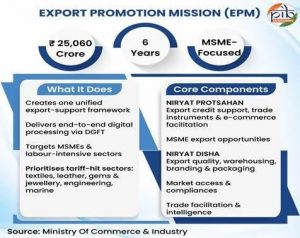
- Support Measures: Provides affordable trade finance, compliance certification support, and improved access to global markets.
- Employment Generation: Targets the creation of jobs across manufacturing, logistics, and allied services, enhancing India’s global export competitiveness.
- The Mission integrates financial support (Niryat Protsahan) including affordable trade finance and credit enhancement with non-financial enablers (Niryat Disha) such as quality compliance, branding, logistics, and market access.
Impact:
- Expands India’s global market presence, boosts exports, and strengthens employment across sectors like manufacturing, logistics, and services.
- Aims to make India a globally competitive exporter.
9. Future-Ready Economic Reforms
- Digital Payments: Strengthened push for cashless transactions and digital infrastructure to enhance transparency and accountability in the economy.
- Ease of Doing Business: Simplified regulatory processes for MSMEs and startups, including digital integration for trade procedures like the National Single Window, e-Commerce Export Hubs, and ICEGATE.
- Labour Force Reforms: Focus on women’s representation, safety net for gig workers, and creating a resilient workforce for India’s long-term growth.
Conclusion
The 2025 Economic Reforms represent a critical shift towards a transparent, efficient, and inclusive economic framework. The combination of tax simplification, modern labor laws, MSME support, and enhanced export promotion ensures that India can tap into its youth potential, rural workforce, and entrepreneurial spirit to drive sustainable growth. These reforms align with India’s aspirations for a future-ready economy, empowering the next generation with access to opportunities, while strengthening India’s position as a global leader in trade and innovation.
UPSC Prelims Multiple Choice Questions

Ques 1. Consider the following statements regarding the “Income Tax Reforms” in India under the Union Budget 2025-26:
- Income up to Rs. 12 lakh is exempt from income tax under the new regime.
- The New Income Tax Act, 2025 has no major tax policy changes but aims to simplify and streamline the tax framework.
- The Income Tax Act, 2025 introduces a unified Tax Year concept, replacing the previous Assessment Year and Previous Year.
- The main aim of the reforms is to increase tax rates and improve the overall tax burden on taxpayers.
Which of the statements given above is/are correct?
- 1 and 2 only
- 1, 2, and 3 only
- 2, 3, and 4 only
- 1, 2, 3, and 4
Ans 1. (2) 1, 2, and 3 only
- Income up to Rs. 12 lakh is indeed exempt, offering relief to middle-class taxpayers.
- The New Income Tax Act, 2025 introduces simplifications but does not change tax rates.
- The unified Tax Year improves clarity and simplifies compliance.
- The reform does not aim to increase tax burden but to simplify the system and make it more transparent.
Ques 2. Consider the following statements about the “Labour Reforms” in India:
- India consolidated 29 existing labour laws into four Labour Codes: the Code on Wages, Industrial Relations Code, Code on Social Security, and Occupational Safety, Health, and Working Conditions Code.
- The reforms only focus on enhancing wage security and do not address social protection for workers.
- The Labour Codes are designed to provide better safety and welfare for gig and platform workers.
- The Occupational Safety & Health Code is specifically focused on creating a business-friendly regulatory environment.
Which of the following statements is/are correct?
- 1, 3, and 4 only
- 1 and 3 only
- 2 and 4 only
- 1, 2, and 3 only
Ans 2. (1) 1, 3, and 4 only
- India has consolidated 29 labour laws into four Labour Codes, modernizing the legal framework.
- Social protection for workers is also a key focus, so statement 2 is incorrect.
- The Codes extend social security and welfare benefits to gig and platform workers.
- The Occupational Safety & Health Code is designed to improve workplace safety and align with business growth.
Ques 3. Consider the following statements regarding “Rural Employment Reforms” under the Viksit Bharat – Guarantee for Rozgar and Ajeevika Mission (Gramin) Act, 2025:
- The Act replaces MGNREGA with a modern framework that guarantees 125 days of employment per rural household per year.
- The focus of the scheme is only on providing agricultural labour, without considering rural infrastructure development.
- The Act ensures timely wage payments within 15 days of completing work, reinforcing wage security.
- The Act is implemented as a Centrally Sponsored Scheme, notified and operationalized by State Governments.
Which of the following statements is/are correct?
- 1, 3, and 4 only
- 1, 2, and 3 only
- 1 and 3 only
- 1, 2, 3, and 4
Ans 3. (1) 1, 3, and 4 only
- The Viksit Bharat Act replaces MGNREGA and guarantees 125 days of employment for rural households.
- The Act covers both agricultural labour and rural infrastructure, so statement 2 is incorrect.
- Timely wage payments within 15 days enhance wage security for workers.
- The Centrally Sponsored Scheme is implemented with State Government involvement for effective delivery.
Ques 4. Consider the following statements regarding “Ease of Doing Business Reforms” in India:
- The Quality Control Orders (QCOs) have been implemented in a phased manner with MSME-friendly exemptions.
- MSMEs have been provided with collateral-free loans up to Rs. 10 lakh for expansion and modernization.
- The District Business Reform Action Plan (D-BRAP 2025) is aimed at decentralizing approvals and inspections to ease business operations.
- The Bureau of Indian Standards (BIS) has relaxed requirements for in-house laboratories for MSMEs.
Which of the following statements is/are correct?
- 1, 2, and 3 only
- 1, 2, and 4 only
- 2, 3, and 4 only
- 1, 2, 3, and 4
Ans 4. (4) 1, 2, 3, and 4
- The QCOs have been implemented with MSME exemptions for easier compliance.
- MSMEs have access to collateral-free loans up to Rs. 10 lakh.
- The D-BRAP 2025 promotes decentralization to improve the ease of doing business.
- The BIS has relaxed the in-house laboratory requirement for MSMEs to reduce compliance burdens.
Ques 5. Consider the following statements regarding “GST 2.0 Reforms”:
- The GST 2.0 introduces a two-slab system with 5% and 18% tax rates.
- MSMEs and startups are incentivized with lower input costs, simplified registration, and returns.
- Next Generation GST aims to expand tax base and improve compliance, targeting small traders.
- GST 2.0 also promotes affordable trade finance for MSMEs to enhance global competitiveness.
Which of the following statements is/are correct?
- 1, 2, and 3 only
- 1, 3, and 4 only
- 1, 2, 3, and 4
- 2, 3, and 4 only
Ans 5. (3) 1, 2, 3, and 4
- The two-slab system reduces complexity for businesses and simplifies compliance.
- MSMEs and startups are supported with lower input costs and simplified processes.
- Next Generation GST expands the taxpayer base and improves compliance.
- Affordable trade finance enables MSMEs to enhance global competitiveness, in line with the reforms.
Ques 6. Consider the following statements regarding the Export Promotion Mission (EPM) approved by the Union Cabinet:
- The EPM integrates financial support and non-financial enablers aimed at empowering MSMEs and first-time exporters.
- The mission is set to span from FY 2025–26 to FY 2030–31 with an outlay of Rs. 25,060 crore.
- EPM marks a shift from a digitally driven framework to fragmented export support schemes.
- The mission focuses primarily on large enterprises and high-tech industries.
Which of the statements given above is/are correct?
- 1 and 2 only
- 1, 2, and 3 only
- 2 and 4 only
- 1, 2, 3, and 4
Ans 6. (1) 1 and 2 only
- Statement 1 is correct because the Export Promotion Mission (EPM) integrates financial support (such as trade finance and credit enhancement) and non-financial enablers (like quality compliance, branding, logistics, and market access) aimed at empowering MSMEs, first-time exporters, and labour-intensive sectors.
- Statement 2 is correct. The mission is backed by a substantial outlay of Rs. 25,060 crore and spans from FY 2025–26 to FY 2030–31.
- Statement 3 is incorrect because the EPM marks a shift towards a single, outcome-based, digitally driven framework rather than fragmented schemes.
- Statement 4 is incorrect as the mission focuses on MSMEs, first-time exporters, and labour-intensive sectors, not large enterprises and high-tech industries. Thus, the correct answer is (a) 1 and 2 only.
UPSC Mains Basic Question

Ques 1. Discuss the significance of income tax reforms in India’s 2025 economic vision.
Answer Framework:
- Introduction:
India’s income tax system has undergone substantial reforms, especially in 2025, with a focus on simplification, fairness, and predictability. These reforms are aimed at easing the financial burden on taxpayers while ensuring more streamlined processes and increased tax compliance.
- Body:
The Income Tax Act, 2025 introduces key changes such as the exemption of income up to Rs. 12 lakh from income tax, offering a significant relief to middle-class households. The introduction of a unified “Tax Year” system further simplifies tax filing, reducing ambiguity between Assessment Year and Previous Year. Additionally, the reforms focus on faceless tax administration to reduce human interaction and increase transparency. The Government has also incorporated digital-first enforcement mechanisms, aiming for better monitoring and compliance.
These changes align with India’s broader economic reforms designed to simplify processes, encourage savings and investments, and reduce the administrative burden on both the Government and taxpayers. Simplified tax laws increase taxpayer confidence and promote greater participation in the formal economy.
- Conclusion:
Income tax reforms play a crucial role in India’s vision for a simpler, transparent, and predictable economic environment. By providing relief to individuals and businesses while improving tax administration, these reforms contribute to the nation’s long-term economic resilience and growth.
Advanced UPSC Mains Question
Ques 2. Analyze the implications of labour law reforms, especially the consolidation of 29 laws into four labour codes, on India’s workforce and business environment.
Answer Framework:
- Introduction:
In 2020, India initiated a comprehensive reform of its labour laws by consolidating 29 laws into four Labour Codes. These reforms are a critical step in improving India’s business environment while ensuring the protection of workers’ rights. They reflect the Government’s commitment to ease of doing business while addressing long-standing labour issues.
- Body:
The four Labour Codes—the Code on Wages, Industrial Relations Code, Code on Social Security, and Occupational Safety, Health, and Working Conditions Code—bring about significant changes. The Code on Wages simplifies the wage structure and ensures a uniform definition of wages across all sectors, benefiting workers with better income security. The Industrial Relations Code addresses labour disputes, simplifying the process for dispute resolution, which is expected to improve industrial harmony and productivity.
The Social Security Code extends coverage to the gig and platform workers, ensuring social security benefits for all workers, including those in the informal sector. The Occupational Safety Code ensures improved working conditions, with a focus on women’s rights, safety, and health at the workplace. These reforms create a business-friendly regulatory environment that simplifies compliance and reduces the burden on employers, encouraging investment and job creation.
However, critics argue that these reforms could potentially weaken workers’ bargaining power, especially in the case of informal sector workers, and may lead to increased exploitation if not implemented correctly.
- Conclusion:
The labour law reforms have far-reaching implications for India’s workforce and business ecosystem. While they promise improved workplace safety, wage security, and ease of compliance, there is a need for careful implementation to balance the protection of workers’ rights with the need for economic growth. These reforms could act as a foundation for a more resilient and future-ready labour market, but it is crucial that they empower all workers, particularly those in vulnerable and informal sectors.
Ques 3. “The economic reforms introduced in India in 2025 mark a significant shift from regulatory expansion to delivering measurable outcomes. Analyze the key reforms in taxation, labour, and rural employment and evaluate their impact on India’s economic resilience and long-term growth.”
Answer Framework:
- Introduction:
India’s economic reforms in 2025 reflect a maturing governance phase, focusing on measurable outcomes rather than merely expanding regulatory frameworks. With a vision to ensure inclusive growth and ease of doing business, the government has streamlined taxation, labour regulations, and rural employment. These reforms aim to enhance economic predictability, support MSMEs, and bolster India’s global competitiveness.
- Body:
The income tax reforms introduced in 2025 offer significant relief to taxpayers, with income up to Rs. 12 lakh exempted from taxes. This reform provides higher disposable income, boosting consumption and investment. The overhaul of the Income Tax Act, 1961 aims to simplify taxation laws and reduce ambiguity, making them more accessible and transparent for taxpayers.
The labour reforms, particularly the consolidation of 29 labour laws into four Labour Codes, promote a simplified compliance structure, while enhancing wage security, social protection, and workplace safety. These reforms expand the social safety net to include gig workers, migrant workers, and women workers, ensuring comprehensive economic security for the workforce. The occupational safety and health codes create a business-friendly environment, attracting more investment.
Rural employment reforms, encapsulated in the Viksit Bharat Guarantee for Rozgar and Ajeevika Mission, extend 125 days of wage employment per rural household annually, replacing MGNREGA with a modern, statutory framework. This promotes sustainable development by focusing on asset creation like water security, climate resilience, and rural infrastructure.
- Conclusion:
India’s 2025 economic reforms focus on outcome-driven governance that addresses business growth and worker welfare simultaneously. These reforms aim to streamline compliance, improve transparency, and empower marginalized sectors. The comprehensive changes in taxation, labour laws, and rural employment promise to strengthen India’s economic resilience, positioning the country for sustained growth. By simplifying systems and ensuring predictability, these reforms create an environment conducive to inclusive progress and global competitiveness.
UPSC Interview-Based Questions

1. How do you view the impact of India’s new income tax reforms on the middle class?
Answer:
The income tax reforms in India, especially the exemption of income up to Rs. 12 lakh, will significantly benefit the middle class. This move increases their disposable income, boosting consumption and savings. It also simplifies the tax structure, making it more transparent and predictable, thus fostering greater compliance. Ultimately, it reflects the government’s commitment to creating a growth-oriented tax environment.
2. What is the significance of the consolidation of 29 labour laws into four Labour Codes?
Answer:
The consolidation of 29 labour laws into four Labour Codes simplifies and streamlines compliance for businesses while ensuring better protection of workers’ rights. It provides a unified framework, enhancing wage security, social protection, and workplace safety for workers across all sectors, including gig and platform workers. These reforms make India’s labour market more business-friendly and future-ready. Additionally, they ensure a balanced approach between worker welfare and economic growth.
3. How will rural employment reforms under the Viksit Bharat Act 2025 help rural India?
Answer:
The Viksit Bharat Act 2025 extends the employment guarantee to 125 days per rural household, providing livelihood security. It also integrates agriculture and rural employment, ensuring timely wages and creating sustainable public assets like water security and rural infrastructure. Through decentralized planning, the Act encourages participatory governance, empowering Gram Panchayats to drive local development. These reforms aim to reduce rural poverty and enhance economic opportunities for rural communities.
4. In your opinion, how do GST reforms contribute to India’s business environment?
Answer:
The GST reforms simplify the tax structure by reducing the number of tax slabs, making it easier for businesses to comply, especially for MSMEs. The introduction of a two-slab system and simpler rates enhances efficiency and transparency. These changes reduce compliance costs and provide predictability for businesses. Furthermore, the wider tax base helps improve revenue stability, ensuring a growth-oriented business ecosystem.
5. What role do export promotion reforms play in enhancing India’s global competitiveness?
Answer:
The Export Promotion Mission (EPM), with its focus on affordable trade finance, market access, and compliance support, empowers MSMEs and first-time exporters. By improving export readiness and integrating financial and non-financial enablers, the mission enhances India’s export ecosystem. It will also improve exports from non-traditional sectors, creating employment and boosting manufacturing. Ultimately, these reforms position India for sustained and globally competitive growth.
Suggested Readings:
India’s Labour Reforms: Constitutional Status & Labour Codes United States Conducted a Military Operation ‘Absolute Resolve’ In Venezuela