

Table of Contents
Why in News?
- Amid heavy monsoon rains, Himachal Pradesh has recorded 80 deaths due to cloudbursts, landslides, and related incidents, according to the State Disaster Management Authority (SDMA). Of these, 52 fatalities were rain-induced, while 28 occurred in accidents such as electrocution, snake bites, and falls. Mandi district was the worst affected, reporting 17 deaths. The data covers incidents between June 20 and July 7. Authorities continue relief and rescue operations across the state.
- On August 5, 2025, a sudden flash flood caused by a cloudburst in the Kheer Ganga river catchment area in Uttarakhand swept away houses, shops and roads, leaving a trail of destruction. Two cloudburst incidents were reported, one in Dharali and another in the Sukhi Top area, resulting in widespread destruction. Dharali bore the brunt of the damage. This latest incident adds to a growing list of extreme weather events that have struck the hill state in recent years, particularly during the monsoon.
What is a Cloudburst?
Phenomenon of Cloudburst
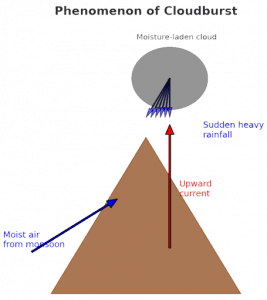
Here’s a schematic diagram of the cloudburst phenomenon:
- Moist monsoon winds rise along the mountain slope (orographic lifting).
- Upward hot air currents hold raindrops from falling, making them grow larger.
- Once currents weaken, the cloud suddenly releases water as a violent downpour (cloudburst).
Flow Chart: Cloudburst Phenomenon
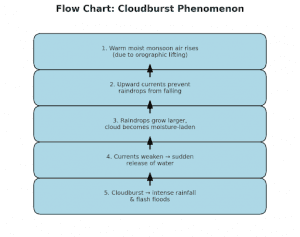
Flow chart on the phenomenon of cloudburst:
- Warm moist monsoon air rises (orographic lifting).
- Upward currents prevent raindrops from falling.
- Raindrops grow larger, clouds become moisture-laden.
- Currents weaken → sudden release of water.
- Cloudburst occurs → intense rainfall and flash floods.

About Cloudbursts
- IMD Definition: According to the India Meteorological Department (IMD), cloudbursts are sudden, heavy rainstorms where more than 10 cm of rain falls in less than an hour over a small area, of about 10 to 30 square km. They often happen in mountainous areas, especially in the Himalayas.
- Subcontinent: occurs when monsoon clouds drift northwards from Bay of Bengal/Arabian Sea to Himalayas → sometimes 75 mm/hr rainfall.
Causes
- Upward currents of hot air hold raindrops → drops grow larger; abrupt release when currents weaken.
- Frequent in hilly/mountainous areas due to:
- Orographic lifting: moist air rises up mountain slopes, cools, condenses → heavy rain.
- Localised weather patterns + monsoon dynamics intensify rainfall.
Difference from Normal Rainfall
- Rain = water condensed falling from clouds.
- Cloudburst = localised, intense rainfall (>10 cm/hr).
- Natural, unexpected, abrupt, and drenching.
Prediction
- Difficult to predict via satellites/ground stations due to small area + short duration.
- Requires dense radar network (costly).
- Only areas likely to face heavy rainfall can be identified short-term.
- Focus on mapping vulnerable zones + favourable conditions.
Examples of Cloudbursts
- Uttarakhand (July 2021): Chamoli, Uttarkashi, Pithoragarh → flash floods, landslides, massive damage.
- Himachal Pradesh (Aug 2020): Kullu, Lahaul-Spiti, Kinnaur → landslides, flash floods, road/bridge destruction.
Consequences
- Flash Floods
- Definition (WMO): Flash floods are sudden, localised surges in water levels during or after intense rainfall. Flash flooding starts within 6 or 3 hours of heavy rainfall.
- Causes: intense thunderstorms, dam/levee breaks, mudslides.
- Factors: rainfall intensity, soil condition, vegetation, land use, topography.
- In India, ~25% flash floods directly due to extreme rainfall, rest due to rainfall + soil/geological conditions.
- Landslides
- A landslide is a mass movement of material, such as rock, earth or debris, down a slope. It can happen suddenly or more slowly over long periods of time. Triggered by rainfall, erosion, weathering.
- India:
- ~8% global fatalities (2001–21: 847 deaths, thousands displaced, IIT-Madras study).
- 13.17% area landslide-prone, 4.75% very high susceptibility.
- Sikkim most prone, Kerala: 14% very high susceptibility.
- Often accompany flash floods in Himalayan regions.
- Mudflows
- High-density, viscous water flow with silt/particles.
- Transports coarse material → irreversible sediment entrainment.
- Shorter flow distances than water streams.
Climate Change and Cloudbursts
- Increased Moisture: Warm air holds more water → intense cloud formation.
- Changed Rainfall Patterns: Some regions face prolonged dry periods, others extreme rainfall.
- Atmospheric Instability: Higher temperatures → stronger convection + thunderstorms.
- Glacier Retreat & Snowmelt: Rapid meltwater adds to precipitation events.
- Land Use Change: Deforestation, urbanisation alter microclimates, aggravating cloudburst risks.
Frequency of Cloudbursts
- Cloudbursts = extreme weather event.
- Global warming → more extreme precipitation events.
- Experts: paucity of past data, undercounting (only major/destructive ones noted).
- But trend shows increase in extreme precipitation → likely increase in cloudbursts.
Forecasting Cloudbursts
- IMD forecasts rainfall intensity (light, heavy, very heavy), not exact quantum.
- Forecasts reliable at regional/district level, not very localised.
- Theoretical prediction possible with dense weather instruments + advanced computing (currently unfeasible).
- Present: General heavy rainfall alerts 4–5 days ahead. Extreme rainfall (cloudburst-type) alerts 6–12 hrs in advance.
- No specific “cloudburst” forecast issued.
Why Common in Hilly Areas?
- Orographic Lift: Warm moist air forced up slopes → expands, cools, condenses.
- Mountain Height: Low-pressure zones attract clouds, intensifying build-up.
- Moisture & Wind Patterns: Converging winds block air, increasing rainfall.
- Upward Currents: Prevent raindrops from falling → sudden release.
Link with Flash Floods
- Sudden downpour overwhelms drainage systems.
- Leads to flash floods, landslides, debris flows.
- In Himalayas: glacial lake overflows + snowmelt add risk.
Reducing Risk of Catastrophe (Way Forward)
- Early Warning Systems
- Expand & modernise weather monitoring, esp. in Himalayas.
- Install Automatic Weather Stations (AWS), use satellite-based data.
- Ecological Infrastructure
- Move beyond “grey infra” (dams, embankments).
- Restore wetlands, mangroves, natural sponge zones → absorb excess water.
- Land Use Planning
- Preserve forests, natural buffers → stabilise slopes.
- Expand afforestation/reforestation in erosion-prone areas.
- Climate Adaptation in Policy
- Mainstream climate resilience in planning.
- Allocate funds for risk assessments, build resilient infrastructure.
- Empower local communities with training/resources.
- Community-Based Disaster Management
- Use traditional knowledge of locals for early warning.
- Local disaster groups for evacuation & response.
- Collaboration & Innovation
- Invest in research, climate-resilient technologies.
- Regional cooperation with neighbours in Himalayas.
Mitigation Measures
- Early Warning Systems: Alerts, evacuation drills.
- Resilient Urban Planning: Storm drains, retention ponds, green belts.
- Watershed Management: Reduce erosion, improve infiltration.
- Reforestation/Green Infra: Stabilise slopes, absorb rainfall.
- Awareness/Education: Training communities.
- Sustainable Land Use: Avoid construction in flood-prone zones.
- International Cooperation: Technology sharing, joint disaster management.
UPSC Prelims Multiple Choice Questions

Ques 1. Consider the following statements with reference to Cloudbursts:
- A cloudburst is defined as precipitation exceeding 100 mm per hour over an area of about 20–30 sq. km.
- All instances of heavy rainfall qualify as cloudbursts.
- Cloudbursts are more frequent in the Himalayan region due to orographic lifting.
Which of the statements given above is/are correct?
(a) 1 and 3 only
(b) 2 and 3 only
(c) 1 only
(d) 1, 2 and 3
Ans. 1 (a) 1 and 3 only
- IMD defines cloudburst as unexpected precipitation exceeding 100 mm (10 cm) per hour over ~20–30 sq. km → Statement 1 correct.
- Not all heavy rainfall is a cloudburst; it must meet the criterion → Statement 2 incorrect.
- Cloudbursts are frequent in Himalayas due to orographic lift (moist air rising, cooling, and condensing over mountains) → Statement 3 correct.
Ques 2. Which of the following correctly differentiates normal rainfall from a cloudburst?
(a) Normal rainfall lasts longer, while a cloudburst is caused by snowmelt and glacial retreat.
(b) Rainfall is condensed water falling from a cloud, while a cloudburst is an abrupt heavy downpour exceeding 10 cm per hour.
(c) Rainfall occurs only in plains, whereas cloudbursts occur only in mountainous regions.
(d) Rainfall requires convection currents, while cloudbursts occur due to volcanic activity.
Ans. 2. (b) Rainfall is condensed water falling from a cloud, while a cloudburst is an abrupt heavy downpour exceeding 10 cm per hour.
- Rainfall = general condensation and falling of water from clouds.
- Cloudburst = sudden, intense rainfall >10 cm/hr.
- Not linked exclusively to snowmelt, volcanic activity, or plains/mountains distinction.
Ques 3. With reference to the consequences of cloudbursts in India, consider the following pairs:
Event Associated Consequence
- Flash Floods Sudden surges in water levels within 3–6 hours
- Landslides Downslope movement of rock, earth, or debris
- Mudflows High-density viscous flow with silt and particles
Which of the pairs given above is/are correctly matched?
(a) 1 and 2 only
(b) 2 and 3 only
(c) 1, 2 and 3
(d) 1 only
Ans. 3 (c) 1, 2 and 3
- Flash floods: occur within 3–6 hours of intense rainfall.
- Landslides: downslope mass movement triggered by heavy rainfall and erosion.
- Mudflows: dense, viscous water flow carrying silt/particles, shorter in distance.
- → All correctly matched.
Ques 4. Which of the following factors explain why cloudbursts are more frequent in hilly and mountainous areas?
- Orographic lifting of moist air.
- Formation of low-pressure zones at high altitudes.
- Collision of air currents with mountain barriers.
Select the correct answer using the code given below:
(a) 1 only
(b) 1 and 2 only
(c) 1 and 3 only
(d) 1, 2 and 3
Ans. 4 (d) 1, 2 and 3
- Orographic lifting forces air to rise and cool → condensation.
- Low-pressure at mountain tops attracts clouds.
- Colliding air currents with mountains intensify rainfall.
- All three factors explain cloudburst frequency in mountains.
Ques. 5 Which of the following statements with regard to cloudburst is/are correct? [UPSC CDS 2017]
- It is defined as sudden localized very heavy downpour with cloud thunder and lightning.
- It mostly occurs in the hilly areas.
- It results into very high intensity of rainfall, i.e., 250 mm-300 mm in a couple of hours.
- It occurs only during the daytime.
Select the correct answer using the code given below.
(a) 1, 2, and 3
(b) 1, 3, and 4
(c) 2 and 3
(d) 2 only
Ans. 5 (a) 1, 2 and 3
Statement 1: It is defined as sudden localized very heavy downpour with cloud thunder and lightning.
- Correct. A cloudburst is indeed a sudden, localized, and extremely heavy downpour of rain occurring over a small area, often accompanied by thunder and lightning, and can trigger flash floods and landslides.
Statement 2: It mostly occurs in the hilly areas.
- Correct. Due to orographic lifting and moisture-laden monsoon winds, Himalayas and hilly terrains are more prone to cloudbursts.
Statement 3: It results into very high intensity of rainfall, i.e., 250 mm–300 mm in a couple of hours.
- Correct. Cloudbursts are defined as extreme rainfall events. IMD generally uses the criterion of >100 mm per hour, but field records show 250–300 mm in 2 hours is typical in actual cases.
Statement 4: It occurs only during the daytime.
Incorrect. Cloudbursts are not restricted to daytime. They depend on weather conditions (moisture, uplift, orographic lift) and can occur both day and night.
UPSC Mains Basic Questions

Ques 1. What are cloudbursts? Discuss their causes and consequences in the Himalayan region.
✔ Explanation:
Introduction: According to the India Meteorological Department (IMD), cloudbursts are sudden, heavy rainstorms where more than 10 cm of rain falls in less than an hour over a small area, of about 10 to 30 square km. In India, they are frequently reported from the Himalayan region, causing large-scale disasters.
Causes
- Orographic lifting: Moist monsoon winds rising over steep mountains condense into heavy rainfall.
- Atmospheric instability: Upward currents of hot air prevent raindrops from falling, which later descend suddenly.
- Localised weather patterns: Interaction of monsoon dynamics with complex Himalayan topography.
- Climate change: Rising temperatures increase atmospheric moisture and convective activity.
Consequences
- Flash floods: Sudden surge of water, overwhelming rivers and drainage systems.
- Landslides: Slope instability triggered by intense rainfall.
- Mudflows and debris flows: Causing destruction of agricultural land and infrastructure.
- Human loss: In Himachal Pradesh (2025), five killed and fifty missing due to multiple cloudbursts.
Examples
- Uttarakhand (2021): Chamoli disaster with flash floods and infrastructure damage.
- Himachal Pradesh (2020 & 2025): Cloudbursts in Kullu, Lahaul-Spiti leading to bridge collapse and house destruction.
Conclusion: Cloudbursts, though natural, are exacerbated by climate change and unplanned development in fragile Himalayan ecosystems. A multi-pronged approach—better forecasting, eco-sensitive land use, and community preparedness—is vital to reduce their devastating impacts.
Ques 2. Cloudbursts are increasing in frequency due to climate change. Suggest measures to mitigate their impact in India.
✔ Explanation:
Introduction: Recent years have witnessed an alarming rise in extreme weather events, including cloudbursts. Their destructive potential is amplified in the Himalayas, where fragile ecosystems, deforestation, and climate change converge.
Body
Link with Climate Change
- Warmer atmosphere retains more moisture, intensifying cloud formation.
- Glacier retreat and snowmelt release additional water.
- Erratic monsoon patterns contribute to localised downpours.
Mitigation Measures
- Early Warning Systems: Expanding Automatic Weather Stations (AWS), using satellites and Doppler radars.
- Urban & Infrastructure Planning: Flood-resilient stormwater drains, retention ponds, zoning laws against construction in flood-prone zones.
- Ecological Solutions: Restoring wetlands, afforestation, and slope stabilisation.
- Community-Based Disaster Management: Training local populations and integrating traditional knowledge.
- Policy Integration: Embedding climate resilience in developmental planning, allocating funds for risk assessments.
Examples
- Kerala’s watershed management post-2018 floods improved resilience.
- Himalayan states implementing reforestation drives for slope stabilisation.
Conclusion: Cloudbursts are no longer rare anomalies but indicators of a changing climate. India must combine technology with ecological wisdom and community participation to mitigate risks. Building climate-resilient infrastructure and policies is critical to safeguard lives and livelihoods in vulnerable regions.
Advanced UPSC Mains Questions
Ques 1. Examine the role of climate change in altering the frequency and intensity of cloudburst events in India. Suggest adaptive strategies for disaster risk reduction.
✔ Explanation:
Introduction: Cloudbursts, defined as intense precipitation exceeding 100 mm per hour over ~20–30 sq. km, have become increasingly frequent in India’s Himalayan states. Climate change has amplified these extreme precipitation events, making them more destructive.
Body
Role of Climate Change
- Increased moisture retention: Warmer air holds ~7% more water vapour per degree rise, intensifying downpours.
- Erratic monsoons: Altered precipitation patterns lead to sudden high-intensity rainfall.
- Atmospheric instability: Higher land surface heating increases convective activity, conducive to cloudbursts.
- Glacier retreat: Himalayan glaciers melting faster → enhanced water availability in clouds.
- Land-use changes: Urbanisation and deforestation reduce natural drainage and exacerbate impacts.
Adaptive Strategies
- Forecasting: Expand AWS, Doppler radars, AI-based rainfall prediction.
- Infrastructure resilience: Stormwater drainage, permeable pavements, slope stabilisation.
- Ecological restoration: Wetlands, mangroves, and afforestation as natural buffers.
- Policy integration: Climate risk assessment embedded in planning; NDMA guidelines for Himalayan zones.
- Community engagement: Awareness, evacuation drills, and local disaster task forces.
Examples
- Kedarnath floods (2013), Chamoli (2021), and Himachal Pradesh (2025) illustrate rising frequency linked to climate variability.
Conclusion: Climate change has transformed cloudbursts from rare anomalies into recurrent threats. A blend of technological innovation, ecological planning, and local participation is vital for climate-resilient disaster management in India.
Ques 2. Cloudbursts exemplify the vulnerability of Himalayan ecosystems. Critically analyse how unplanned development and land-use practices aggravate their impact.
✔ Explanation:
Introduction: The Himalayas, a fragile young fold mountain system, are prone to extreme precipitation events such as cloudbursts. While natural causes play a role, human-induced stress worsens their consequences.
Body
Unplanned Development Impacts
- Deforestation & slope destabilisation: Reduces root binding, increases landslide risks.
- Road widening & tunneling projects: Disturbs natural drainage and geological stability.
- Urbanisation in floodplains: Encroachment narrows river channels, raising flood intensity.
- Tourism-driven construction: Hotels and resorts in eco-sensitive zones without carrying capacity studies.
- Hydropower projects: Reservoir-induced instability; debris disposal into rivers worsens flash flood damage.
Why Himalayas are Vulnerable
- Geological youth: Weak, unstable terrain.
- High seismicity: Adds compounding risks.
- Climate change: Intensifies precipitation and glacier retreat.
Way Forward
- Enforce eco-sensitive zone regulations under Environment Protection Act.
- Promote sustainable tourism with carrying capacity limits.
- Adopt watershed management, afforestation, and natural buffers.
- Strengthen local governance & NDMA/SDMA guidelines for land use in Himalayan states.
Examples
- Kedarnath (2013) devastation worsened by illegal construction.
- Himachal Pradesh cloudbursts (2020 & 2025) show how roads and urbanisation magnified destruction.
Conclusion: Cloudbursts cannot be prevented, but their impacts are aggravated by reckless human intervention. Sustainable development, ecological safeguards, and adherence to carrying capacity norms are critical to protecting the fragile Himalayas.
UPSC Interview-Based Questions

Ques 1. What is a cloudburst and why is it significant in the Indian context?
✔ Explanation:
According to the India Meteorological Department (IMD), cloudbursts are sudden, heavy rainstorms where more than 10 cm of rain falls in less than an hour over a small area, of about 10 to 30 square km. It is significant for India because the Himalayan region’s fragile terrain and dense population make these events highly destructive, often leading to flash floods and landslides.
Ques 2. Why are cloudbursts more frequent in the Himalayan states compared to the plains?
✔ Explanation:
They are more frequent due to orographic lifting, low-pressure zones, and colliding wind patterns in the mountains. The complex topography and high moisture content of monsoon winds make the Himalayas particularly vulnerable.
Ques 3. How does climate change influence the frequency of cloudbursts?
✔ Explanation:
Global warming increases the moisture-holding capacity of air and atmospheric instability, leading to more intense rainfall events. Studies show that extreme precipitation events have increased in the past few decades, suggesting cloudbursts may also be on the rise.
Ques 4. Can cloudbursts be predicted accurately with current technology?
✔ Explanation:
No, because cloudbursts are localized and short-duration events. While IMD can issue forecasts for heavy rainfall over a region, predicting the exact location, intensity, and timing of a cloudburst remains beyond current capabilities.
Ques 5. In your view, what steps should India take to mitigate the impact of cloudbursts?
✔ Explanation:
India must strengthen early warning systems, watershed management, afforestation, and eco-sensitive land use planning. At the same time, community-based disaster preparedness and nature-based solutions like wetlands restoration are crucial to reduce risks.
Also read:
India’s UPI Revolution Crimes Against Women in India The Chola Empire