
Table of Contents
Definition of the Constitution (130th Amendment) Bill, 2025
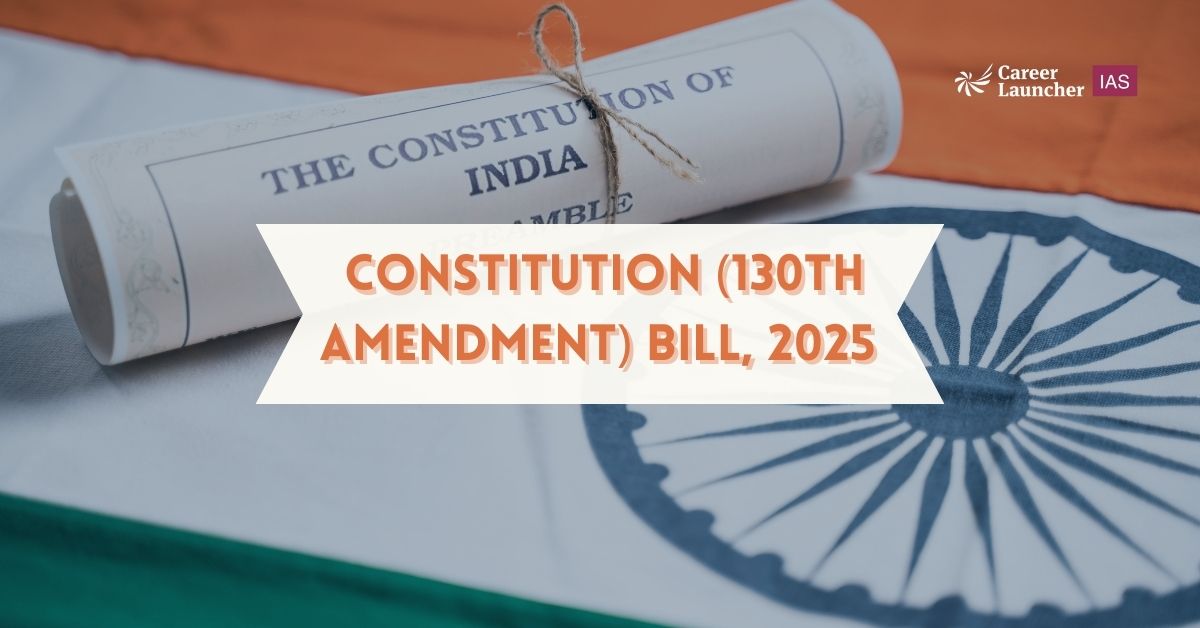
- The Constitution (130th Amendment) Bill, 2025 is a legislative proposal introduced in the Lok Sabha under Article 368 of the Indian Constitution to amend Articles 75, 164, and 239AA. It specifically focuses on removal of ministers (Prime Minister and Council of Ministers, Chief Ministers and Council of Ministers) who are under detention for serious criminal offences.
Key Features of the Constitution (130th Amendment) Bill, 2025
- A minister arrested and detained for 30 consecutive days for an offence punishable with 5 years or more imprisonment will lose office.
- The President, acting on the advice of the Chief Minister, must remove the minister by the 31st day of detention.
- If the Chief Minister does not give advice, the minister automatically ceases to hold office.
After release, the minister can be reappointed, allowing flexibility in governance.

Why is the Bill required?
The Bill seeks to address gaps in accountability and governance related to ministers accused of serious criminal offences. Key reasons include:
- Ensuring Good Governance and Constitutional Morality
Ministers facing serious allegations may compromise decision-making, constitutional trust, and ethical governance. The Bill intends to prevent them from wielding executive power while in custody.
- Addressing Pre-Conviction Custody Loopholes
- Currently, ministers may remain in office while incarcerated, potentially undermining governance.
- By introducing a 30-day threshold, the Bill ensures ministers in detention cannot exercise ministerial powers, even before conviction.
- Reinforcing Public Trust
Public perception of political integrity is critical. Preventing detained ministers from holding office helps preserve faith in democratic institutions.
Existing Legal Framework
Before this Bill, two major provisions governed the disqualification of legislators and ministers:
- Section 8 of the Representation of People Act (RPA), 1951
- Legislators are disqualified only upon conviction and a sentence of at least 2 years.
- Limitation: Ministers could remain in office during pre-conviction detention.
- Law Commission’s 170th Report
- Recommended disqualification from the stage of framing charges for offences punishable by 5 years or more.
- Limitation: The report was not enacted, and pre-conviction detention was not addressed, leaving a loophole.
Why Existing Laws Were Inadequate
- Ministers could continue to exercise power while in jail.
- There was no mechanism to temporarily remove them without waiting for conviction.
- The principle of constitutional morality and ethical governance was at risk.
Challenges and Concerns
The Bill has faced strong opposition on several fronts:
- Presumption of Innocence Undermined
- Removal is based on detention, not conviction, contradicting the legal principle: “innocent until proven guilty.”
- May violate Article 14 (Right to Equality) and Article 21 (Right to Life and Liberty).
- Scope for Political Misuse
Critics argue that investigative agencies like CBI and ED could be used to target political opponents, destabilizing state governments.
- Threat to Federalism
Centralizing power in the Union government may weaken the autonomy of state governments.
- Judicial Challenges
The Bill could face scrutiny under the Basic Structure Doctrine, especially concerning separation of powers and independence of the executive.
- Ethical Governance vs Democratic Safeguards
While promoting integrity, removal without judicial verdict may erode democratic norms and allow executive overreach.
- Public Perception
Opposition leaders, including Mamata Banerjee, have criticized the Bill as a “draconian measure”, potentially moving towards authoritarianism.
Proposed Solutions and Safeguards
To balance ethical governance with democratic principles, several solutions can be considered:
- Judicial Oversight
- Introduce a mechanism for judicial review to ensure the removal is not arbitrary or politically motivated.
- A special court or tribunal could verify detention related to serious offences before removal.
- Threshold Refinement
Maintain the 30-day detention period, but include seriousness of offence review to prevent misuse for minor charges.
- Transparency in Reappointment
Establish a mandatory cooling-off period after release to avoid immediate reappointment, mitigating public perception of favoritism.
- Strengthening Anti-Misuse Provisions
- Introduce checks against the selective targeting of ministers using investigative agencies.
- Mandate periodic reporting to Parliament on enforcement of the Bill.
- State-Centre Consultation
Require consultation with state governments for the removal of ministers to safeguard federalism.
Role of the Joint Parliamentary Committee (JPC)
The Bill has been referred to a Joint Parliamentary Committee (JPC) for detailed scrutiny:
- Composition: Members from both Lok Sabha and Rajya Sabha (typically 31 members).
- Mandate: Examine the Bill clause-by-clause, seek expert opinions, and submit a report to Parliament.
- Nature of Recommendations: Persuasive but not binding on the government.
- Purpose: Ensure careful deliberation, considering legal, political, and ethical implications.
Conclusion
- The Constitution (130th Amendment) Bill, 2025 represents a significant attempt to improve ministerial accountability and constitutional morality. However, it raises constitutional, political, and ethical challenges, especially regarding presumption of innocence, federalism, and potential misuse.
- Referral to a Joint Parliamentary Committee ensures detailed scrutiny and allows Parliament to consider safeguards before final approval. The Bill illustrates the ongoing tension in Indian democracy between enhancing ethical governance and protecting democratic rights.

UPSC Prelims Multiple Choice Questions
Ques 1. With reference to the Constitution (130th Amendment) Bill, 2025, consider the following statements:
- A minister who is arrested and detained for thirty consecutive days for a serious offence punishable with imprisonment of five years or more shall automatically lose their ministerial post.
- The Bill allows for the reappointment of a minister once they are released from custody.
- The Bill directly amends Articles 19 and 21 of the Constitution.
Which of the statements given above is/are correct?
(a) 1 and 2 only
(b) 1 and 3 only
(c) 2 and 3 only
(d) 1, 2, and 3
Ans. 1 (a) 1 and 2 only
- Statement 1 is correct: The Bill introduces a 30-day detention threshold for removal.
- Statement 2 is correct: The Bill allows reappointment post-release.
- Statement 3 is incorrect: The Bill amends Articles 75, 164, and 239AA, not Articles 19 or 21.
Ques 2. Consider the following regarding pre-existing legal provisions on criminal disqualification of ministers:
- Section 8 of the Representation of the People Act, 1951 disqualifies legislators only after conviction and sentence of at least two years.
- Law Commission’s 170th Report recommended disqualification from the stage of framing of charges for offences punishable with five years or more imprisonment.
- Both Section 8 of RPA 1951 and the Law Commission report addressed pre-conviction custody of ministers.
Which of the statements given above is/are correct?
(a) 1 and 2 only
(b) 1 and 3 only
(c) 2 and 3 only
(d) 1, 2, and 3
Ans 2. (a) 1 and 2 only
- Statement 1 is correct: Section 8 disqualification occurs after conviction and sentence ≥2 years.
- Statement 2 is correct: Law Commission recommended disqualification from framing of charges for offences ≥5 years.
- Statement 3 is incorrect: Neither provision addressed pre-conviction custody, which the 130th Amendment now proposes to tackle.
Ques 3. With reference to the Constitution (130th Amendment) Bill, 2025, consider the following statements:
- The Bill has faced opposition for potentially violating the presumption of innocence under Articles 14 and 21.
- The Bill allows central agencies to remove ministers without judicial oversight.
- The Bill requires ratification by half of the state legislatures because it affects federal provisions.
Which of the statements given above is/are correct?
(a) 1 only
(b) 1 and 2 only
(c) 2 and 3 only
(d) 1, 2, and 3
Ans. 3 (b) 1 and 2 only
- Statement 1 is correct: Opposition claims detention-based removal undermines Articles 14 and 21.
- Statement 2 is correct: Critics fear political misuse via central investigative agencies.
- Statement 3 is incorrect: Constitutional amendments affecting federalism require state ratification only if explicitly stated, but this Bill is introduced under Article 368 and state ratification is not mandated yet.
Ques 4. Consider the following statements regarding the Joint Parliamentary Committee (JPC) examining the 130th Amendment Bill:
- It is composed of members from both Lok Sabha and Rajya Sabha.
- Its recommendations are binding on the government.
- The JPC is a permanent body formed for continuous parliamentary oversight.
Which of the statements given above is/are correct?
(a) 1 only
(b) 1 and 2 only
(c) 2 and 3 only
(d) 1, 2, and 3
Ans 4. (a) 1 only
- Statement 1 is correct: JPC consists of members from both Houses.
- Statement 2 is incorrect: JPC recommendations carry persuasive value but are not binding.
- Statement 3 is incorrect: JPC is ad hoc and dissolves after submitting its report.
Ques 5. With reference to the Constitution (130th Amendment) Bill, 2025, consider the following statements:
- The Bill mandates removal of ministers based on arrest, even before conviction.
- It allows ministers to be reappointed after release from jail.
- The Bill completely removes the powers of the President in ministerial appointments.
Which of the statements given above is/are correct?
(a) 1 and 2 only
(b) 1 and 3 only
(c) 2 and 3 only
(d) 1, 2, and 3
Ans 5. (a) 1 and 2 only
- Statement 1 is correct: Detention triggers automatic removal without waiting for conviction.
- Statement 2 is correct: Reappointment is permitted after release from custody.
- Statement 3 is incorrect: The President still acts on advice of the Chief Minister; powers are not removed.

UPSC Mains Basic Questions
Ques 1. The Constitution (130th Amendment) Bill, 2025 proposes removal of ministers detained for serious offences even before conviction. Critically examine the ethical and governance challenges posed by this Bill.
Explanation:
The 130th Amendment Bill aims to strengthen ethical governance by ensuring that ministers facing serious criminal charges do not continue to exercise executive power. The Bill mandates removal if a minister is detained for 30 consecutive days for offences punishable with five years or more imprisonment, thereby addressing concerns about constitutional morality, integrity, and public trust.
From a governance perspective, the amendment seeks to prevent compromised decision-making and uphold good governance norms, reflecting public expectations of probity. It aligns with Supreme Court observations in cases like Lily Thomas (2013) and Manoj Narula (2013), emphasizing the need for accountability among lawmakers holding executive positions.
However, ethical challenges arise due to potential conflict with the principle of presumption of innocence, a cornerstone of justice. Removal based on detention rather than conviction risks undermining fundamental rights under Articles 14 and 21, potentially violating equality and liberty. Political misuse is another concern, as central investigative agencies may selectively target opposition ministers, eroding democratic norms.
The Bill also introduces ambiguity in federal governance, as the executive assumes quasi-judicial powers, challenging the separation of powers. While reappointment after release is permitted, it does not fully address fears of politically motivated harassment or instability in state governments.
In conclusion, the amendment embodies a tension between ethical governance and democratic safeguards. While it reinforces ministerial accountability, careful design, oversight, and judicial review mechanisms are essential to prevent misuse and preserve constitutional morality without compromising fundamental rights.
Ques 2. Discuss the rationale, procedural aspects, and challenges associated with the Constitution (130th Amendment) Bill, 2025, highlighting its impact on the federal structure of India.
Explanation:
The 130th Amendment Bill was introduced to amend Articles 75, 164, and 239AA, providing a mechanism for removal of ministers detained for serious criminal offences. The rationale is to prevent ministers facing allegations of grave crimes from exercising executive authority, thereby safeguarding constitutional morality, public trust, and good governance. The Bill introduces accountability at the pre-conviction stage, addressing limitations in the Representation of the People Act, 1951, which disqualifies only after conviction.
Procedurally, the Bill is a Constitution Amendment Bill under Article 368, requiring a special majority in both Houses. Certain amendments affecting federal provisions require ratification by half of state legislatures, though this particular Bill does not explicitly mandate it. Amid strong opposition protests, the Bill was referred to a Joint Parliamentary Committee (JPC), an ad hoc body tasked with detailed scrutiny. The JPC’s recommendations are persuasive but not binding.
Challenges include potential political misuse and undermining the principle of presumption of innocence. Centralized removal powers may weaken state autonomy, raising concerns about federal imbalance. Judicial scrutiny under the Basic Structure Doctrine is likely, especially regarding separation of powers and the independence of the executive.
Overall, the amendment balances the need for ethical governance against the risk of democratic erosion and federal tension. Its success depends on transparent implementation, judicial oversight, and mechanisms to prevent political exploitation, reflecting the continuing tension in India’s constitutional framework between governance reforms and safeguarding democratic rights.
Advanced UPSC Mains Questions
Ques 1. “The Constitution (130th Amendment) Bill, 2025 reflects a tension between ethical governance and the presumption of innocence. Examine how the Bill addresses ministerial accountability and discuss the ethical dilemmas it raises in the context of democratic norms.”
Explanation:
The 130th Amendment Bill seeks to enhance ministerial accountability by mandating removal of ministers detained for 30 consecutive days for offences punishable with five years or more imprisonment. It targets the pre-conviction phase, addressing concerns about ministers exercising executive power while facing serious criminal allegations. From a governance standpoint, this aligns with constitutional morality, as ministers under detention may compromise public trust, integrity, and decision-making. Supreme Court cases like Lily Thomas (2013) and Manoj Narula (2013) emphasize that legislators with criminal charges should not wield unchecked authority, reinforcing the ethical rationale of the Bill.
However, the Bill raises ethical dilemmas. First, it challenges the principle of presumption of innocence, as ministers are punished for arrest rather than proven guilt, potentially violating Articles 14 and 21. Second, it creates a risk of political misuse, where central investigative agencies could target opposition ministers, raising questions about fairness and impartiality. Third, by granting the executive quasi-judicial powers, it blurs the separation of powers, potentially undermining democratic safeguards.
While the provision for reappointment after release introduces flexibility, it does not fully mitigate concerns regarding political vendetta, federal imbalance, or destabilisation of state governments. Therefore, the Bill embodies a delicate balance between promoting ethical governance and protecting democratic norms. Effective implementation, judicial oversight, and safeguards against misuse are essential to reconcile ministerial accountability with constitutional morality.
Ques 2. Critically analyze the implications of the Constitution (130th Amendment) Bill, 2025 on the federal structure of India and the principle of separation of powers. How does the Bill redefine the relationship between the executive and legislature?
Explanation:
The 130th Amendment Bill amends Articles 75, 164, and 239AA to ensure that ministers detained for serious offences lose office after 30 days in custody, subject to removal by the President on the Chief Minister’s advice. The rationale is to uphold good governance and maintain constitutional morality by preventing detained ministers from influencing policy or administrative decisions.
From a federal perspective, the Bill centralizes significant power in the executive, as the President acts on the advice of the Chief Minister for removal. Critics argue that this may weaken state autonomy, especially if central investigative agencies selectively target ministers in opposition-led states, potentially creating federal friction. The ability of the executive to act before judicial conviction raises concerns regarding judicial oversight and the separation of powers, as ministers are effectively punished by the executive without legislative or judicial validation.
Additionally, the Bill redefines the executive-legislature relationship by imposing pre-conviction accountability, a departure from the conventional model where legislators and ministers hold office unless convicted or disqualified. While this strengthens ethical governance, it risks political misuse, creating instability in the council of ministers and state governments.
In conclusion, the Bill is an intersection of governance reform and federal-constitutional principles, challenging the equilibrium between ethical oversight, democratic legitimacy, and federalism. The success of this amendment will depend on robust checks and balances, including judicial review and procedural safeguards, to prevent misuse while maintaining ministerial accountability.

UPSC Interview-Based Questions
Ques 1. Do you think removing ministers on the basis of arrest violates the principle of presumption of innocence?
Explanation:
Yes, the Bill challenges ‘innocent until proven guilty’ as ministers lose office before conviction, raising legal and ethical concerns under Articles 14 and 21.
Ques 2. How can this Bill be misused politically?
Explanation:
Opposition leaders fear selective targeting using central agencies like CBI or ED, destabilising state governments and threatening democratic fairness.
Ques 3. Does the Bill strengthen governance in India?
Explanation:
It promotes ministerial accountability and constitutional morality, preventing detained ministers from making decisions that may compromise public trust.
Ques 4. What impact does the Bill have on federalism?
Explanation:
By centralising removal power and allowing executive pre-conviction action, the Bill may weaken state autonomy and create tensions between Centre and States.
Ques 5. How does this Bill affect the separation of powers?
Explanation:
It blurs boundaries by giving the executive quasi-judicial authority to remove ministers, potentially undermining judicial oversight and democratic safeguards.