
Table of Contents
Introduction
- India continues to grapple with the pervasive issue of gender-based violence, a concern that significantly impacts the safety and dignity of women. A recent incident involving the gang rape of a 28-year-old Spanish-Brazilian vlogger in Jharkhand led to a debate about India’s safety for women. While the National Commission for Women (NCW) responded with statistics on women tourists’ safety, the reality of crimes against women in India demands a deeper reflection on the root causes, statistics, and systemic solutions.
Rising Crime Rates against Women
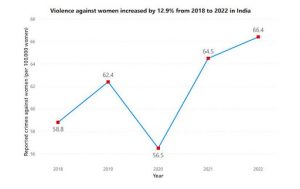
- According to the National Crime Records Bureau (NCRB), crimes against women in India have been increasing steadily. The rate of reported crimes per 100,000 women population grew by 12.9% from 58.8 in 2018 to 66.4 in 2022. Factors contributing to this rise include:
- Increased actual crimes,
- Improved reporting mechanisms, and
- Growing willingness of women to report violence.

Crime Hotspots and State-wise Statistics
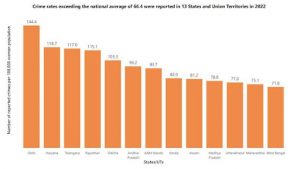
- The NCRB’s Crime in India 2022 report reveals that 13 states and Union Territories recorded crime rates higher than the national average of 66.4 per 100,000 women. Notably, Delhi topped the list with 144.4, followed by Haryana, Telangana, Rajasthan, and Uttar Pradesh. Uttar Pradesh alone contributed nearly 15% of the crimes against women in India.
Categories of Crimes against Women
- Despite the enactment of laws like the Protection of Women from Domestic Violence Act (2005), the majority of crimes under the Indian Penal Code are of:
- Cruelty by the husband or relatives (31.4%),
- Kidnapping and abduction of women (19.2%),
- Assault with intent to outrage modesty (18.7%), and
- Rape (7.1%)
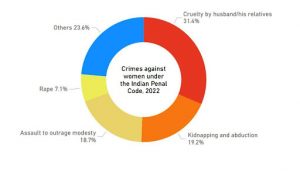
- This highlights the continuing issue of domestic violence, which remains the most prevalent form of gender-based violence.
Impact of the COVID-19 Pandemic
- The pandemic exacerbated the situation. The crime rate per 100,000 women increased from 56.5 in 2020 to 64.5 in 2021, driven by:
- Reverse migration,
- Social isolation, and
- Economic strain on families, all of which contributed to heightened violence in households.
Lack of Economic Independence
- Many women in India face significant challenges due to economic dependency, which limits their ability to protect themselves from harassment and abuse. Social norms often deny women a share in property, and most women work in the informal economy, with limited access to social protection.
Workplace Sexual Harassment
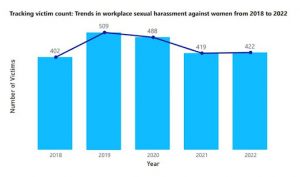
- Women in India also face gender violence in the workplace. Despite the Sexual Harassment of Women at Workplace Act (POSH Act, 2013), reports of workplace harassment have increased, from 402 victims in 2018 to 422 in 2022. The underreporting of such incidents is largely due to:
- Fear of backlash,
- Inadequate awareness, and
- Societal biases that discourage women from speaking up.

Global Context of Violence against Women and Girls (VAWG)
- Globally, one in three women has experienced physical or sexual violence in their lifetime, as per the World Health Organization (WHO). This alarming statistic underscores the global nature of Violence against Women and Girls (VAWG), which is rooted in gender inequality and patriarchal norms.
Challenges in Reporting and Seeking Justice
The prevalence of gender bias and patriarchal values in India prevents many women from reporting crimes, as they fear reprisals or societal backlash. This highlights the need for significant social change and the importance of changing cultural attitudes towards women and violence.
Gender–Transformative Approaches
- To combat gender-based violence, India needs gender-transformative strategies that:
- Promote gender equality through education at an early age,
- Use community interventions to shift attitudes, and
- Implement innovative methods like gameplay to involve both men and women in gender equality efforts.
Government Initiatives
- Several government initiatives aim to support survivors of gender-based violence:
- The One Stop Centre (OSC) scheme provides police facilitation, medical aid, legal assistance, and temporary shelter to women affected by violence. With 752 OSCs operational, over eight lakh women have been assisted.
- Civil society organizations, self-help groups (SHGs), ASHA workers, and faith-based institutions also play an active role in raising awareness and providing social support to victims.
Recommendations for Effective Solutions
- Addressing gender-based violence requires a multi-faceted approach:
- Strengthening legal frameworks and ensuring faster justice.
- Increasing financial and social independence for women through education and workforce integration.
- Awareness campaigns at household and community levels, and policy reforms to ensure gender equality.
- Data-driven interventions based on real-time evidence and continuous research.
Conclusion
- While India has made significant strides in legislating for women’s protection, the persistent issue of gender-based violence requires urgent systemic changes. Addressing entrenched gender biases, improving social infrastructure, and fostering gender equality through education, policy reform, and community involvement are crucial steps in creating a safer and more equitable society for women. VAWG in India has serious social, economic, and cultural implications, and tackling it effectively will require collective action from government, civil society, and individuals alike.To download this article, and the questions for UPSC Prelims, Mains and Interview in PDF format, click the button below.
UPSC Prelims Multiple Choice Questions

Que 1. Consider the following statements regarding crimes against women in India:
- India ranks 128th out of 177 countries in terms of women’s inclusion, justice, and security as per the Women Peace and Security Index 2023.
- The reported crimes against women per 100,000 women population in India increased from 58.8 in 2018 to 66.4 in 2022, showing a growth of 12.9%.
- According to the NCRB, domestic violence is the most common crime committed against women in India, contributing 31.4% of the total crimes.
Which of the above statements are correct?
(a) 1 and 2 only
(b) 1 and 3 only
(c) 2 and 3 only
(d) 1, 2, and 3
Que 2 – Consider the following statements regarding the Protection of Women from Domestic Violence Act, 2005:
- The Act provides provisions for protection orders, residence orders, and monetary relief to women who are victims of domestic violence.
- Despite the enactment of the law, cruelty by husband or his relatives still remains the most common form of violence, as per the NCRB records.
- The Act is effective only in urban areas where women have better access to legal resources and support systems.
Which of the above statements are correct?
(a) 1 and 2 only
(b) 1 and 3 only
(c) 2 and 3 only
(d) 1, 2, and 3
Que 3 – Consider the following statements regarding the increase in gender-based violence during the COVID-19 pandemic:
- The crime rate per 100,000 women increased from 56.5 in 2020 to 64.5 in 2021 due to reverse migration, economic strain, and social isolation.
- The increase in crime is linked to a surge in domestic violence, aggravated by economic stress within households during the pandemic.
- Workplace sexual harassment has decreased significantly since 2020 due to remote working.
Which of the above statements are correct?
(a) 1 and 2 only
(b) 1 and 3 only
(c) 2 and 3 only
(d) 1, 2, and 3
Que 4 – Consider the following statements regarding the role of the One Stop Centre (OSC) scheme in India:
- The OSC scheme, launched in 2015, provides integrated services such as police facilitation, medical aid, legal aid, and temporary shelter for women affected by violence.
- Over 1,000 OSCs are operating across India, helping women with crisis management.
- OSCs help women by offering psycho-social counseling, temporary housing, and legal support under one roof, creating a holistic support system.
Which of the above statements are correct?
(a) 1 and 2 only
(b) 1 and 3 only
(c) 2 and 3 only
(d) 1, 2, and 3
Que 5 – Consider the following statements regarding Violence Against Women and Girls (VAWG) globally:
- According to the World Health Organization (WHO), one in three women worldwide has experienced physical or sexual violence in their lifetime.
- The global statistics on VAWG highlight that one in 10 girls has experienced forced sexual intercourse or other sexual acts.
- Gender-based violence is a regional issue and primarily affects developing countries rather than developed ones.
Which of the above statements are correct?
(a) 1 and 2 only
(b) 1 and 3 only
(c) 2 and 3 only
(d) 1, 2, and 3
Answers
1. (d) 1, 2, and 3
All three statements are accurate:
- Statement 1: India ranks 128th out of 177 countries in terms of women’s inclusion, justice, and security, according to the Women, Peace and Security Index 2023.
- Statement 2: The crime rate against women in India indeed increased by 12.9%, from 58.8 in 2018 to 66.4 in 2022.
- Statement 3: Domestic violence (cruelty by the husband or his relatives) contributes 31.4% of the total crimes against women, as per NCRB data.
2. (a) 1 and 2 only
- Statement 1: The Protection of Women from Domestic Violence Act (2005) provides protection orders, residence orders, and monetary relief, which helps women to escape domestic abuse and access legal assistance.
- Statement 2: Cruelty by husband or his relatives remains the leading form of violence against women, contributing 31.4% of the total crimes as per NCRB.
- Statement 3 is incorrect as the Act is not limited to urban areas. It applies nationwide, although there may be issues of implementation in rural areas due to a lack of awareness and resources.
3. (a) 1 and 2 only
- Statement 1: The crime rate indeed increased from 56.5 in 2020 to 64.5 in 2021, reflecting the heightened stress and violence due to the pandemic.
- Statement 2: Economic strain, social isolation, and reverse migration contributed to an increase in domestic violence, which is a known consequence of pandemic-induced stress.
- Statement 3 is incorrect as workplace sexual harassment has not decreased; it actually increased slightly from 402 cases in 2018 to 422 in 2022, as per NCRB data.
4. (b) 1 and 3 only
- Statement 1: The One Stop Centre (OSC) scheme provides a range of integrated services such as police facilitation, medical aid, and legal support.
- Statement 2 is incorrect, as 752 OSCs are operational, not over 1,000.
- Statement 3: OSCs are designed to offer psycho-social counseling, temporary housing, and legal support to women, making them an effective support system for survivors of gender-based violence.
5. (a) 1 and 2 only
- Statement 1: The WHO indeed reports that one in three women globally has experienced physical or sexual violence.
- Statement 2: One in 10 girls globally has experienced forced sexual acts as per WHO data.
- Statement 3 is incorrect, as gender-based violence is a global issue affecting both developing and developed countries. It is not confined to one region.
UPSC Mains Basic Questions

Que 1- Discuss the key factors contributing to the rising rates of violence against women in India and the challenges in addressing this issue.
Explanation:
This question requires an analysis of the root causes of increasing violence against women in India, based on social, cultural, economic, and legal factors. The candidate should examine:
- Patriarchal structures: The persistence of gender bias and traditional roles that hinder women’s autonomy.
- Economic dependency: Women’s economic insecurity and the lack of financial independence make them vulnerable to abuse.
- Legal gaps and enforcement: The lack of effective law enforcement, fear of reporting crimes, and inadequacy of support systems despite the presence of laws like the Protection of Women from Domestic Violence Act (2005) and the POSH Act (2013).
- Societal norms and under-reporting: Cultural attitudes that discourage women from reporting crimes due to fear of societal stigma, as well as lack of awareness regarding their rights.
The candidate should also highlight the COVID-19 pandemic and its role in aggravating violence against women due to economic strain, social isolation, and reverse migration.
Que 2- Analyze the role of government schemes such as the One Stop Centre (OSC) in addressing violence against women in India.
Explanation:
This question demands an evaluation of the Government of India’s initiatives designed to address gender-based violence, with a focus on the One Stop Centre (OSC) scheme, which was launched in 2015. The response should address:
-
- Purpose and services: OSC provides integrated services, including police facilitation, medical aid, legal support, psycho-social counseling, and temporary shelter under one roof.
- Impact: With 752 OSCs operational, the scheme has assisted over eight lakh women across India, offering crucial support during times of distress.
- Effectiveness and challenges: While the OSC provides a comprehensive, victim-centered approach, challenges such as lack of awareness, limited access in remote areas, and insufficient resources can limit its impact.
- Other governmental and non-governmental efforts: The role of SHGs, ASHA workers, civil society organizations, and media outreach in complementing government efforts to raise awareness and educate communities about gender-based violence.
Evaluate the significance of gender-transformative approaches in reducing violence against women in India.
Explanation:
This question requires a holistic understanding of gender-transformative approaches to tackle violence against women (VAW) in India. Key points for discussion include:
- Gender-transformative approaches: These focus on changing power dynamics, transforming gender norms, and addressing inequality at both individual and societal levels. The response should highlight educational initiatives aimed at challenging patriarchal attitudes and promoting gender equality.
- Community-level interventions: Initiatives that involve both men and women in gender equality campaigns, leveraging innovative methods such as gameplay, workshops, and media outreach. These are key to raising awareness about gender-based violence and creating safe spaces for victims.
- Policy and law reforms: The need for a multi-faceted policy that includes economic support, women’s empowerment, and supportive infrastructure like helplines, legal aid, and safe spaces.
- Holistic interventions: A collaborative approach involving governments, NGOs, civil societies, and religious groups to foster a culture of respect, equality, and safety for women.
The candidate should conclude by emphasizing that gender-transformative policies are essential for the long-term elimination of violence against women, and these must be supported by socioeconomic reforms to truly empower women.
Advanced UPSC Mains Questions
Que 1- Despite several legislative and policy measures, violence against women (VAW) remains a persistent issue in India. Discuss the causes, consequences, and the role of government schemes in addressing gender-based violence in India.”
Explanation:
This question assesses the candidate’s understanding of the root causes of violence against women (VAW) in India, its impact, and the existing measures taken by the government. The answer should focus on:
- Causes: Patriarchal social norms, gender bias, economic dependency, lack of social protection, and underreporting of crimes.
- Consequences: Impact on women’s mental and physical health, social and economic implications like increased poverty and poor health outcomes, as well as weakened social fabric.
- Government Schemes: Initiatives like the One Stop Centre (OSC) scheme, which provides integrated services to survivors, and POSH Act (2013) for workplace harassment.
- The economic dependence and lack of access to resources continue to undermine women’s ability to escape violent situations, making policy frameworks essential but insufficient without societal change.
The candidate can explore how laws, schemes, and social programs are integral to protecting women, but they must also address enforcement issues and the societal mindset shift needed to reduce gender violence.
“Discuss the impact of socio-economic factors such as poverty, unemployment, and economic dependency on women’s vulnerability to gender-based violence in India.”
Explanation:
This question tests the candidate’s ability to link economic conditions with gender violence. It requires a nuanced discussion of how poverty, unemployment, and economic dependence exacerbate women’s vulnerability to violence.
Key points for the answer:
- Economic Dependency: Lack of financial independence and job security make women more dependent on their abusers, limiting their ability to leave abusive situations.
- Unemployment: Women in informal sectors are more vulnerable as they lack job security, social benefits, and legal protections.
- Poverty: High economic strain within households can lead to increased tensions, and women are often the first to suffer in stressful economic conditions.
- Cycle of Poverty and Abuse: Women in abusive relationships or unsafe working conditions may experience mental health issues, which hinder their ability to seek help or break the cycle of poverty.
The candidate should highlight how economic empowerment through education, job opportunities, and financial independence can be effective in addressing the root causes of gender-based violence. The role of women’s participation in the workforce and access to social safety nets should also be discussed.
Que 2 – Evaluate the effectiveness of the Protection of Women from Domestic Violence Act (2005) in addressing domestic violence in India. What are the challenges in its implementation, and how can it be improved?
Explanation:
This question invites the candidate to critically examine the Protection of Women from Domestic Violence Act (2005), its effectiveness, and the challenges faced in its implementation.
Key aspects to address in the answer:
- Effectiveness: The Act was a significant legal step in protecting women from domestic violence. It provides various reliefs like shelter, legal aid, medical assistance, and temporary injunctions against abusers. However, there is a gap between the law and implementation.
- Challenges: Despite the law, the implementation has been inadequate due to factors like lack of awareness, slow judicial processes, cultural reluctance to report violence, and societal stigma.
- Improvement Suggestions: The answer should propose greater awareness campaigns, training for law enforcement, faster judicial redressal, strengthened support systems, and resource allocation for Women’s Domestic Violence Helplines. Improved gender sensitization for police officers and legal professionals would ensure more effective enforcement of the law.
The response should conclude with the recognition that while legal reforms like this Act are vital, the change in societal attitudes and structural reforms are key to long-term success in combating domestic violence.
UPSC Interview-Based Questions

Que 1- How do you think societal attitudes towards women and gender equality can be changed in India?
Explanation:
Societal attitudes can be transformed by gender-sensitive education that challenges traditional stereotypes. Media campaigns and community involvement are essential for spreading awareness and shifting norms. Strengthening laws and workplace reforms will provide a supportive legal and social framework for women’s rights.
Que 2 – In your opinion, what is the biggest challenge in implementing laws related to gender-based violence in India?
Explanation:
The biggest challenge is underreporting due to societal stigma and fear of backlash. Weak enforcement of laws and slow judicial processes further exacerbate the issue. Additionally, patriarchal norms prevent women from seeking legal recourse or reporting abuse.
Que 3 – What steps can be taken to improve women’s participation in India’s workforce?
Explanation:
Improving women’s workforce participation requires flexible work arrangements and equal pay for equal work. Creating a safe work environment and providing child care support will enable women to join and stay in the workforce. Economic empowerment through education and skill development is also crucial.
Que 4 – What role do you think education can play in addressing the issue of gender-based violence?
Explanation:
Education can help challenge gender stereotypes and promote understanding of women’s rights. Incorporating gender equality into school curricula and sensitizing young minds can significantly reduce future violence. Awareness programs can also equip women with knowledge to report and prevent violence.
Que 5 – What role do you think the government and civil society organizations can play together in reducing gender-based violence in India?
Explanation:
The government and civil society organizations can collaborate on awareness campaigns, improve law enforcement, and establish support services for survivors. CSOs can assist with monitoring and advocating for stronger policies. Together, they can address social norms, enforce legal protections, and empower victims.