
The Government has consolidated 29 labour laws into four comprehensive Labour Codes. The four Labour Codes include the Code on Wages, 2019, the Industrial Relations Code, 2020, the Code on Social Security, 2020 and the Occupational Safety, Health and Working Conditions Code, 2020. The historic reform streamlines compliance, modernizes outdated provisions, and creates a simplified, efficient framework that promotes ease of doing business while safeguarding workers’ rights and welfare.
Table of Contents
1. Constitutional Position of Labour
- Labour is placed in the Concurrent List of the Seventh Schedule, allowing both Centre and States to legislate, subject to Union supremacy.
Relevant Entries
Union List
- Entry 55: Regulation of labour and safety in mines and oilfields
- Entry 61: Industrial disputes concerning Union employees
- Entry 65: Union agencies and institutions for vocational training
Concurrent List
- Entry 22: Trade unions; industrial and labour disputes
- Entry 23: Social security and insurance; employment and unemployment
- Entry 24: Welfare of labour including working conditions, provident fund, pensions, maternity benefits
2. Consolidation of Labour Laws
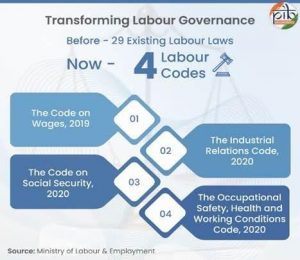
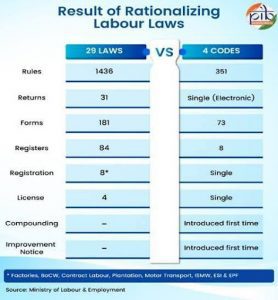
- 29 Central labour laws consolidated into 4 Labour Codes
- Objective: Simplification, harmonisation, ease of compliance, worker protection
- Based on recommendations of Second National Commission on Labour
Four Labour Codes
- Code on Wages, 2019
- Industrial Relations Code, 2020
- Code on Social Security, 2020
- Occupational Safety, Health and Working Conditions Code, 2020

3. Rationale behind Codification
- Multiplicity of laws → compliance burden
- Overlapping authorities → weak enforcement
- Colonial-era laws → outdated provisions
- Need to balance ease of doing business with worker welfare
Key reform principles:
- Single registration, license, and return
- Digitisation and transparency
- Decriminalisation of minor offences
- Facilitator-based inspection system
4. Labour at the Core of India’s Growth
- Employment rose from 47.5 crore (2017-18) to 64.33 crore (2023-24)
- Net addition: 16.83 crore jobs
- Unemployment rate declined from 6.0% to 3.2%
- 1.56 crore women entered formal workforce
- Expansion of social protection → reduction in poverty
5. Code-wise Key Highlights
A. Code on Wages, 2019
- Universal minimum wages (organised + unorganised sectors)
- Introduction of floor wage (States cannot go below it)
- Uniform definition of wages
- Gender equality including transgender workers
- Overtime at twice the normal rate
- Timely wage payment for all employees
- Inspector-cum-Facilitator system
- Decriminalisation and compounding of offences
B. Industrial Relations Code, 2020
- Fixed Term Employment with full benefits
- Recognition of negotiating trade union (51% rule)
- Threshold for layoff/closure approval raised from 100 to 300
- Re-skilling fund for retrenched workers
- Work-from-home provision (service sector)
- Mandatory strike/lockout notice
- Expanded definition of worker and industry
- Faster dispute resolution via Industrial Tribunals
C. Code on Social Security, 2020
- Universal social security coverage
- Inclusion of gig, platform, and unorganised workers
- ESIC expanded pan-India
- EPF inquiry time limits introduced
- Social Security Fund for unorganised workers
- Gratuity eligibility for fixed-term workers after one year
- Accident during commute treated as employment injury
- Digitised compliance and inspections
D. Occupational Safety, Health & Working Conditions Code, 2020
- Amalgamation of 13 labour laws
- One registration, one license, one return
- Free annual health check-ups
- Expanded inter-state migrant worker definition
- Women allowed night shifts with safeguards
- National OSH Advisory Board
- Contract labour reforms (threshold raised to 50)
- Working hours capped at 8/day, 48/week
- Safety committees for large establishments
- Victim compensation from fines
6. Transformative Impact of Labour Codes
- Harmonisation and simplification of labour laws
- Formalisation of workforce
- Improved safety, health, and wage security
- Reduced litigation and inspector raj
- Technology-driven governance
- Balanced worker protection with economic growth
7. Challenges & Criticisms (for Mains)
- Delay in implementation by States
- Concerns over dilution of job security
- Trade union resistance
- Need for awareness among workers
- Capacity building of enforcement machinery
Conclusion
The Labour Codes represent a structural reform in India’s labour ecosystem-modernising regulations, expanding social security, and simplifying compliance while safeguarding workers’ dignity and rights. Effective implementation and cooperative federalism will determine their success in achieving inclusive and sustainable growth.
UPSC Prelims Multiple Choice Questions

Ques 1. With reference to Labour as a subject under the Constitution of India, consider the following statements:
- Labour is included in the Union List.
- Trade unions and industrial disputes fall under the Concurrent List.
- Regulation of labour and safety in mines and oilfields is exclusively a State subject.
Which of the statements given above is/are correct?
- 1 and 2 only
- 2 only
- 2 and 3 only
- 1, 2 and 3
Ans 1. (2) 2 only
- Statement 1 is incorrect: Labour is primarily in the Concurrent List, not the Union List.
- Statement 2 is correct: Entry 22 of the Concurrent List covers trade unions and industrial disputes.
- Statement 3 is incorrect: Regulation of labour and safety in mines and oilfields is a Union List (Entry 55) subject.
Ques 2. The Second National Commission on Labour recommended:
- Abolition of contract labour across all sectors
- Grouping of existing labour laws into multiple Labour Codes
- Transfer of labour entirely to the State List
- Replacement of labour laws with executive guidelines
Ans 2. (2) Grouping of existing labour laws into multiple Labour Codes
- The Second National Commission on Labour recommended rationalising and consolidating labour laws into four or five Labour Codes based on functional areas.
Ques 3. Which of the following labour laws were subsumed under the Code on Wages, 2019?
- Payment of Wages Act, 1936
- Minimum Wages Act, 1948
- Payment of Gratuity Act, 1972
- Equal Remuneration Act, 1976
Select the correct answer using the code below:
- 1 and 2 only
- 1, 2 and 4 only
- 1, 2, 3 and 4
- 2 and 3 only
Ans 3. (2) 1, 2 and 4 only
- The Code on Wages subsumed four Acts: Payment of Wages, Minimum Wages, Payment of Bonus, and Equal Remuneration Acts.
- The Payment of Gratuity Act is covered under the Code on Social Security.
Ques 4. With reference to the Industrial Relations Code, 2020, consider the following statements:
- Fixed-term employees are entitled to the same wages and benefits as permanent workers.
- Establishments employing up to 300 workers can carry out layoffs without prior government approval.
- A trade union with at least 20% membership is automatically recognised as the sole negotiating union.
Which of the statements given above are correct?
- 1 and 2 only
- 1 only
- 2 and 3 only
- 1, 2 and 3
Ans 4. (1) 1 and 2 only
- Statement 1 is correct: Fixed-term employees receive equal wages and benefits.
- Statement 2 is correct: Threshold raised from 100 to 300 workers.
- Statement 3 is incorrect: 51% membership is required for sole negotiating union; otherwise, a negotiating council is formed.
Ques 5. Consider the following features:
- Inclusion of gig and platform workers
- Creation of a Social Security Fund
- Mandatory ESIC coverage only in notified areas
- Uniform definition of wages
These features are associated with which of the following Labour Codes?
- Code on Wages, 2019
- Industrial Relations Code, 2020
- Code on Social Security, 2020
- Occupational Safety, Health and Working Conditions Code, 2020
Ans 5. (3) Code on Social Security, 2020
- The Code on Social Security expands coverage to gig and platform workers, creates a Social Security Fund, removes the “notified area” restriction for ESIC, and introduces a uniform wage definition for social security benefits.
Ques 6. With reference to the Code on Social Security, 2020, consider the following statements:
- Gig and platform workers have been formally recognised under the Code.
- Aggregators are required to contribute to a social security fund for gig and platform workers.
- Gratuity for fixed-term employees is payable only after five years of continuous service.
Which of the statements given above is/are correct?
- 1 and 2 only
- 2 and 3 only
- 1 only
- 1, 2 and 3
Ans 6. (1) 1 and 2 only
- Statement 1 is correct: The Code on Social Security introduces definitions for gig and platform workers.
- Statement 2 is correct: Aggregators must contribute 1–2% of annual turnover (subject to a cap) to a social security fund.
- Statement 3 is incorrect: Fixed-term employees become eligible for gratuity after one year, not five years.
Ques 7. Consider the following provisions:
- Single electronic registration for establishments
- Free annual health check-ups for employees
- Inclusion of inter-state migrant workers employed directly or through contractors
- Mandatory formation of safety committees in establishments with 500 or more workers
These provisions are primarily associated with which Labour Code?
- Code on Wages, 2019
- Industrial Relations Code, 2020
- Code on Social Security, 2020
- Occupational Safety, Health and Working Conditions Code, 2020
Ans 7. (4) Occupational Safety, Health and Working Conditions Code, 2020
- All the listed provisions—single registration, health check-ups, expanded definition of migrant workers, and safety committees for large establishments—are key features of the Occupational Safety, Health and Working Conditions Code, 2020.
Ques 8. Consider the following statements:
Assertion (A): The Code on Wages, 2019 extends the statutory right to minimum wages to all employees across organised and unorganised sectors.
Reason (R): Earlier, the Minimum Wages Act, 1948 applied only to scheduled employments, leaving a large section of workers outside its coverage.
Choose the correct answer:
- Both A and R are true, and R is the correct explanation of A
- Both A and R are true, but R is not the correct explanation of A
- A is true, but R is false
- A is false, but R is true
Ans 8. (1) Both A and R are true, and R is the correct explanation of A
- The Code on Wages universalises minimum wage coverage, addressing the limitation of the earlier regime where only scheduled employments were covered. Hence, both statements are true, and the Reason correctly explains the Assertion.
Ques 9. Consider the following statements:
Assertion (A): The Industrial Relations Code, 2020 raised the threshold for government approval for layoffs, retrenchment, and closure from 100 to 300 workers.
Reason (R): This change was introduced to simplify compliance and encourage formalisation and investment in the industrial sector.
Choose the correct answer:
- Both A and R are true, and R is the correct explanation of A
- Both A and R are true, but R is not the correct explanation of A
- A is true, but R is false
- A is false, but R is true
Ans 9. (1) Both A and R are true, and R is the correct explanation of A
- The threshold enhancement aims to reduce regulatory rigidity for employers, thereby promoting ease of doing business and investment. Both the Assertion and Reason are correct, and the Reason explains the policy intent behind the Assertion.
Ques 10. Consider the following statements:
Assertion (A): The Code on Social Security, 2020 provides for the creation of a Social Security Fund for unorganised, gig, and platform workers.
Reason (R): The fund is intended to be financed through contributions from employers, aggregators, and amounts collected through compounding of offences.
Choose the correct answer:
- Both A and R are true, and R is the correct explanation of A
- Both A and R are true, but R is not the correct explanation of A
- A is true, but R is false
- A is false, but R is true
Ans 10. (1) Both A and R are true, and R is the correct explanation of A
- The Code on Social Security explicitly creates a Social Security Fund to extend protection to unorganised, gig, and platform workers. The financing mechanism includes aggregator contributions and compounding proceeds, which directly explains how and why such a fund is established.
UPSC Mains Basic Question

Ques 1. Labour is placed in the Concurrent List of the Constitution of India. In this context, examine the rationale and key features of the consolidation of labour laws into four Labour Codes.
Answer Framework:
- Introduction
Under the Constitution of India, labour is a subject in the Concurrent List, enabling both the Union and State Governments to legislate. To simplify a complex and fragmented labour law regime, the Government consolidated 29 central labour laws into four comprehensive Labour Codes, marking a major structural reform in India’s labour governance framework.
- Body
The rationale for consolidation lay in addressing long-standing challenges such as multiplicity of laws, overlapping authorities, and outdated colonial-era provisions. Employers faced high compliance burdens, while workers often struggled to access benefits due to procedural complexity. The Second National Commission on Labour recommended grouping labour laws into functional codes, which guided the reform.
The four Labour Codes are: the Code on Wages, 2019; the Industrial Relations Code, 2020; the Code on Social Security, 2020; and the Occupational Safety, Health and Working Conditions Code, 2020. Together, they aim to simplify compliance through single registration, licensing, and returns, while ensuring uniform definitions and digital governance.
Key features include universal minimum wages, recognition of fixed-term employment with equal benefits, expanded social security coverage for unorganised and gig workers, improved workplace safety norms, and decriminalisation of minor offences. The inspector-cum-facilitator approach reflects a shift from punitive enforcement to compliance-oriented regulation.
- Conclusion
Overall, the consolidation of labour laws seeks to balance worker welfare with ease of doing business. By modernising labour regulation within India’s federal framework, the Labour Codes aim to create a transparent, inclusive, and growth-oriented labour ecosystem, provided effective implementation by both Centre and States is ensured.
Advanced UPSC Mains Question
Ques 2. Critically evaluate how the new Labour Codes attempt to balance workers’ rights with economic efficiency. Discuss the challenges in their implementation within India’s federal structure.
Answer Framework:
- Introduction
The new Labour Codes represent one of India’s most ambitious labour reforms, aiming to reconcile worker protection with economic competitiveness. While they seek to modernise labour regulation, their success depends on achieving a delicate balance between flexibility for employers and security for workers within a federal system.
- Body
On the positive side, the Labour Codes expand worker coverage by extending minimum wages and social security to unorganised, gig, and platform workers. Provisions such as gratuity for fixed-term employees, occupational safety norms, and maternity benefits enhance dignity and security at work. Simultaneously, measures like higher thresholds for layoffs, simplified compliance, and digitised inspections reduce regulatory burden and promote investment and formalisation.
However, concerns remain regarding potential dilution of job security, particularly due to increased thresholds for government approval in layoffs and closures. Trade unions argue that collective bargaining power may weaken, especially in smaller establishments. Moreover, flexibility provisions may disproportionately benefit employers if enforcement is weak.
Implementation poses significant challenges. Labour being a Concurrent subject, States must frame rules, leading to uneven adoption and delays. Capacity constraints, lack of awareness among workers, and digital exclusion may further limit effectiveness. Without strong institutional mechanisms and cooperative federalism, intended benefits may not fully reach workers.
- Conclusion
The Labour Codes reflect an attempt to create a future-ready labour framework that aligns growth with welfare. Their real test lies not in legislative intent but in balanced implementation—where economic efficiency does not come at the cost of workers’ rights, and federal coordination ensures uniform and inclusive outcomes across India.
UPSC Interview-Based Questions

1. Why was it necessary to place labour in the Concurrent List rather than the Union or State List?
Answer:
- Labour issues vary across regions and sectors, requiring flexibility for States.
- At the same time, minimum national standards are essential to protect workers.
- The Concurrent List enables uniformity with regional adaptation.
- It reflects cooperative federalism in labour governance.
2. Do the new Labour Codes dilute workers’ rights in favour of employers?
Answer:
- The Codes attempt to balance flexibility with protection.
- They expand wage and social security coverage to unorganised and gig workers.
- However, higher thresholds for layoffs raise concerns of job insecurity.
- The outcome depends largely on effective enforcement.
3. How do Labour Codes contribute to ease of doing business?
Answer:
- They replace multiple laws with a simplified four-code framework.
- Single registration, licensing, and returns reduce compliance burden.
- Digitisation lowers inspector discretion and transaction costs.
- This encourages investment and formal employment creation.
4. What challenges may arise in implementing Labour Codes at the ground level?
Answer:
- Labour is a Concurrent subject, requiring State-level rules.
- Uneven adoption by States may create regulatory fragmentation.
- Worker awareness and administrative capacity remain limited.
- Digital systems may exclude informal and migrant workers initially.
5. How do the Labour Codes align with India’s goal of becoming Aatmanirbhar?
Answer:
- They aim to create a flexible yet secure labour market.
- Formalisation and skill development improve productivity.
- Expanded social security strengthens workforce resilience.
- Together, these support sustainable and self-reliant growth.