
Table of Contents
Introduction
- Left Wing Extremism (LWE)/Naxalism: An armed insurgency rooted in socio-economic inequalities and Maoist ideology.
- Origin: Naxalbari movement, 1967, West Bengal.
- Affected Areas: Red Corridor – Chhattisgarh, Jharkhand, Odisha, Maharashtra, Kerala, West Bengal, Madhya Pradesh, Andhra Pradesh, Telangana.
- Objectives of Maoists: The Maoist insurgents claim to fight for the rights of the marginalized, particularly tribal communities, but their methods include armed violence, extortion, destruction of infrastructure, and recruitment of children and civilians.
India’s Commitment: Complete elimination of Naxalism by 31 March 2026.
Scale of the Problem (Data Highlights)
- Affected Districts: Reduced from 126 (2018) → 90 → 70 (2021) → 38 (2024).
- Most Affected Districts (6):
- Chhattisgarh: Bijapur, Kanker, Narayanpur, Sukma
- Jharkhand: West Singhbhum
- Maharashtra: Gadchiroli
- Districts of Concern (6):
- Andhra Pradesh – Alluri Sitarama Raju
- Madhya Pradesh – Balaghat
- Odisha – Kalahandi, Kandhamal, Malkangiri
- Telangana – Bhadradri-Kothagudem
- Other LWE-Affected Districts (6): Chhattisgarh (Dantewada, Gariaband, Mohla-Manpur-Ambagarh), Jharkhand (Latehar), Odisha (Nuapada), Telangana (Mulugu)
- Violence Trends:
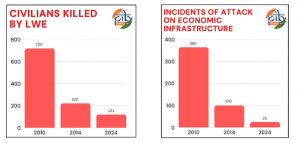
- Incidents fell from 1936 (2010) → 374 (2024) → 81% decrease
- Deaths (civilians + security forces) from 1005 → 150 → 85% decrease

Government Strategy
- The government of India has adopted a zero-tolerance approach towards left-wing extremism and with 100% implementation of government schemes, it seeks to fully develop the LWE-affected areas. The government had laid down two rules of law to fight left wing extremism. First, to establish the rule of law in Naxalism-affected areas and completely stop illegal violent activities. Second, to quickly compensate for the loss in those areas which were deprived of development due to the long Naxalite movement.
- To address the LWE menace holistically, a National Policy and Action Plan to address LWE was approved in 2015. It envisages a multi-pronged strategy involving security related measures, development interventions, ensuring rights and entitlements of local communities etc.
- Security Measures
- Deployment of Central Armed Police Forces (CAPFs) and India Reserve (IR) battalions.
- Specialized training via Counter Insurgency & Anti-Terrorism (CIAT) schools.
- Modernization of state police & intelligence apparatus.
- Security-Related Expenditure (SRE) Scheme: Reimbursement for operational costs, ex-gratia, rehabilitation of surrendered cadres (Rs. 3,260.37 crore released).
- Fortified Police Stations (FPS): Increased from 66 (2014) → 612 (2024).
- NIA & Enforcement Directorate: Financially choke Naxalites; PMLA cases filed.
- Development Interventions
- Special Central Assistance (SCA): The most affected Districts and Districts of Concern are given financial assistance of Rs. 30 crore and Rs. 10 crore, respectively, by the Government of India under a special scheme, Special Central Assistance (SCA), to fill the gaps in public infrastructure.
- Special Central Assistance (SCA) for most LWE affected districts: This Scheme was approved in 2017 and is being implemented as a sub-scheme of the umbrella scheme ‘Modernization of Police Forces’. The main objective of the Scheme is to fill the critical gaps in Public Infrastructure and Services in most LWE affected districts, which are of emergent nature. Till now, Rs 3,563 crore have been released since the inception of Scheme in 2017.
- Special Infrastructure Scheme (SIS): This Scheme is being implemented as a sub-scheme of the umbrella scheme ‘Modernization of Police Forces’. Under Special Infrastructure Scheme, funds are provided for strengthening of State Intelligence Branches (SIBs), Special Forces, District Polices and Fortified Police Stations (FPSs). Under the SIS, Rs. 1741 crore have been sanctioned. 221 Fortified Police Stations have been constructed under the Scheme.
- Scheme of Fortified Police stations: Under the scheme 400 Fortified Police Stations have been constructed in 10 LWE affected States. Put together 612 Fortified Police Stations have been constructed in LWE affected areas in the last 10 years. This is in contrast to 2014, when there were only 66 fortified police stations.
- Road & Telecom Connectivity:
- 17,589 km roads sanctioned, 14,618 km constructed
- 10,505 mobile towers planned, 7,768 commissioned
- 100% 4G coverage in LWE regions by Dec 2025
- Financial Inclusion: For financial inclusion of the local populace in these areas, 1,007 bank branches and 937 ATMs in 30 Most LWE affected districts and 5,731 new post offices have been opened in LWE affected districts since April 2015. 37,850 Banking Correspondents (BCs) have been made operational in Most LWE affected districts.
- Aspirational District: The Ministry of Home Affairs has been tasked with the monitoring of Aspirational districts programme in 35 LWE affected districts.
- Education & Skill Development: For Skill development 48 Industrial Training Institutes (ITIs) and 61 Skill Development Centres (SDCs) have been made functional in LWE affected districts. For quality education in tribal blocks of LWE affected districts 178 Eklavya Model Residential Schools (EMRSs) have been made functional in LWE affected districts. The Skill Development Scheme reached all 48 districts, and a strong vertical of the National Investigation Agency (NIA) was created. 1,143 tribal youths were recruited into the security forces.
- Dharti Aaba Janjatiya Gram Utkarsh Abhiyan (Oct 2024): October 2, 2024, PM Narendra Modi launched the ‘Dharti Aaba Janjatiya Gram Utkarsh Abhiyan’ from Jharkhand. This campaign will be a milestone in providing personal amenities for achieving full saturation in rural areas in over 15,000 villages, benefiting nearly 1.5 crore people in LWE affected areas. The government is strengthening 3-C i.e., Road connectivity, Mobile connectivity and Financial connectivity in the LWE affected areas.
Community Engagement
- Civic Action Programme (CAP): Bridges gaps between security forces and locals, humanizes enforcement
- Media & Outreach: Tribal youth exchange programs, radio jingles, documentaries, pamphlets
Financial Measures
- To financially choke the Naxalites and break their financial backbone, National Investigation Agency (NIA) and Enforcement Directorate were used, seizing several crores of rupees from Naxalites. Under the Prevention of Money Laundering Act (PMLA), cases were filed, and those who funded the Naxalites were sent behind bars.
- To bring development to Naxal-affected areas, the budget allocation for these regions was increased by 300%.
Achievements & Impact
- Neutralization (2024-25): 237 Naxalites killed, 812 arrested, 723 surrendered in Chhattisgarh (Jan 2024 onwards)
- Over 8,000 Naxalites surrendered in last 10 years
- LWE incidents declined 53% between 2004–2014 and further until 2024
- 85% cadre strength eliminated in Chhattisgarh
- Casualties fell below 100 for the first time in 30 years (2022)
- LWE-affected areas reduced from 18,000 sq km → 4,200 sq km
- Police stations reporting incidents reduced from 330 → 104
- Areas like Buddha Pahad and Chakarbandha freed from Naxal control
Threats posed by Naxalism
Threat to Internal Security
- Naxalism challenges the authority of the state by establishing parallel governance in affected regions.
- Insurgents attack police, security forces, and government offices, creating law-and-order instability.
- They disrupt constitutional processes and undermine the rule of law in remote areas.
Socio-Economic Threat
- LWE blocks developmental initiatives, delaying infrastructure, education, healthcare, and financial inclusion in tribal areas.
- Extortion and forced taxation of local businesses and contractors reduce economic activity.
- Fear of violence discourages private and government investment in affected regions.
Humanitarian Threat
- Recruitment of children and coercion of local civilians violate human rights.
- Violence leads to displacement, loss of lives, and trauma among villagers.
- Marginalized communities remain trapped in poverty and illiteracy, reinforcing the cycle of exploitation.
Political Threat
- Attempts to influence local elections through intimidation can distort democratic processes.
- Disruption of governance structures hampers policy implementation.
- Creation of “liberated zones” or strongholds undermines sovereignty.
National Development Threat
- Mining, road construction, and industrial projects are often targeted, slowing regional economic growth.
- Lack of connectivity and disrupted supply chains limit integration of resource-rich areas into national economy.
- Hinders central government’s vision of inclusive growth and prosperity in remote regions.
Challenges
- Difficult terrain & dense forests hinder operations
- Socio-economic grievances may cause resurgence
- Coordination among multiple agencies for integrated response
Conclusion
- India’s multi-dimensional strategy against Naxalism — combining security, development, financial inclusion, infrastructure, civic engagement, and intelligence operations — has substantially weakened the insurgency.
- LWE violence, territorial control, and casualties have drastically decreased, reflecting a significant policy success.
- The government’s approach demonstrates that combining law enforcement with socio-economic development is critical in counter-insurgency.
- With sustained political will, administrative commitment, and people’s participation, the vision of a LWE-free India is closer than ever. Sustained efforts, monitoring, and community participation are essential to achieve the goal of a Naxal-free India by March 31, 2026.

UPSC Prelims Multiple Choice Questions

Ques 1. Consider the following statements about Left Wing Extremism (LWE) in India:
- LWE originated from the Naxalbari movement in West Bengal in 1967.
- LWE-affected areas are primarily in southern India.
- Maoist insurgents often recruit children and target security forces and infrastructure.
Which of the statements given above are correct?
- 1 and 3 only
- 2 and 3 only
- 1 and 2 only
- 1, 2, and 3
Ques 2. Consider the following statements regarding the reduction in LWE-affected districts in India:
- The total number of affected districts reduced from 126 in 2018 to fewer than 20 in 2024.
- Out of the total affected districts, “Districts of Concern” require additional resources for intensive development.
- The government plans to eliminate LWE completely by March 2026.
Which of the statements given above are correct?
- 1 and 2 only
- 1 and 3 only
- 2 and 3 only
- 1, 2, and 3
Ques 3. Consider the following statements about the Security Related Expenditure (SRE) and Special Central Assistance (SCA) schemes:
- The SRE scheme reimburses security-related expenditure in LWE-affected districts.
- The SCA scheme is implemented to fill critical gaps in public infrastructure and services in affected districts.
- Both schemes are sub-schemes under the Ministry of Defence.
Which of the statements given above are correct?
- 1 and 2 only
- 2 and 3 only
- 1 and 3 only
- 1, 2, and 3
Ques 4. Consider the following statements regarding the progress under Naxalmukt Bharat Abhiyan:
- Incidents of LWE violence have decreased by more than 80% from 2010 to 2024.
- The number of fortified police stations in LWE areas has increased from 66 in 2014 to 612 in 2024.
- All LWE-affected districts now have 100% mobile connectivity.
Which of the statements given above are correct?
- 1 and 2 only
- 2 and 3 only
- 1 and 3 only
- 1, 2, and 3
Ques 5. Consider the following statements about community development initiatives in LWE-affected areas:
- ‘Dharti Aaba Janjatiya Gram Utkarsh Abhiyan’ focuses on road, mobile, and financial connectivity.
- More than 37,000 banking correspondents have been deployed in LWE-affected districts since 2015.
- Eklavya Model Residential Schools (EMRS) provide skill development and quality education in tribal areas.
Which of the statements given above are correct?
- 1 and 2 only
- 2 and 3 only
- 1 and 3 only
- 1, 2, and 3
Answers
(a) 1 and 3 only
- Statement 1 is correct: Naxalbari, West Bengal (1967) was the origin of the Naxalite movement.
- Statement 2 is incorrect: LWE is concentrated in central and eastern India, in the “Red Corridor,” not in southern India.
- Statement 3 is correct: LWE uses child recruitment, armed violence, and destruction of infrastructure as tactics.
(d) 1, 2, and 3
- Statement 1 is correct: LWE-affected districts have decreased from 126 → fewer than 20 over the decade.
- Statement 2 is correct: Districts of Concern are provided additional resources under SCA schemes.
- Statement 3 is correct: The government aims to completely eliminate Naxalism by 31st March 2026.
(a) 1 and 2 only
- Statement 1 is correct: SRE reimburses security-related expenditure, including operational and training costs.
- Statement 2 is correct: SCA provides financial aid for infrastructure and services in LWE districts.
- Statement 3 is incorrect: Both schemes are under the Ministry of Home Affairs, not Defence.
(a) 1 and 2 only
- Statement 1 is correct: Incidents dropped from 1936 in 2010 to 374 in 2024, an 81% reduction.
- Statement 2 is correct: Fortified police stations increased from 66 → 612 in 10 years.
- Statement 3 is incorrect: While telecom projects are ongoing, full 100% mobile connectivity is planned by December 2025, not yet achieved.
(d) 1, 2, and 3
- Statement 1 is correct: The ‘Dharti Aaba Janjatiya Gram Utkarsh Abhiyan’ improves roads, mobile connectivity, and financial services.
- Statement 2 is correct: 37,850 Banking Correspondents have been deployed for financial inclusion in LWE districts.
- Statement 3 is correct: 178 EMRS schools provide education and skill development to tribal youth in affected areas.
UPSC Mains Basic Questions

Ques 1. Discuss the objectives, strategies, and outcomes of the Naxalmukt Bharat Abhiyan (NBA) in India.
✔ Answer Framework:
- Introduction:
Left Wing Extremism (LWE), commonly known as Naxalism, has been one of India’s most serious internal security challenges, originating in 1967 with the Naxalbari movement in West Bengal. The movement thrived in underdeveloped and tribal-dominated regions, particularly the “Red Corridor,” spanning Chhattisgarh, Jharkhand, Odisha, and neighboring states. LWE has historically disrupted governance, education, health services, and infrastructure development in these areas.
- Body:
- Objectives of Naxalmukt Bharat Abhiyan:
- To completely eliminate LWE by 31st March 2026.
- To establish the rule of law and stop illegal violent activities in affected areas.
- To ensure socio-economic development of marginalized and tribal populations.
-
- Strategies Adopted:
- Security Measures: Deployment of CAPFs, India Reserve battalions, modernisation of police forces, and offensive operations against Naxalites.
- Developmental Measures: Expansion of road networks, mobile and financial connectivity, skill development centers, EMRS schools, and public infrastructure projects funded under Special Central Assistance (SCA) and Security-Related Expenditure (SRE) schemes.
- Community Engagement: Civic Action Programmes (CAPs), media campaigns, tribal youth exchange programmes, and rehabilitation of surrendered Naxalites.
- Financial Control: Use of NIA and Enforcement Directorate to choke Naxalite finances and enforce the Prevention of Money Laundering Act (PMLA) against funders.
- Outcomes Achieved:
- Reduction of LWE-affected districts from 126 (2018) to fewer than 20 (2024).
- Decline in violent incidents by over 50% and total deaths by 85% since 2010.
- More than 8,000 Naxalites renounced violence; key districts freed from insurgent control (e.g., Buddha Pahad, Chakarbandha).
- Over 600 fortified police stations constructed; 280 new camps and 68 night-landing helipads established.
- Examples:
- 237 Naxalites killed, 812 arrested, and 723 surrendered in Chhattisgarh alone in 2024.
- ‘Dharti Aaba Janjatiya Gram Utkarsh Abhiyan’ implemented to strengthen road, mobile, and financial connectivity in over 15,000 villages.
Conclusion:
Naxalmukt Bharat Abhiyan illustrates a successful multi-pronged approach integrating security, development, and rights-based empowerment. By addressing the structural causes of extremism and reinforcing governance, India is progressively reintegrating LWE-affected regions into the mainstream and moving closer to a violence-free society.
Ques 2. Analyze the major factors behind the persistence of Left-Wing Extremism in certain regions of India. Suggest strategic measures required to combat this threat effectively.
✔ Answer Framework:
- Introduction
Left-Wing Extremism (LWE), or Naxalism, is one of India’s most enduring internal security challenges. It primarily affects the “Red Corridor” spanning central and eastern India. While often viewed as a security threat, LWE is deeply rooted in socio-economic and developmental inequalities, tribal marginalization, and governance deficits. The persistence of LWE in certain regions reflects both historical deprivation and contemporary administrative challenges.
- Major Factors Behind Persistence
-
- Socio-Economic Deprivation
- Widespread poverty, landlessness, and unemployment among tribal and rural populations.
- Lack of access to basic services: education, healthcare, financial facilities, and housing.
- Exploitation by local elites and displacement due to industrial or mining projects.
-
- Historical and Cultural Marginalization
Tribal communities historically excluded from political and economic participation.
- Alienation from mainstream governance leads to distrust of state institutions.
-
- Geographical and Infrastructural Challenges
- Dense forests, difficult terrain, and remote locations hinder administrative and security access.
- Poor connectivity facilitates clandestine operations and recruitment by insurgents.
-
- Weak Governance and Corruption
- Limited law enforcement presence, delayed implementation of welfare schemes, and corruption undermine legitimacy of the state.
- Gaps in judicial and policing mechanisms allow Naxals to establish parallel governance structures.
-
- Operational Strength of Insurgents
- Recruitment of local youth and minors, along with use of guerrilla tactics.
- Control over arms, extortion networks, and ideological mobilization maintain insurgent presence.
- Strategic Measures to Combat LWE
-
- Security and Law Enforcement
- Deployment of CAPFs, IR battalions, and Special Forces in affected areas.
- Fortified police stations, intelligence sharing, and specialized training via CIAT schools.
- Financial disruption of insurgents through NIA and Enforcement Directorate actions.
-
- Development-Oriented Interventions
- Infrastructure: Roads, mobile connectivity, banking services, and public amenities.
- Education and skill development: EMRSs, ITIs, and Skill Development Centres for tribal youth.
- Special Central Assistance (SCA) to fill critical gaps in public services.
-
- Community Engagement and Governance
- Civic Action Programmes (CAP) to foster trust between security forces and locals.
- Media outreach, awareness campaigns, and tribal youth exchange programs.
- Strengthening Panchayati Raj institutions and local governance for participatory development.
-
- Integrated and Sustained Approach
- Synchronization between security, development, and governance initiatives.
- Monitoring via Ministry of Home Affairs and inter-state coordination for adaptive strategy.
- Emphasis on inclusion, rights-based empowerment, and grievance redressal.
- Conclusion
The persistence of LWE is a manifestation of socio-economic inequities, governance gaps, and operational strengths of insurgents. A multi-pronged approach—combining security, development, and community empowerment—is essential for effectively tackling the menace. Sustained political will, inter-agency coordination, and participatory governance can gradually eliminate Naxalism, restore state authority, and enable socio-economic growth in affected regions.
Advanced UPSC Mains Questions
Ques 3. Critically examine the Naxalmukt Bharat Abhiyan (NBA) in India. Evaluate its multi-dimensional strategy, successes, and remaining challenges. Suggest measures for sustainable eradication of Left Wing Extremism.
✔ Answer Framework:
- Introduction:
Left Wing Extremism (LWE) continues to pose both security and developmental challenges in India’s Red Corridor. The Naxalbari movement of 1967 evolved into a significant insurgency, undermining state authority in tribal and remote areas. Recognizing this, the Indian government launched the Naxalmukt Bharat Abhiyan (NBA) in 2015, combining zero-tolerance security measures with developmental and community-focused strategies.
- Body:
-
- Multi-Dimensional Strategy of NBA:
-
- Security-Oriented Measures:
- Deployment of Central Armed Police Forces (CAPFs) and India Reserve battalions.
- Construction of fortified police stations (612 over 10 years).
- Offensive operations neutralizing high-ranking Naxal leaders and dismantling arms caches.
- Strengthening intelligence apparatus and inter-state coordination.
-
- Development-Oriented Measures:
- Infrastructure development via Special Central Assistance (SCA) and Special Infrastructure Scheme (SIS).
- Improvement in telecom connectivity: ~7,768 mobile towers commissioned in LWE areas.
- Expansion of financial services: over 37,850 banking correspondents deployed.
- Skill development and education: 48 ITIs, 61 SDCs, 178 EMRS schools functional in tribal areas.
-
- Community Engagement & Rehabilitation:
- Civic Action Programmes (CAPs), media campaigns, youth exchange programmes.
- Rehabilitation and integration of surrendered Naxalites.
- Successes of NBA:
-
- LWE-related incidents reduced by 53% from 2014–2024.
- Deaths among civilians and security forces declined by 73%.
- High surrender rate of Naxalites: >8,000 renounced violence in the past decade.
- Critical infrastructure and basic services now reaching remote tribal areas.
- Challenges Remaining:
-
- Geographical isolation of affected regions still limits accessibility.
- Persistent socio-economic grievances among tribal communities.
- Technological and financial adaptability of Naxalites in some pockets.
- Ensuring sustainable development and effective utilization of funds.
- Measures for Sustainable Eradication:
- Integrated Development Planning: Focus on education, health, and livelihood schemes tailored to tribal needs.
- Community Policing & Participation: Empower local communities to report and resist LWE influence.
- Technological Interventions: GIS mapping of hotspots, drone surveillance, and rapid response teams.
- Financial and Social Rehabilitation: Continued focus on surrendered cadre rehabilitation, income-generation schemes, and conflict-resolution mechanisms.
- Examples:
- Roads constructed under RRP-I and RCPLWE schemes: 14,618 km completed for connectivity and economic access.
- Financial choke on Naxal funding using NIA and PMLA actions.
- Surrender and reintegration: 50 Naxalites surrendered in Bijapur (March 2025), indicating community-level impact.
- Conclusion:
The Naxalmukt Bharat Abhiyan demonstrates that counter-insurgency success requires a combination of security, development, and social empowerment. While measurable reductions in violence highlight the effectiveness of NBA, sustainable eradication of LWE will depend on continued economic inclusion, political engagement, and addressing the root causes of alienation in tribal areas. The campaign sets a benchmark for addressing internal security threats while promoting inclusive growth.
Ques 4. The Government of India recently stated that Left Wing Extremism (LWE) will be eliminated by 2026. What do you understand by LWE and how are the people affected by it? What measures have been taken by the government to eliminate LWE?
(Answer in 250 words) (UPSC-PYQ-2025)
✔ Answer Framework:
- Introduction
Left Wing Extremism (LWE), commonly known as Naxalism, is an armed insurgency rooted in socio-economic inequalities and Maoist ideology. Originating from the Naxalbari movement in West Bengal (1967), LWE primarily affects tribal-dominated and underdeveloped regions across central and eastern India, forming the Red Corridor, including states like Chhattisgarh, Jharkhand, Odisha, Maharashtra, Madhya Pradesh, Andhra Pradesh, and Telangana. The movement seeks to undermine the Indian state through armed rebellion, extortion, destruction of infrastructure, recruitment of civilians and children, and establishing parallel governance in affected areas.
- Body
-
- Impact on people: LWE disrupts access to basic amenities such as education, healthcare, banking, and postal services. Violence and intimidation prevent development projects, creating fear and socio-economic deprivation among local communities, especially tribal populations. Children are often recruited as combatants, and local livelihoods are affected due to extortion and destruction of property.
- Government measures: India’s strategy combines security, development, and community engagement. The National Policy and Action Plan (2015) emphasizes zero-tolerance towards violence while addressing developmental deficits. Key measures include deployment of Central Armed Police Forces (CAPFs), India Reserve battalions, and creation of Special Forces and fortified police stations. Security-Related Expenditure (SRE) and Special Central Assistance (SCA) schemes reimburse operational costs and fund infrastructure development. Roads and telecom networks are expanded; financial inclusion is enhanced through banks, ATMs, and post offices. Skill development and education initiatives, including ITIs, Skill Development Centres, and Eklavya Model Residential Schools, empower local youth. Civic Action Programmes and media outreach foster community trust, while the National Investigation Agency and Enforcement Directorate disrupt Naxalite funding.
- Conclusion
India’s multi-pronged strategy against Left Wing Extremism has significantly weakened the insurgency, both territorially and operationally. The government’s focus on a blend of security, development, and rights-based empowerment has transformed the landscape in previously affected areas. With sustained political will, administrative commitment, and people’s participation, the vision of a LWE-free India is closer than ever. Through this multi-dimensional approach, India has reduced violence, neutralized insurgents, and aims to achieve a Naxal-free India by March 2026.
Ques 5. Naxalism is a social, economic and developmental issue manifesting as a violent internal security threat. In this context, discuss the emerging issues and suggest a multilayered strategy to tackle the menace of Naxalism. (UPSC-PYQ-2022)
✔ Answer Framework:
- Introduction
Naxalism, also known as Left Wing Extremism (LWE), is a complex phenomenon rooted in socio-economic inequalities, historical marginalization of tribal populations, and lack of development in remote areas. While it manifests as violent insurgency against the state, its origins lie in persistent deprivation, land alienation, and governance deficits. Over decades, Naxalism has evolved into both a security challenge and a developmental issue, affecting the “Red Corridor” across central and eastern India.
- Emerging Issues
- Socio-Economic and Developmental Grievances
- Persistent poverty, landlessness, and marginalization of tribal communities provide fertile ground for Naxal ideology.
- Inadequate access to education, healthcare, banking, and infrastructure perpetuates underdevelopment.
- Governance and Political Challenges
- Weak administrative presence and limited law enforcement in remote forests create governance vacuums.
- Corruption and delays in welfare schemes reduce state legitimacy and public trust.
- Security and Law & Order Threats
- Increasing use of improvised explosive devices (IEDs), ambushes, and extortion destabilizes peace.
- Recruitment of minors and vulnerable populations expands the operational capacity of Naxals.
- Developmental Disruption
- Attacks on infrastructure and obstruction of industrial projects hinder regional economic growth.
- Displacement due to violence affects livelihoods and social cohesion.
- Multi-Layered Strategy to Tackle Naxalism
-
- Security Measures
- Deployment of Central Armed Police Forces (CAPFs) and specialized units.
- Fortified police stations, intelligence sharing, CIAT schools, and coordinated anti-Naxal operations.
- Financial choke measures via National Investigation Agency (NIA) and Enforcement Directorate (ED).
-
- Development and Welfare Initiatives
- Special Central Assistance (SCA) for critical infrastructure gaps.
- Road, telecom, and financial inclusion projects in LWE-affected areas.
- Education and skill development via EMRSs, ITIs, and Skill Development Centres.
-
- Community Engagement and Governance
- Civic Action Programmes (CAP) to bridge gaps between security forces and locals.
- Media outreach, tribal youth exchange programs, and awareness campaigns.
- Strengthening local governance institutions to empower communities.
-
- Integrated Approach
- Combining law enforcement with socio-economic development, infrastructure expansion, and participatory governance.
- Monitoring through MHA and inter-state coordination for sustained outcomes.
- Conclusion
Naxalism is not merely a security problem but a reflection of deep-rooted socio-economic and developmental deficits. A multi-dimensional strategy—integrating security, development, governance, and community empowerment—offers the best path forward. Sustained political will, active monitoring, and inclusive development can help India achieve a Naxal-free Red Corridor, ensuring peace, growth, and national security.

UPSC Interview-Based Questions
Ques 1. What is the main objective of the Naxalmukt Bharat Abhiyan?
✔ Answer:
The NBA aims to completely eliminate Left Wing Extremism (LWE) by 31st March 2026. It integrates security operations, socio-economic development, and community engagement to reintegrate previously affected areas into mainstream governance. The approach focuses on both law enforcement and inclusive development.
Ques 2. How has India reduced the LWE-affected districts over the last decade?
✔ Answer:
The number of LWE-affected districts reduced from 126 in 2018 to 38 in 2024. Focused operations, fortified police stations, new security camps, and targeted development projects have been key to reducing insurgency geographically and operationally. This shows effective multi-pronged strategy implementation.
Ques 3. Explain the role of Special Central Assistance (SCA) and Security-Related Expenditure (SRE) schemes.
✔ Answer:
SCA funds critical public infrastructure in the most-affected districts, while SRE reimburses security-related expenditure to state forces. Both schemes strengthen operational efficiency and facilitate socio-economic development, bridging gaps that insurgents exploit.
Ques 4. Discuss the significance of the ‘Dharti Aaba Janjatiya Gram Utkarsh Abhiyan’ for LWE-affected areas.
✔ Answer:
Launched in 2024, the campaign focuses on the 3-Cs: road, mobile, and financial connectivity. By improving access to amenities and opportunities, it reduces alienation among tribal communities, directly addressing root causes of extremism. It impacts 1.5 crore people in over 15,000 villages.
Ques 5. What challenges remain for sustaining a Naxal-free India despite current successes?
✔ Answer:
Challenges include difficult terrain, sporadic socio-economic grievances, and ensuring long-term monitoring of development programs. Sustained political will, participatory governance, and continuous community engagement are essential for preventing resurgence of extremism.