
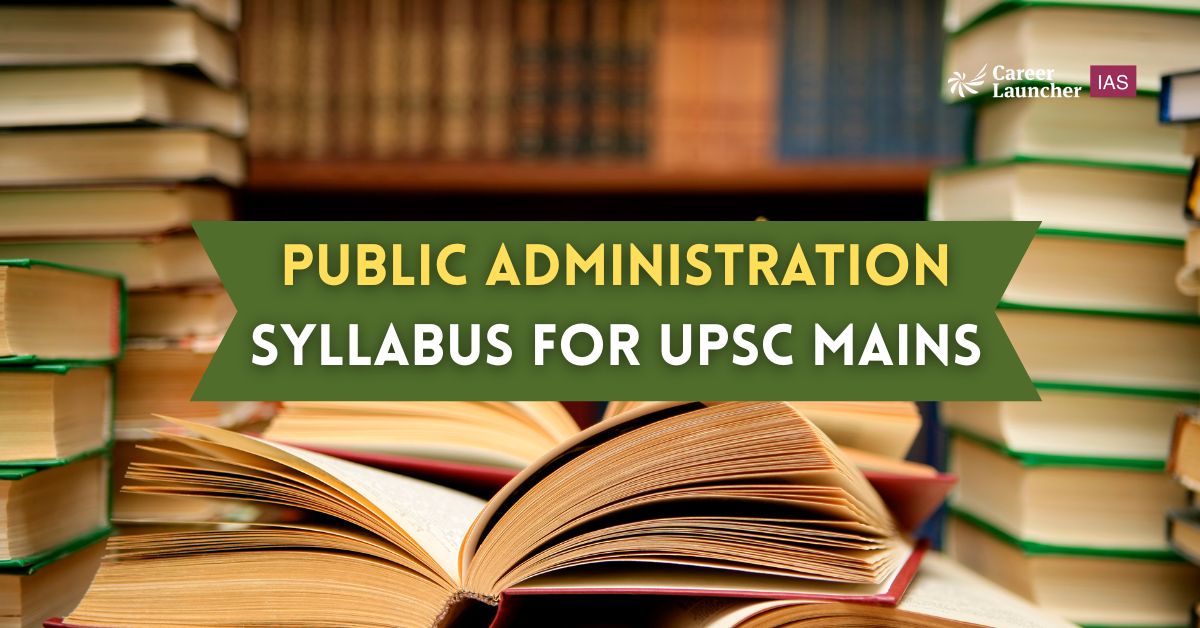
Public Administration is one of the optional subjects in the UPSC Civil Services Main Examination. It is one of the popular choices because of its high relevance in the job role of an IAS officer. This subject introduces the candidates to the mechanism of public administration which is of great use for future administrators. Further, it is a concept-intensive subjects. So, if you’re not that good in cramming, this subject is for you as it largely entails conceptual understanding. This paper consists of 2 papers, carrying 250 marks each. Paper 1 deals with administrative theory and Paper 2 deals with Indian administration.
Moreover, availability of resources and ease of understanding of the subject is also the factors that persuades aspirants to choose this optional subject. However, candidates opting for this subject must be cautious of writing generic answers as this subject is highly competitive. A lot of aspirants opt for this subject, hence make sure your answers stand-out to secure high marks in the examination. Read on to know the detailed syllabus for Public Administration for UPSC.
Table of Contents
Public Administration Syllabus for UPSC
Public Administration Syllabus Paper 1: Administrative Theory
| Introduction | Meaning, scope and significance of Public Administration; Wilson’s vision of Public Administration; Evolution of the discipline and its present status; New Public Administration; Public Choice approach; Challenges of liberalization, Privatisation, Globalisation; Good Governance: concept and application; New Public Management |
| Administrative Thought | Scientific Management and Scientific Management movement; Classical Theory; Weber’s bureaucratic model – its critique and post-Weberian Developments; Dynamic Administration (Mary Parker Follett); Human Relations School (Elton Mayo and others); Functions of the Executive (C.I. Barnard); Simon’s decision-making theory; Participative Management (R. Likert, C. Argyris, D. McGregor). |
| Administrative Behaviour | Process and techniques of decision-making; Communication; Morale; Motivation Theories – content, process and contemporary; Theories of Leadership: Traditional and Modern. |
| Organizations | Theories – systems, contingency; Structure and forms: Ministries and Departments, Corporations, Companies, Boards and Commissions; Ad hoc and advisory bodies; Headquarters and Field relationships; Regulatory Authorities; Public-Private Partnerships |
| Accountability and control | Concepts of accountability and control; Legislative, Executive and Judicial control over administration; Citizen and Administration; Role of media, interest groups, voluntary organizations; Civil society; Citizen’s Charters; Right to Information; Social audit |
| Administrative Law | Meaning, scope, and significance; Dicey on Administrative law; Delegated legislation; Administrative Tribunals |
| Comparative Public Administration | Historical and sociological factors affecting administrative systems; Administration and politics in different countries; Current status of Comparative Public Administration; Ecology and administration; Riggsian models and their critique. |
| Development Dynamics | Concept of development; Changing profile of development administration; ‘Anti development thesis’; Bureaucracy and development; Strong state versus the market debate; Impact of liberalization on administration in developing countries; Women and development – the self-help group movement. |
| Personnel Administration | Importance of human resource development; Recruitment, training, career advancement, position classification, discipline, performance appraisal, promotion, pay and service conditions; employer-employee relations, grievance redressal mechanism; Code of conduct; Administrative ethics. |
| Public Policy | Models of policy-making and their critique; Processes of conceptualization, planning, implementation, monitoring, evaluation and review, and their limitations; State theories and public policy formulation |
| Techniques of Administrative Improvement | Organization and methods, Work study and work management; e-governance and information technology; Management aid tools like network analysis, MIS, PERT, CPM. |
| Financial Administration | Monetary and fiscal policies; Public borrowings and public debt Budgets – types and forms; Budgetary process; Financial accountability; Accounts and audit. |
Public Administration Syllabus Paper-II: Indian Administration
| Evolution of Indian Administration | Kautilya’s Arthashastra; Mughal administration; Legacy of British rule in politics and administration – Indianization of public services, revenue administration, district administration, local self-government |
| Philosophical and Constitutional framework of government | Salient features and value premises; Constitutionalism; Political culture; Bureaucracy and democracy; Bureaucracy and development |
| Public Sector Undertakings | The public sector in modern India; Forms of Public Sector Undertakings; Problems of autonomy, accountability, and control; Impact of liberalization and privatization |
| Union Government and Administration | Executive, Parliament, Judiciary – structure, functions, work processes; Recent trends; Intragovernmental relations; Cabinet Secretariat; Prime Minister’s Office; Central Secretariat; Ministries and Departments; Boards; Commissions; Attached offices; Field organizations. |
| Plans and Priorities | Machinery of planning; Role, composition and functions of the Planning Commission and the National Development Council; ‘Indicative’ planning; Process of plan formulation at Union and State levels; Constitutional Amendments (1992) and decentralized planning for economic development and social justice |
| State Government and Administration | Union-State administrative, legislative and financial relations; Role of the Finance Commission; Governor; Chief Minister; Council of Ministers; Chief Secretary; State Secretariat; Directorates. |
| District Administration since Independence | Changing role of the Collector; Union state-local relations; Imperatives of development management and law and order administration; District administration and democratic decentralization |
| Civil Services | Constitutional position; Structure, recruitment, training and capacity-building; Good governance initiatives; Code of conduct and discipline; Staff associations; Political rights; Grievance redressal mechanism; Civil service neutrality; Civil service activism |
| Financial Management | Budget as a political instrument; Parliamentary control of public expenditure; Role of finance ministry in the monetary and fiscal area; Accounting techniques; Audit; Role of Controller General of Accounts and Comptroller and Auditor General of India |
| Administrative Reforms since Independence | Major concerns; Important Committees and Commissions; Reforms in financial management and human resource development; Problems of implementation. |
| Rural Development | Institutions and agencies since independence; Rural development programs: foci and strategies; Decentralization and Panchayati Raj; 73rd Constitutional amendment. |
| Urban Local Government | Municipal governance: main features, structures, finance, and problem areas; 74th Constitutional Amendment; Globallocal debate; New localism; Development dynamics, politics, and administration with special reference to city management. |
| Law and Order Administration | British legacy; National Police Commission; Investigative agencies; Role of central and state agencies including paramilitary forces in maintenance of law and order and countering insurgency and terrorism; Criminalisation of politics and administration; Police- public relations; Reforms in Police. |
| Significant issues in Indian Administration | Values in public service; Regulatory Commissions; National Human Rights Commission; Problems of administration in coalition regimes; Citizen-administration interface; Corruption and administration; Disaster management |
How to study Public Administration for UPSC?
Since the competition for Public Administration optional is high, you will have to put in extra efforts to ensure your answers stand out. Here’s a full-proof strategy of preparing public administration for UPSC.
- Know the syllabus & basic concepts inside out: It is very important to know the basic concepts of any subject in depth, especially in conceptual subjects like Public Administration. Ensure you know the basic concepts and theories thoroughly. If you have conceptual clarity you will be able to answer questions easily.
- Make Concise Notes: Make your own handwritten notes for the topics mentioned in both paper 1 and paper 2. You can use online resources and standard books for preparing these notes.
- Practice Answer Writing: Incorporate these notes into your answer writing practice and come up with a basic structure of answers that works well. Your answer must have a proper beginning and end with substantial content in the body.
- Read editorials in The Hindu and The Indian Express: For relevant facts and figures, read editorials in newspapers such as Hindu and Indian Express. Delve deeper into the relevant editorials and make proper notes on them.
- Second Administrative Reforms Commission : Reports: These reports will future allow you to make your answers exclusive and enriching. Read these reports and jot down relevant information for answer-writing practice.
- Blogs: Blogs on NITI Aayog website, PSUs’ website and other ministries’ websites are also some of the usually ignored yet very relevant material that can be used for enriching your answers.

Booklist for Public Administration for UPSC
Following is the recommended booklist to prepare for Public Administration Optional Syllabus.
| Book / Source | Author(s) |
|---|---|
| IGNOU BA and MA Notes | IGNOU |
| Administrative Thinkers | Prasad and Prasad |
| New Horizons of Public Administration | Mohit Bhattacharya |
| Public Administration and Public Affairs | Nicholas Henry |
| Public Policy: Concept, Theory and Practice | Bidyut Chakrabarty and Prakash Chand |
| Essentials of Organisational Behaviour | Stephen P. Robbins |
| Public Administration | M. Laxmikanth |
| Indian Public Administration | R. K. Arora and Rajni Goyal |
| Indian Administration | S. R. Maheswari |
| Public Administration: Administrative Theories and Concepts | Fadia and Fadia |
| ARC Reports | Government of India |
| Important Reports from Ministries | Government of India |
Frequently Asked Questions
What are the pros and cons of choosing Public Administration?
Here are some pros and cons to consider while choosing Public Administration as an optional subject.
- Pros: Some pros of this optional are the direct relevance to the job role, strong overlap with GS papers thus making for easier overall preparation for Mains, and easy access to resources and study material.
- Cons: Since many aspirants opt for this optional subject, the competition is high, and some parts of it are concept-heavy and require extreme conceptual clarity. Aspirants also need to stay updated with current administrative practices and case studies to make your answers relevant.
How many months of preparation does one need after choosing the Public Administration optional?
While the answer to this question won’t be the same for everyone, typically, if one is familiar with the syllabus, they should allot at least 3-4 months of dedicated prep to the optional. However, if you are unfamiliar with the subject, 6-9 months of dedicated prep is recommended to cover the syllabus in depth.