Step 1:
There are 5 Cases to distribute points:
Case 1: Four “Hi” –1, –1, –1, –1
Case 2: Three “Hi” +1, +1, +1 & One “Lo” –3
Case 3: Two “Hi” +2, +2 & Two “Lo” –2, –2
Case 4: One “Hi” +3 & Three “Lo” –1, –1, –1
Case 5: Four “Lo” +1, +1, +1, +1
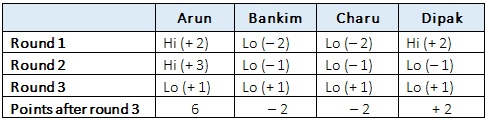
From conditions (1) and (3), we first analyse the scores after the first three rounds. The total score after three rounds is 6 + 2 – 2 – 2 = 4. Since a round contributes a total of either 0 points or 4 points, exactly one of the first three rounds must have been an all-Lo round. Also, Arun's total after three rounds is 6. Since the maximum score a player can earn in a round is 3, Arun's scores across the three rounds must have been +2, +3, and +1. The score of +1 is possible only in an all-Lo round.
Now consider condition (3), which says that Dipak's score in Round 3 was less than his score in Round 1 but greater than his score in Round 2. Since the all-Lo round gives everyone +1, Dipak's scores must have been +2, –1, and +1 respectively. Hence, Round 3 must be the all-Lo round.
Since Dipak scored +2 in Round 1, Round 1 must have been a 2 Hi –2 Lo round. Arun also needs a +2 score, so Arun and Dipak must have been the two Hi bidders, while Bankim and Charu bid Lo. Arun still requires a +3 score, which is possible only when he is the sole Hi bidder. Therefore, Round 2 must have Arun as the only Hi bidder.
Thus, the first three rounds are shown in the table below.
 Step 2:
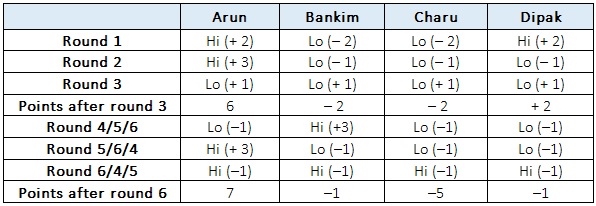
Now use condition (2), comparing the scores after six rounds (7, –1, –5, –1) with those after three rounds (6, –2, –2, 2), the net changes in Rounds 4–6 are:
Arun = +1, Bankim = +1, Charu = –3, Dipak = –3.
Condition (4) says Arun was the sole Hi bidder in exactly two rounds. One such round is already Round 2, so among Rounds 4–6 there must be exactly one more round with Arun as the sole Hi bidder. The only way to obtain the required net changes is to have one round with Arun as the sole Hi bidder and the other two rounds with all four players bidding Hi.
The score contributions over Rounds 4–6 are therefore:
Two rounds: (+3, –1, –1, –1) each
One round: (–1, –1, –1, –1)
Net effect:
Arun = +3 –1 – 1 = +1
Bankim = +3 – 1 – 1 = +1
Charu = –1 – 1 – 1 = –3
Dipak = –1 – 1 – 1 = –3
This uniquely determines the pattern of the last three rounds and satisfies all conditions. All rounds are shown in the table below.
In the first round, the bids by Arun, Bankim, Charu and Dipak were Hi, Lo, Lo and Hi respectively.