Directions for question 1: Read the following passage
and answer the question that follows.
In a small college, students are allowed to take only one
specialization. Traditionally, only two specializations are
offered: Science and Arts. Students enrolled to specialize
in Science must take Physics and Mathematics subjects,
while students enrolled to specialize in Arts must take
Economics and Political Science subjects. Students
enrolled in Science are not allowed to take either
Economics or Political Science, while students enrolled
in Arts are not allowed to take either Physics or
Mathematics.
Recently, the college has started a third specialization
called MatEco that requires students to take Economics
and Mathematics. However, MatEco students would not
be allowed to take either Physics or Political Science.
When the college opens this new specialization for
enrolment, it allows students, originally enrolled in Science
or Arts, to switch to MatEco.
From among the students originally enrolled in Arts, 20
students switch to MatEco. This makes the number of
Science students twice the number of Arts students. After
this, from among the students who originally enrolled in
Science, 45 students switch to MatEco. This makes the
number of Arts students twice the number of Science
students.
Q. 1 In total, how many students, from among those
originally enrolled in Science or Arts, are now taking
Economics?
Let there be M and N students enrolled in Science
and Arts respectively.
After 20 students from Arts switch to MATEco:
2(N – 20) = M
After 45 students from science switch to MATEco:
N – 20 = 2(M – 45)
Solve the two equations and get M = 60 and N
= 50.
Hence, total students who study economics must
be 45 + 50 = 95.
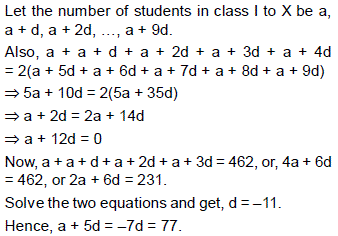
Q. 2 In a school, the number of students in each class,
from Class I to X, in that order, are in an arithmetic
progression. The total number of students from Class
I to V is twice the total number of students from
Class VI to X.
If the total number of students from Class I to IV is
462, how many students are there in Class VI?
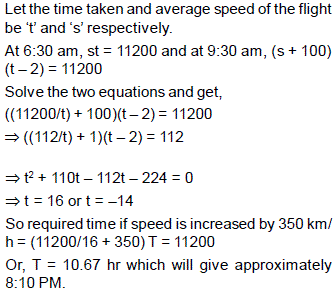
Q. 3 A flight, traveling to a destination 11,200 kms away,
was supposed to take off at 6:30 AM. Due to bad
weather, the departure of the flight got delayed by
three hours. The pilot increased the average speed
of the airplane by 100 km/hr from the initially planned
average speed, to reduce the overall delay to one
hour.
Had the pilot increased the average speed by 350
km/hr from the initially planned average speed, when
would have the flight reached its destination?
Q. 5 The cost of running a movie theatre is Rs. 10,000
per day, plus additional Rs. 5,000 per show. The
theatre has 200 seats. A new movie released on
Friday. There were three shows, where the ticket
price was Rs. 250 each for the first two shows and
Rs. 200 for the late-night show.
For all shows together, total occupancy was 80%.
What was the maximum amount of profit possible?
Given: Total occupancy was 80%.
80% of 600 = 480
The maximum amount of profit possible
= 200(250) + 200 (250) + 80 (200) – 10000 + 3 ×
5000
= 50000 + 50000 + 16000 – 10000 + 15000
= Rs. 91,000
Q. 6 FS food stall sells only chicken biriyani. If FS fixes a
selling price of Rs. 160 per plate, 300 plates of biriyani
are sold. For each increase in the selling price by
Rs. 10 per plate, 10 fewer plates are sold. Similarly,
for each decrease in the selling price by Rs. 10 per
plate, 10 more plates are sold. FS incurs a cost of
Rs. 120 per plate of biriyani, and has decided that
the selling price will never be less than the cost price.
Moreover, due to capacity constraints, more than
400 plates cannot be produced in a day.
If the selling price on any given day is the same for
all the plates and can only be a multiple of Rs. 10,
then what is the maximum profit that FS can achieve
in a day?
If selling price is Rs. 160, then 300 plates are sold. Case 1: If 160 is decreased by 10k, then 300 is
increased by 10k.
Here total revenue = (160 – 10k)(300 + 10k)
Profit = (160 – 10k)(300 + 10k) – 120 ×
(300 + 10k)
= (300 + 10k) (40 – 10k)
= 10(30 + k)(4 – k) (here sum of 30 + k + 4 – k
= 34 is a constant, hence it will be maximum when
30 + k = 4 – k or, k = –13). This case is cancelled. Case 2: If 160 is increased by 10k, then 300 is
decreased by 10k.
Here total revenue = (160 + 10k)(300 - 10k)
Profit = (160 + 10k)(300 – 10k) – 120 × (300 - 10k)
= (300 – 10k) (40 + 10k)
= 10(30 – k)(4 + k) (here sum of 30 – k + 4 + k
= 34 is a constant, hence it will be maximum when
30 – k = 4 + k or, k = 13).
Hence, maximum profit is 10(30 – 13)(4 + 13)
= Rs. 28,900.
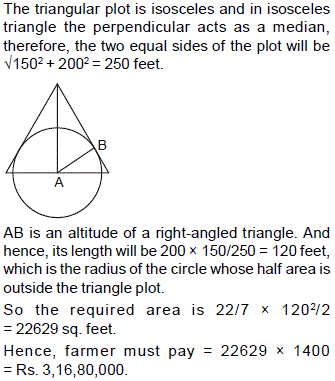
Q. 7 A farmer has a triangular plot of land. One side of the
plot, henceforth called the base, is 300 feet long
and the other two sides are equal. The perpendicular
distance, from the corner of the plot, where the two
equal sides meet, to the base, is 200 feet.
To counter the adverse effect of climate change, the
farmer wants to dig a circular pond. He plans that
half of the circular area will be inside the triangular
plot and the other half will be outside, which he will
purchase at the market rate from his neighbour. The
diameter of the circular plot is entirely contained in
the base and the circumference of the pond touches
the two equal sides of the triangle from inside.
If the market rate per square feet of land is Rs. 1,400,
how much does the farmer must pay to buy the land
from his neighbour for the pond? (Choose the closest
option.)
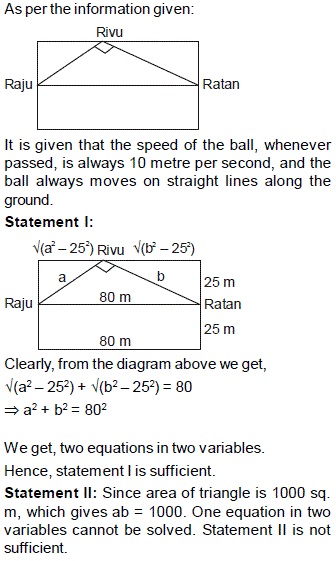
Q. 8 A group of boys is practising football in a rectangular
ground. Raju and Ratan are standing at the two
opposite mid-points of the two shorter sides. Raju
has the ball, who passes it to Rivu, who is standing
somewhere on one of the longer sides. Rivu holds
the ball for 3 seconds and passes it to Ratan. Ratan
holds the ball for 2 seconds and passes it back to
Raju. The path of the ball from Raju to Rivu makes a
right angle with the path of the ball from Rivu to Ratan.
The speed of the ball, whenever passed, is always
10 metre per second, and the ball always moves on
straight lines along the ground.
Consider the following two additional pieces of
information:
I. The dimension of the ground is 80 metres × 50
metres.
II. The area of the triangle formed by Raju, Rivu and
Ratan is 1000 square metres.
Consider the problem of computing the following: how
many seconds does it take for Raju to get the ball
back since he passed it to Rivu? Choose the correct
option.
Q. 9 The least common multiple of a number and 990 is
6930. The greatest common divisor of that number
and 550 is 110.
What is the sum of the digits of the least possible
value of that number?
LCM (N, 990 = 2 × 32 × 5 × 11) = 6930 = 2 × 32 ×
5 × 7 × 11
Here N can be minimum 7.
GCD (N, 550 = 2 × 52 × 11) = 110 = 2 × 5 × 11
Here N can be atleast 110.
Therefore, N should be 770. Sum of the digits will
be 14.
Q. 10 The roots of the polynomial P(x) = 2x3 – 11x2 + 17x – 6
are the radii of three concentric circles.
The ratio of their area, when arranged from the largest
to the smallest, is:
Apply hit and trial and get that x = 2 is a root of the
polynomial P(x) = 2x3 – 11x2 + 17x – 6.
P(x) = (x – 2)(x – 3)(2x – 1)
Radius from largest to smallest are 1/2, 2, 3
Required ratio is 36 : 16 : 1.
Q. 11 A local restaurant has 16 vegetarian items and
9 non-vegetarian items in their menu. Some items
contain gluten, while the rest are gluten-free.
One evening, Rohit and his friends went to the
restaurant. They planned to choose two different
vegetarian items and three different non-vegetarian
items from the entire menu. Later, Bela and her
friends also went to the same restaurant: they
planned to choose two different vegetarian items and
one non-vegetarian item only from the gluten-free
options. The number of item combinations that Rohit
and his friends could choose from, given their plan,
was 12 times the number of item combinations that
Bela and her friends could choose from, given their
plan.
How many menu items contain gluten?
Q. 12 Consider the system of two linear equations as follows:
3x + 21y + p = 0; and qx + ry – 7 = 0,
where p, q, and r are real numbers.
Which of the following statements DEFINITELY
CONTRADICTS the fact that the lines represented
by the two equations are coinciding?
Q. 13 Consider a 4-digit number of the form abbb, i.e., the
first digit is a (a > 0) and the last three digits are all b.
Which of the following conditions is both
NECESSARY and SUFFICIENT to ensure that the
4-digit number is divisible by a?
Given ‘abbb’ is a 4 digit number.
Abbb can be written as:
1000a + 111 × b = 1000a + 3 × 37 × b
The numbers 3 and 37 are coprime.
For the number ‘abbb’ to be divisible by a we can
have 3 possibilities which will be necessary and
sufficient:
1. 3b is divisible by a
2. 37b is divisible by a
3. The number b is divisible by a.
Hence, “3b is divisible by a” is the only option that
is necessary and sufficient.
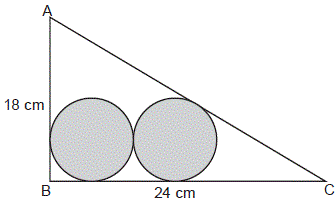
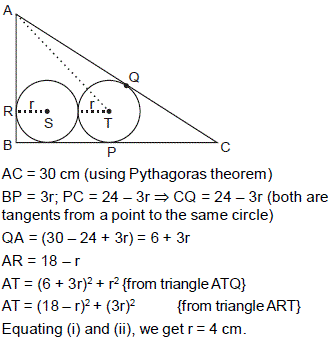
Q. 14 Consider a right-angled triangle ABC, right angled at
B. Two circles, each of radius r, are drawn inside the
triangle in such a way that one of them touches AB
and BC, while the other one touches AC and BC.
The two circles also touch each other (see the image
below).
If AB = 18 cm and BC = 24 cm, then find the value
of r.
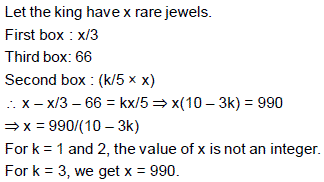
Q. 15 A king has distributed all his rare jewels in three
boxes. The first box contains 1/3 of the rare jewels,
while the second box contains k/5 of the rare jewels,
for some positive integer value of k. The third box
contains 66 rare jewels.
How many rare jewels does the king have?
Directions for questions 16 and 17: Read the following
scenario and answer the TWO questions that follow.
Aman has come to the market with Rs. 100. If he buys
5 kilograms of cabbage and 4 kilograms of potato, he will
have Rs. 20 left; or else, if he buys 4 kilograms of cabbage
and 5 kilograms of onion, he will have Rs. 7 left. The per
kilogram prices of cabbage, onion and potato are positive
integers (in rupees), and any type of these vegetables
can only be purchased in positive integer kilogram, or none
at all.
Q. 16 Aman decides to buy only onion, in whatever maximum
quantity possible (in positive integer kilogram), with
the money he has come to the market with.
How much money will he be left with after the purchase?
Let the price of the three items be Rs.p, Rs.c and Rs.n.
From the given information we have two equations:
5c + 4p = (100 – 20) = 80 …(i)
4c + 5n = (100 – 7) = 93 …(ii)
Given that all are positive integers.
From equation (i), p has to be a multiple of 5 as 5c and
80 are both multiples of 5.
For p = 5; c = 12 and n = 9 (possible value)
For p = 10; c = 8 and n is not an integer.
For p = 15; c = 4 and n is not an integer.
Hence, we have c = 12, p = 5 and n = 9.
If he buys only onion for Rs. 100, there will be 11
kg of onion worth 9 × 11 = Rs.99.
Amount remaining = Re.1
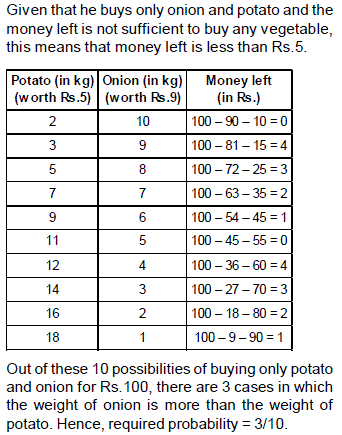
Q. 17 Aman decides to buy only onion and potato, both in
positive integer kilogram, in such a way that the
money left with him after the purchase will be
insufficient to buy a full kilogram of either of the two
vegetables.
If all such permissible combinations of purchases
are equally likely, what is the probability that Aman
buys more onion than potato?
Let the price of the three items be Rs.p, Rs.c and Rs.n.
From the given information we have two equations:
5c + 4p = (100 – 20) = 80 …(i)
4c + 5n = (100 – 7) = 93 …(ii)
Given that all are positive integers.
From equation (i), p has to be a multiple of 5 as 5c and
80 are both multiples of 5.
For p = 5; c = 12 and n = 9 (possible value)
For p = 10; c = 8 and n is not an integer.
For p = 15; c = 4 and n is not an integer.
Hence, we have c = 12, p = 5 and n = 9.
Directions for questions 18 and 19: Read the following
scenario and answer the TWO questions that follow.
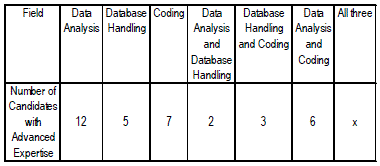
41 applicants have been shortlisted for interviews for some
data analyst positions. Some of the applicants have
advanced expertise in one or more fields among the
following: data analysis, database handling and coding.
The numbers of applicants with different advanced expertise
are given in the 2 × 8 table below.
The number of applicants with advanced expertise in all
three fields is given as x in the table, where x is a nonnegative
integer.
Q. 18 What BEST can be concluded about the value of x?
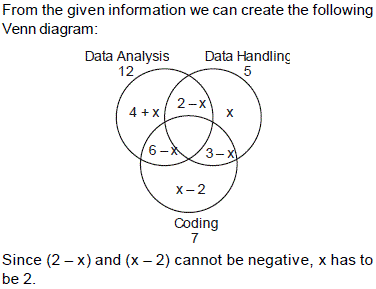
Total number of people = 41
On putting x = 2 in the venn diagram we get, people
with expertise = 15
Hence, people with no expertise = 41 – 15 = 26.
Directions for questions 20 to 22: Read the following
scenario and answer the THREE questions that follow.
The upper hinge of a dataset is the median of all the values
to the right of the median of the dataset in an ascending
arrangement, while the lower hinge of the dataset is the
median of all the values to the left of the median of the
dataset in the same arrangement.
For example, consider the dataset 4, 3, 2, 6, 4, 2, 7.
When arranged in the ascending order, it becomes 2, 2,
3, 4, 4, 6, 7. The median is 4 (the bold value), and hence
the upper hinge is the median of 4, 6, 7, i.e., 6. Similarly,
the lower hinge is 2.
A student has surveyed thirteen of her teachers, and
recorded their work experience (in integer years). Two of
the values recorded by the student got smudged, and she
cannot recall those values. All she remembers is that those
two values were unequal, so let us write them as A and B,
where A < B. The remaining eleven values, as recorded,
are: 5, 6, 7, 8, 12, 16, 19, 21, 21, 27, 29. Moreover, the
student also remembers the following summary measures,
calculated based on all the thirteen values:
The remaining eleven values, as recorded, are:
5, 6, 7, 8, 12, 16, 19, 21, 21, 27, 29
Minimum = 2, Lower Hinge = 6.5, Median = 12, Upper
Hinge = 21, Maximum = 20
Two values are A and B, where A < B.
Since minimum = 2, so A = 2.
Since Lower Hinge = 6.5 and Median = 12, so 7 ≤ B ≤ 12.
2, 5, 6, 7, 8, 12, 16, 19, 21, 21, 27, 29 and 7 ≤ B ≤ 12
The possible sum of experience = 2 + 5 + 6 + 7 + 8 + 12
+ 16 + 19 + 21 + 21 + 27 + 29 + (7, 8, 9, 10, 11, 12)
= 180, 181, 182, 183, 184 or 185 years
From the given options, the possible value of B is
8.
Q. 21 Based on the information recorded, which of the
following can be the average work experience of the
thirteen teachers?
The remaining eleven values, as recorded, are:
5, 6, 7, 8, 12, 16, 19, 21, 21, 27, 29
Minimum = 2, Lower Hinge = 6.5, Median = 12, Upper
Hinge = 21, Maximum = 20
Two values are A and B, where A < B.
Since minimum = 2, so A = 2.
Since Lower Hinge = 6.5 and Median = 12, so 7 ≤ B ≤ 12.
2, 5, 6, 7, 8, 12, 16, 19, 21, 21, 27, 29 and 7 ≤ B ≤ 12
The possible sum of experience = 2 + 5 + 6 + 7 + 8 + 12
+ 16 + 19 + 21 + 21 + 27 + 29 + (7, 8, 9, 10, 11, 12)
= 180, 181, 182, 183, 184 or 185 years
From the given options, the average work
experience of the 13 teachers = 13 × 14 = 182
years, which is the only possible option.
Q. 22 While rechecking her original notes to re-enter the
smudged values of A and B in the records, the student
found that one of the eleven recorded work experience
values that did not get smudged was recorded
wrongly as half of its correct value. After re-entering
the values of A and B, and correcting the wrongly
recorded value, she recalculated all the summary
measures. The recalculated average value was 15.
What is the value of B?
The remaining eleven values, as recorded, are:
5, 6, 7, 8, 12, 16, 19, 21, 21, 27, 29
Minimum = 2, Lower Hinge = 6.5, Median = 12, Upper
Hinge = 21, Maximum = 20
Two values are A and B, where A < B.
Since minimum = 2, so A = 2.
Since Lower Hinge = 6.5 and Median = 12, so 7 ≤ B ≤ 12.
2, 5, 6, 7, 8, 12, 16, 19, 21, 21, 27, 29 and 7 ≤ B ≤ 12
The possible sum of experience = 2 + 5 + 6 + 7 + 8 + 12
+ 16 + 19 + 21 + 21 + 27 + 29 + (7, 8, 9, 10, 11, 12)
= 180, 181, 182, 183, 184 or 185 years
The total sum of work experience is from 180 to
185 years. However, the sum of all
13 numbers is actually 13 × 15 = 195 years.
Missing number is from 10 to 15. Instead of taking
2x we took x.
Therefore, 12 is between 10 and 15.
So the sum of work experience = 183 years
So 173 + B = 183, after the correction it goes to
195.
Hence, B = 10.
Directions for questions 23 to 25: Read the following
scenario and answer the THREE questions that follow.
A T20 cricket match consists of two teams playing twenty
overs each, numbered 1 to 20. The runs scored in any
over is a non-negative integer. The run rate at the end of
any over is the average runs scored up to and including
that over, i.e., the run rate at the end of the k-th over is the
average number of runs scored in overs numbered 1, 2,
…, c, k, where 1 ≤ k ≤ 20 , k a positive integer. The
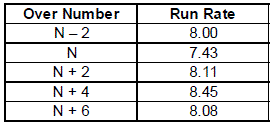
following table indicates the run rate of a team at the end
of some of the overs during a T20 cricket match (correct
up to 2 decimal places), where 1 ≤ N - 2 < N + 6 ≤ 20 , N
a positive integer. It is also known that the team did not
score less than 6 runs and more than 15 runs in any over.
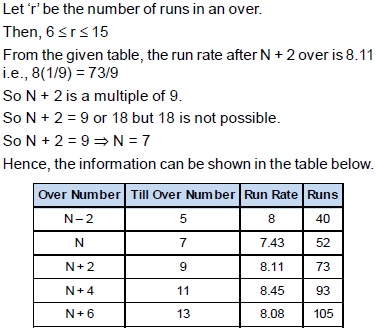
Pair of over numbers:
6 and 7: Total 12 runs.
7 and 8: Total 21 runs.
8 and 9: Total 21 runs.
9 and 10: The team could have scored 22 runs in
total.
10 and 11: Total 20 runs.
Hence, a total of 22 runs could have been scored
in 9 and 10 overs.
Q. 25 In which of the following over numbers, the team MUST
have scored the least number of runs?
A total of 12 runs were scored in the 6th and 7th
overs, with 6 runs in each over. Hence, 7th over is
the required answer.
Directions for questions 26 to 28: Read the following
scenario and answer the THREE questions that follow.
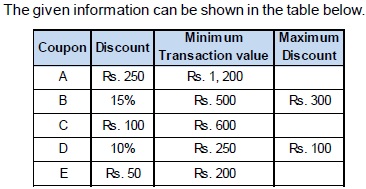
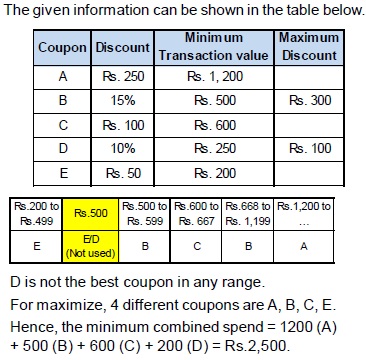
A store offers a choice of five different discount coupons
to its customers, described as follows:
Coupon A: A flat discount of Rs. 250 on a minimum spend
of Rs. 1200 in one transaction.
Coupon B: A 15% discount on a minimum spend of
Rs. 500 in one transaction, up to a maximum discount of
Rs. 300.
Coupon C: A flat discount of Rs. 100 on a minimum spend
of Rs. 600 in one transaction.
Coupon D: A 10% discount on a minimum spend of
Rs. 250 in one transaction, up to a maximum discount of
Rs. 100.
Coupon E: A flat discount of Rs. 50 on a minimum spend
of Rs. 200 in one transaction.
The customers are allowed to use at most one coupon in
one transaction, i.e., two or more coupons cannot be
combined for the same transaction.
Q. 26 Four customers used four different discount coupons
for their respective transactions in such a way that
they obtained a total discount of Rs. 710.
Which discount coupon was not used?
The total discount of coupons A and C = 250 + 100
= Rs.350
If we add coupon B, then the total discount = 350
+ 300 = Rs.650
For a total discount of Rs.710, we have to add
coupon D for a discount of Rs.60.
Hence, coupon E was not utilized.
Q. 27 Four customers used four different discount coupons
for their respective transactions in such a way that
nobody used any discount coupon sub-optimally. (A
discount coupon is used sub-optimally if using
another discount coupon could have resulted in a
higher discount for the same transaction.)
What was the minimum combined spend (before
application of any discount)?
Q. 28 A family wanted to purchase four products worth
Rs. 1,000 each, and another product worth Rs. 300.
They were told that they could:
I) pay for the five products through one or more
transactions in any way they wanted, as long as
the purchase amount of any one product would
not get split into different transactions, and
II) use the same discount coupon repeatedly for
separate transactions, if they opt for more than
one transaction.
What was the maximum discount that they could
obtain for their purchase?
For the maximum discount, one transection of
(1,000 + 300 =) Rs.1,300 using coupon A and three
transections of Rs.1,000 each using coupon B.
Hence, the maximum discount
= 250 + 3 × 1000 × 0.15 = 250 + 450 = Rs.700.