Q. 1 There are 25 rooms in a hotel. Each room can
accommodate at the most three people. For each
room, the single occupancy charge is Rs. 2000 per
day, the double occupancy charge is Rs. 3000 per
day, and the triple occupancy charge is Rs. 3500
per day.
If there are 55 people staying in the hotel today, what
is the maximum possible revenue from room
occupancy charges today?
Since there are 25 rooms in total and 55 people
are there. Cost of single, double and triple
occupancy room is Rs. 2,000, Rs. 3,000 and
Rs. 3,500, respectively.
For one person it will be Rs. 2,000, Rs. 1,500 and
Rs. 1,166.67.
Let number of single, double and triple occupancy
rooms to be used be x, y, and z, respectively. Then,
x + y + z = 25 ...(1)
x + 2y + 3z = 55 ...(2)
If z = 5, then y = 20.
Hence, maximum total revenue will be 20 × 3,000
+ 5 × 3,500 = Rs. 77,500.
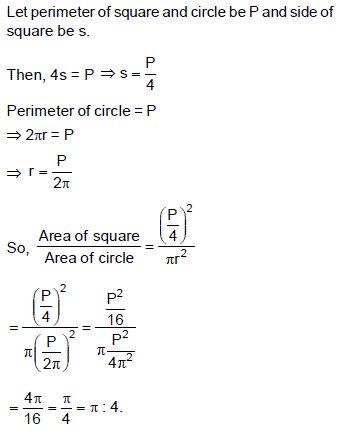
Q. 3 Adu and Amu have bought two pieces of land on the
Moon from an e-store. Both the pieces of land have
the same perimeters, but Adu’s piece of land is in
the shape of a square, while Amu’s piece of land is
in the shape of a circle.
The ratio of the areas of Adu’s piece of land to Amu’s
piece of land is:
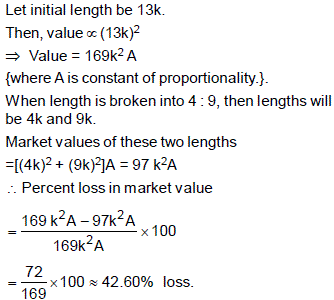
Q. 4 The market value of beams, made of a rare metal,
has a unique property: the market value of any such
beam is proportional to the square of its length. Due
to an accident, one such beam got broken into two
pieces having lengths in the ratio 4 : 9.
Considering each broken piece as a separate beam,
how much gain or loss, with respect to the market
value of the original beam before the accident, is
incurred?
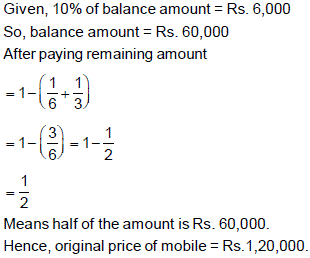
Q. 5 Ramesh bought a mobile from a local store. He paid
1/6 of the price via UPI and 1/3 of the price via cash.
He agreed to pay the balance amount a year later.
While paying back the balance amount, Ramesh
paid 10% interest on the balance amount.
If the interest paid was Rs. 6000, what was the original
price of the mobile?
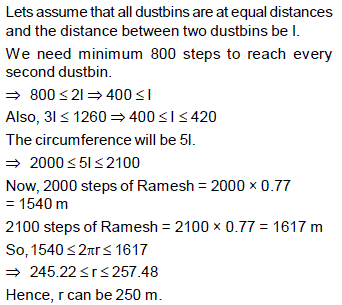
Q. 8 There are five dustbins along a circular path at different
places. Ramesh takes multiple rounds of the path
every morning, always at the same speed. He noticed
that it took him a different number of steps to walk
between any two consecutive dustbins. Ramesh also
noticed that starting from any of the dustbins, it took
a minimum 800 steps to reach every second dustbin.
On the other hand, starting from any of the dustbins,
it took a maximum 1260 steps to reach every third
dustbin.
If Ramesh’s one step is 0.77 metre, and the width of
the path is negligible, which the following can be the
radius of the circular path?
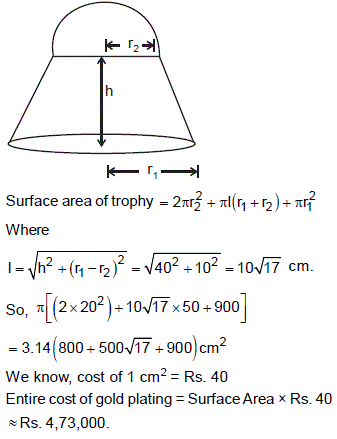
Q. 9 A soild trophy, consisting of two parts, has been
designed in the following manner: the bottom part is
a frustum of a cone with the bottom radius 30 cm,
the top radius 20 cm, and height 40 cm, while the
top part is a hemisphere with radius 20 cm. Moreover,
the flat surface of the hemisphere is the same as
the top surface of the frustum.
If the entire trophy is to be gold-plated at the cost of
Rs. 40 per square cm, what would the cost for goldplating
be closest to?
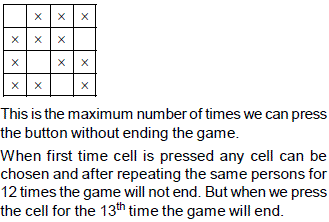
Q. 10 In a computer game, each move requires pressing a
button. When the button is pressed for the first time,
as a move, the computer randomly chooses a cell
from a 4x4 grid of sixteen cells and puts an “X” mark
on that cell. When the button is pressed
subsequently, the computer randomly chooses a cell
from the remaining unmarked cells and puts an “X”
mark on that cell. This goes on till the end of the
game. The game ends when either all the cells in
any one row, or all the cells in any one column, are
marked with “X”.
What is the maximum possible number of times a
player has to press the button to finish the game?
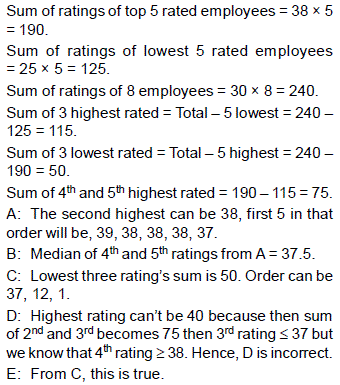
Q. 11 Eight employees of an organization have been rated
on a scale of 1 to 50 for their performance. All ratings
are integers. The overall average rating of the eight
employees is 30. While the five employees with the
highest ratings average 38, the five employees with
the lowest ratings average 25.
Which of the following, about the ratings obtained by
the eight employees, is DEFINITELY FALSE?
Q. 12 Arun selected an integer x between 2 and 40, both
inclusive. He noticed that the greatest common divisor
of the selected integer x and any other integer
between 2 and 40, both inclusive, is 1.
How many different choices for such an x are
possible?
If GCD of two numbers is 1, they are co-prime.
Given that GCD of x any other integer between 2
and 40 both inclusive is 1.
So number has to be a prime number > 20 as
prime numbers less than 20 like 19 will have their
multiple like 38.
Possible values of x are 23, 29, 31 and 37 i.e.,
4 values.
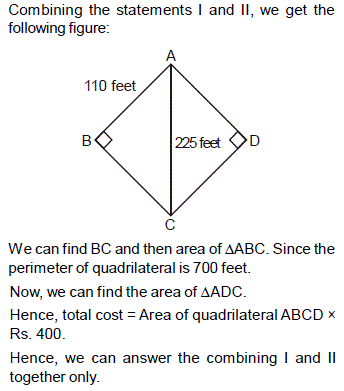
Q. 13 A farmer has a quadrilateral parcel of land with a
perimeter of 700 feet. Two opposite angles of that
parcel of land are right angles, while the remaining
two are not. The farmer wants to do organic farming
on that parcel of land. The cost of organic farming is
Rs. 400 per square foot.
Consider the following two additional pieces of
information:
I. The length of one of the sides of that parcel of
land is 110 feet.
II. The distance between the two corner points where
the non-perpendicular sides of that parcel of land
intersect is 255 feet.
To determine the amount of money the farmer needs
to spend to do organic farming on the entire parcel
of land, which of the above additional pieces of
information is/are MINIMALLY SUFFICIENT?
Q. 14 An industrial robot manufacturing company is tasked
to design humanoid robots to be used in warehouses
where the robots need to pick items from a stack of
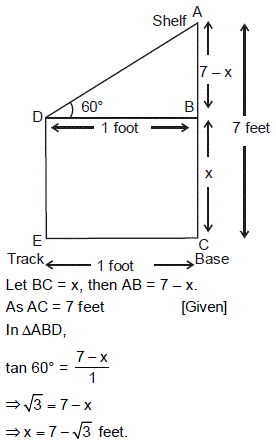
shelves. The height of the topmost shelf from the
ground is 7 feet. To operate, the robot has to move
on a track, running parallel to the stack of shelves.
The track is fixed 1 foot away from the base of the
stack of shelves. Further, the robot cannot raise its
arms by more than 60° from the horizontal plane.
If the robot’s arms are attached to its shoulder, what
should be the minimum height of the robot from the
ground to the shoulder for its arms to reach the
topmost shelf?
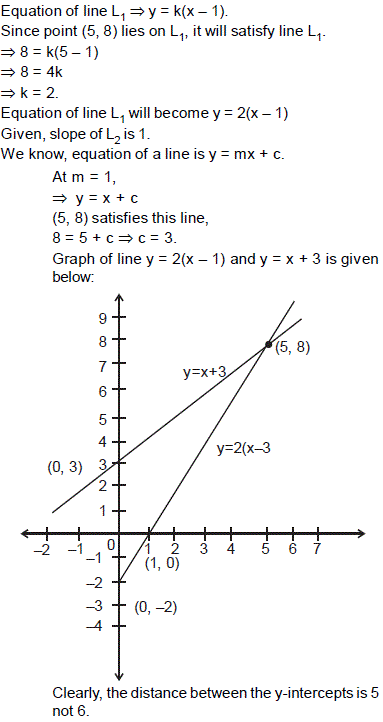
Q. 16 A straight line L1 has the equation y = k(x – 1), where
k is some real number. The straight line L1 intersects
another straight line L2 at the point (5, 8).
If L2 has a slope of 1, which of the following is
definitely FALSE?
Directions for questions 17 to 19: Read the following
scenario and answer the THREE questions that follow.
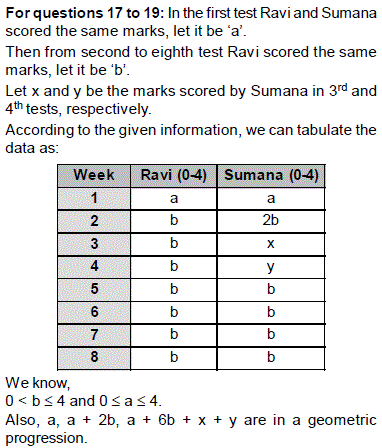
In an 8-week course, a professor administered a test at
the end of each week. Each of the eight tests was scored
out of 4 marks, and a student could only receive a nonnegative
integer score.
Two students, Ravi and Sumana, took the eight tests.
In the first test, Ravi and Sumana scored the same marks.
From the second to eighth tests, Ravi scored the exact
same non-zero marks. Sumana scored the same marks
as Ravi from the fifth test onwards. Ravi’s total marks in
the first three tests was the same as Sumana’s total marks
in the first two tests. Also, Sumana’s marks in the first
test, total marks of the first two tests, and total marks of
the eight tests are in a geometric progression.
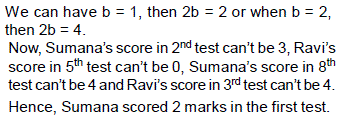
Ravi scored 4 marks in the first test, i.e., a = 4.
There can be two cases:
(i) b = 1.
The G.P. will be 4, 6, 10 + x + y.
But the third term should be 9. So, this case is
rejected.
(ii) b = 2.
The G.P. will be 4, 8, 16 + x + y.
And the third term should be 16 which implies
x = y = 0.
Hence, Sumana’s score in 3rd test is 0.
Q. 19 If Ravi scored 1 mark in the second test, what is the
maximum possible value of Sumana’s total marks
in all the eight tests together?
We have, b = 1 i.e., 2b = 2.
We have 5 possible values of a:
(i) a = 0, G.P. will begin with 0, which is not possible.
(ii) a = 1, G.P. will be 1, 3. 3rd term is 9, which is a
valid case.
(iii) a = 2, G.P. will be 2, 4. 3rd term is 8, which is a
valid case.
(iv) a = 3, G.P. will be 3, 5. 3rd term is 25/3, which
is not possible.
(v) a = 4, G.P. will be 4, 6. 3rd term is 9, which is a
valid case.
So, the maximum value of Sumana’s total score
which is the third term of the G.P. is 9.
Directions for questions 20 to 22: Read the following
scenario and answer the THREE questions that follow.
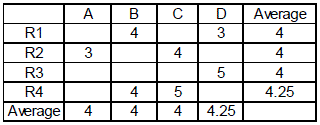
GadRev is a firm that reviews different latest gadgets
through a team of four reviewers (R1, R2, R3, and R4).
Recently the reviewers reviewed four different tech gadgets
(A, B, C, and D) on a scale of 1 to 5 (all integer values)
where 1 denotes poor and 5 denotes excellent. These
review ratings were then tabulated. However, due to a
technical glitch, some of these ratings got deleted. The
average rating given by each reviewer, and the average
rating given to each gadget were earlier communicated to
the team management in a separate email and hence can
be useful to retrieve the deleted ratings. The available
ratings along with the average ratings are represented in
the following table:
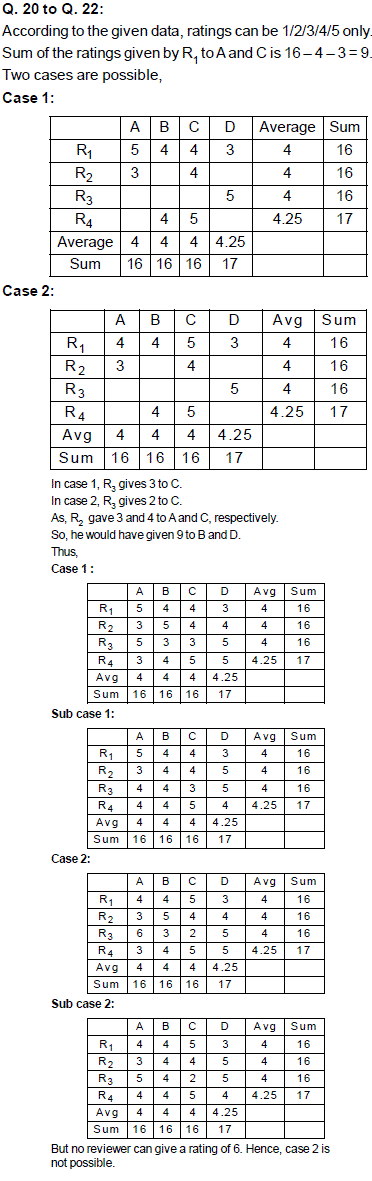
Q. 20 What rating provided by Reviewer R1 to Gadget A
can help determining the remaining ratings uniquely?
If R1 gives a rating of 5 to A we can’t find the
remaining ratings. Hence, R1 has to give 4 to A.
Q. 21 In how many different ways could Reviewer R2 have
rated Gadget B so that the ratings lead to the same
averages for the gadgets and the reviewers as shown
in the table?
There are 3 possible valid combinations for the
missing ratings.
Directions for questions 23 to 25: Read the following
scenario and answer the THREE questions that follow.
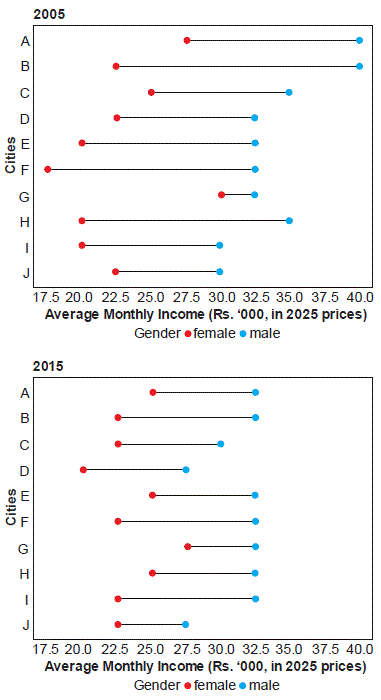
The plots below depict and compare the average monthly
incomes (in Rs. ’000) of males and females in ten cities of
India in the years 2005 and 2015. The ten cities, marked
A-J in the records, are of different population sizes. For a
fair comparison, to adjust for inflation, incomes for both
the periods are scaled to 2025 prices.
Each red dot represents the average monthly income of
females in a particular city in a particular year, while each
blue dot represents the average monthly income of males
in a particular city in a particular year. The gender gap for
a city, for a particular year, is defined as the absolute
value of the average monthly income of males, minus the
average monthly income of females, in that year.
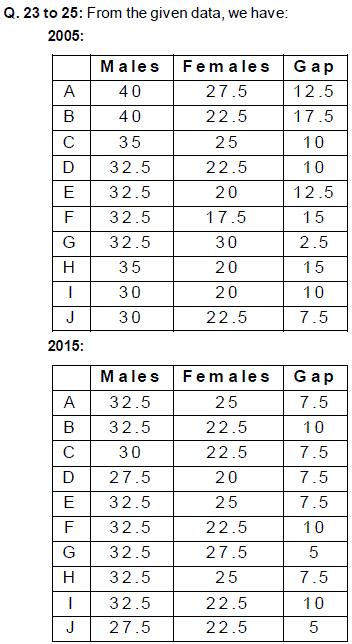
Q. 23 In which city did the gender gap, in terms of 2025
prices, change the least, from 2005 to 2015, in terms
of percentage?
A: There are some cities where average income
of females is less than Rs. 22,000.
B: Median of men’s income in 2005 = Rs. 32,500.
Median of women’s income in 2005 = Rs. 22,500.
Median of men’s income in 2015 = Rs. 32,500.
Median of women’s income in 2015 = Rs. 22,500.
Median of men’s income is higher than median
of women’s income in both years.
C: Average monthly income of men in 2005 in
6 cities is more than that of in 2015.
D: Average wage gap is 2005 = Rs. 11,250.
Average wage gap in 2015 = Rs. 7,750.
Average wage gap in 2015 is less than 2005.
E: Average men’s income in all 10 cities in 2005
is more than or equal to Rs. 30,000.
Hence, statement E is false.
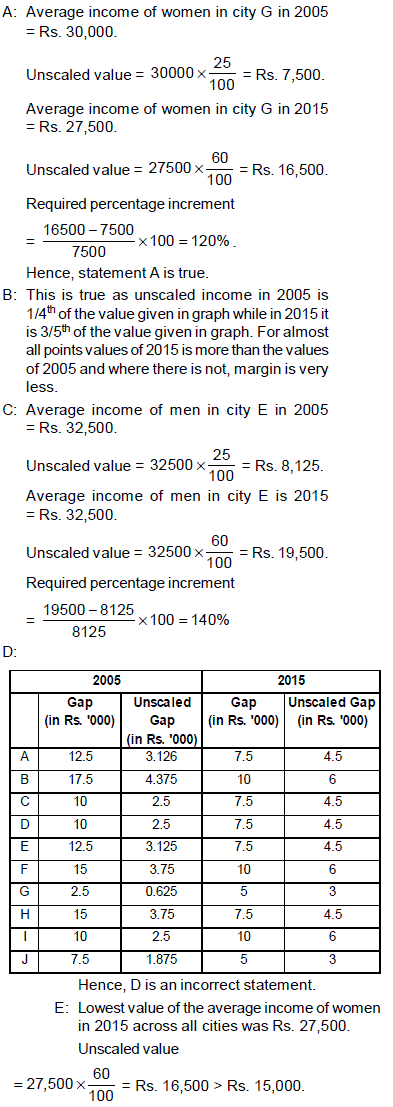
Q. 25 Rs.100 in 2025 is worth Rs. 60 in 2015 prices, and
Rs. 25 in 2005 prices. Based on the given plots,
which of the following statements, about the unscaled
incomes, i.e., the incomes before scaling to 2025
prices, CANNOT be correct? (All statements refer
to people represented in the given plots.)
Directions for questions 26 to 28: Read the following
scenario and answer the THREE questions that follow.
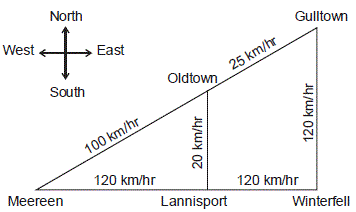
The diagram below represents a road network connecting
five towns, namely Meereen, Lannisport, Winterfell,
Oldtown, and Gulltown. The maximum speed limits along
any stretch of road are as shown in the diagram. The
straight road that connects Meereen to Gulltown passes
through Oldtown. Another straight road, running west to
east, connecting Meereen to Winterfell, passes through
Lannisport. Further, two straight roads, one from Lannisport
to Oldtown and another from Winterfell to Gulltown, are
perpendicular to the road joining Meereen to Winterfell,
and run from south to north.
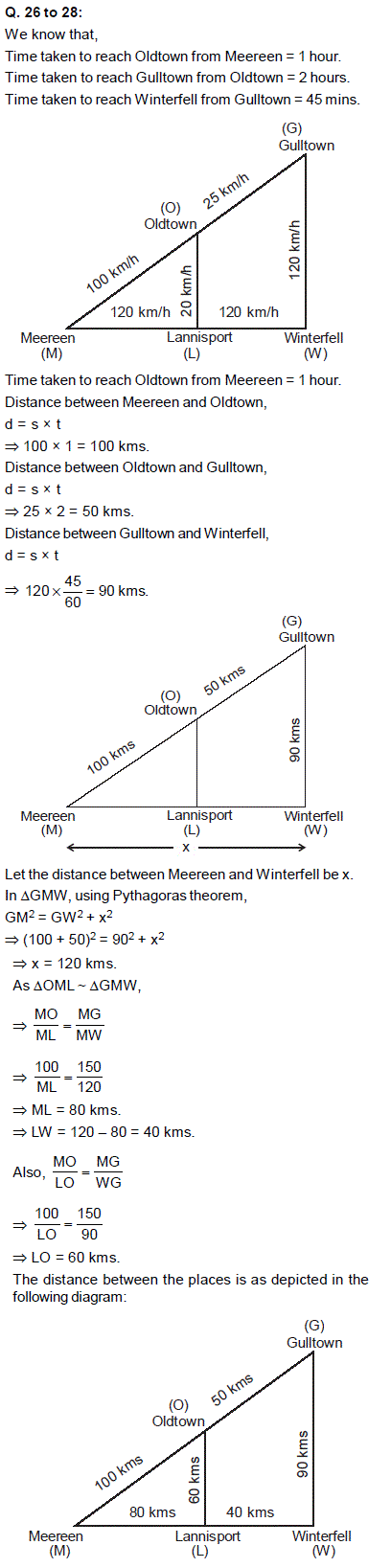
Consider a car always travelling at the maximum
permissible speed, and always taking the shortest route.
It takes 1 hour to reach Oldtown from Meereen, 2 hours to
reach Gulltown from Oldtown, and 45 minutes to reach
Winterfell from Gulltown. (For this problem, always
consider the shortest route in terms of distance.)
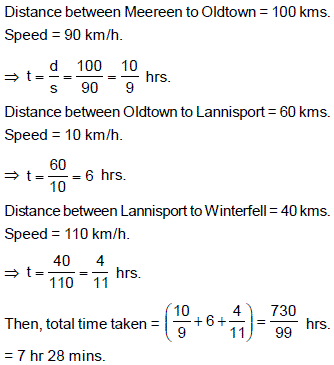
Q. 26 Tyrion Lannister drove from Meereen to Oldtown, then
from Oldtown to Lannisport, and finally from
Lannisport to Winterfell, always taking the shortest
paths. He always drove at a speed 10 km/hr below
the maximum speed limits for the stretches he took.
Q. 27 Missandei starts from Gulltown towards Oldtown by
the shortest path, driving at the maximum permissible
speed. From Oldtown, she drives at a speed of
10 km/hr towards Lannisport. When Missandei starts
from Gulltown, Varys starts at the same time from
Lannisport to Oldtown along the shortest path, always
driving at the maximum permissible speed.
If they don’t stop anywhere, at what point will they
meet?
The path taken by Missandei is GO, OL at a speed
of 25 kmph and 10 kmph. The path taken by Varys
is LO at a speed of 20 kmph.
Missandei reaches 0.2 hours after he starts.
In the meantime, Varys travels 20 × 2 = 40 kms.
Now, both are travelling in opposite directions and
20 kms away.
The speed of Varys is 20 kmph, and that of
Missandei is 10 kmph.
The time taken for them to meet is 20/30 = 2/3 hr.
In 2/3 hr, Missandei travels 6.67 km, and Varys
travels 13.33 kms.
So, they will meet at 6.67 kms south of Oldtown.
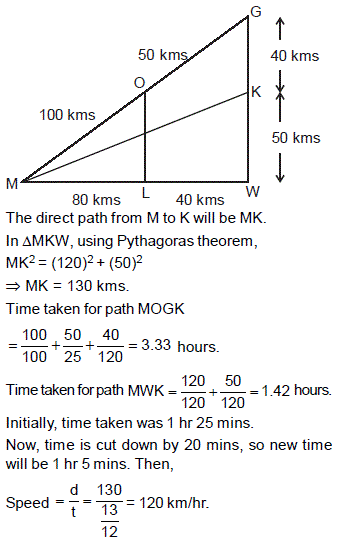
Q. 28 The capital city, King’s Landing, located 40 km to
the south of Gulltown on the road connecting Gulltown
to Winterfell, did not have a straight road, connecting
to Meereen. Now, a new expressway is being built
to connect these two towns by a straight road.
What should be the maximum speed limit allowed
on this expressway so that it cuts down the travel
time, from Meeren to King’s Landing, from the fastest
possible route through the road network shown in
the diagram, by 20 minutes?