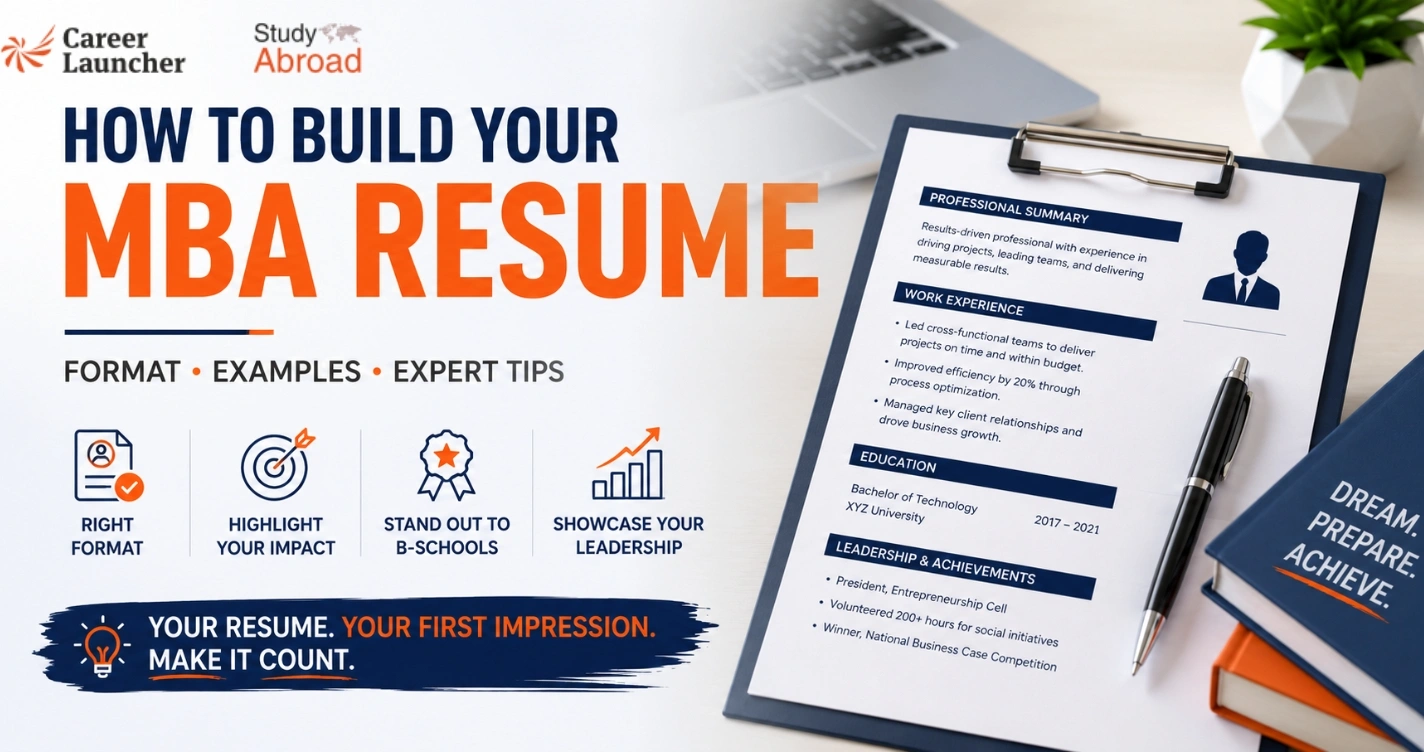
What Should Go Into Your MBA Resume?
There's no single format every school insists on, but four sections form the backbone of almost every strong MBA resume:
Personal Details
Your name, phone number, email address, city, and LinkedIn URL. Keep this to one or two lines — a full postal address is unnecessary and wastes valuable space.
Academic Information
Your degrees in reverse chronological order, along with the institution, graduation year, and any notable honours or GPA worth highlighting.
Work Experience Details
For most colleges under the GMAT, work experience plays a vital role in the shortlisting criteria. Therefore, you should have 2–3 years of work experience before applying to the colleges of your dreams. If the applicant is a fresher, this section is typically replaced with more detail about the candidate's time in college and any internships or projects undertaken. See our comparison of MiM vs. MBA if you're weighing which path suits your experience level.
Extracurricular Activities
Leadership roles, clubs, volunteering, and interests outside of work — these round out the profile and often become talking points in the interview. UNC Kenan-Flagler's guide for applicants puts it plainly: every line on your resume should tell the admissions committee something about your impact, not just your assignment.
MBA Resume Format: Length, Font, and Structure
How Long Should It Be?
A single page is the standard for most applicants with under 10 years of professional experience. If you're applying to an Executive MBA program or have 10+ years of experience, a two-page resume is acceptable and expected — admissions committees would rather see your full career arc clearly than have it compressed into an unreadable single page.
Font, Margins, and File Type
- Font: Times New Roman, Calibri, or Arial, 10–12 pt for body text, 14 pt for headings.
- Margins: no smaller than 0.75″ top/bottom and 1″ on either side.
- Colour: stick to black and white — avoid graphics, headshots, and colour blocks.
- File type: save and submit as a PDF so formatting doesn't shift across devices.
Sample MBA Resume: A Full Example
Reading advice about resumes only goes so far — seeing a full one laid out makes the format easier to copy. Here's a sample built around a typical applicant profile with 3-4 years of experience:
|
Abhishek Singh
Delhi, India | abhishek.singh@email.com | +91-72XXXXXXXX | linkedin.com/in/abhisheksingh
|
|
EDUCATION
Delhi University — B.Com (Honours), Economics, 2018 | GPA: 8.7/10
Relevant coursework: Financial Accounting, Business Statistics, Microeconomics
|
|
PROFESSIONAL EXPERIENCE
Senior Analyst, ABC Consulting Pvt. Ltd. — Gurugram | July 2021–Present
- Led a 4-member team on a supply-chain cost audit for a Fortune 500 FMCG client, identifying ₹3.2Cr in annual savings
- Built a pricing model adopted across 3 business units, reducing forecast error by 15%
- Managed client relationships for 2 mid-market accounts worth a combined ₹6Cr in annual billings
- Business Analyst, XYZ Solutions — Bengaluru | June 2018–June 2021
- Automated a manual reporting process using Excel macros, cutting weekly reporting time from 6 hours to 45 minutes
- Trained 3 new analysts as team lead during a period of 40% headcount growth
- Presented quarterly performance reviews directly to senior leadership
|
|
LEADERSHIP & EXTRACURRICULARS
- Founder, Weekend Finance Circle — a 25-member peer group running monthly investing workshops for young professionals (2022–present)
- Volunteer tutor, Teach for Tomorrow NGO — taught mathematics to underprivileged students for 2 years
- Completed 3 half-marathons since 2021
|
|
CERTIFICATIONS & SKILLS
CFA Level I Cleared (2023) | Advanced Excel & Power BI | Conversational Spanish
|
Notice what this sample does: every bullet leads with a result or a number, the leadership section gets almost as much space as the job history, and there's no objective statement eating up the top third of the page.
Ways to Strengthen Your MBA Resume Beyond Your Grades
Some things you can't change at this stage — your academic record, your years of experience. But a few other levers can meaningfully strengthen your MBA resume:
Certifications and Courses
Certifications and short courses are one of the simplest ways to strengthen your profile. They show where your interests genuinely lie, and if you're trying to pivot into a new field, they signal that you've already started building relevant knowledge.
Internships
Internships carry more weight than certifications, because they show you've applied what you learned in a real setting rather than just studied it. Machine learning and data-related internships tend to stand out most right now, given how quickly the field has grown.
Social Service
Long-term volunteering signals the kind of ethical judgment admissions committees look for in future managers — people who will one day be responsible for entire teams. The longer you've stuck with it, the more it reads as genuine rather than resume padding.
Hobbies
Hobbies aren't filler. They show you follow through on things outside work and academics, and give the panel a sense of how you're likely to handle pressure and downtime alike.
MBA Resume Mistakes to Avoid
mba.com's admissions team has flagged the same handful of mistakes for years — and their guide on the topic is worth reading in full. The most common one: listing responsibilities instead of results, which does nothing to separate you from another applicant who held the same job title.
Know the One-Page Rule — and the Exception
Aim for a single page — the admissions committee has limited time, and a resume that isn't concise can create a negative bias. The one exception is applicants with 10+ years of experience or those applying to Executive MBA programs, who may use two pages to do justice to a longer career history. Only the most relevant, differentiating points should make the cut either way.
Keep It Short and Concise
Your resume isn't meant to tell your whole story — it's meant to earn you an interview. If it already says everything, the interview has nothing left to explore. Say less, but make every line count.
Use Action Words
Action words attract the reader's attention and make the resume easier to scan. Avoid flooding your resume with too many of them — place them periodically so the reader stays engaged through the entire document rather than skipping sections.
A few strong options: led, launched, drove, optimised, negotiated, scaled, and spearheaded — all of which signal ownership rather than a passive job duty.
Use the Most Recent Information
Make sure every detail — your certifications, current role, and contact information — is accurate and up to date. Discrepancies discovered later, even small ones, can lead to disqualification. Most B-schools also expect a LinkedIn profile link alongside your resume.
Quantify Data Wherever You Can
Quantifying your accomplishments is an excellent step in resume building. Include quantified data wherever possible, as it adds massively to your credibility — numbers are easier to interpret than words and give a clear sense of scale.
For example, instead of “Responsible for managing a marketing budget and a team,” write “Managed a ₹40L marketing budget and a 5-member team, increasing campaign ROI by 22% in one year.”
Include Both Results and Responsibilities
List both what you achieved and what you were responsible for. It gives the interview panel something concrete to probe — they'll ask how you got the result, not whether you actually did the work.
Mention Leadership Roles
Every B-school is filtering for future managers, so leadership experience — even informal or short-term — deserves its own line rather than a mention buried inside another bullet.
Show Career Progression
If you've moved from one role into a bigger one, make that visible. It signals ambition and growth, and it often becomes a natural talking point in your interview.
Make a Draft Well in Advance
Give yourself months, not weeks. Candidates who wait until after their GMAT to start their resume tend to rush it — and it shows.
Put Only Authentic Information
Only claim what you can back up. Admissions readers see thousands of resumes a year and are quick to spot exaggeration — and if it surfaces after you're admitted, the consequences are far more serious than a rejected application.
Should You Include an Objective or Summary Statement?
In most cases, skip it — the admissions committee already knows your objective is to get into their program, and a mission statement takes up space better used for accomplishments. The one exception is freshers with little to no work experience, who can use a two-line summary to frame their academic strengths and career direction.
Before-and-After: MBA Resume Bullet Examples
Seeing the difference between a responsibility-only bullet and a results-driven one makes the earlier tips easier to apply:
|
|
Weak (responsibility-only)
|
Strong (results-driven)
|
|
Example 1
|
Responsible for managing client accounts and coordinating with the sales team.
|
Managed 12 client accounts worth ₹2.5Cr, improving retention by 18% through closer sales-team coordination.
|
|
Example 2
|
Assisted in organising college fest and managing volunteers.
|
Led a 30-member volunteer team to organise a college fest with 5,000+ attendees, cutting logistics costs by 15%.
|
Key Takeaways
Keep these points in mind when you’re building your MBA resume and see the difference it can make.
- Your MBA resume should speak to managerial and leadership potential, not technical skill.
- One page is standard; two pages are acceptable only for Executive MBA applicants or those with 10+ years of experience.
- Quantify achievements wherever possible — numbers build credibility faster than adjectives.
- Skip the objective statement unless you're a fresher with little work experience.
- Authenticity matters more than polish — admissions panels catch inflated claims quickly.
Conclusion
As with anything in life, first impressions are critical. The MBA Resume represents this first impression as it is the first touchpoint where the candidate can impress the selection panel of the B-School that they are targeting. A well-presented MBA resume is also an indication of a candidate's dedication when it comes to the overall resume-building process. There should be no discrepancy in terms of the format as the MBA Resume is generally the first impression that the B-School will have of the candidate. The candidate needs to ensure that the MBA Resume provided has the right hooks such that the panel is intrigued enough to justify an interview while maintaining all the basic requirements that the college asks for. Resume building is a vital part of the overall process of getting admitted into your dream B-school. You should not ignore it at any cost. We hope that this article helps you in building your MBA resume, which will, in turn, get you in the best possible B-school.
Recommended Reads
FAQ's
One page for most applicants with under 10 years of experience. Two pages are acceptable for Executive MBA applicants or those with 10+ years of work history.
Generally no — the admissions committee already knows your objective. Freshers with limited work experience are the main exception.
Times New Roman, Calibri, or Arial at 10-12 pt, black and white only, saved and submitted as a PDF.
An MBA resume is reviewed by an admissions committee rather than a recruiter or ATS, and it emphasises managerial and leadership potential over technical skills.
No. Photos, headshots, and decorative graphics are a risk rather than a differentiator — they can distract from the content and, in some cases, introduce unconscious bias.
Address it briefly rather than hoping it goes unnoticed. A one-line note on context (e.g., a career break, a company shutting down) reads better than a resume that silently skips months.
Yes — if you have little to no full-time experience, internships and significant college projects can anchor your Work Experience section instead of sitting in a separate, less visible block.
It's optional. Most schools already have your official score through your application, so including it on the resume is a matter of space — only add it if you have room left after your core sections.