Why Study MS in Hospitality Management in Canada?

Being one of the fastest-growing sectors, the hospitality and tourism industry contributed around $41 billion to Canada’s GDP in 2024. Nearly 1 in 10 jobs in Canada are from this sector, reflecting the scale and economic importance of this sector.

The hospitality industry offers many employment opportunities as both accommodation and food services contribute to a large share of available jobs, with hospitality consistently among the sectors supporting economic activity and workforce demand. There are over 265,800 businesses in the tourism-related industry in 2024, which means that graduates with hospitality management expertise are well-positioned to meet industry needs.

Canada is one of the few countries that offer clear and structured pathways to gain work experience for students and then eventually apply for Permanent Residency (PR). Canadian work experience received through the Post-Graduation Work Permit (PGWP) also improves your CRS (Comprehensive Ranking System) score in the Express Entry system.

Canadian institutions are known for their quality education and strong emphasis on applied learning. Many hospitality and tourism master's programs include co-op placements, internships, or industry projects that integrate academic learning with practical experience. This way, students get ready for real-world challenges in hotels, resorts, event management, and tourism organisations.

When compared with countries like the UK or the USA, Canada is generally considered to be a more affordable study destination, especially when factoring in the length of study and post-study work options. For reference, average tuition fees for an MS in Hospitality Management in Canada are around INR 13L, while for an MS in Hospitality Management in the UK, it can go up to 28L.

MS in Hospitality Management in Canada: Program Overview

The MS in Hospitality Management in Canada is a graduate-level program aimed at training students in hotel operations, different culinary disciplines, catering, and event management, among others.

This degree is ideal for students who want to build global careers in hotel management, tourism operations, event management, or guest experience leadership in Canada and abroad.

Most programs in Canada are offered as full-time courses lasting 1 to 2 years, depending on whether they include a thesis, project, or co-op or internship component.

MS in Hospitality Management vs Tourism vs MBA in Hospitality

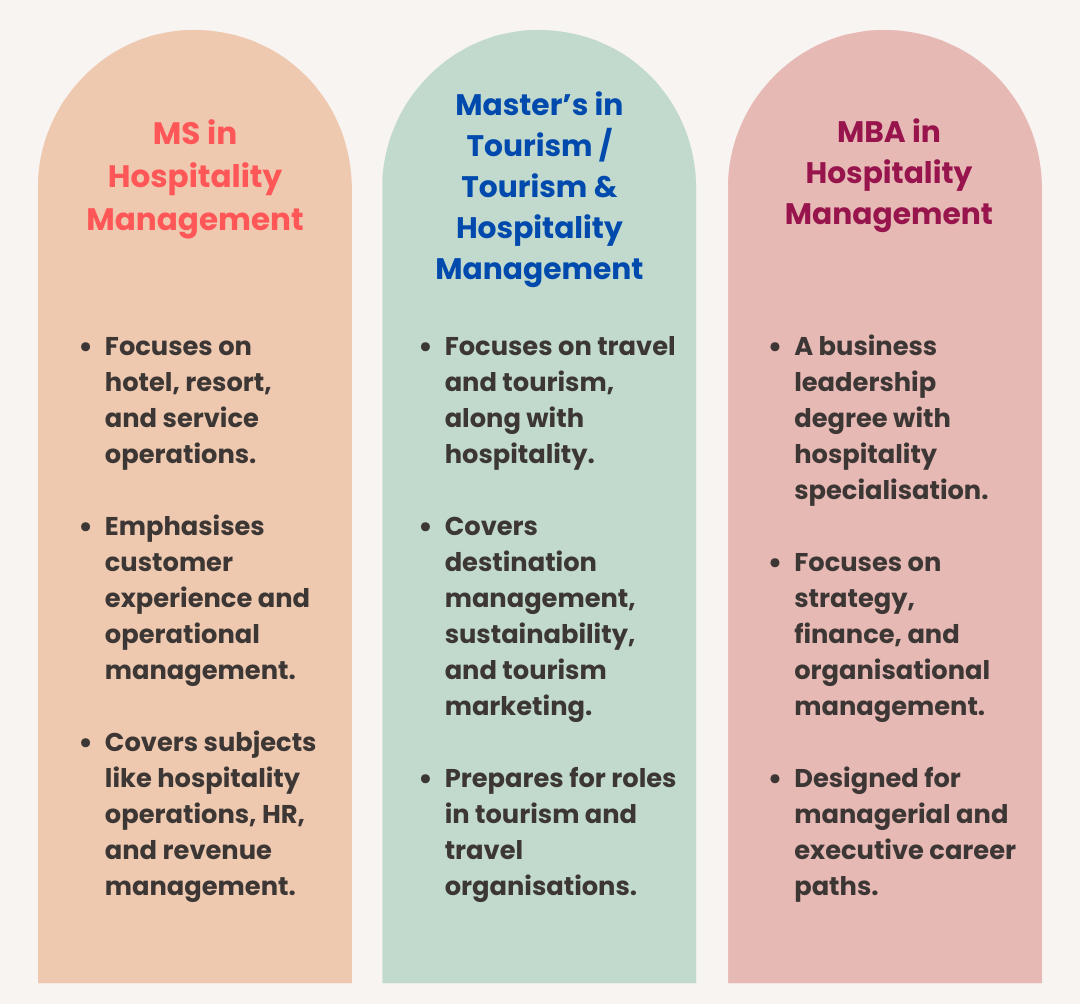
Students are often confused about pursuing an MS in Hospitality Management, a Master’s in Tourism, or an MBA in Hospitality Management. All three are distinct in nature despite belonging to the same field, and lead to different career outcomes.

See a brief comparison of all three below for a clearer understanding:

Top Universities for MS in Hospitality Management in Canada

University

Program/ Related Program

Tuition Fees

University of Guelph

MS Tourism & Hospitality Management

CA$35,800


INR 23,24,297

Fairleigh Dickinson University 

Hospitality Management Studies

CA$20,635 per year


INR 13,39,717

Royal Roads University

MA in Tourism Management

CA$28,500 per year


INR 18,50,348

Seneca College

Grad. Cert. in Global Hospitality Mgmt.

CA$17,500 per year


INR 11,36,179

Humber College

Grad. Cert. in Hospitality & Tourism Operations

CA$18,000 per year


INR 11,68,641

Conestoga College

Grad. Cert. in Global Hospitality Mgmt. (Co-op)

CA$19,500 per year


INR 12,66,028

Niagara College

Grad. Cert. in Global Hospitality Mgmt.

CA$17,000 per year


INR 11,03,716

*Figures above are indicative and subject to change.

Our admissions experts help students build realistic shortlists based on academics, budget, and post-study opportunities, improving their chances of securing offers from the right Canadian universities.

Eligibility & Entry Requirements for MS in Hospitality Management in Canada

Requirement Category

Criteria

Academic qualifications

  • A bachelor’s degree or equivalent from a recognised institution
  • A minimum GPA equivalent to a Canadian B or B- (generally around 65–75%+)

English Language Proficiency

  • IELTS Academic: Overall 6.5 (with no band below 6.0)
  • TOEFL iBT: 90+ overall
  • PTE Academic: 60–65+

Work Experience 

  • Not mandatory, but it can strengthen your application, especially for co-op internship-linked programs

Statement of Purpose (SOP)

  • SOP is mandatory and must outline 
    • your academic background
    • reasons for choosing hospitality management
    • career goals, 
    • how the Canadian program fits your aspirations

Letters of Recommendation (LORs)

  • Usually, 1-2 LORs are required, but this varies for each university

CV/Resume 

  • Universities expect a concise CV or resume highlighting: 
    • academic achievements
    • internships, work history
    • leadership activities 
    • any relevant project or industry experience

Interview 

  • Some universities may conduct online interviews as well

*Entry requirements may vary across universities and programs. Applicants should always verify the specific eligibility criteria on the official university course page before applying.

Cost of Studying MS in Hospitality Management in Canada

For any student wanting to pursue their MS in Hospitality Management in Canada, understanding the cost remains a crucial aspect. Find below a breakdown of costs that a student can expect, including a rough estimate of the tuition fees and the other living expenses.

Tuition Fees in Canada

Tuition fees can vary depending on the program and school you choose. On average, in Canada, the MS in Hospitality Management can cost around $21,100 per year (INR 13,69,907) for international graduate students.

Living Expenses in Canada

Your living expenses largely depend on your location and spending habits. According to the 2019 Mercer Cost of Living Survey, Toronto was the most expensive Canadian city to live in, closely followed by Vancouver, with rent particularly high in both cities. On average, you can expect some of your living expenses to be:

Apart from this, you also need a Canadian study permit, which serves as a student visa for the duration of your stay. Applying for a study permit costs around CA$150 (INR 9,842).

Refer to our complete guide on Studying in Canada to gain a comprehensive understanding.

Scholarships & Funding Options in Canada

Many Indian students have concerns about scholarships due to the high tuition fees when compared to those in India. Below, you can find the main types of scholarships for students pursuing an MS in Hospitality Management in Canada.

University Scholarships

Many universities offer their own scholarships to international students on the basis of either merit or financial need. Students should check the university website to get a full list of scholarships available.

It’s important to apply as early as possible, as scholarship funding is limited and highly competitive.

Government-Funded Scholarships

There are multiple scholarships provided by the Canadian government for Indian students who want to pursue higher education. Find some of them below:

There are also external foundations that sometimes offer grants, fellowships and partial funding to the students.

Career Scope After an MS in Hospitality Management in Canada

An MS in Hospitality Management in Canada opens up diverse career opportunities across hotels, resorts, restaurants, tourism boards, event companies, cruise lines, and service-focused organisations.

Some of the job roles that students can explore are:

Job Role

Average Annual Salary

Hotel / Resort Manager

CA$71,841


INR 47 lacs (approx.)

Hospitality Operations Manager

CA$59,786


INR 39 lacs (approx.)

Food & Beverage Manager

CA$62,517


INR 41 lacs (approx.)

Event & Conference Manager

CA$63,643


INR 41 lacs (approx.)

Guest Experience / Service Manager

CA$56,956


INR 37 lacs (approx.)

*Figures above are indicative and subject to change.

Indian students can also apply for the Post-Graduation Work Permit (PGWP), which allows them to work in Canada for up to 3 years, depending on the length of their program. This provides valuable Canadian work experience and significantly improves employability in the hospitality industry.

Planning to Study MS in Hospitality Management in Canada?

With 29+ years of admissions experience, Career Launcher has guided students across leading global destinations, helping a majority secure at least one admit from their shortlisted universities. Our personalised approach ensures you choose the right programs in Canada and build applications that stand out.

Hear what our student has to say:

"My journey to McMaster would have been incomplete without a mention of the active support and sage counsel received from Career Launcher. The mentors there are very actively involved with the student. I really benefited from the personal attention showered on me. I was able to make revisions galore (no pains there, trust me!) because of the hawk-eyed reviews I received from my Mentor. He was a key catalyst in making my application a really differentiated one."

Anant Jain, McMaster University, Hamilton, ON, Canada

FAQ's

Yes, Canada is a good destination for jobs after hospitality management because of its strong tourism and service industry and the availability of post-study work opportunities. International graduates can apply for the Post-Graduation Work Permit (PGWP), which allows them to work in Canada for up to three years after completing their degree.

There is no single 'best' school, as the right choice depends on your academic background, budget, and career goals. However, universities such as Fairleigh Dickinson University (Vancouver) and the University of Guelph are known for their Tourism and Hospitality programs.

Applicants typically need a recognised bachelor's degree with around 65-75%, along with English proficiency such as IELTS 6.5 overall. Most universities also require a Statement of Purpose, CV, and 1-2 letters of recommendation.

Some Canadian institutions offer online or hybrid master's programs in hospitality or tourism management. However, fully online programs may not qualify for the PGWP, so students should confirm post-study work eligibility before applying.

Yes, hospitality management is a good field in Canada due to steady industry demand, applied learning opportunities, and post-study work and PR pathways. It suits students seeking people-focused and service-oriented careers.

Graduates can work as hotel or resort managers, operations managers, food and beverage managers, event managers, tourism managers, or hospitality HR professionals. With experience, they can progress into senior management or consulting roles in Canada and abroad.

Register Now