Master's in Biotechnology in USA
Choosing to pursue a Master's in Biotechnology in the USA provides aspiring biotechnologists with incomparable advantages. Comprising areas such as food and ecological preservation, the field of biotechnology holds the power to revolutionize various aspects of our lives. According to a recent report by Grand View Research, the global biotech market is expected to reach a staggering USD 727.1 billion by 2025. With the industry's value projected to soar to nearly $4 trillion by 2030, at a remarkable CAGR of 14%, there is a pressing need for competent professionals with expertise in biotechnology.
On this page, we are covering:
- Why Study MS in Biotechnology in USA?
- Universities for MS in Biotechnology in USA
- MS in Biotechnology Curriculum in USA
- MS in Biotechnology Requirements & Eligibility Criteria in USA
- Scholarships for MS Programs in USA
- Internships for MS Students in USA
- MS in Biotechnology Scope in USA
- Jobs after MS in Biotechnology in USA
- Work Permit Post MS in Biotechnology in USA
- FAQ's
Why Study MS in Biotechnology in USA?
The United States is recognized as one of the most advanced countries in the field of biotechnology, as highlighted in a 2022 report. With 2,880 biotech companies, the industry in the US is thriving, experiencing a growth rate of 3.9% in 2022. Renowned companies such as Eli Lilly, Pfizer, and Johnson & Johnson are leading the way in innovative research and development.
Moreover, the United States is home to some of the world's top universities offering biotechnology and applied microbiology programs. Institutions like Harvard University, the Massachusetts Institute of Technology (MIT), Stanford University, and the University of California, San Diego, rank among the best in global biotechnology education. US institutions provide cutting-edge research facilities, state-of-the-art laboratories, and world-class faculty who are pioneers in their respective fields.
Studying MS in Biotechnology in the United States not only equips students with technical expertise in genetic engineering, molecular diagnostics, and therapeutic techniques but also offers a comprehensive understanding of the social, business, and regulatory aspects of the field. By immersing in this dynamic academic environment, students gain exposure to a diverse community of researchers and industry experts, fostering collaboration and networking opportunities
Book 30-minute FREE Counselling SessionUniversities for MS in Biotechnology in USA
The following table shows some US universities offering Master's programs in Biotechnology and their tuition fees:
|
University Name |
Program Name |
Fee (in USD)/Year* |
|---|---|---|
|
Harvard University |
MS/MBA Biotechnology: Life Sciences |
79,455 |
|
University of Massachusetts Boston |
MS in Biotechnology and Biomedical Science |
36,879 |
|
John Hopkins University |
Master of Science in Biotechnology |
52,100 – 54,100 |
|
John Hopkins University |
Master of Biotechnology Enterprise and Entrepreneurship |
54,100 |
|
University of California Berkeley |
Master of Bioprocess Engineering |
55,440 |
|
University of San Francisco |
Professional Science Master’s (PSM) in Biotechnology |
27,455 |
|
University of Pennsylvania |
Master of Biotechnology |
55,308 |
|
Carnegie Mellon University |
M.S. in Biotechnology and Pharmaceutical Engineering |
- |
|
Syracuse University |
M.S. in Biotechnology |
33,696 |
|
The University of Texas at Dallas |
Master of Science in Biotechnology |
31,552 |
|
Tufts University |
MS in Chemistry/Biotechnology |
54,196 |
|
San José State University |
Master of Biotechnology |
36036 |
|
University of Alabama at Birmingham |
MS in Biotechnology |
36,901 |
|
University of Wisconsin |
MS in Applied Biotechnology |
21,000 |
|
University of Delaware College of Health Sciences |
MS in Applied Molecular Biology and Biotechnology |
36,975 |
|
Georgetown University |
Master of Science in Biotechnology |
- |
|
Northwestern University |
Master of Biotechnology |
35180 |
|
Columbia University |
MA Biotechnology |
77612 |
* The figures mentioned above serve only as general indicators and can change.
Find your Best-fit University - Speak to Our Experts NowMS in Biotechnology Curriculum in USA
Below are some examples of Master’s programs in Biotechnology offered by universities in the USA. Each program has its own unique curriculum. You may explore specific universities to find the one that suits your interests and goals the best.
Harvard University’s MS/MBA Biotechnology: Life Sciences
Harvard University offers a joint degree program that awards an MBA from Harvard Business School and a Master of Science from the Graduate School of Arts and Sciences and Harvard Medical School in the Harvard Department of Stem Cell and Regenerative Biology. The curriculum includes a diverse range of subjects, including:
- NextGen Biotechnology
- Finance
- Financial Reporting and Control
- Leadership & Organizational Behavior
- Marketing
- Technology & Operations Management
- Data Analytics for Life Sciences
- Business, Government, and the International Economy (BGIE)
- The Entrepreneurial Manager
- Leadership and Corporate Accountability
- Strategy
- Life Science, Ethics, and Management Seminar
- Entrepreneurship in the Life Sciences
- Frontiers in Therapeutics
- Life Science, Ethics, and Management Seminar
Additionally, students can pursue internships during the summer between the program years in fields related to biotechnology and life sciences.
University of Pennsylvania’s Master of Biotechnology
The Master of Biotechnology program at the University of Pennsylvania is an interdisciplinary program designed to prepare students for leadership roles. Located in proximity to renowned biomedical research centers and the largest pharmaceutical/biotechnology corridor in the United States, the program offers three parallel curriculum tracks: molecular biotechnology, biopharmaceutical/engineering biotechnology, and biomedical technologies. These tracks, along with core courses, provide students with the flexibility to tailor their degree according to their background, interests, and career goals. By exploring a wide range of subjects, students gain a comprehensive understanding of the entire field of biotechnology.
Carnegie Mellon University’s MS in Biotechnology and Pharmaceutical Engineering
Carnegie Mellon University offers the MS in Biotechnology and Pharmaceutical Engineering (MS-BTPE) program, a powerful fusion of the Biological Sciences and Chemical Engineering departments. The curriculum blends theoretical knowledge with hands-on instruction. Students receive advanced training in the sciences, with a focus on commercial research, bioinformatic integration, regulatory compliance, medicinal chemistry, and drug development. The program encourages students to pursue external internships after the first year and offers a full-time completion option within three semesters. Key courses in the curriculum include:
- Material and Mass Balance
- Metabolism, Cell Biology, and Molecular Biology
- Applied Cell & Molecular Biology
- Professional Skills
- Bioseparations
- Spectoscopy & Characterization
- Molecular biology lab
- CPS Chemical Engineering Lab
- Bioprocess Design
For further information on a particular university or MS in Biotechnology program that has piqued your interest, reach out to us today!
Learn more about MS in Biotechnology Curriculum in USAMS in Biotechnology Requirements & Eligibility Criteria in USA
Below are the requirements for students who want to pursue MS in Biotechnology in the USA:
- Bachelor’s degree with a minimum GPA of 3.0 out of 4.0.
- Internship certificate/s or work experience, though not mandatory at some universities
- Valid GRE scores
- English language proficiency scores – IELTS or TOEFL.
- Detailed resume
- Letters of Recommendation
- Statement of Purpose and/or other admission essays
Scholarships for MS Programs in USA
When it comes to pursuing an MS in Biotechnology in the USA, there are scholarship opportunities available for international students. Here are some options:
- International Financial Aid and College Scholarship Search: This program stands as the premier database for scholarships dedicated to international students. It aims to promote international education by offering an extensive database of scholarships and financial aid information for international students.
- Fulbright Scholarships: Fulbright Scholarships are fully funded scholarships for international students. These scholarships are only offered for masters and PhD studies. Fulbright Foreign Student Program covers full tuition fee, a living stipend, full accommodation fee, airfare and health insurance.
- Rotary Peace Fellowships: Rotary Peace Fellowships are highly esteemed, fully funded scholarships for international students pursuing master's and PhD programs. These fellowships cover various expenses, including tuition and fees, room and board, round-trip transportation, as well as internship and field-study expenses.
It is important to note that these are just a few scholarship options available. Many universities offering MS in Biotechnology programs also have their own scholarship opportunities for international students. To explore specific scholarships offered by universities, it is recommended to visit their official websites or reach out to us for further information.
Fund your Education - Learn more about MS Scholarships in USAInternships for MS Students in USA
International students seeking paid internship in the USA during their MS programs can apply for Curricular Practical Training (CPT) after completing two semesters of full-time study. CPT allows students to pursue internships with off-campus employers as a necessary part of their degree program. Pursuing a Master's degree in the USA provides students with an opportunity to connect with American tech employers.
MS in Biotechnology Scope in USA
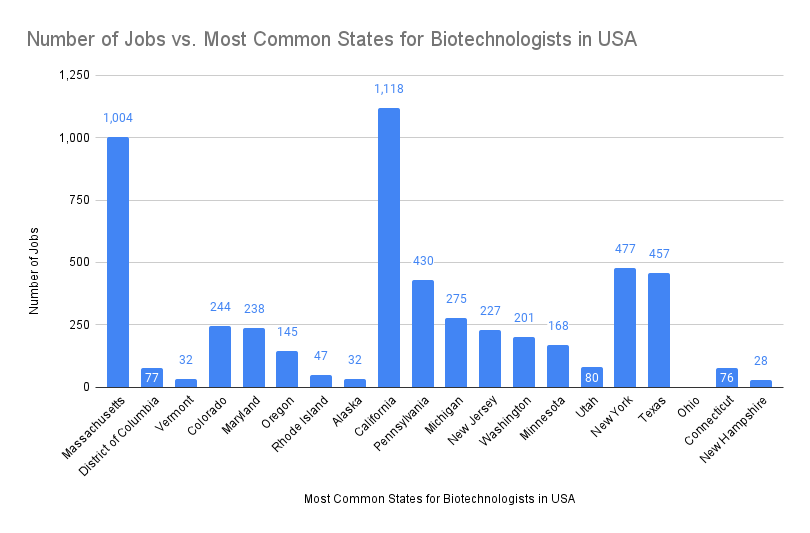
If you're thinking about pursuing a Master's degree in Biotechnology in the USA, it's important to know which states are the most popular for biotechnologists.
Source: https://www.zippia.com/
Below is a table presenting key statistics on the best states for biotechnologists, including population, number of jobs, and employment per 1,000 people:
|
State |
Population |
Number of Jobs |
Employment/1000 people |
|---|---|---|---|
|
Massachusetts |
6,859,819 |
1,004 |
15% |
|
District of Columbia |
693,972 |
77 |
11% |
|
Vermont |
623,657 |
32 |
5% |
|
Colorado |
5,607,154 |
244 |
4% |
|
Maryland |
6,052,177 |
238 |
4% |
|
Oregon |
4,142,776 |
145 |
4% |
|
Rhode Island |
1,059,639 |
47 |
4% |
|
Alaska |
739,795 |
32 |
4% |
|
California |
39,536,653 |
1,118 |
3% |
|
Pennsylvania |
12,805,537 |
430 |
3% |
|
Michigan |
9,962,311 |
275 |
3% |
|
New Jersey |
9,005,644 |
227 |
3% |
|
Washington |
7,405,743 |
201 |
3% |
|
Minnesota |
5,576,606 |
168 |
3% |
|
Utah |
3,101,833 |
80 |
3% |
|
New York |
19,849,399 |
477 |
2% |
|
Texas |
28,304,596 |
457 |
2% |
|
Ohio |
11,658,609 |
205l |
2% |
|
Connecticut |
3,588,184 |
76 |
2% |
|
New Hampshire |
1,342,795 |
28 |
2% |
Jobs after MS in Biotechnology in USA
Biotechnologists are in high demand in the United States, so graduates with an MS in Biotechnology have a lot of work opportunities. Analysts predict a 7% growth in the job market for biotechnologists from 2018 to 2028, indicating a favorable outlook for career prospects in this field. Some of the market leaders in the USA include:
- Eli Lilly and Company
- Novo Nordisk A/S
- Merck & Co., Inc.
- Pfizer Inc.
- BioNTech SE
- Galapagos NV
The interdisciplinary nature of biotechnology equips students with the skills and knowledge to contribute to advancements in genetics, genomics, molecular biology, drug development, and more. With a Master's degree in Biotechnology, graduates can pursue diverse career paths in areas such as:
- Healthcare
- Bioinformatics
- Genetic Engineering
- Agriculture and Environment Biotechnology
- Food and Nutrition
- Pharmaceutical Biotechnology
- Industrial Biotechnology
- Cosmetics R&D
- Nano Biotech
The table below displays different jobs for Master's in Biotechnology graduates along with their average salary packages:
|
Job Title |
Average Salary (in USD)/year* |
|---|---|
|
Research Associate, Biotechnology |
63,821 |
|
Senior Research Associate |
79,896 |
|
Research Scientist, Biotechnology |
77,576 |
|
Research Scientist |
70,394 |
|
Associate Research Scientist |
69,727 |
|
Quality Assurance Manager |
89,072 |
|
Project Manager |
93,38 |
|
Quality Assurance (QA) Specialist |
81,229 |
|
Laboratory Manager |
70,579 |
|
Senior Research Scientist, Biotechnology |
90,254 |
|
Research Associate, Molecular Biology |
57,883 |
|
Researcher, Scientific |
55,690 |
|
Regulatory Affairs Associate |
66,987 |
|
Staff Scientist |
65,248 |
|
Regulatory Affairs Manager |
$92,143 |
|
Project Manager, Pharmaceuticals |
88,182 |
|
Bioinformatics Scientist |
80,571 |
|
Senior Regulatory Affairs Specialist |
104,527 |
|
Quality Control (QC) Supervisor |
75,884 |
|
Quality Control (QC) Specialist |
65,936 |
|
Sr. Operations Manager |
135,576 |
* The figures mentioned above serve only as general indicators and can change.
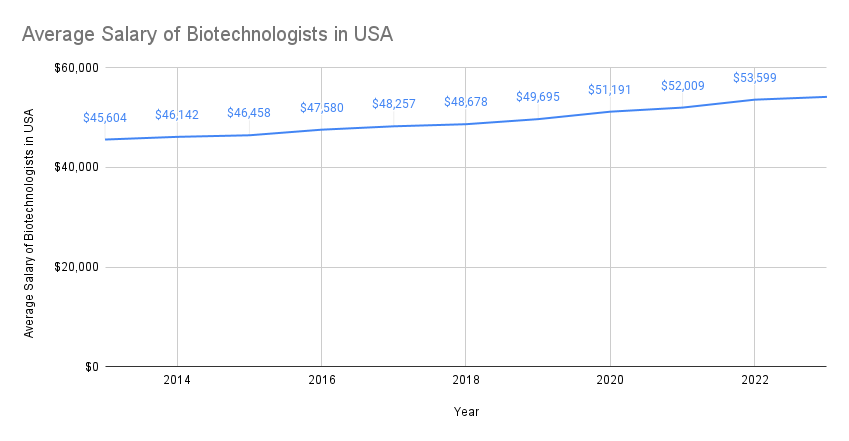
Over the past decade, salaries for biotechnologists have witnessed significant growth. Take a look at the chart below, which showcases biotechnologist salaries by year from 2013 to 2023:
Source: https://www.zippia.com/
Work Permit Post MS in Biotechnology in USA
The Optional Practical Training (OPT) program allows international students to work in the US for up to 12 months after completing their studies. Students who have completed a degree in a Science, Technology, Engineering, or Math (STEM) field may be eligible for an additional 24 months of OPT, for a total of 36 months. In addition to the OPT program, you may also be eligible for an H-1B visa. The H-1B visa is a work visa for highly skilled workers in specialty occupations, including many jobs in the science field. However, the H-1B visa has a limited number of slots available each year, and the application process can be highly competitive.
Book 30-minute FREE Counselling SessionFAQ’s
The USA boasts a robust biotechnology industry, with numerous research institutes, biopharmaceutical companies, and biotech startups. This offers ample opportunities for biotechnology professionals in areas such as research and development, product development, clinical trials, regulatory affairs, and entrepreneurship.
Biotechnology in the USA is thriving and continuously evolving. The country has a strong emphasis on research and innovation, with leading universities and research institutions at the forefront of groundbreaking discoveries and advancements in the field. This industry attracts top talent, offers competitive salaries, and provides a conducive environment for biotech professionals.
To pursue an MSc in Biotechnology in the USA, you need to first research and identify universities offering this degree in the country. Check the admission requirements and prerequisites for each university, and submit your applications to the chosen universities within their application deadlines. If accepted, complete the necessary visa procedures and secure financial support for your studies (through scholarships, assistantships, or personal funding).
Master's programs in biotechnology abroad cover various specialized branches within the field. Some common branches include Biochemistry, Bioinformatics, Biophysics, and Molecular Biology.
The cost of pursuing an MS in Biotechnology in the USA can range between 30k and 70k USD. The lucrative career prospects and potential return on investment (ROI) for biotechnology graduates in the USA make it a worthwhile investment.