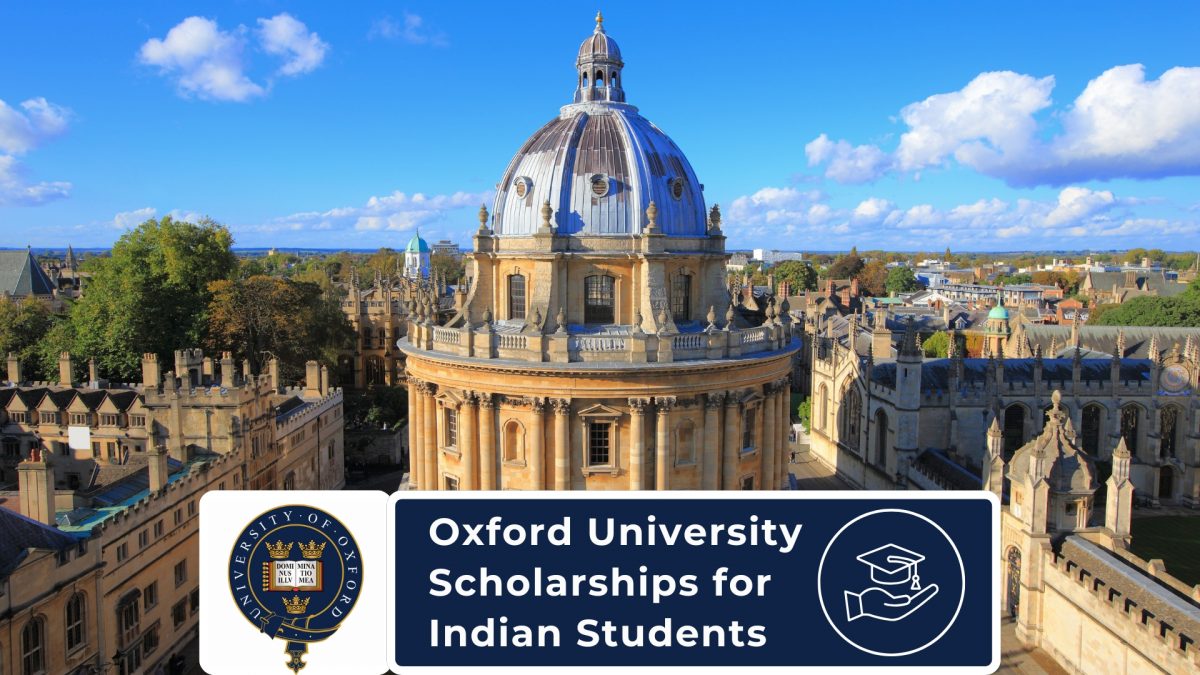
Oxford University and India have a relationship that goes back over a century — over 200 Indian Rhodes Scholars have studied here since 1947. But for most Indian families today, the first question isn’t about history: it’s about money. Graduate tuition at Oxford runs into tens of thousands of pounds, and the cost of living in the UK adds up fast.
The good news is that Oxford has one of the most structured scholarship ecosystems in the world for international students, including several that are specifically designed for — or restricted to — Indian applicants. This guide breaks down exactly what’s available, who qualifies, and how to apply.
Still exploring the UK as a destination? Read our complete UK Study Guide for Indian Students (2026) covers universities, costs, scholarships, and student life in detail.
Table of Contents
How Oxford University Scholarships Work
Oxford University offers over 1,100 full or partial graduate scholarships for new students each academic year. Scholarships are awarded primarily on academic merit and potential, and can cover course fees, living costs, or both — for the full duration of your studies.
Here’s the most important thing to know: for the majority of Oxford scholarships, there is no separate application. You simply submit your graduate application by the December or January deadline for your course, and you’re automatically considered for every scholarship you’re eligible for. Most awards are announced between late February and June.
Since scholarship deadlines are closely tied to application timelines, students should also review the Complete UK Application Document Checklist (2026) to avoid missing key requirements.
Some scholarships do require a separate application, and those are noted below.
Oxford Scholarships Indian Students Can Apply For
-
The Clarendon Fund
The Clarendon Fund is Oxford’s flagship scholarship programme, open to all nationalities. It covers course fees and provides a grant for living costs for the full period of fee liability. Indian students are fully eligible, and roughly 60 Indian students have received Clarendon awards over the past decade.
No separate application is required — submit your graduate application by the December/January deadline, and you’re in the pool.
-
The Felix Scholarship
The Felix Scholarship is one of the few Oxford awards specifically created for Indian students. It has been running since 1991 and covers:
- 100% of course fees
- A living costs grant of approximately £19,000 per year
- One return flight between India and the UK
Awards are available for full-time Master’s and full-time DPhil courses in any subject. Up to 7 awards are made each year. Decisions are expected by the end of May for any given cycle.
Eligibility requirements:
- Indian national, ordinarily resident in India
- First-class undergraduate or Master’s degree from an Indian university
- No degree from a university outside India (prior to the scholarship)
- Must be unable to take up the Oxford place without financial assistance
- Expected to return to India after completing studies
- Must not have previously studied at the same level (e.g., if you already hold a Master’s, you cannot apply for another Master’s under this scheme)
No separate application — you must submit your graduate application by the December/January course deadline. Shortlisted candidates may be asked to complete a questionnaire and attend an interview held in India.
-
The Rhodes Scholarship (India Constituency)
The Rhodes Scholarship is the oldest and most prestigious international scholarship programme in the world. Five Rhodes Scholarships are available for India each year. The scholarship covers full tuition and living costs for postgraduate study at Oxford.
Unlike most Oxford scholarships, the Rhodes operates on its own application timeline and process. For India, the application window for 2026 runs from 1 June to 23 July 2026. Applications are submitted through the Rhodes Trust, not through Oxford’s graduate admissions system.
The scholarship is awarded on the basis of academic achievement, character, leadership, and commitment to service — not financial need.
-
The Reach Oxford Scholarship (Undergraduate)
For Indian students applying for undergraduate study at Oxford, the Reach Oxford Scholarship supports students from low-income countries who cannot pursue a degree in their home country for financial or political reasons, or because suitable facilities don’t exist.
It covers course fees, living costs, and one return flight home per year. Importantly, you must apply for admission to Oxford first — the scholarship is only open to students who have already received an offer. Applications for 2027 entry will open in January 2027.
Discover more: Top UK Scholarships for Indian Students

External Scholarships for Indian Students at Oxford
Oxford’s own website lists a set of external scholarships specifically for Indian nationals. These are funded by organisations outside the university but can be used to support Oxford study.
-
Oxford and Cambridge Society of India Scholarships
Partial funding for undergraduate, second undergraduate, and graduate students who are ordinarily resident in India, for study and research in any subject at Oxford or Cambridge. Indian citizens can apply directly through the Oxford and Cambridge Society of India.
-
J.N. Tata Endowment Awards
Predominantly loan scholarships, though selected scholars may also qualify for an outright gift award. Open to Indian nationals who are graduates of a recognised Indian university. These awards are designed to support postgraduate study abroad, including at Oxford.
-
Narotam Sekhsaria Scholarships
Interest-free scholarship loans for Indian students under 30 pursuing postgraduate studies abroad. The interest-free structure makes these a meaningful option for students who don’t qualify for grant-based aid.
-
Charles Wallace India Trust
Grants and fellowships for Indian nationals to support education or professional development in the UK. The Trust is listed on Oxford’s official external scholarships page for students from Asia and is administered separately from Oxford admissions.
Before applying for scholarships, understand the admission process through our Oxford University Acceptance Rate for Indian Students guide.
A Quick Comparison
| Scholarship | Type | Level | India-Specific? | Separate Application? |
| Clarendon Fund | Full (fees + living) | Graduate | No (all nationalities) | No |
| Felix Scholarship | Full (fees + living + flight) | Graduate | Yes | No |
| Rhodes Scholarship | Full (fees + living) | Graduate | No (but India constituency) | Yes |
| Reach Oxford | Full (fees + living + flight) | Undergraduate | No (low-income countries) | Yes |
| Oxford-Cambridge Society of India | Partial | UG + Graduate | Yes | Yes (via OCSI) |
| J.N. Tata Endowment | Loan/gift | Graduate | Yes | Yes |
| Narotam Sekhsaria | Interest-free loan | Graduate | Yes | Yes |
| Charles Wallace India Trust | Grant/fellowship | Graduate | Yes | Yes |
Read: How to Write a Scholarship Essay That Gets Selected
How to Apply For Oxford Scholarships: Step-by-Step
- Choose your course and check the deadline. Most scholarships require you to apply by the December or January deadline for your course — not the March deadline. Missing this window makes you ineligible for most funding.
- Submit your Oxford graduate application. For Clarendon and Felix, this is all you need. Fill in the Nationality and Ordinary Residence section accurately — Oxford uses this to determine your eligibility for country-specific awards.
- Apply separately for the Rhodes (if applicable). If you’re pursuing the Rhodes, apply directly through the Rhodes Trust by the India-specific deadline (July 2026 for current cycle).
- Apply for external scholarships in parallel. The OCSI, J.N. Tata Endowment, Narotam Sekhsaria, and Charles Wallace Trust all have their own application portals and deadlines. Start early — many open their applications months before Oxford’s own cycle closes.
- Use Oxford’s Fees, Funding and Scholarships Search. Oxford’s official search tool at ox.ac.uk lets you filter by nationality, subject, and level to find every award you’re eligible for, including college-level scholarships that don’t appear in central listings.
Here’s the full merged section, ready to copy-paste:
What Does It Actually Cost to Study at Oxford?
Knowing the cost of studying in the UK helps to understand the full financial picture — tuition fees and living costs together.
Tuition Fees for Indian Students (2025–26)
Oxford charges international (non-UK) fees for Indian students. These vary significantly by course:
| Course Type | Approximate Annual Fee |
|---|---|
| Humanities & Social Sciences | £28,000 – £34,000 |
| Sciences & Engineering | £34,000 – £45,000 |
| MBA / Business | £54,000+ |
| Medical Sciences | £39,000 – £50,000 |
*Always verify fees on your specific course page. Figures are updated annually.
Cost of Living in Oxford (2026–27)
Tuition fees are only half the equation. Oxford’s official figures for a single, full-time graduate student with no dependants break down monthly living costs as follows:
| Category | Lower Range (per month) | Upper Range (per month) |
|---|---|---|
| Food | £315 | £545 |
| Accommodation | £825 | £990 |
| Personal items | £160 | £310 |
| Social activities | £50 | £130 |
| Study costs | £35 | £90 |
| Other | £20 | £40 |
| Total | £1,405 | £2,105 |
Source: University of Oxford, 2026–27 living costs estimate
Annualised, that’s roughly £16,860 – £25,260 per year for living costs alone — which is why scholarships that cover living expenses (like the Felix and Clarendon) make such a material difference. The Felix Scholarship’s £19,000 annual living grant sits almost exactly at the midpoint of this range.
A few things to keep in mind:
- Accommodation is the single largest monthly expense. College-owned housing is generally more affordable than private rentals and worth prioritising when you apply.
- These figures do not include the UK Student visa application fee, the Immigration Health Surcharge (IHS), or flights — all of which add to the upfront cost for Indian students.
- Students in the final year of a DPhil pay continuation fees only, but living costs remain constant throughout.
Tip: Use the Felix Scholarship’s £19,000 living grant as your baseline budget benchmark. If your lifestyle costs fall below that, you’re in a comfortable position. If they exceed it, factor the gap into your scholarship planning early.
The Bottom Line
The range of scholarships available to Indian students at Oxford is broader than most people realise — from the fully-funded Felix and Rhodes to partial and loan-based options like the Narotam Sekhsaria and J.N. Tata awards. The most important step is applying by the December or January course deadline, and starting your external scholarship search well before that.
Use Oxford’s official Fees, Funding and Scholarships Search to build your complete list.

Recommended Reads
FAQs
Can Indian students apply for Oxford scholarships?
Yes. Indian students are eligible for a wide range of Oxford scholarships, including university-wide awards like the Clarendon Fund and India-specific awards like the Felix Scholarship and Rhodes Scholarship (India constituency). Several external scholarships are also listed specifically for Indian nationals on Oxford’s official funding page.
Does applying for a scholarship affect my Oxford admission?
No. Scholarship decisions are made separately from admissions decisions. You can receive a place offer before or after a scholarship award — they run on parallel tracks.
What does the Felix Scholarship cover?
The Felix Scholarship covers 100% of course fees, a living costs grant of around £19,000 per year, and one return flight between India and the UK. It is available for full-time Master’s and DPhil courses in any subject at Oxford.
Is there an Oxford scholarship for Indian undergraduate students?
The Reach Oxford Scholarship is open to students from low-income countries, which can include India, for undergraduate study. You must receive an offer of admission before you can apply for it.
Do I need a first-class degree to apply for Oxford scholarships?
For the Felix Scholarship, a first-class undergraduate or Master’s degree from an Indian university is a stated requirement. For the Clarendon Fund, Oxford looks for academic excellence and potential, but doesn’t specify a grade threshold. Requirements vary by scholarship.
When will I hear about my scholarship decision?
Most Oxford scholarships are awarded between late February and June. The Felix Scholarship decisions are expected by the end of May. The Rhodes Scholarship runs on its own timeline, with India selections announced after the July application deadline.
Can I apply for multiple Oxford scholarships at once?
Yes. By submitting your graduate application by the December/January deadline, you’re automatically considered for all scholarships you’re eligible for simultaneously. For external scholarships and the Rhodes, you apply separately.
Is the Rhodes Scholarship only for certain subjects?
No. The Rhodes Scholarship funds postgraduate study at Oxford in any subject, as long as the proposed course is approved. Check the Conditions of Tenure document on the Rhodes Trust website to confirm your course is covered.