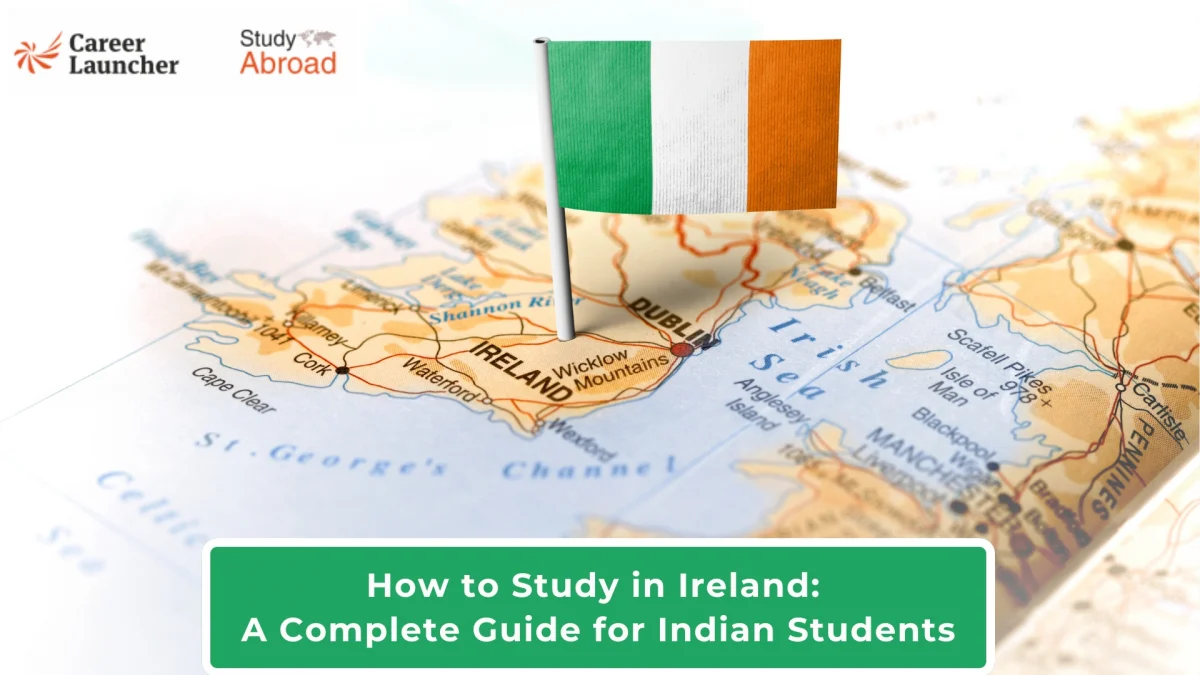
Ireland has become one of the fastest-growing study destinations for Indian students — and for good reason. It’s an English-speaking EU country, home to global tech giants like Google, Apple, and Microsoft, and one of the very few destinations that combines ranked universities, affordable tuition, and a clear post-study work pathway. This guide, How to Study in Ireland in 2026, covers everything you need to make an informed decision: universities, costs, scholarships, visas, and career prospects for 2026.
Looking for a broader overview of student life, universities, costs, and visa pathways? Read our complete Study in Ireland Guide for Indian Students.
Table of Contents
Why Ireland? Key Reasons Indian Students Are Choosing This Top Destination
Before looking at costs, universities, and visa steps, it helps to understand why Ireland has climbed so quickly up the list of preferred destinations for Indian students. Each reason below plays a distinct role in the overall decision, and together they explain why Ireland now competes directly with the UK, Canada, and Australia.
English-medium education in an EU country
Ireland is the only country in the Eurozone where English is the primary language of instruction. This means students get the academic and cultural benefits of studying in a native English-speaking environment, while still holding an EU-recognised degree and the mobility advantages that come with being part of the European Union.
Globally ranked universities
All 8 public universities in Ireland rank in the QS World University Rankings 2026. This matters because it signals consistent quality assurance across the entire public higher education system, rather than a handful of standout institutions surrounded by lesser-known ones, which gives students more reliable choices even outside the very top-ranked names.
Tech and pharma hub
Ireland hosts the European headquarters of major global companies including Google, Apple, Meta, and Pfizer. For students, this translates into a strong local pipeline for internships, campus recruitment, and graduate hiring, since many of these companies actively recruit from Irish universities rather than relying solely on relocation from abroad.
2-year post-study work visa for Master’s graduates (Stamp 1G)
Master’s graduates receive a 2-year post-study work permission under Stamp 1G. This is significant because it gives graduates enough runway to secure a relevant job and build local work experience without the pressure of an immediate visa deadline, which is often the biggest constraint international students face elsewhere.
Shorter course durations
Most Master’s programmes in Ireland run for 1 year instead of 2. A shorter duration directly reduces total tuition and living costs, and it also means students enter the post-study work window and job market sooner compared to two-year programmes in countries like the US.
Strong Indian student community
Over 15,000 Indian students are currently studying in Ireland. A large, established community makes the transition easier in practical ways, from finding accommodation and navigating part-time work to simply having a support network of people going through the same experience.
Ireland consistently ranks among the top destinations for Indian students. You can also compare it with other popular destinations in our guide to Top 10 Best Countries to Study Abroad for Indian Students.
Top Universities in Ireland for Indian Students (QS 2026)
| University | QS World Rank 2026 | Known For |
| Trinity College Dublin (TCD) | #75 | Law, Computer Science, Humanities, Nursing |
| University College Dublin (UCD) | #118 | Business, AI, Engineering, Agriculture |
| University College Cork (UCC) | #246 | Medicine, Science, Business |
| University of Galway | #284 | Medicine, Arts, Social Sciences |
Trinity College Dublin leads as Ireland’s most globally recognised university, ranking first in Ireland across 34 of 43 QS subject areas in 2026, including a top-10 global position for Nursing. This breadth across subjects, not just a single flagship programme, is why TCD remains the default reference point for Irish higher education.
UCD is Ireland’s largest university and a top choice for students targeting business and data analytics, with its Smurfit Graduate Business School carrying a strong international reputation. Its scale also means a wider range of programme options and a larger, more established international student support system.
UCC is best known for Medicine, Science, and Business, and is a strong option for students who want a highly ranked university outside the capital, often with a comparatively lower cost of living in Cork than in Dublin.
University of Galway is recognised for Medicine, Arts, and Social Sciences, and appeals to students who want a globally ranked degree in a smaller city environment rather than Dublin’s faster pace.
Read more: Ranking Systems of Foreign Universities

Popular Courses in Ireland for Indian Students
Course choice matters as much as university choice, since Ireland’s economy is built around a small number of dominant sectors. The table below groups the most popular courses by field and explains why each is in demand among Indian students specifically.
| Field | Popular Courses | Why Indian Students Choose This |
| Technology | Computer Science, Data Analytics, Artificial Intelligence, Cybersecurity | Ireland’s role as the European base for major tech companies creates direct campus recruitment and internship pipelines in these fields. |
| Business | MBA, Business Analytics, Finance, International Business | Many multinational finance and business operations are headquartered in Ireland, and 1-year MBA programmes offer a faster, lower-cost route to a global qualification. |
| Engineering | Electrical, Mechanical, Civil, Biomedical Engineering | Growing manufacturing and med-tech sectors in Ireland create steady demand for engineering graduates, particularly in biomedical fields. |
| Healthcare & Life Sciences | Pharmacy, Biotechnology, Nursing | Ireland is a major global hub for pharmaceutical manufacturing, and nursing offers one of the more direct pathways to post-study employment and visas. |
| Humanities & Social Sciences | Law, Education, Media Studies | Institutions like Trinity College Dublin carry strong international reputations in law and the humanities, supported by a growing media and education sector. |
Cost of Studying in Ireland in 2026
Tuition Fees (Annual, Non-EU Students)
Tuition varies significantly by level and programme type, as shown below. Understanding this range early helps with realistic budgeting and loan planning before you shortlist universities.
| Level | Fee Range |
| Undergraduate | €10,000 – €25,000/year |
| Postgraduate (Master’s) | €12,000 – €30,000/year |
| MBA | €25,000 – €40,000/year |
Most Master’s students pay €18,000 to €25,000 per year in tuition. This range typically depends on whether the programme is offered by a top-ranked university in Dublin or by a university in a smaller city, and whether it falls under a specialised, high-demand field such as an MBA.
Living Costs
Monthly living expenses typically range from €1,000 to €1,500, with Dublin being the most expensive city. Total first-year costs, combining tuition and living expenses, generally fall between €30,000 and €40,000, comparable to the UK and significantly less than the US.
Choosing a university outside Dublin, such as UCC in Cork or University of Galway, is one of the more direct ways students reduce this total cost, since accommodation is the single biggest driver of the difference between cities.
CTA: Talk to a counsellor about education loan options
Scholarships for Indian Students in Ireland (2026)
Scholarships in Ireland fall into four broad categories: government-funded awards, university-level merit scholarships, and India-specific schemes. Knowing which category you qualify for narrows down the application process considerably.
Government of Ireland International Education Scholarship (GOI-IES)
- Award: Full tuition waiver + €10,000 living stipend
- Level: Postgraduate (NFQ Level 9 or 10)
- Seats: Only 60 globally per year — highly competitive
- Deadline: March 2026
Government of Ireland Postgraduate Scholarship Programme (GOIPG)
- Award: €25,000 stipend + tuition fees (up to €5,750) + eligible costs
- Level: PhD students
- Duration: Up to 4 years
University-Level Scholarships
Most top universities, including TCD and UCD, offer merit-based partial scholarships of €2,000 to €7,000 for international students. These are worth applying for even if you do not qualify for a government scholarship, since they are assessed directly by the university alongside your admission application. UCD also offers the V.V. Giri Scholarship, which provides 50 to 100 percent tuition waivers specifically for Indian students, making it one of the more targeted options available.
National Overseas Scholarship (NOS) — India
This is a scheme run by the Government of India, available to students from SC, DNT/NT/SNT, Landless Agricultural Labourers, and Traditional Artisan categories, with an annual family income below ₹8 lakh. Ireland is an eligible country under this scheme, which makes it a relevant option for eligible students who want government support routed through India rather than through an Irish institution.
Learn how students finance their overseas education through scholarships in our guide on How to Get a Scholarship to Study Abroad.
CTA: Get help identifying and applying for the right scholarships
Ireland Student Visa for Indian Students (2026)
Indian students need a Long Stay ‘D’ Study Visa for any course longer than 90 days, since Ireland treats shorter and longer courses differently for immigration purposes. The requirements and process below apply specifically to this long-stay category.
Key Requirements
Each requirement below serves a specific purpose in the visa officer’s assessment, and missing even one is a common reason for delays or rejection.
- Unconditional Letter of Acceptance from an ILEP-registered institution
- Full-time course with a minimum of 15 classroom hours per week
- Pre-payment of at least €6,000 toward tuition fees
- Proof of living funds: €10,000–€12,000 for the first year
- Minimum IELTS 6.5 (or equivalent PTE/TOEFL)
- Medical insurance and biometric submission via VFS Global
Application Process
The process runs through Ireland’s official visa system and a designated visa application centre, and follows a fixed sequence:
- Register and complete the online form on AVATS (Automated Visa Application and Tracking System) – this creates your official application record.
- Print, sign, and date the summary application form – a physical, signed copy is required alongside the online submission.
- Book an appointment at VFS Global and submit documents – this is where your paperwork is formally reviewed and lodged.
- Provide biometrics (fingerprints) – required for identity verification and background checks.
- Track your application using the transaction number from AVATS – lets you monitor progress instead of waiting without visibility.
Processing time is typically 8 to 12 weeks, though the peak season of June to August can take longer due to higher application volumes. Apply at least 3 to 4 months before your course start date, and for September intake, do not wait beyond May, since delays during peak months can otherwise push your course start past.
After arriving in Ireland, register with the Irish Naturalisation and Immigration Service (INIS) within 90 days to receive your Irish Residence Permit (IRP), known as Stamp 2, which legally allows you to study and work part-time. This step is what converts your entry visa into ongoing legal permission to stay and work part-time for the duration of your course.
CTA: Get end-to-end visa documentation support from Career Launcher
Work Rights and Post-Study Opportunities
While Studying (Stamp 2)
Students on Stamp 2 can work up to 20 hours per week during term and full-time during holidays. Ireland’s national minimum wage is €14.15/hour as of January 2026 — higher than the UK, Australia, and Canada.
After Graduation (Stamp 1G — Post-Study Work Visa)
Under Ireland’s Third Level Graduate Programme:
- Level 8 (Bachelor’s) graduates: 12 months to find employment
- Level 9 (Master’s) graduates: 24 months to find employment
- Level 10 (PhD) graduates: 24 months to find employment
The longer window for Master’s and PhD graduates reflects the Irish government’s interest in retaining higher-skilled postgraduate talent for longer. During Stamp 1G, graduates can work full-time, up to 40 hours per week, without needing a separate employment permit, which removes one of the biggest hurdles international graduates typically face when trying to convert a student visa into a working one. Indian nationals received the highest number of Irish work permits of any non-EU nationality in 2023, which reflects both a strong track record of employer trust and the scale of the Indian student and graduate population in Ireland.
Starting salary benchmarks for 2026 vary by sector, reflecting where graduate demand is concentrated:
- Cybersecurity roles: €40,000–€60,000
- Tech and data analytics: €35,000–€55,000
- Finance and fintech: €38,000–€55,000
How Career Launcher Study Abroad Can Help
With 30+ years of experience and over 2 million+ students guided, Career Launcher Study Abroad provides end-to-end support to help you secure admits at top universities in Ireland.
- Profile Evaluation & University Shortlisting – Find the right-fit university and programme best suited to your goals
- Test Prep Support – Coaching for IELTS, GRE, GMAT, and more
- Application & Documentation – SOP, LOR, CV, and complete application assistance
- Visa & Loan Counselling – End-to-end guidance for a smooth admission journey
- Post-Admission Support – Accommodation and pre-departure assistance
Recommended Reads
- How to Choose Right Country for Studying Abroad
- How Not to Write Your College Essay: 3 Takeaways
- Checklist of Documents Required to Study Abroad
- Why Choose Germany for Master’s (2026)
FAQs
Is Ireland a good option for Indian students in 2026?
Yes. Ireland offers globally ranked universities, an English-speaking environment, a 2-year post-study work visa, and direct access to European headquarters of top global companies — making it one of the smartest study destinations for Indian students today.
What is the total cost of studying in Ireland for Indian students?
Total first-year costs, including tuition and living expenses, typically range from €30,000–€40,000. A 1-year Master’s programme with living costs averages €28,000–€45,000 depending on the university and city.
Can Indian students work while studying in Ireland?
Yes. Students on Stamp 2 permission can work up to 20 hours per week during term and full-time during semester breaks. Ireland’s minimum wage is €14.15/hour as of January 2026.
How long can Indian students stay in Ireland after graduation?
Master’s graduates receive a 2-year Stamp 1G post-study work permission. Bachelor’s graduates receive 1 year. During this time, graduates can work full-time without a separate employment permit.
What is the visa approval rate for Indian students applying to Ireland?
Ireland’s student visa approval rate is approximately 96%. Most rejections are avoidable and typically result from incomplete financial documentation or unexplained bank deposits.
What are the top courses Indian students choose in Ireland?
The most popular courses are Computer Science, Data Analytics, Business Analytics, Engineering, MBA, and Biotechnology — all aligned with Ireland’s dominant tech, pharma, and finance sectors.
Is IELTS mandatory for Ireland student visa?
A minimum IELTS score of 6.5 is required for the student visa. PTE Academic and TOEFL are now also widely accepted by Irish universities and for visa purposes.
What is the ILEP and why does it matter?
The Interim List of Eligible Programmes (ILEP) is the official list of courses that qualify for a student visa. Your institution and programme must appear on this list before you apply for the visa — always verify this on the Irish Immigration Service website.