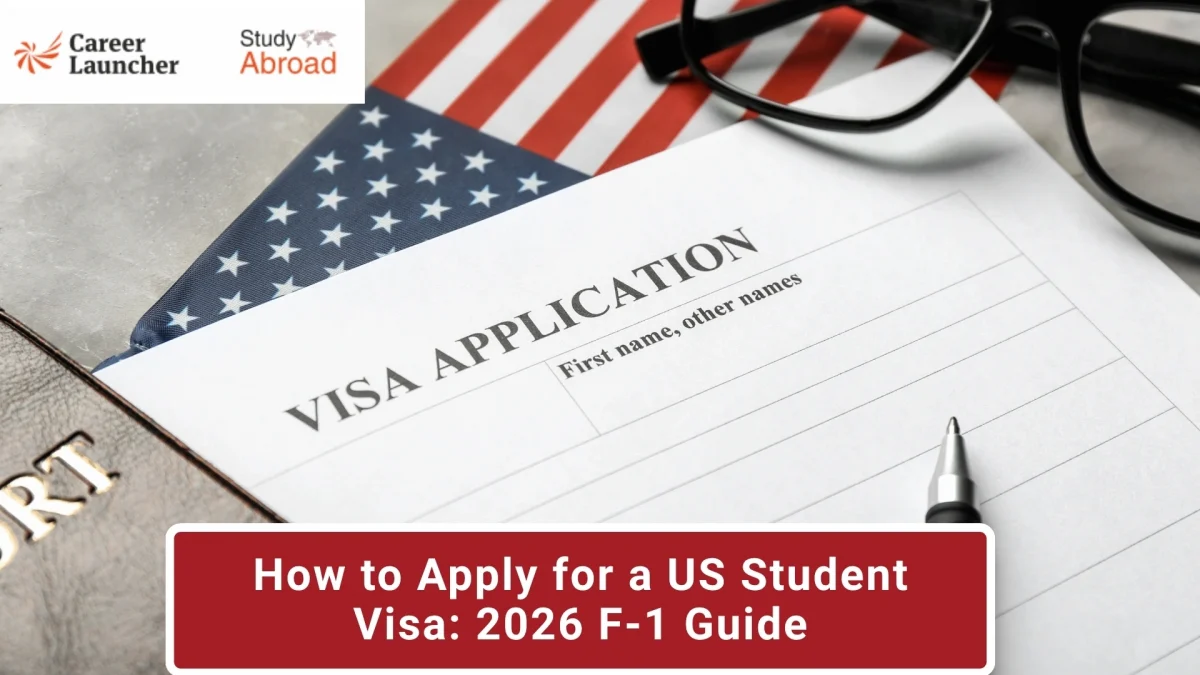
Knowing exactly how to apply for a US student visa matters more in 2026 than it has in years. The State Department has scaled back the interview-waiver (Drop box) programme, which means every Indian applicant, including renewals and children under 14, must now attend an in-person consular interview. Combined with expanded social media screening and refusal rates that several visa-tracking services now place between 35% and 61% depending on the year and consulate, the margin for a poorly prepared application has shrunk considerably.
This guide walks through the exact F-1 visa process step by step, from your I-20 to the DS-160 to the interview itself, along with current fees, realistic wait times by consulate, the documents officers actually scrutinise, and the specific answers that trigger a 214(b) refusal. You’ll also get a month-by-month timeline so you’re not racing the clock during peak season.
Table of Contents
What Is the US Student Visa (F-1)?
The F-1 visa is a non-immigrant visa issued by the US Department of State that permits international students to pursue full-time academic study at a SEVP-approved US institution. It does not grant permanent residency, remains valid for the “duration of status” (D/S) as long as you maintain full-time enrolment, and is the primary visa category for Indian students admitted to a bachelor’s, master’s, PhD, or approved vocational programme in the United States.
Need help preparing your documents or a mock visa interview?Connect with a Career Launcher study-abroad counsellor for personalised F-1 visa guidance.
|

How to Apply for a US Student Visa: Step-by-Step
| Step 1 | Get admitted to a SEVP-approved institution and receive your Form I-20. ₹₹
Once your university registers you in SEVIS, they issue your I-20 — the single most important document in your application, listing your SEVIS ID, program dates, and estimated cost of attendance. Check every detail, especially that your listed “Major” matches your Statement of Purpose exactly, since mismatches are a common flag during the interview. |
| Step 2 | Pay the SEVIS I-901 fee ($350).
This must be paid through the official FMJfee.com portal before you schedule your interview. Print the payment confirmation and keep it with your documents — you’ll need it at your appointment. |
| Step 3 | Complete the DS-160 online.
Fill this out at the Consular Electronic Application Center (ceac.state.gov). Every field must be accurate and consistent with your I-20 and SOP, since inconsistencies between your DS-160 and your interview answers are the single most common cause of refusal. As of December 2025, the DS-160 also requires disclosure of social media handles used over the past five years, and officers may cross-check your profiles during screening. |
| Step 4 | Pay the MRV visa application fee ($185).
This is separate from the SEVIS fee and is required before you can book your appointment. Both fees are non-refundable regardless of outcome. |
| Step 5 | Schedule your biometric (VAC) appointment and consular interview.
These are two separate appointments — the VAC appointment captures fingerprints and a digital photograph, while the consular interview is the face-to-face meeting with a visa officer that determines your outcome. |
| Step 6 | Attend your biometric appointment.
Bring your passport, DS-160 confirmation, and appointment letter; this step is procedural but mandatory. |
| Step 7 | Attend your consular interview.
Most F-1 interviews last between 90 seconds and 3 minutes. Officers rely heavily on your first, direct answer and rarely ask multiple follow-ups, so rehearsed rambling tends to raise more concern than it resolves. |
| Step 8 | Wait for a decision.
Most applicants receive an outcome the same day. If your case is placed under Section 221(g) for administrative processing, this is not a refusal — it typically means additional background verification is needed and can take anywhere from a few days to several weeks. |
| Step 9 | Collect your passport with the visa stamp.
You may enter the US up to 30 days before your program start date, even if your visa was issued earlier — visas can be granted up to 365 days ahead of the course start. |
US Student Visa Fees in 2026
| Fee | Amount (USD) | Approx. INR | Refundable? |
| SEVIS I-901 Fee | $350 | ~₹29,000–31,700 | No |
| MRV (DS-160) Application Fee | $185 | ~₹15,500 | No |
| Total Mandatory Government Fees | $535 | ~₹44,000–48,700 | No |
Note: Indian applicants do not pay a separate visa issuance (reciprocity) fee. Figures fluctuate with the exchange rate; always confirm current amounts on the official FMJfee.com and ais.usvisa-info.com portals before paying.
Documents You Need for Your F-1 Visa Interview
- Valid passport (with at least 6 months’ validity beyond your intended stay)
- Form I-20, signed by both you and your Designated School Official
- DS-160 confirmation page with barcode
- SEVIS fee payment receipt
- Visa appointment confirmation letter
- Financial documents: bank statements, education loan sanction letter, or sponsor affidavit of support, showing funds are genuine, available, and sustainable — officers focus on the source and consistency of funds, not just the total amount
- Academic transcripts and standardised test scores (GRE, GMAT, IELTS, TOEFL as applicable)
- Passport-size photographs meeting US visa specifications
If you’re still finalising your college list and need to confirm current admission odds before locking in your I-20, our guide to step-by-step UG admissions in the US is a useful companion read, alongside acceptance-rate data for schools like Harvard’s Class of 2029, Duke University for 2026, and NYU’s Class of 2029.
When to Apply: A Realistic Timeline
Visa interview wait times currently range from roughly 30 to 60 days across Indian consulates, with Chennai typically showing the fastest availability and Mumbai often running longer. Because peak season (May–August, driven by the Fall intake rush) sees the heaviest demand, most consultancies now recommend booking your interview 4–6 months before your program start date, rather than the 2–3 months that was once sufficient.
| Intake | When to Start the Visa Process |
| Fall (August/September) | March–April |
| Spring (January) | September–October |
Financial proof matters most in the months leading up to your interview — avoid sudden large deposits into your bank account close to the interview date, since these can trigger scrutiny unless clearly explained with supporting documentation. If your funding involves a scholarship, keep your award letter and any partial-funding breakdown ready; applicants combining a scholarship with a loan or sponsor should see our guides on Harvard scholarships for Indian students, MIT scholarships, and Stanford scholarships for how to document award coverage clearly.
Why F-1 Visa Applications Get Rejected
The most common refusal is under Section 214(b), which requires applicants to demonstrate strong, credible ties to their home country and a genuine intent to return after completing their studies. Common triggers include:
- Inconsistencies between the DS-160 and your interview answers — even small factual mismatches can raise doubt about the application’s overall accuracy
- Weak or unclear financial documentation — funds that appear suddenly, come from an unclear source, or don’t match the cost of attendance on your I-20
- Framing the degree primarily as a path to working in the US, rather than explaining genuine academic motivation — officers are trained to detect this framing and probe further
- Memorised or generic answers that don’t hold up under a natural follow-up question
- Inability to clearly explain course choice or university fit, suggesting the applicant hasn’t genuinely researched the program
How to Prepare for the F-1 Visa Interview
- Know your course and university cold. Be ready to explain specifically why you chose this program and institution — officers can distinguish a researched answer from a rehearsed one.
- Keep answers direct and brief. Most interviews last under three minutes; a clear, confident first answer performs better than an elaborate one with multiple qualifiers.
- Lead with academic intent, not post-study work plans. Frame your reasoning around the program’s academic value first; your career goals can follow naturally from that.
- Organise your documents logically. Even if the officer doesn’t ask to see every document, having them ready and well-labelled projects preparedness.
- Practice out loud, not just in your head. Rehearsing verbally — ideally with a mock interview — helps you sound natural rather than scripted when the real question comes.
What Separates an Approval From a 214(b) Refusal
Two Indian applicants with identical university offers and similar bank balances can receive opposite outcomes at the same consulate. The first explains their course choice generically (“It’s a good university with strong rankings”) and, when asked about post-study plans, pivots quickly to talking about US job prospects. The second explains a specific research area within their program, names a professor or lab they’re interested in, and describes a concrete return plan tied to their home-country career goals — without volunteering unprompted details about working in the US. Visa officers are trained specifically to probe for genuine academic intent versus immigration intent, and the second applicant’s specificity and framing consistently perform better, even when the financial and academic profiles are otherwise comparable. This is precisely why interview prep focused on rehearsing “correct” answers tends to backfire — officers are listening for natural, consistent reasoning, not a polished script.
F-1 vs. J-1 vs. M-1: Which Visa Do You Need?
Most Indian students pursuing a full-time bachelor’s, master’s, or PhD program need the F-1 visa. The J-1 visa applies to exchange visitors, including some funded fellowship or exchange programs. The M-1 visa applies to vocational or non-academic training programs. If you’re unsure which category fits your admitted program, check directly with your university’s international student office before starting the DS-160, since selecting the wrong category can delay your entire application.
Key Takeaways
- The F-1 process has five core stages: I-20 issuance, SEVIS fee payment, DS-160 submission, MRV fee payment, and the biometric plus interview appointments.
- All Indian applicants now require an in-person interview — plan for 4–6 months of lead time given current 30–60 day wait times.
- Most refusals come down to inconsistent answers, unclear financial documentation, or unconvincing academic intent — not a weak academic profile.
- A 221(g) administrative processing notice is not a rejection; it typically just means additional verification is underway.
Recommended Reads
FAQs
How do I apply for a US student visa?
Get your I-20 from a SEVP-approved university, pay the SEVIS I-901 fee, complete the DS-160 online, pay the MRV application fee, schedule your biometric and interview appointments, attend both, and wait for a decision — most applicants receive an outcome the same day as their interview.
How much does a US student visa cost in 2026?
Total mandatory government fees are $535 — a $350 SEVIS I-901 fee and a $185 MRV application fee — both non-refundable regardless of the outcome. Indian applicants do not pay an additional visa issuance fee.
When should I apply for my F-1 visa?
Start the process 4–6 months before your program start date. For a Fall (August/September) intake, begin around March–April; for Spring (January), begin around September–October, since peak-season wait times can run 30–60 days or longer.
Why do F-1 visa applications get rejected?
Most refusals fall under Section 214(b) and stem from inconsistent DS-160/interview answers, weak or unclear financial documentation, or an inability to demonstrate genuine academic intent and credible ties to return home after study.
Is the F-1 visa interview compulsory for all Indian applicants?
Yes. Since the State Department discontinued the interview-waiver (Dropbox) programme, all Indian F-1 applicants — including first-time applicants, renewals, children under 14, and seniors — must attend an in-person consular interview.
How much money do I need to show for an F-1 visa?
There is no fixed minimum amount specified by the State Department. Officers evaluate the genuineness, availability, and sustainability of your funding sources relative to your program’s total cost of attendance as listed on your I-20, rather than checking against a set threshold.
Can I work while on an F-1 student visa?
Yes — F-1 students can work on-campus for up to 20 hours per week during the academic year and up to 40 hours per week during official school breaks. Off-campus employment requires separate authorisation, such as CPT or OPT.
What happens if my visa is placed under 221(g)?
Section 221(g) means your application requires additional administrative processing — it is not a refusal. Processing can take anywhere from a few days to several weeks depending on the reason for the review.
How early can I enter the US on my F-1 visa?
You may enter the United States up to 30 days before your program’s official start date, even if your visa was issued earlier — visas themselves can be granted up to 365 days in advance of the course start.