If you’re an Engineering, Commerce, or Business graduate planning a Master’s in Germany from Summer 2027 onward, dMAT exam has just become a mandatory part of your application checklist. APS India introduced the Digital Master Test in June 2026, which is mandatory to obtain APS certification. This guide breaks down exactly what the exam is, who needs it, and how to prepare for it without losing months to confusion.
Table of Contents
What Is the dMAT Exam and Why Was It Introduced?
The dMAT — short for Digital Master Test — is a standardised academic aptitude test developed by g.a.s.t. with support from the DAAD. It doesn’t test subject memorisation the way a typical Indian university exam does. Instead, it measures general reasoning ability and how well you can apply your existing subject knowledge to new problems — closer in spirit to an aptitude test than a syllabus-based one.
APS India added the requirement to give German universities a more consistent way to compare applicants from very different undergraduate systems. It’s important to get one thing straight early: the dMAT does not replace your APS certificate, and it isn’t a university entrance exam by itself. It’s an additional requirement that sits alongside your existing APS verification.
Who Actually Needs to Take the dMAT?
Not every applicant is affected, and this is where most of the confusion starts. The requirement is narrow — it applies only to specific undergraduate fields, specific intakes, and applications initiated after a fixed cutoff date.
| You need the dMAT if… | You’re exempt if… |
Your Bachelor’s degree is in
|
You’re an Undergraduate applicant or a PhD applicant |
| You’re targeting 2027 or a later intake | You’re targeting the 2026 intake |
| Your APS process started on or after June 29, 2026 | Your APS online registration, documents, or certificate were completed before June 29, 2026 |
| You’re applying as a standalone Master’s candidate | You’re in an exchange, double-degree, or university partnership programme |
If your degree is a borderline case — say, a B.Sc. in Statistics or Data Science, or a dual major — don’t guess based on subject overlap. Our counsellors can help you check your exact classification against the official list of affected fields before you register.

dMAT Exam Pattern and Scoring
The exam runs for three hours with a break of 30 minutes between the two parts of the exam, is taken digitally at a g.a.s.t.-appointed test centre, and every question is single-choice. There’s no scratch paper and no calculator, so mental arithmetic and quick pattern recognition matter more than you’d expect.
Modules
It has two modules:
1. Core Module — tests general reasoning through three formats:
-
- Figure Sequences — pattern recognition across grid-based sequences
- Mathematical Equations — applied numerical and logical reasoning
- Latin Squares — structured, rule-based problem-solving
2. Subject Module — tests your understanding of your own undergraduate field. Not new topics, but how fast and accurately you can use what you already know under exam conditions.
Scoring
Scoring is reported on two scales:
- A dMAT score from 0–200 (mean of 100)
- A percentile rank showing how you performed relative to other candidates
There’s no fixed pass/fail line. Each German university decides independently how much weight to give your score, and a lower score doesn’t automatically block your APS certificate or your application.
How to Prepare for the dMAT Exam
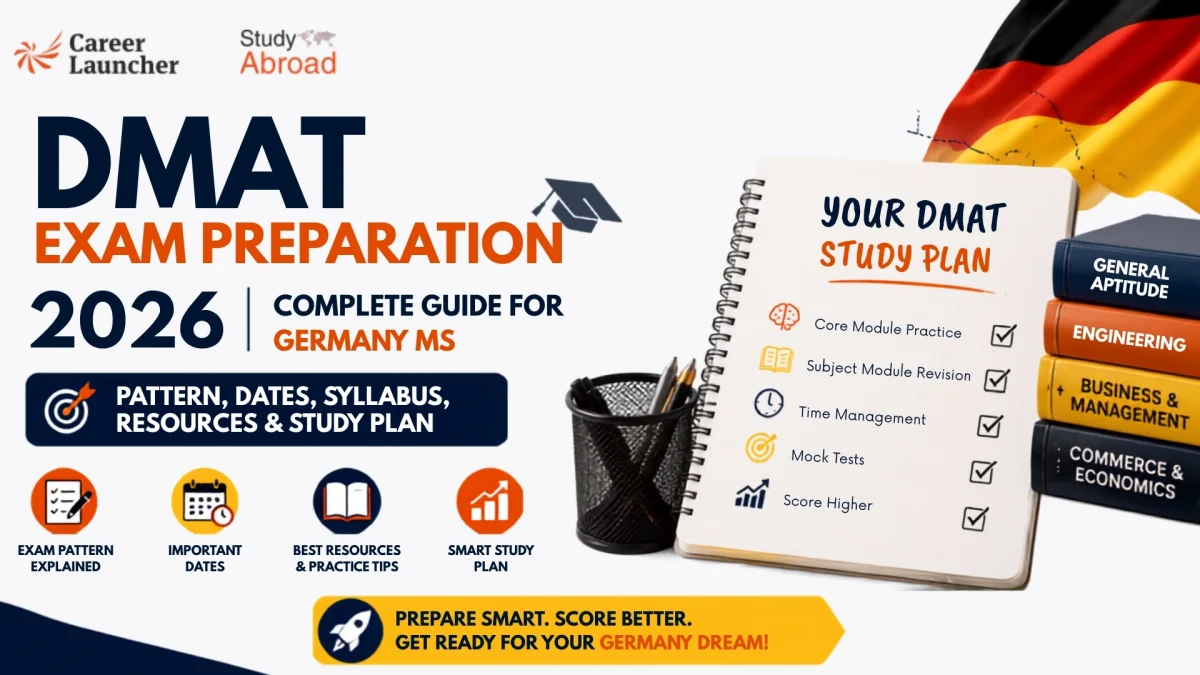
There’s no fixed syllabus for the dMAT exam that you can memorise, so the best thing that students can do is build their speed and comfort with the question formats themselves.
- Drill the Core Module formats in short, timed bursts. Practise figure sequences, mathematical equations, and Latin squares in sets of five, timing yourself to recognise within 20 seconds whether an item is a solve-now or a guess-and-move — that single skill matters more than raw knowledge here.
- Revise your Subject Module fundamentals, not new topics. Engineering applicants should focus on core problem-solving in their branch; Commerce and Economics applicants should revisit accounting logic, financial arithmetic, and micro/macro basics; Business and Management applicants should brush up on business analysis and applied economics. The goal is application, not recall.
- Never leave an item blank as there is no negative marking in the exam.
- Simulate the no-notes, no-calculator condition during practice sessions so test-day conditions don’t catch you off guard.
- Follow the official exam schedule and regularly check updates from official sources.
dMAT Prep Resources
Find a few resources by g.a.s.t. as they’re the closest thing to real exam conditions you’ll find:
- Preparatory materials for the Battery Science & Technology subject module — full instructions, worked examples, and solved exercises for the Core Module plus Engineering-adjacent subject areas
- Preparatory materials for the Data Science subject module — the same structure, tailored to Data Science applicants
- Introductory video: how the digital exam works
- Figure Sequences walkthrough video
- Mathematical Equations walkthrough video
- Latin Squares walkthrough video
- Subject Module walkthrough video
These materials cover only the currently published subject modules (Battery Science and Technology, Data Science), so Commerce, Business, and broader Engineering applicants should treat the Core Module practice as the main takeaway and revise their own subject fundamentals separately.
Common Mistakes to Avoid Before Test Day
- Assuming it applies to you when it doesn’t (or vice versa). The requirement is genuinely narrow — check the official affected-fields list rather than going by subject overlap alone.
- Missing the registration window. Because the dMAT runs on fixed dates, a missed deadline can delay your German Master’s entry by an entire cycle.
- Treating the dMAT as a pass/fail gate. There’s no cutoff score, but a stronger result still helps in competitive programmes — so it’s worth preparing seriously even without a hard bar to clear.
dMAT Exam Dates, Fees, and Registration Steps for 2026
The first Indian cycle follows a tight, fixed schedule — there’s no on-demand booking, so missing a date pushes your entire timeline to the next cycle.
Key 2026 dates
- Registration opens: June 29, 2026
- Registration closes: September 15, 2026
- Exam date: September 26, 2026
- Certificate available: October 12, 2026
How to register:
- Visit the official dMAT portal (d-mat.de) and create an account.
- Enter your personal details exactly as they appear on your passport.
- Choose your test centre from the ten available Indian cities: Ahmedabad, Bengaluru, Bhopal, Chandigarh, Chennai, Kolkata, Mananthavady, Mumbai, New Delhi, and Pune.
- Pay the registration fee online and save your confirmation.
- Complete your subject module selection based on the Master’s programme you’re applying to — not your undergraduate degree title alone.
Cost breakdown
| Item | Approx. Cost |
| dMAT registration fee | €150 (~₹16,300) |
| APS certification fee | ~₹18,000 |
| Combined (before language tests) | ~₹34,000 |
Add IELTS, TOEFL, or German language test fees on top, and your documentation budget can cross ₹50,000 before tuition even enters the picture — worth factoring into your overall Germany masters planning early.
Conclusion
The dMAT is a new checkpoint, not a new obstacle course — it sits quietly inside your APS process, and calm, structured preparation will take you further than panic ever will. Confirm whether it applies to your degree field, register before September 15, and build your prep around the Core Module formats and your own subject fundamentals rather than chasing an imaginary syllabus.
If you’d like a second set of eyes on your Germany Master’s timeline — APS, dMAT, and application deadlines all mapped out together — Career Launcher’s study-abroad counsellors can walk you through it in a free session.
Still Confused About the Germany Master’s timeline?Career Launcher’s Study Abroad experts can help you with APS, dMAT, and application deadlines, all mapped out together.
|
Recommended Reads
- What is dMAT Exam 2026: Germany’s New Test for Indian Master’s Applicants
- Why Choose Germany for Your Master’s?
- Scholarships in Germany for Indian Students 2026
- How to Choose the Right Country for Studying Abroad
- Unlocking the Secrets of Winning Study Abroad Scholarships
FAQs
What is the dMAT exam?
The dMAT (Digital Master Test) is a standardised aptitude test introduced by APS India and g.a.s.t. in 2026 as part of the APS documentation process for select Indian Master’s applicants to Germany.
Who needs to take the dMAT exam?
Indian students with an undergraduate degree in Engineering, Commerce, Business, Economics, or Finance, applying for a standalone Master’s programme in Germany from Summer Semester 2027 onward.
Is there negative marking in the dMAT exam?
No penalty is applied for wrong answers, and since unanswered questions earn nothing, official guidance recommends attempting every item even when unsure.
Is there a passing score for the dMAT exam?
No. The dMAT reports a score (0–200) and a percentile rank, but there’s no fixed pass/fail threshold — each university decides independently how to weigh it.
How much time should I dedicate to dMAT exam preparation?
Since there’s no traditional syllabus, most of your preparation time should go into practising the Core Module question formats under timed conditions and revising your own Subject Module fundamentals — a few focused weeks is typically enough.
Does a low dMAT score affect my APS certificate or admission?
No. APS India has confirmed that a low dMAT score does not block your APS certificate, and admission decisions remain at each university’s discretion.
When and where can I take the dMAT exam in 2026?
The first Indian cycle is on September 26, 2026 (registration closes September 15, 2026), at test centres in Ahmedabad, Bengaluru, Bhopal, Chandigarh, Chennai, Kolkata, Mananthavady, Mumbai, New Delhi, and Pune.