The CAT 2027 syllabus covers three sections: Verbal Ability and Reading Comprehension (VARC), Data Interpretation and Logical Reasoning (DILR), and Quantitative Ability (QA). While the IIMs do not release an official topic-wise CAT syllabus, the questions asked in previous years provide a clear idea of the topics candidates should prepare.
This article covers the CAT 2027 syllabus for VARC, DILR and QA, along with the expected exam pattern, section-wise topics and important areas to prioritise during preparation. Since the CAT 2027 notification is yet to be released, the exam pattern mentioned here is based on recent CAT trends and should be treated as expected.
CAT 2027 Exam Pattern (Expected)
The CAT 2027 exam pattern is expected to follow the recent format, with three sections: VARC, DILR and QA. Based on the CAT 2025 pattern, the exam is expected to have 68 questions carrying 204 marks, with 40 minutes allotted to each section.
| Section | Questions | Marks | Time |
| VARC | 24 | 72 | 40 min |
| DILR | 22 | 66 | 40 min |
| QA | 22 | 66 | 40 min |
| Total | 68 | 204 | 120 min |
- Marking: +3 for a correct answer, -1 for a wrong MCQ, no negative marking for TITA.
- Order: VARC, then DILR, then QA. You cannot switch between sections.
- Mode: Computer-based test, in English. An on-screen calculator is provided.
- PwD candidates: 53 minutes 20 seconds per section.
CAT 2027 Syllabus: Section-Wise Topics
The CAT 2027 syllabus is divided into three sections: VARC, DILR and QA. Since the IIMs do not publish a topic-wise syllabus, the topics below are based on areas commonly tested in previous CAT papers.
| Section | Key Topics |
| VARC | Reading Comprehension, Para Jumbles, Odd One Out, Para Summary, Para Completion |
| DILR | Tables, Graphs, Charts, Venn Diagrams, Arrangements, Games & Tournaments, Routes & Networks, Logical Puzzles, Data Sufficiency |
| QA | Ratio & Proportion, Time & Work, Linear Equations, Inequalities, Geometry, Averages, Profit & Loss, Percentages, Coordinate Geometry, Probability, Simple & Compound Interest |
CAT 2027 VARC Syllabus
The CAT VARC syllabus primarily tests reading comprehension and verbal reasoning. The section includes both Reading Comprehension and Verbal Ability questions.
- Reading Comprehension: Usually forms the larger part of VARC, with questions based on passages covering topics such as philosophy, economics, science, history and social issues.
- Verbal Ability: Includes Para Jumbles, Para Summary and Odd Sentence Out questions. These questions test your ability to understand the logical flow and structure of a passage rather than grammar alone.
CAT 2027 DILR Syllabus
The CAT DILR syllabus includes questions that require candidates to interpret data and apply logical reasoning to different situations. The exact combination of topics and sets can vary from one CAT paper to another.
Common areas include:
- Tables and charts
- Bar graphs and other forms of data representation
- Venn diagrams
- Arrangements
- Games and tournaments
- Routes and networks
- Logical puzzles
- Data sufficiency
DILR is largely set-based, so candidates need to identify the sets they can solve efficiently and use their time accordingly.
| Suggested Articles | ||
| Prepare For CAT VARC | Prepare for DILR in CAT | Prepare for QA in CAT |
CAT 2027 QA Syllabus
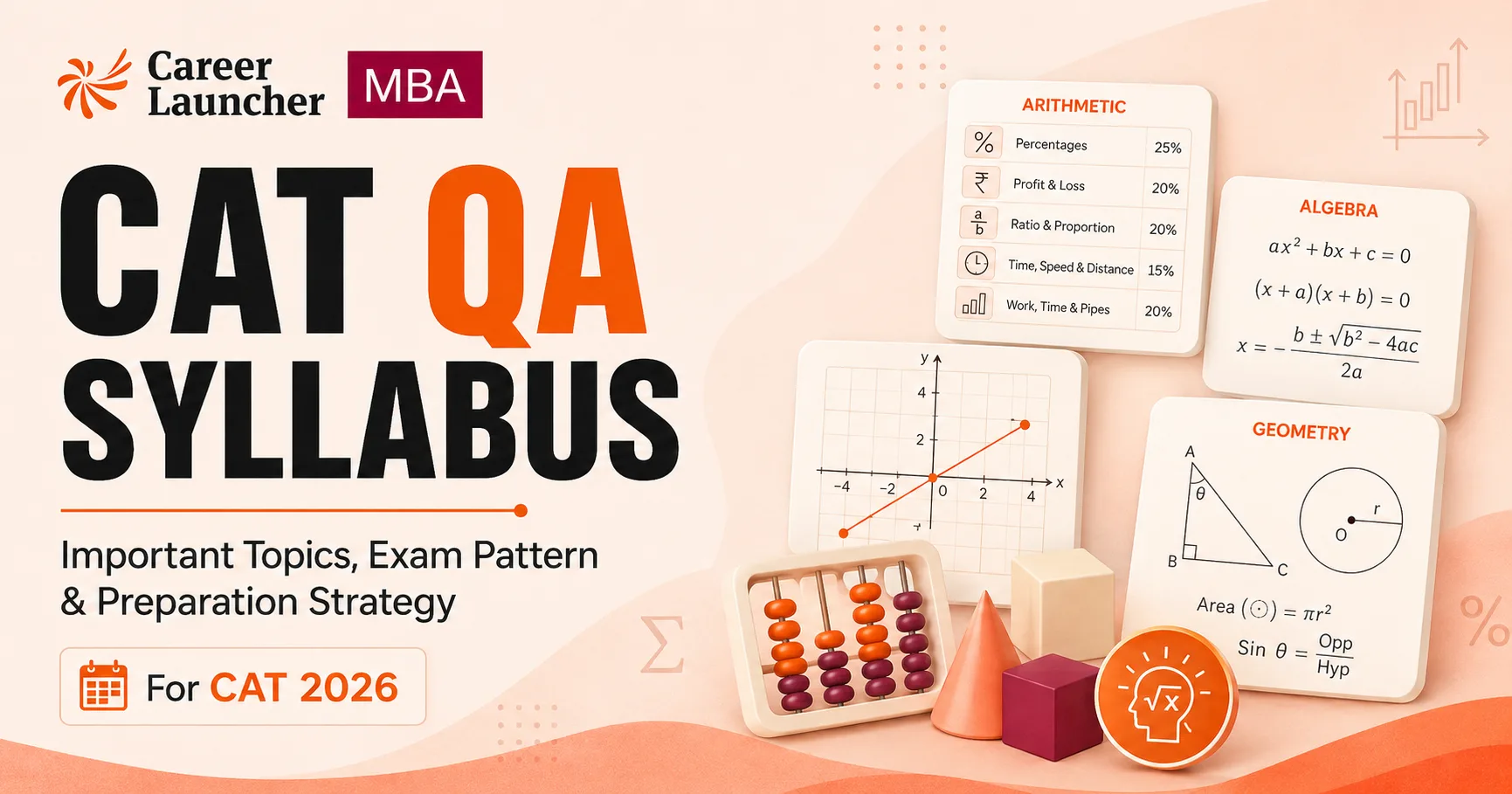
The CAT QA syllabus broadly covers five areas: Arithmetic, Algebra, Geometry, Number Systems and Modern Maths. Based on previous CAT papers, Arithmetic and Algebra generally account for a significant share of the section.
| Area | Past-Trend Question Range | Key Topics |
| Arithmetic | 8–10 | Percentages, Profit & Loss, Ratio & Proportion, Time-Speed-Distance, Time & Work, Mixtures |
| Algebra | 5–7 | Linear & Quadratic Equations, Inequalities, Functions, Logarithms |
| Geometry & Mensuration | 3–4 | Triangles, Circles, Mensuration, Coordinate Geometry |
| Modern Maths | 2–4 | Permutation & Combination, Probability, Progressions |
| Number Systems | 1–2 | Remainders, HCF & LCM, Divisibility |
These figures are indicative ranges based on past-paper trends, not a fixed CAT 2027 distribution. Candidates should therefore prepare all major QA topics rather than relying only on the expected number of questions from each area.
Start Your CAT 2027 Preparation
Knowing the CAT 2027 syllabus tells you what to study. But knowing how to prepare, what to prioritise, and when to move from concepts to practice and mocks can make all the difference. With Career Launcher’s CAT Online Coaching 2027, get expert-led preparation for VARC, DILR and QA, structured practice, doubt-solving support, and the right guidance to turn your syllabus into a focused preparation strategy.

CAT 2027 Preparation Tips
A structured approach to CAT 2027 preparation can help you cover the syllabus, improve accuracy and build the right exam strategy.
Understand the Syllabus
Start by familiarising yourself with the VARC, DILR and QA sections and their key topics. Break the syllabus into smaller areas and create a study plan that gives enough time to cover concepts, practise questions and revise.
Build Strong Fundamentals
Focus on developing conceptual clarity before moving to advanced-level questions. In QA, strengthen topics such as Arithmetic, Algebra and Geometry. For VARC, develop a regular Reading Comprehension habit, while DILR requires practice with different types of sets and logical structures.
Practise Consistently
Regular practice is important for improving both speed and accuracy. Begin with topic-wise questions and gradually include sectional tests. Track the questions you get wrong and revisit the concepts behind them.
Take Mock Tests
Once your fundamentals are strong, start taking full-length CAT mock tests. Initially, focus on understanding the exam format and managing the sectional time limits. As the exam approaches, increase mock frequency and practise under exam-like conditions.
Analyse Every Mock
Mock analysis is as important as taking the test. Review incorrect answers, questions that took too much time and questions you left unanswered. Identify recurring mistakes and use the analysis to improve your question selection and time-management strategy.
Revise and Track Progress
Maintain an error log containing important mistakes, difficult questions and concepts that need revision. Regularly revisit these areas and track your performance across VARC, DILR and QA to measure improvement and adjust your preparation plan.
Conclusion
The CAT 2027 syllabus covers VARC, DILR and QA, with each section requiring a different preparation approach. Since the IIMs do not release an official topic-wise syllabus, aspirants should use previous CAT papers and past trends to understand the topics and question types they are likely to encounter. Along with completing the syllabus, consistent practice, mock tests and performance analysis are essential to improve accuracy and time management. Starting with the right topics and following a structured preparation plan can help you build a strong foundation for CAT 2027.
Frequently Added Questions
1. Is there an official CAT 2027 syllabus?
A. No. The IIMs do not release a detailed topic-wise CAT syllabus. Candidates generally refer to topics and question types from previous CAT papers to plan their preparation.
2. What are the three sections in the CAT 2027 syllabus?
A. The CAT 2027 syllabus is expected to cover three sections: Verbal Ability and Reading Comprehension (VARC), Data Interpretation and Logical Reasoning (DILR), and Quantitative Ability (QA).
3. How many questions are expected in CAT 2027?
A. Based on the CAT 2025 pattern, CAT 2027 is expected to have 68 questions carrying 204 marks: 24 questions in VARC, 22 in DILR and 22 in QA. The final pattern will be confirmed through the official CAT 2027 notification.
4. Which topics are important for CAT 2027?
A. Important areas include Reading Comprehension and Verbal Ability in VARC; Data Interpretation and Logical Reasoning sets in DILR; and Arithmetic, Algebra, Geometry, Number Systems and Modern Maths in QA. Candidates should prepare all major topics rather than relying only on expected topic-wise weightage.
5. When should I start preparing for CAT 2027?
A. Starting early gives you enough time to complete the syllabus, build concepts, practise different question types and take multiple mock tests. A structured preparation plan can help you balance syllabus coverage with revision and mock-test practice.