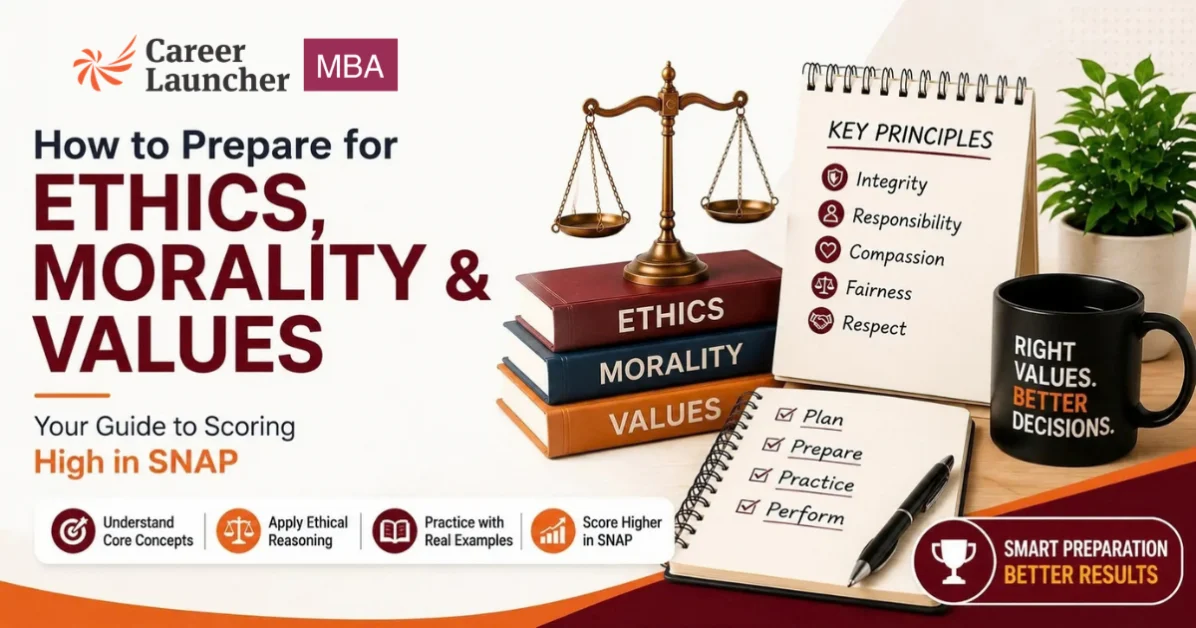
How to Prepare for Ethics, Morality and Values in SNAP 2026: Ethics, Morality & Values has been introduced by SNAP 2026 as a new dimension to MBA entrance preparation. Unlike Quantitative Aptitude or Logical Reasoning, this section is expected to focus on ethical principles, situational judgement and decision-making rather than formulas or fixed question types.
Since Ethics, Morality & Values is a new addition to SNAP 2026, the exact question format is yet to be established. While SIU has not yet outlined a detailed breakdown of topics and question types, the areas discussed below should be used as a preparation guide rather than a definitive syllabus.
Table of Contents
SNAP 2026 Exam Pattern: Key Changes
The SNAP exam pattern continues to follow a 60-minute objective format, with four answer choices and 25% negative marking for an incorrect answer. The revised section-wise breakup is given below:
| Section | Questions | Marks |
| General English | 10 | 10 |
| Analytical & Logical Reasoning | 20 | 20 |
| Quantitative, DI & DS | 20 | 20 |
| Ethics, Morality & Values | 10 | 10 |
| Total | 60 | 60 |
Also Read: SNAP 2026 Exam Pattern Changed
SNAP 2026 Ethics, Morality & Values: Expected Question Types
The exact format of the section is yet to be announced. Aspirants can expect a broad mix of scenario-based, concept-based and statement-based questions, which are commonly used to assess ethical reasoning and values.
- Ethical Dilemmas & Situational Judgement: These questions could describe situations where candidates must evaluate different choices and identify the most appropriate response. For example, if a colleague manipulates sales figures, the focus may be on choosing an ethical and responsible way to address the issue rather than ignoring it or confronting the person publicly.
- Morality-Based Situations: A question may describe an everyday situation that tests values such as honesty, empathy, respect, responsibility and social conduct. The emphasis is likely to be on applying these values in a given situation rather than simply identifying their meanings.
- Conflicting Values: A question may describe a situation where candidates have to choose between competing but equally important values, such as loyalty versus fairness or individual interest versus collective welfare. They may need to assess the consequences of each option and identify a response that balances the interests of the stakeholders involved.
- Business & Corporate Ethics: Questions may cover common workplace issues such as conflict of interest, bribery, confidentiality, data privacy, discrimination and fair competition. For instance, selecting a vendor owned by a close relative creates a conflict of interest, which should be disclosed and managed through appropriate recusal.
- Identifying Ethical Principles : Candidates may be given a situation and asked to identify the ethical value or principle reflected in the response, such as integrity, transparency, fairness, accountability or responsibility. For instance, an employee who reports financial misconduct through the appropriate channel despite peer pressure demonstrates integrity and accountability.
- Definition- or Concept-Based Questions: These questions may test your understanding of fundamental concepts related to ethics, morality, values, professional conduct and business ethics. Candidates could be asked to identify the meaning of a principle or distinguish between similar concepts.
- Statement-Based Questions: These questions may include multiple statements about ethics, values or professional conduct. Candidates may need to determine which statement or combination is correct. The focus may be on applying ethical principles to different situations rather than relying on personal opinions.

SNAP 2026 Ethics, Morality & Values: Important Topics to Prepare
Aspirants can refer to the detailed SNAP syllabus, and focus on the following broad areas:
| Area | Topics to Cover |
| Core Ethical Concepts | Ethics, Morality & Values; Integrity, Honesty & Transparency; Fairness, Justice & Equality; Responsibility & Accountability |
| Personal & Social Ethics | Empathy, Respect & Social Conduct; Personal vs. Professional Ethics |
| Business & Workplace Ethics | Business Ethics & Corporate Governance; Conflict of Interest; Bribery, Corruption & Fraud; Whistleblowing & Ethical Reporting; Confidentiality & Data Privacy; Workplace Discrimination & Harassment |
| Consumer & Corporate Responsibility | Customer Rights & Misleading Advertising; Fair Competition & Responsible Business; CSR, Sustainability & Stakeholder Responsibility; Ethical Decision-Making Frameworks |
Also Read: XAT vs SNAP Exam Pattern
How to Prepare for SNAP 2026 Ethics, Morality & Values
Since the exact question pattern is yet to be known, build your SNAP Preparation around conceptual clarity, ethical reasoning and situational judgement.
- Build Conceptual Clarity First: Develop a clear understanding of core ethical concepts and principles, including integrity, accountability, transparency and fairness. This will make it easier to evaluate different situations effectively.
- Read Business Ethics Case Studies: Study real-world cases related to corporate governance, whistleblowing, CSR, conflicts of interest and ethical decision-making. This will help you connect theoretical concepts with their practical application.
- Practise Situational Judgement Questions: Practise scenario-based questions from MBA entrance exams, aptitude tests and other competitive examinations. This can help you develop the judgement needed to analyse different situations and weigh possible responses.
- Look for Balanced and Responsible Choices: When evaluating ethical questions, consider options that balance transparency, accountability, fairness and stakeholder interests. Rather than choosing extreme responses, assess which option addresses the situation in a responsible and practical manner.
- Think Beyond Personal Opinions: When solving these questions, avoid relying solely on your personal views. Assess the situation from a professional and organisational perspective and apply the relevant ethical principles before choosing an answer.
- Stay Updated as the Exam Approaches: Keep track of official SNAP announcements and updates as the exam draws closer. If SIU releases further details about the section or its question format, use them to refine your preparation strategy accordingly.
Also Read : CAT vs SNAP 2026 | SNAP 2025 Question Paper
Conclusion
The Ethics, Morality & Values section is a new addition to SNAP 2026 and carries 10 marks. Unlike Quantitative Aptitude or Logical Reasoning, it focuses less on formulas and more on ethical reasoning, situational judgement and decision-making. Building conceptual clarity and practising different scenarios can help you approach the section with greater confidence.
Stay tuned to Career Launcher for the latest updates as SIU releases more details about the SNAP 2026 exam pattern.
Frequently Asked Questions
1. What is the Ethics, Morality & Values section in SNAP 2026?
A. It is a new section in SNAP 2026 with 10 questions carrying 10 marks, focused on ethical reasoning, values and situational judgement.
2. What type of questions can be expected in this section?
A. Questions may be scenario-based, concept-based or statement-based, covering ethical dilemmas, morality, values and business ethics.
3. What topics should I prepare for SNAP 2026 Ethics, Morality & Values?
A. Focus on ethics, morality, integrity, fairness, accountability, professional ethics, business ethics, conflict of interest, CSR and ethical decision-making.
4. How should I prepare for the Ethics, Morality & Values section?
A. Build conceptual clarity and ethical reasoning, and practise scenario-based questions to improve situational judgement.
5. Is there negative marking in the Ethics, Morality & Values section?
A. Yes. SNAP 2026 has 25% negative marking for every incorrect answer, including this section.