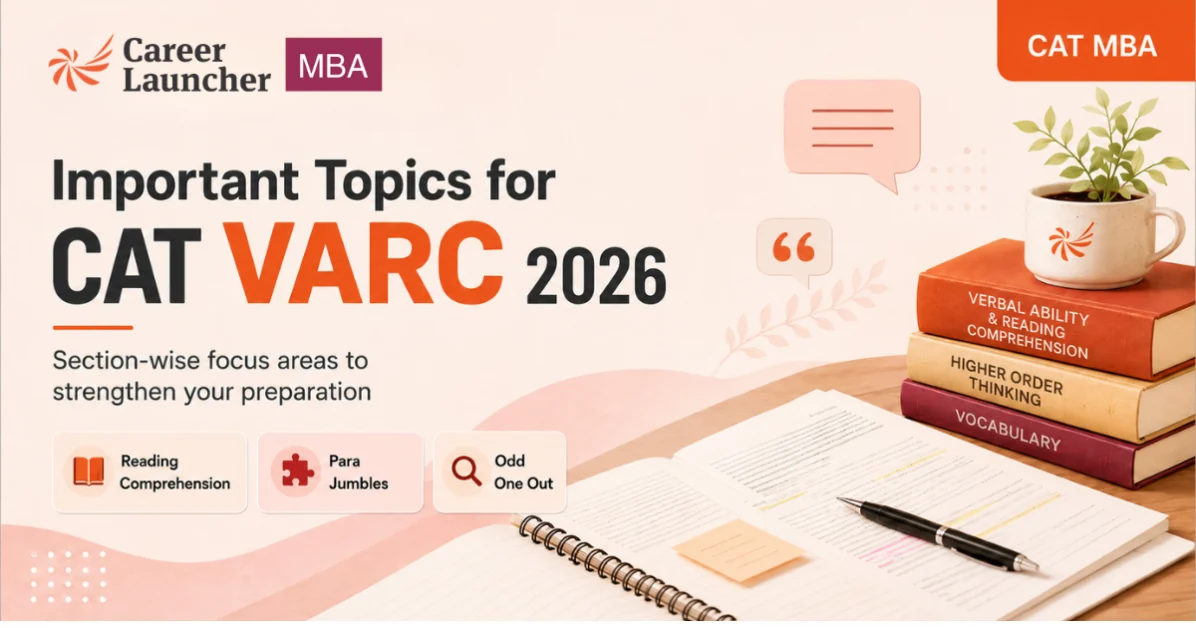
The important topics for CAT VARC 2026 primarily include Reading Comprehension, Para Jumbles, Para Summary, Odd Sentence Out, and Verbal Ability-based questions. Based on previous CAT VARC trends, understanding the question types and CAT VARC topic-wise weightage can help you prioritise the right areas, improve accuracy, and manage the 40-minute VARC section more effectively.
Since Reading Comprehension accounts for a significant portion of the CAT VARC section, developing strong reading and comprehension skills is essential alongside practising Verbal Ability questions. This guide covers the CAT VARC important topics, their expected question distribution, and the areas you should prioritise for CAT 2026 preparation.
Latest Updates – CAT 2026 Notification Released
CAT VARC 2026 Exam Pattern
Here’s how the CAT VARC section is expected to be in CAT 2026
| Parameter | Detail |
|---|---|
| Total Questions | 24 |
| Time Allotted | 40 minutes |
| RC Questions | 16 (4 passages × 4 questions) |
| Verbal Ability Questions | 8 (2 each: Para Summary, Para Jumble, Para Completion, Odd One Out) |
| Non-MCQ (TITA) Questions | 4 |
| Marking Scheme | +3 for correct, −1 for wrong MCQ, no negative marking on TITA |
Read in detail the CAT Exam pattern 2026 | CAT 2026 Syllabus

Important Topics for CAT VARC 2026
Here’s how the VARC section’s weightage is expected to be for CAT 2026, helping you gauge the important topics.
| Format | Questions | Weightage Share | Priority |
|---|---|---|---|
| Reading Comprehension (4 passages) | 16 | 67% | Highest |
| Para Jumble | 2 | 8% | High |
| Para Summary | 2 | 8% | High |
| Odd One Out | 2 | 8% | High |
| Para Completion | 2 | 8% | High |
Test your reading speed and accuracy against real CAT-level passages. Take a free CAT mock test to see where your VARC score stands today.

Common RC Passage Themes Asked in CAT
RC passage topics don’t repeat exactly, but the categories they’re drawn from are remarkably consistent.
| Theme Category | Examples |
|---|---|
| Social Sciences & Economics | Income Inequality, Human Ecology |
| Science & Technology | Electronic Music, AI Ethics, Language in AI, Complex Systems |
| Culture & Arts | Tribal Artists, Literature |
| Environment & Policy | Dams, Forest Officials, Blind Fish (marine ecology) |
| Psychology & Philosophy | Mental Insanity, Legalised Assisted (dying/ethics) |
This spread tells you exactly what your reading list should look like: dense academic and long-form journalism across science, policy, economics, and culture, not just news headlines.
Also read: CAT Full length Mocks Vs Sectional Tests
VARC Difficulty Comparison Across CAT 2025 Slots
Here’s how VA and RC difficulty shifted from Slot 1 to Slot 3:
| Slots | VA Difficulty | RC Difficulty |
|---|---|---|
| Slot 1 | Moderate | Moderate-High (dense passages) |
| Slot 2 | Moderate | Moderate to Difficult |
| Slot 3 | Easy to Moderate | Easy-Moderate (lengthy options) |
If you want VARC practice built around the same passage themes and question formats CAT actually uses, explore Career Launcher’s CAT Test Series for full-length, section-accurate mocks.
How to Prepare for CAT VARC 2026
VARC preparation fails for a very specific reason: students treat it as a section you either “are good at” or “aren’t,” instead of a section built from four trainable sub-skills. Here’s a format-by-format approach.
1. Reading Comprehension – Read Actively, Not Passively
Since RC alone is nearly 67% of the section, this is where most of your prep time should go.
- Read one dense, 400–500-word article daily from sources covering economics, science, or policy, the same register CAT passages are drawn from, rather than short news pieces.
- After each paragraph, pause and summarise it in one line before moving on. This builds the “gist-tracking” habit CAT RCs demand under time pressure, since passages are rarely simple to skim.
- Practice answering inference and tone questions separately from fact-based questions, they require different re-reading strategies, and mixing your approach to both slows you down on exam day.
- Attempt one RC passage under a strict 8-minute cap at least four times a week; speed without comprehension loss is the actual skill being tested.
2. Para Jumbles – Build a Two-Pass Habit
- First pass: identify the opening sentence (usually the one with no pronoun referring back to something unstated) and the closing sentence (often a concluding or forward-looking statement).
- Second pass: look for linking cues, pronouns, transition words (“however,” “therefore,” “this”), and repeated nouns, to lock in pairs of sentences before you try to sequence the whole paragraph.
- Don’t try to solve jumbles in one linear read-through; locking 2-3 confirmed pairs first is faster and more accurate than guessing an entire sequence at once.
3. Odd One Out – Look for the Thematic Outlier, Not the Grammatical One
- These questions test which sentence breaks the paragraph’s logical flow, not which one is grammatically weakest, a common and costly misreading.
- Read all sentences once for theme, then re-read for the one sentence that shifts focus, contradicts the argument, or introduces an unrelated idea.
- If two sentences seem equally “off,” check which one the paragraph could survive removing without losing continuity, that’s usually your answer.
4. Para Summary & Para Completion – Practice Compression
- For Para Summary, practice writing one-sentence summaries of news editorials daily; this trains you to distinguish the paragraph’s core argument from its supporting examples, which is exactly what wrong options exploit.
- For Para Completion, focus on identifying the paragraph’s argumentative direction in the first two sentences, the correct completion almost always continues that direction rather than introducing a new idea.
5. Build a Realistic Mock Routine
- Attempt full VARC sections under 40-minute timed conditions at least twice a week, not just RC passages in isolation, VA questions under time pressure feel very different from VA questions solved leisurely.
- After each mock, categorise your errors by format (RC-inference, RC-fact, jumble, odd-one-out, summary, completion) rather than just noting a rough score. This tells you which specific skill to drill next, not just that VARC “needs work.”
Conclusion
The important topics for CAT VARC 2026 come down to a fixed, predictable structure: 4 RC passages worth two-thirds of the section, and four Verbal Ability formats sharing the rest. Build daily reading habits around the passage themes CAT actually uses, drill each VA format separately, and track your errors by category, not just your score, to know exactly where to improve next.
Explore Career Launcher’s CAT 2026 Crash Course for structured VARC practice aligned to this exact question pattern.
Frequently Asked Questions
Q: Which topics are important for CAT VARC 2026?
A: Reading Comprehension (16 of 24 questions, drawn from social science, science & tech, culture, environment, and psychology/philosophy themes) carries the highest weightage, followed by four Verbal Ability formats, Para Jumble, Para Summary, Odd One Out, and Para Completion, with 2 questions each.
Q: How many RC passages come in CAT VARC?
A: CAT consistently features 4 RC passages of roughly 400–450 words each, with 4 questions per passage, totalling 16 RC questions across all CAT 2025 slots.
Q: How do I prepare for para jumbles in CAT VARC?
A: Identify the opening and closing sentences first, then use linking cues like pronouns and transition words to lock in confirmed sentence pairs before attempting the full sequence, rather than reading through linearly and guessing.
Q: What kind of passages does CAT VARC RC usually cover?
A: Based on CAT 2025, passages are drawn from social sciences and economics, science and technology, culture and arts, environment and policy, and psychology or philosophy, favouring dense, argument-driven writing over simple narrative pieces.
Q: Is Odd One Out about grammar or logic in CAT VARC?
A: It’s about logic and thematic flow, not grammar. The correct answer is the sentence that breaks the paragraph’s argument or introduces an unrelated idea, not the one that sounds grammatically weakest.