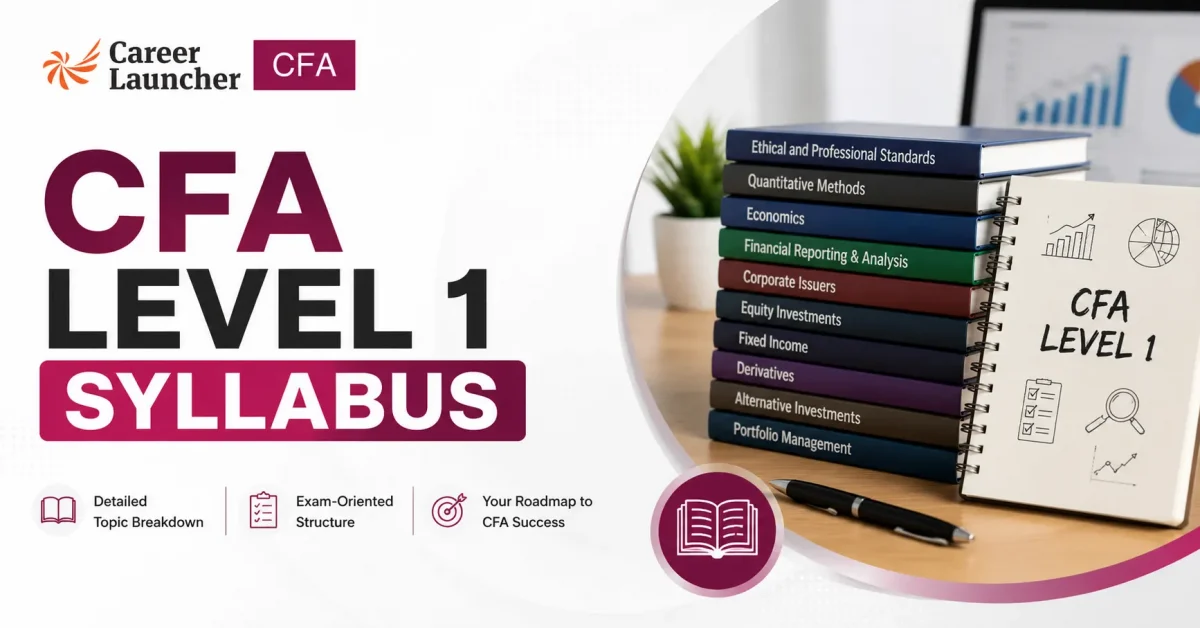
CFA Level 1 is the foundational examination of the Chartered Financial Analyst program administered by the CFA Institute. The 2026 curriculum spans 10 topic areas across 93 Learning Modules and 365 Learning Outcome Statements, tested through 180 multiple-choice questions delivered in two computer-based sessions.
The CFA Level 1 Syllabus 2026 covers 10 core subject areas — from Ethical and Professional Standards to Portfolio Management — and mastering the official topic weightage is the single most important step toward a targeted, effective study plan. According to the CFA Institute, the 2026 Level I curriculum retains 93 Learning Modules and 365 Learning Outcome Statements (LOS), unchanged from 2025, giving candidates a stable and well-documented roadmap to follow.
In this complete guide, you will find a detailed breakdown of every CFA Level 1 topic for 2026, official percentage weights sourced directly from the CFA Institute, the full exam format and pattern, high-priority areas, and proven preparation strategies. Whether you are sitting for the first time or retaking, this resource covers everything you need to align your study plan with what the exam actually tests.
According to the CFA Institute’s historical data, the global Level I pass rate has ranged between 35% and 45%, making intentional, weight-driven preparation the difference between passing and falling short. The candidates who succeed treat the syllabus — and especially the topic weights — as their primary study compass.
“The CFA exam is not just a test of knowledge — it is a test of disciplined preparation, and understanding the exact syllabus and weightage is the foundation of that discipline.”
(Pass rates dropped to a historic low of 22% in 2021 due to pandemic disruption before recovering to the 40–45% range seen in recent administrations )
Table of Contents
What Is the CFA Level 1 Exam?
The CFA Level 1 exam is the first of three progressive assessments in the Chartered Financial Analyst program, operated by the CFA Institute — the global authority in investment management education. Candidates who pass all three levels and fulfill the professional work-experience requirements earn the right to use the CFA designation, one of the most respected credentials in global finance.
Level I tests knowledge and comprehension of investment tools, asset valuation fundamentals, and ethical standards. Unlike Level II (item-set application) and Level III (portfolio-level synthesis), Level I emphasizes breadth over depth — candidates must demonstrate foundational competence across all 10 topic areas simultaneously.
The exam is offered four times annually — typically in February, May, August, and November — delivered as a computer-based test (CBT) at Prometric testing centers around the world. The CFA Institute recommends a minimum of 300 hours of preparation before sitting Level I, though successful candidates often invest 300–400 hours depending on their academic background.
CFA Level 1 Syllabus 2026: Complete List of Topics
The CFA Level 1 2026 syllabus is organized into 10 topic areas, split evenly across two exam sessions. Each topic comprises multiple Learning Modules with specific LOS that prescribe precisely what candidates must be able to describe, calculate, apply, or evaluate.
Session 1 Topics
- Ethical and Professional Standards (15–20%)
This is the single highest-weighted topic on the CFA Level 1 exam and must not be deprioritized. The section covers the CFA Institute’s Code of Ethics and Standards of Professional Conduct, including detailed guidance on duties to clients, duties to employers, investment analysis and recommendations, conflicts of interest, and the Global Investment Performance Standards (GIPS). Questions are scenario-based, testing nuanced application of the Standards rather than rote memorization.
- Quantitative Methods (6–9%)
Quantitative Methods lays the mathematical foundation for all other topics. Core areas include the time value of money (TVM), interest rate and return calculations, probability theory, statistical distributions, sampling and hypothesis testing, simple and multiple regression analysis, and an introduction to big data, machine learning, and algorithmic trading concepts. Proficiency with the Texas Instruments BA II Plus or HP 12C calculator is essential.
- Economics (6–9%)
The Economics topic covers both microeconomic and macroeconomic concepts. Microeconomics includes demand and supply analysis, consumer theory, firm behavior, and market structures (perfect competition, monopoly, oligopoly). Macroeconomics addresses GDP measurement, business cycle phases, monetary and fiscal policy tools, inflation, and international trade. Currency exchange rate determination and the roles of central banks are also tested.
- Financial Statement Analysis (11–14%)
Financial Statement Analysis (FSA) is one of the most demanding and heavily tested sections of the CFA Level 1 exam. Candidates must master the interpretation of income statements, balance sheets, and cash flow statements under both IFRS and US GAAP frameworks. Topics include revenue recognition, inventory methods, depreciation, long-lived assets, income taxes, financial ratios (liquidity, solvency, profitability, efficiency), earnings quality analysis, and off-balance-sheet financing.
- Corporate Issuers (6–9%)
Formerly called Corporate Finance, this section covers the corporate governance framework, ESG considerations, stakeholder theory, capital structure decisions, leverage analysis, working capital management, and dividend and share repurchase policies.
Session 2 Topics
- Equity Investments (11–14%)
Equity Investments covers equity market organization, types of orders, market efficiency (weak, semi-strong, strong form), equity security types, and security market indices. The valuation section includes the Discounted Dividend Model (DDM), Free Cash Flow to Equity (FCFE), and relative valuation using price multiples such as P/E, P/B, and EV/EBITDA. Industry analysis frameworks (Porter’s Five Forces, PESTLE) are also included.
- Fixed Income (11–14%)
Fixed Income is among the most quantitatively intensive topics. Candidates must understand bond features, yield measures (YTM, YTC), spot and forward rates, duration (Macaulay, modified, effective), convexity, and the term structure of interest rates. Credit analysis — including credit ratings, credit spreads, and default risk — is tested in depth. Structured products such as mortgage-backed securities (MBS) and asset-backed securities (ABS) are introduced.
- Derivatives (5–8%)
The Derivatives section introduces candidates to forwards, futures, options, and swaps. Key learning outcomes include understanding the mechanics of each contract, basic pricing and valuation principles, and risk management applications. The Black-Scholes-Merton (BSM) model is covered conceptually, and put-call parity is tested computationally.
- Alternative Investments (7–10%)
Alternative Investments explores non-traditional asset classes including private equity, venture capital, hedge funds, real estate, commodities, infrastructure, and digital assets (cryptocurrencies and tokenized assets). Emphasis is on characteristics, return drivers, due diligence considerations, fee structures, and portfolio diversification roles.
- Portfolio Management (8–12%)
Portfolio Management introduces the foundational frameworks of modern portfolio theory (MPT), including expected returns, variance, covariance, the efficient frontier, and the Capital Asset Pricing Model (CAPM). Behavioral finance biases (overconfidence, anchoring, herding) are also tested. The Investment Policy Statement (IPS) and the portfolio management process round out this section.
Also Read – CFA Course Guide 2026

CFA Level 1 Topic Weightage 2026: Official Breakdown
| Topic | Session | Exam Weight |
| Ethical and Professional Standards | 1 | 15–20% |
| Quantitative Methods | 1 | 6–9% |
| Economics | 1 | 6–9% |
| Financial Statement Analysis | 1 | 11–14% |
| Corporate Issuers | 1 | 6–9% |
| Equity Investments | 2 | 11–14% |
| Fixed Income | 2 | 11–14% |
| Derivatives | 2 | 5–8% |
| Alternative Investments | 2 | 7–10% |
| Portfolio Management | 2 | 8–12% |
Source: CFA Institute — 2026 Level I Exam Topic Weights
The four highest-weighted topics — Ethics, Financial Statement Analysis, Equity Investments, and Fixed Income — collectively represent approximately 48–62% of the total exam.
“In the CFA Level 1 exam, time is your scarcest resource — allocating it in proportion to topic weights is the strategy that separates passing candidates from those who fall short.”
Also Read – CFA Course Fees in India 2026
CFA Level 1 Exam Pattern 2026: Format and Structure
Exam Format Overview
- Total Questions: 180 multiple-choice questions (MCQs)
- Sessions: Two sessions of 90 questions each
- Total Duration: 4 hours 30 minutes (two 135-minute sessions)
- Optional Break: Between Session 1 and Session 2
- Question Format: Stem with three answer choices — A, B, and C
- No Negative Marking: Incorrect and unanswered questions carry no penalty
- Approved Calculators: Texas Instruments BA II Plus or HP 12C only
- Delivery Mode: Computer-based test (CBT) at Prometric centers globally
- Time Per Question: Approximately 90 seconds
Session Topic Distribution
Session 1 covers Ethical and Professional Standards, Quantitative Methods, Economics, Financial Statement Analysis, and Corporate Issuers — approximately 50% of total exam questions.
Session 2 covers Equity Investments, Fixed Income, Derivatives, Alternative Investments, and Portfolio Management — the remaining 50%.
Scoring, Results, and Performance Feedback
The CFA Level 1 exam is strictly pass/fail. The Minimum Passing Score (MPS) is set by the Board of Governors after each administration and is now reported as a scaled score of 1600 (on a scale of 1000–1900) on candidates’ official score reports. All candidates receive a topic-level performance summary useful for retake planning. Results are typically available 5–7 weeks after the close of the exam window
High-Weightage Topics to Prioritize in Your CFA Level 1 2026 Study Plan
- Ethical and Professional Standards (15–20%): Scenario-based ethics questions are among the most nuanced on the exam. Deep familiarity with the Standards — not just memorization — is required. Study ethics first and revisit it in the final two weeks.
- Financial Statement Analysis (11–14%): FSA rewards hands-on practice. Work through actual financial statements and drill IFRS vs. US GAAP differences. Financial ratio analysis and cash flow interpretation are tested extensively.
- Equity Investments (11–14%): Master all three valuation methodologies — DDM, FCFE, and multiples. Market efficiency generates many exam questions.
- Fixed Income (11–14%): Duration and convexity calculations, yield spreads, and the term structure require both conceptual understanding and calculation speed.
- Portfolio Management (8–12%): CAPM, the efficient frontier, and behavioral biases are high-yield topics that integrate concepts from Quantitative Methods and Economics.
How to Study for CFA Level 1 2026: Step-by-Step Preparation Strategy
- Begin with the Official Curriculum — The 93 Learning Modules are the authoritative source. Start 4–6 months before your exam date.
- Use LOS as Your Study Roadmap — Study until you can confidently perform each LOS: describe, calculate, or evaluate as specified.
- Allocate Time by Topic Weight — Ethics, FSA, Equity, and Fixed Income should receive at least 50% of your total study hours.
- Achieve Calculator Mastery Early — TVM functions, IRR, NPV, and statistical calculations require daily calculator practice.
- Complete Practice Questions After Every Module — Active recall is far more effective than re-reading.
- Take at Least 3–4 Full Mock Exams — Simulate exam conditions in the final 4–6 weeks using CFA Institute’s official practice materials.
- Analyze Every Wrong Answer — Pattern recognition during review saves significant time in the real exam.
- Apply Spaced Repetition for Ethics and Formulas — Use flashcards or tools like Anki to retain the Code and Standards alongside key formulas.
CFA Level 1 Syllabus Changes 2026 vs. 2025
According to the CFA Institute and 300hours.com, the 2026 CFA Level 1 curriculum is substantially unchanged from 2025:
- 93 core Learning Modules — identical to 2025
- 365 Learning Outcome Statements (LOS) — unchanged
- Topic weight ranges — no modifications
- Practical Skills Modules (PSMs) — still included but not directly tested in the MCQ exam
- No new major topic areas introduced for 2026
This stability means 2025 study materials, prep courses, and question banks remain fully applicable for 2026 candidates.
Best Practices for CFA Level 1 2026 Preparation
- Dedicate a minimum of 300 hours across 4–6 months; top performers often log 350–400 hours
- Study ethics first and last — revisit it in the final two weeks before exam day
- Do not neglect Derivatives and Alternative Investments — low weight does not mean low difficulty
- Join a CFA study group or online forum for accountability and concept clarity
- Read each LOS verb carefully — “describe” requires different depth than “calculate” or “evaluate”
- Use active recall over passive re-reading at all times
- Book your exam slot early to secure your preferred test center and date
- Use only the Texas Instruments BA II Plus or HP 12C — no other calculators are allowed
Frequently Asked Questions
Q: What is the CFA Level 1 Syllabus for 2026? A: The CFA Level 1 Syllabus for 2026 covers 10 topic areas: Ethical and Professional Standards, Quantitative Methods, Economics, Financial Statement Analysis, Corporate Issuers, Equity Investments, Fixed Income, Derivatives, Alternative Investments, and Portfolio Management. It includes 93 Learning Modules and 365 Learning Outcome Statements, consistent with the 2025 curriculum.
Q: What are the CFA Level 1 topic weights for 2026? A: Ethics (15–20%), FSA (11–14%), Equity Investments (11–14%), Fixed Income (11–14%), Portfolio Management (8–12%), Alternative Investments (7–10%), Quantitative Methods (6–9%), Economics (6–9%), Corporate Issuers (6–9%), and Derivatives (5–8%), as published by the CFA Institute.
Q: How many questions are in the CFA Level 1 2026 exam? A: The exam consists of 180 multiple-choice questions split into two sessions of 90 questions each, with a total duration of 4 hours and 30 minutes.
Q: Has the CFA Level 1 syllabus changed for 2026? A: No significant changes have been made. The 2026 curriculum retains the same 93 Learning Modules, 365 LOS, and identical topic weight ranges as 2025.
Q: What is the highest-weighted topic in CFA Level 1 2026? A: Ethical and Professional Standards is the highest-weighted topic at 15–20%, followed by Financial Statement Analysis, Equity Investments, and Fixed Income at 11–14% each.
Q: How long should I study for CFA Level 1 2026? A: The CFA Institute recommends a minimum of 300 study hours. Most successful candidates invest 300–400 hours over 4–6 months, combining curriculum reading, practice questions, and full mock exams.
Conclusion
The CFA Level 1 Syllabus 2026 is a comprehensive curriculum designed to establish foundational investment competency across 10 critical topic areas. With Ethical and Professional Standards commanding 15–20% of the exam and Financial Statement Analysis, Equity Investments, and Fixed Income each at 11–14%, the official topic weightage provides a precise blueprint for allocating your 300+ study hours.
The 2026 exam retains the familiar 180-question, two-session CBT format with no major curriculum changes from 2025 — a continuity that benefits all candidates. Start with the official Learning Outcome Statements, let the topic weights guide your time investment, and reinforce your knowledge with consistent mock exam practice.
The CFA designation remains one of the most valuable credentials in global finance — and your path to it begins with knowing exactly what the 2026 Level I syllabus demands.