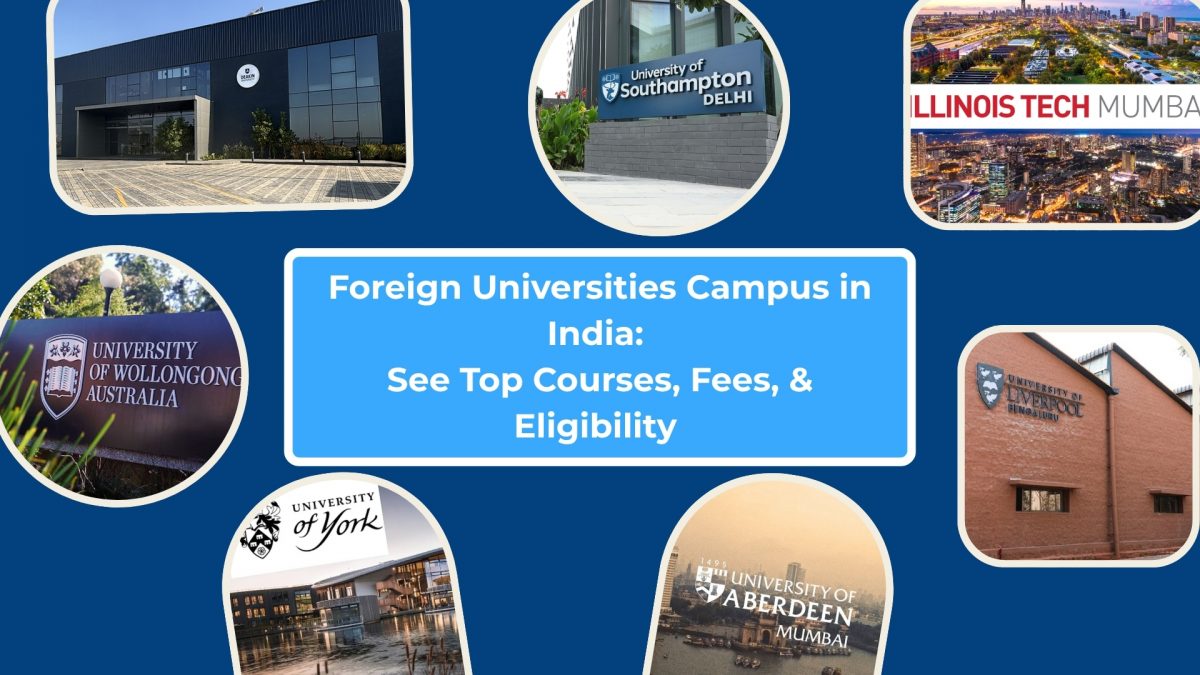
Studying at a foreign university no longer means leaving India. Since the UGC opened the door to international branch campuses in 2023, global names like the University of Southampton, Deakin University, and Illinois Institute of Technology have started teaching Indian students on Indian soil — at a fraction of the cost of studying overseas.
This guide covers exactly which foreign universities have campuses in India right now, how the UGC and IFSCA approval systems work, what it costs, how admissions work, and whether a foreign campus in India is actually a smart alternative to studying abroad. Every fact here is sourced from official UGC and IFSCA regulations and verified by 2026 campus data, so you can make a confident, informed decision.
Table of Contents
What are Foreign University Campuses in India?
A foreign university campus in India is a full branch campus established by an internationally ranked university, operating under the UGC (Setting up and Operation of Campuses of Foreign Higher Educational Institutions in India) Regulations, 2023, or under the IFSCA regulations if located in GIFT City. Students study the university’s original curriculum in India and receive a degree that carries the same recognition as at the home campus abroad, without relocating overseas.
Why International Universities Are Setting Up in India: The Policy Background
India’s foreign campus push traces directly back to the National Education Policy, 2020, which set internationalisation of higher education as a national priority. The regulatory timeline looks like this:
- 2010: The first attempt — the Foreign Educational Institutions Bill — was introduced in Parliament but lapsed.
- 2020: NEP 2020 formally commits India to inviting top global universities to set up campuses domestically.
- 2021: UGC issues Guidelines on Internationalisation of Higher Education, creating international affairs offices in Indian universities.
- 2022: UGC allows twinning, joint-degree, and dual-degree collaborations between Indian and foreign institutions, and IFSCA separately notifies rules for GIFT City campuses.
- November 2023: UGC launches a dedicated online portal so universities ranked in the global top 500 (overall or by subject) can formally apply to open Indian campuses.
Complete List of International University Campuses in India (2026)
As of early 2026, roughly 18–19 foreign universities have received UGC or IFSCA approval, with a growing number now operational or launching this year.
| University | Home Country | Indian Campus Location | Status (2026) |
| University of Southampton | UK | Gurugram, Haryana | Operational (Aug 2025 intake) |
| Deakin University | Australia | GIFT City, Gujarat | Operational since July 2024 |
| University of Wollongong | Australia | GIFT City, Gujarat | Operational since Nov 2024 |
| Illinois Institute of Technology | USA | Mumbai | Operational (2026 intake) |
| University of Liverpool | UK | Bengaluru | Operational (2026 intake) |
| University of York | UK | Mumbai | Operational (2026 intake) |
| University of Aberdeen | UK | Mumbai | Operational (2026 intake) |
| University of Bristol | UK | Mumbai | Operational (2026 intake) |
| Queen’s University Belfast | UK | GIFT City, Gujarat | Operational (2026 intake) |
| Coventry University | UK | GIFT City, Gujarat | Operational (2026 intake) |
Note: Approval and launch timelines shift as universities complete infrastructure and UGC/IFSCA sign-off; always confirm the current status on the university’s official India admissions page before applying.
Not Sure Whether to Study Abroad or Choose a Foreign University Campus in India?
Compare tuition costs, career outcomes, post-study work opportunities, and university options with personalised guidance from Career Launcher Study Abroad experts. Make an informed decision based on your goals and budget.
What are the fees of a foreign university campus in India?
Fees vary sharply by university and programme level, but they consistently undercut the cost of studying at the same university abroad once tuition, visa costs, flights, and living expenses are factored in.
| Campus | Programme | Approx. Annual/Total Fee (INR) |
| University of Southampton | UG Programs
PG Programs |
₹13.86 lakh
₹17.6 lakh – ₹23.1 lakh |
| Deakin, GIFT City | PG Programs | ~26 lakh |
| Wollongong, GIFT City | PG programme | ~₹16 lakh |
| University of Bristol | UG Programs
PG Programs |
₹15 lakh
₹20 lakh – ₹22 lakh |
| University of Aberdeen | UG Programs & PG Programs | ₹12 lakh – ₹17 lakh |
| University of York | UG Programs & PG Programs | ₹12.5 lakh – ₹18 lakh |
| Illinois Institute of Technology | UG Programs
PG Programs |
₹18 lakh
₹20 lakh |
By comparison, the same degrees at the home campuses in the UK or Australia typically cost 2–4x more once tuition and living costs abroad are included — though studying in India also means missing out on the post-study work visas and immersive cultural exposure that come with studying overseas.
If cost is the main barrier, it’s also worth checking top UK scholarships for Indian students before ruling out the home campus entirely.

Top Courses to Study at Foreign University Campuses in India (2026)
Course portfolios are still narrow compared to the home campuses abroad, but a clear pattern has emerged: every operational or launching campus is leading with computing, data-driven business, and finance-adjacent programmes rather than a broad liberal-arts spread.
| University | Campus | Top Courses Offered (2026 intake) |
| University of Southampton | Gurugram | BEng Software Engineering; BSc (Hons) Computer Science, Accounting & Finance, Business Management, Computing, Economics; MSc programmes across engineering and business |
| Illinois Institute of Technology | Mumbai | BS/MS in Computer Science, Artificial Intelligence, Data Science, and Business, 4 undergraduate and 4 graduate programmes in Year 1 |
| University of Liverpool | Bengaluru | Computer Science, Software Development, Biomedical Sciences, Accounting and Finance, Business Management, and Game Design |
| Deakin University | GIFT City | Postgraduate programmes in Business Analytics and Cybersecurity |
| University of Wollongong | GIFT City | Business, computing, and information technology |
| University of York | Mumbai | Bachelor’s in Business and Management, Economics, Computer Science, & Business of Creative Industries. Postgraduate programmes in AI, Management, and Finance |
| University of Aberdeen | Mumbai | Bachelor’s in Business Management, Economics, Data Science, Computing Science |
| University of Bristol | Mumbai | Bachelor’s in Economics and Data Science |
| Queen’s University Belfast & Coventry University | GIFT City | Construction and project management, business analytics, financial analytics, and finance, plus undergraduate Business and Finance programmes from Coventry |
Who Is Eligible to Apply? Admission Criteria
Eligibility varies by university, but most operational campuses follow this pattern:
- Undergraduate: Minimum aggregate score in Class 12 (CBSE/ICSE/State Board) or equivalent IB/A-Level scores, varying by programme (for example, Southampton requires roughly 78–82% aggregate depending on the course)
- Postgraduate: A relevant bachelor’s degree, typically with upper-second-class standing or equivalent Indian percentage/CGPA
- English proficiency: Required for some programmes, though many campuses waive this for students from English-medium Indian schools
- No standardised entrance exam: Most campuses admit purely on academic merit rather than requiring SAT, GMAT, or GRE scores for undergraduate entry
How to Apply: Step-by-Step Process
- Shortlist your target university and confirm it holds active UGC or IFSCA approval for its India campus
- Check programme-specific eligibility and intake dates on the university’s official India admissions page.
- Submit the online application with academic transcripts and the required assessment fee
- Receive a conditional offer based on predicted or final grades.
- Submit final results and complete document verification.
- Pay the confirmation deposit and enrol before the intake begins (most campuses run an August intake, mirroring the UK/Australian academic calendar)
Benefits and Risks of Choosing an International Campus in India
Benefits:
- Genuine foreign degree with home-campus recognition, without relocating
- Significantly lower total cost than studying abroad
- No visa, accommodation-abroad, or currency-conversion stress
- Access to international faculty and curriculum standards
Risks to weigh:
- These are first- and second-generation campuses in India — operational campuses together enrolled fewer than 250 students in their first year combined, so campus life, peer networks, and placement pipelines are still maturing
- No study-abroad post-study work visa or overseas cultural immersion
- Programme options are still narrower than what the home campus abroad offers
Foreign Campus in India vs. Studying Abroad: Which Should You Choose?
If your priority is cost savings, staying close to family, and earning a globally recognised degree, a foreign campus in India is a strong option — provided the university and programme are well-established. If your priority is an overseas work visa, a larger alumni network, or a wider choice of majors and campus life, studying abroad directly still has the edge. Our guide on how to choose the right country for studying abroad breaks this decision down further. Many students also use these Indian campuses as a lower-cost first step before transferring credits to the home campus abroad, where regulations permit it.
Key Takeaways
- International universities can now legally operate full campuses in India under the UGC 2023 Regulations or IFSCA’s GIFT City framework
- Degrees earned at these campuses are automatically equivalent to both the home campus abroad and Indian degrees
- The University of Southampton, Deakin, and Wollongong are already operational, with several more UK and US universities launching through 2026
- Fees are substantially lower than studying abroad, though campus ecosystems, placements, and programme breadth are still developing
- Always verify a university’s official UGC or IFSCA approval status before applying
Weighing a foreign campus in India against studying abroad? Explore Career Launcher’s study abroad resources to compare universities, costs, and application timelines before you decide.

Recommended Reads
- How to Choose the Right Country for Studying Abroad
- Ranking Systems of Foreign Universities Explained
- How to Choose the Right University for Your Study Abroad Experience
- Lesser-Known Universities Worth Considering for Indian Students
FAQs
What is a foreign university campus in India?
It’s a branch campus set up in India by a globally ranked foreign university under UGC 2023 or IFSCA regulations, offering the same curriculum and degree recognition as the university’s home campus abroad.
Which foreign universities currently have campuses in India?
As of 2026, operational and launching campuses include the University of Southampton (Gurugram), Deakin University and University of Wollongong (GIFT City), Illinois Institute of Technology (Mumbai), University of Liverpool (Bengaluru), and the University of York, Aberdeen, and Bristol (all Mumbai), among others.
How do I check if a foreign university’s India campus is officially approved?
Verify the university’s Letter of Intent or final approval status on the UGC’s Foreign Higher Education Institutions portal, or on the IFSCA website for GIFT City campuses, before applying.
Are degrees from foreign campuses in India valid in the home country?
Yes. Under UGC regulations, degrees awarded at the Indian campus carry the same name, seal, and recognition as the parent university’s degree, with no separate equivalence certification required.
How much do foreign university campuses in India cost?
Fees currently range from roughly ₹13–17 lakh for undergraduate and shorter postgraduate programmes to over ₹23 lakh a year for some master’s programmes — still considerably less than the equivalent degree pursued abroad.
When should I apply to a foreign university campus in India?
Most campuses follow an August intake aligned with the UK/Australian academic year, with applications opening 8–10 months in advance; apply as early as possible since seats are limited in each cohort.
Who is eligible to apply for these programmes?
Students who meet the university’s minimum Class 12 or bachelor’s degree percentage requirements, as specified per programme, are eligible; most campuses do not require SAT, GRE, or GMAT scores for admission.
Why are foreign universities setting up campuses in India instead of just recruiting Indian students abroad?
India’s National Education Policy 2020 and the 2023 UGC regulations created a formal, incentivised pathway for foreign universities to tap India’s large student population domestically, while GIFT City adds tax and repatriation incentives for finance-focused institutions.
Is a foreign campus in India better than studying abroad?
It depends on your goals — a foreign campus in India offers major cost savings and the same degree recognition without relocating, while studying abroad still offers post-study work visas, larger alumni networks, and broader programme choice.