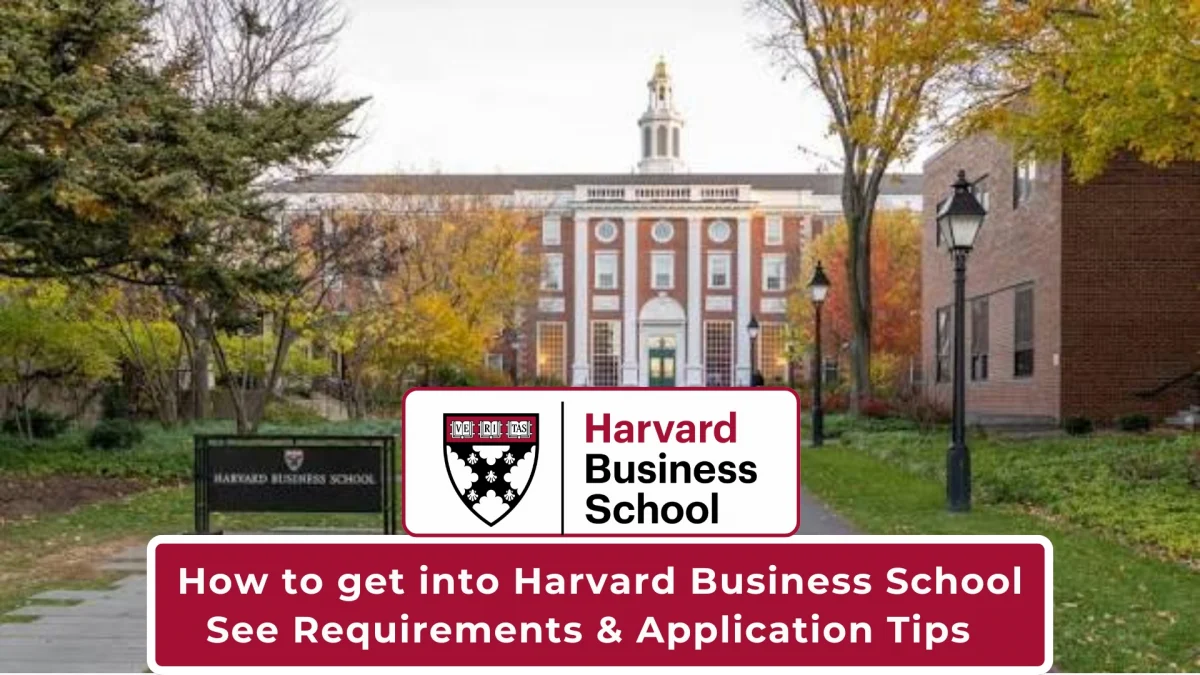
Harvard Business School receives around 9,400 applications every year and enrols fewer than 950 students — an acceptance rate of 10-11%. That number alone does not tell you much. The more useful question is: what separates the candidates who get in from the majority who do not?
This guide breaks down how to get into Harvard Business School with current data from the Class of 2026 and 2027 profiles, the 2026-27 application requirements, and what HBS admissions actually evaluates.
Table of Contents
Harvard MBA at a Glance — Class of 2027
| Metric | Class of 2027 Data |
| Applications received | 9,409 |
| Class size | 943 enrolled |
| Acceptance rate | ~10-11% |
| Average GPA | 3.76 (US 4.0 scale) |
| Median GMAT (Focus Edition) | 685 (middle 80%: 645-735) |
| Median GMAT (10th Edition) | 730 (middle 80%: 690-760) |
| Median GRE (Verbal + Quant) | 164 / 164 |
| Test submission breakdown | 34% GMAT Focus | 28% GMAT 10th Ed. | 44% GRE |
| Average work experience | 4.9 years |
| International students | 37% |
| Women | 44% |
| Top pre-MBA industries | Consulting (19%), Venture Capital / PE (16%), Tech (13%) |
| Annual cost of attendance (2025-26) | USD 126,536 (single student) |
| Tuition | USD 78,700 per year |
| Median base salary (Class of 2025) | USD 184,500 + USD 30,000 signing bonus |
(Source: HBS Employment Report 2025, Harvard MBA Class Profile )
If you’re also evaluating just how competitive Harvard is overall, check out our guide on the Harvard University Acceptance Rate (Class of 2029).
Targeting Harvard or Other Top Global MBA Programmes?
Career Launcher's MBA abroad experts help you build a competitive profile, prepare for the GMAT, shortlist the right business schools, and craft applications that stand out at leading global MBA programmes.
What HBS Is Actually Looking For
Harvard Business School evaluates candidates holistically. No single number guarantees admission — and no single weakness automatically ends your candidacy. That said, the school is explicit about what it values.
Leadership That Has Already Happened
HBS does not want potential leaders — it wants people who have already led. The class profile shows an average of 4.9 years of work experience, but the years matter less than what you did with them. Admissions looks for evidence of impact: teams you built, decisions you owned, outcomes you drove. Titles are less important than the stories behind them.
A Clear “Why MBA, Why Now” Narrative
HBS’s single essay prompt for 2026-27 asks candidates to reflect on how their choices have shaped their career path and aspirations (300 words). That brevity is deliberate — the school wants clarity, not comprehensiveness. Applicants who cannot articulate a crisp post-MBA direction in 300 words typically struggle throughout the process. This is not about picking a safe industry. It is about demonstrating that you have thought seriously about where you are going and why HBS gets you there.

Application Components: What You Need to Submit
The Essay — HBS’s Single-Question Format (2026-27)
Essay 1 (Business-Minded): “Please reflect on how your choices have influenced your career path and aspirations.” — 300 words.
This is your primary opportunity to show self-awareness and direction. HBS is not looking for a career history recap — your resume covers that. Use the 300 words to explain the through-line: why you made the choices you did, what they revealed about you, and where they are taking you. Specificity wins over ambition. One or two concrete examples outperform a list of achievements.
Many applicants focus heavily on their resume but underestimate the importance of writing a compelling admissions essay.
2026-27 update: HBS introduced a second essay for the Class of 2029 cycle — “Business-Minded: Please reflect on how your choices have influenced your career path and aspirations.” Verify the current prompts at hbs.edu/mba before applying, as prompts are updated annually.
Recommendations
Two letters required. HBS suggests (but does not require) one from a direct supervisor. The second should come from someone who can speak to your professional performance, leadership, and potential. Choose recommenders who know your work closely, not the most impressive title available. The questions ask recommenders to give specific examples — a senior leader who barely knows you cannot answer those well.
Interview — By Invitation Only
Roughly 20-25% of applicants receive an interview invitation. Interviews are 30 minutes, conducted by an HBS Admissions Board member who has read your application. Invitations for Round 1 typically go out in early October; for Round 2, late January. After the interview, candidates must submit a post-interview reflection within 24 hours — this is a required step and is factored into the decision.
How to Apply: Step by Step
- Assess your profile: Compare your GPA, GMAT/GRE, work experience, and leadership track record against the class benchmarks above. Identify gaps early — test scores can be improved; professional impact takes longer to build.
- Prepare for GMAT or GRE: HBS accepts both with no preference. Target GMAT Focus 685+ or GRE 164/164+. You can also review the typical GMAT scores required by the world’s top MBA programmes to benchmark your target score. Allow 3-6 months for serious preparation. HBS does not offer test waivers.
- Build your recommender relationships: Decide who will write your letters before applications open. Brief them on what the prompts are asking and give them enough lead time — at least 6-8 weeks.
- Draft your essay: Start with the “why”: Why this direction? Why now? Why Harvard specifically? Only then write the 300 words. Do not summarise your resume. One clear narrative arc, not a list.
- Submit application: Online through the HBS application portal. Includes transcripts, test scores, resume, essay, two recommendations, and USD 250 application fee. International applicants must also submit TOEFL, IELTS, PTE, or Duolingo scores if undergrad instruction was not in English.
- Prepare for interview (if invited): 30-minute application-based interview. The interviewer has read your file. Expect questions on your career choices, leadership examples, and post-MBA goals. Prepare your post-interview reflection in advance — know what you want to say once the interview ends.
Harvard MBA Application Deadlines 2026-27 (Class of 2029)
| Round | Application Deadline | Decision Released |
| Round 1 | September 9, 2026 (noon EST) | December 10, 2026 |
| Round 2 | January 5, 2027 (noon EST) | March 25, 2027 |
| 2+2 Deferred (undergrads / final-year students) | April 22, 2026 (2025-26 cycle; 2026-27 opens summer 2026) | Check hbs.edu |
Note: Round 1 is generally preferred for the strongest candidates — more seats, earlier decision, and first access to fellowship consideration.
Tips That Will Help
- Do not optimise only for stats. A GMAT Focus score in the 690s with no leadership narrative will not get you in. A score in the 650s with a compelling arc of impact might. HBS has no minimum — what it does have is a holistic review where essays and interviews carry serious weight.
- Apply in Round 1 if your application is ready. More spaces are available, and decisions come earlier. Do not rush a weak application — but do not wait for Round 2 unnecessarily if you are ready.
- Be specific in the essay. “I want to build businesses that solve problems” is meaningless. “I want to build healthcare logistics infrastructure for tier-2 cities in India, and HBS’s social enterprise track gives me the network and capital access to do it” is not.
- Prepare your recommenders properly. Send them the prompts, a 1-page summary of your key stories, and the deadline well in advance. A generic letter from a well-known name does more harm than good.
- The post-interview reflection is not an afterthought. It is a fresh writing sample produced under time pressure. Treat it as part of your prep.
Harvard Business School (HBS) is part of the M7 group, which is a group of 7 top business schools in the United States of America tied together because of their history, prestige, and unparalleled academic excellence. Explore our complete guide, How To Get Into M7: Strategy for Indian Students, to get more tips.
Conclusion
Getting into Harvard MBA is not about checking boxes — it is about demonstrating, across every component of the application, that you are someone who leads, thinks clearly about the future, and will add to the room. The numbers matter, but they are the floor, not the ceiling. The essay, the interview, and the recommendations are where most decisions are actually made.
If you are 2-4 years into your career and Harvard is on your radar, the time to start building your profile is now — not when applications open.
Recommended Reads
FAQs
What GMAT score do you need for Harvard MBA?
There is no minimum score requirement. For the Class of 2027, the median GMAT Focus Edition score was 685 (middle 80%: 645–735) — this is the current test most applicants are taking. HBS also reported a legacy GMAT 10th Edition median of 730 (middle 80%: 690–760) for the portion of students who submitted older scores. GRE medians were 164 Verbal and 164 Quant. HBS accepts all three formats with no stated preference. A score below the median is not disqualifying if the rest of your application is strong.
How hard is it to get into Harvard MBA?
Very. HBS received 9,409 applications for the Class of 2027 and enrolled 943 students — an acceptance rate of roughly 10-11%. Among top business schools, only Stanford GSB has a lower acceptance rate. That said, competition is concentrated among similar profiles. Differentiated leadership stories, a clear post-MBA direction, and a strong essay carry significant weight beyond the numbers.
Can Indian students get into Harvard MBA?
Yes. The HBS Class of 2027 is 37% international, representing 62 countries. Indian applicants compete in a strong international pool, but successful candidates come through consistently — typically from consulting, tech, finance, and entrepreneurship backgrounds. The key differentiator for Indian applicants is often the specificity of their post-MBA goals and the quality of their leadership narrative, not their GMAT score.
Does Harvard MBA offer scholarships?
Yes — need-based only. All admitted students are automatically considered for HBS fellowships. Over 50% of students receive some form of financial assistance. There are no merit scholarships. To be considered, students complete the FAFSA and a financial aid application made available after admission. International students can access private loans through the Harvard University Employees Credit Union without a US co-signer.