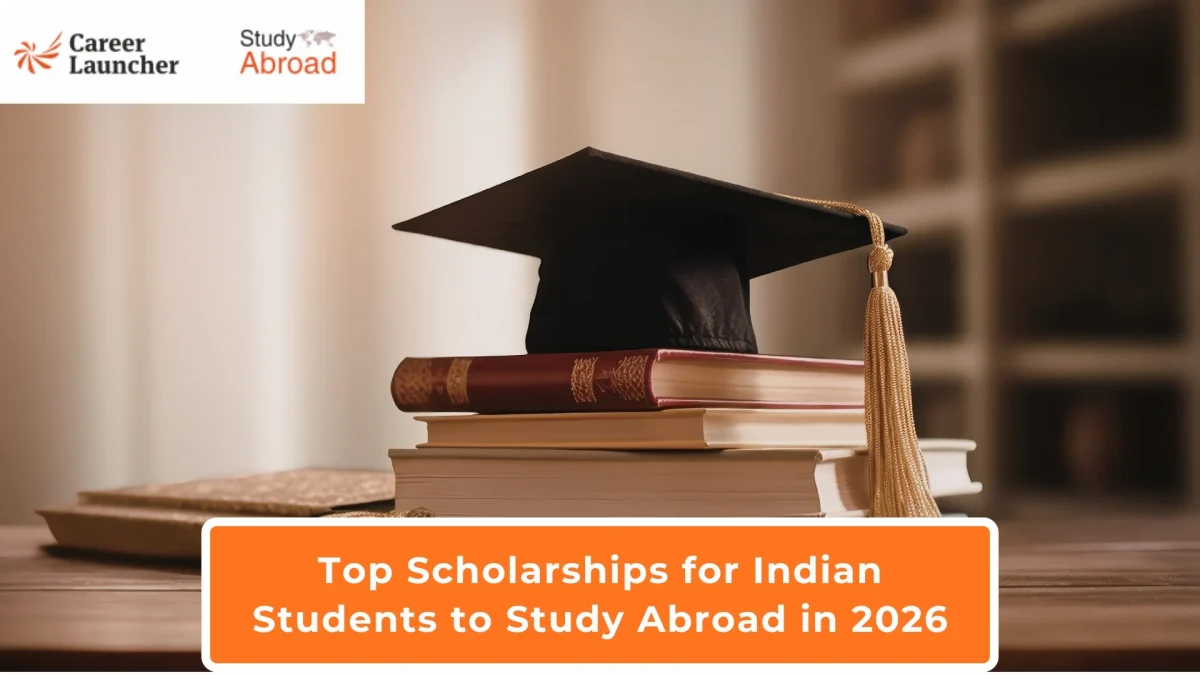
Finding the top scholarships for Indian students to study abroad in 2026 shouldn’t feel like a scavenger hunt across a hundred half-updated blog posts. With over 1.8 million Indian students now studying overseas, the funding landscape has never been bigger — but it has also never been more competitive. Chevening receives roughly 1,100–1,200 Indian applications for just 100–110 awards each year, and DAAD’s EPOS programme sees barely 10% of Indian applicants actually secure funding, despite India topping its global application volumes.
This guide organises every major funding route — Government of India schemes, US and UK university and government awards, Canadian and Australian scholarships, and Germany’s DAAD programmes — by degree level and eligibility, so you can shortlist realistically instead of applying everywhere and hoping. You’ll also get a coverage comparison table, a 12-18 month application timeline, and answers to the questions that actually determine selection (hint: it’s rarely just your CGPA).
Table of Contents
What Are the Top Scholarships for Indian Students to Study Abroad in 2026?
The top scholarships for Indian students in 2026 include Fulbright-Nehru Fellowships, Chevening Scholarships, Commonwealth Scholarships, DAAD EPOS, Inlaks Shivdasani Foundation, JN Tata Endowment, KC Mahindra Scholarships, National Overseas Scholarship (NOS), Erasmus Mundus Joint Masters, and university-specific aid at Harvard, Yale, MIT, Stanford, and Oxford. These awards are selected for their combination of full or near-full funding, strong Indian applicant track record, and realistic acceptance odds relative to application volume.
Why Scholarship Strategy Matters More Than Grades Alone
A common misconception among Indian applicants is that a high CGPA or IIT/IIM pedigree guarantees selection. In practice, panels for Chevening, DAAD, Fulbright, and Commonwealth routinely reject 9+ CGPA candidates with clean profiles in favour of applicants with slightly lower grades but sharper leadership narratives and clearer post-study plans. Three factors matter more than most students assume:
- Fit over marks. Most fully funded government scholarships score leadership impact, networking ability, and a credible return-to-India career plan — not just academic performance.
- Volume changes the math. Commonwealth Master’s awards roughly 800 scholarships globally per cycle; the India quota is a small fraction of that, so a strong-on-paper profile is competing against thousands of similarly strong-on-paper profiles.
- Timing is non-negotiable. Most fully funded scholarships open applications 8–18 months before the intended intake, and late submissions are not accepted under any circumstances.
Scholarships for Indian Students to Study Abroad by Category
1. Government of India Scholarships
These are funded directly by Indian ministries and are typically the most reliable route for students from specific eligible communities or income brackets.
- National Overseas Scholarship (NOS): A flagship central-sector scheme for SC, ST, and other eligible groups, offering approximately 125 awards annually for Master’s and PhD study, covering full tuition, flights, and a maintenance allowance of roughly $15,400 in the US. Requires an unconditional offer from a QS Top 500 university.
- Dr. Ambedkar Scheme of Interest Subsidy: Covers interest payable on education loans for overseas study, aimed at easing the loan burden rather than replacing it.
- State government schemes: Telangana’s Ambedkar and Jyothiba Phule schemes offer up to INR 20 lakhs; Delhi provides up to INR 10 lakhs for Master’s and 20 lakhs for PhD; Maharashtra runs comparable departmental funds.
2. USA: Fulbright, Ivy League Aid & University-Funded Scholarships
- Fulbright-Nehru Master’s Fellowship: A fully funded, US-government-sponsored fellowship covering tuition, J-1 visa sponsorship, round-trip airfare, living expenses, and health insurance, focused on fields tied to India’s development such as public policy, environment, and education.
- University need-based and merit aid: Ivy League and top-tier US universities routinely offer generous need-blind or need-aware financial aid to admitted international students. Review current Yale University scholarships for 2026, Harvard scholarships for Indian students, MIT scholarships for Indian students, and Stanford scholarships for Indian students before finalising your college list, since aid packages vary significantly by institution and applicant profile.
- Admissions context matters: Since scholarship competitiveness tracks admission selectivity, check the latest Harvard acceptance rate for the Class of 2029, Duke University’s 2026 acceptance rate, Boston University’s 2026 acceptance rate, and NYU’s acceptance rate for the Class of 2029 alongside your scholarship shortlist.
3. United Kingdom: Chevening, Felix, GREAT & Oxford Awards
- Chevening Scholarship: The UK government’s flagship award, fully funding a one-year Master’s for future leaders. India sees roughly 1,100–1,200 applications for around 100–110 awards annually, with reading panels weighting leadership and networking ability heavily over raw academics.
- Felix Scholarship: Supports outstanding Indian postgraduate students at select UK institutions including Oxford, Reading, and SOAS.
- GREAT Scholarships: A British Council initiative offered across roughly 20 UK universities, covering tuition support for postgraduate study.
- Oxford-specific funding: Explore Oxford University scholarships for Indian students alongside the current Oxford acceptance rate for 2026 to gauge realistic odds.
- Broader UK scholarship list: For a full country-wide sweep beyond Chevening and Felix, see top UK university scholarships for Indian students in 2026.
4. Germany: DAAD EPOS & Erasmus Mundus
- DAAD EPOS: Germany’s flagship scholarship for developing-country students, primarily funding Master’s and PhD study. India topped DAAD’s global application volumes in 2024, with roughly 49,483 Indian students now studying in Germany overall, though selection consultancies estimate only around 10% of EPOS applicants secure funding.
- Erasmus Mundus Joint Masters (EMJM): Fully waives tuition and pays a monthly allowance of roughly €1,400 for study across multiple European university campuses — one of the most prestigious multi-country funding routes available to Indian students.
- Why Germany is worth the extra effort: Combined with near-zero public university tuition, even a partial DAAD award or Erasmus stipend can make a German Master’s dramatically cheaper than a comparable US or UK program. Read why Germany is a strong choice for a Master’s degree and the broader list of scholarships in Germany for Indian students in 2026.
5. Canada & Australia: Merit and Research Funding
- Lester B. Pearson International Scholarship (Canada): A prestigious undergraduate award recognising exceptional academic merit, creativity, and leadership at the University of Toronto.
- Vanier Canada Graduate Scholarships: The top doctoral-level funding route in Canada, targeting research excellence.
- Broader Canadian options: See scholarships in Canada for Indian students for a full country-wide list.
- Australia Awards & Endeavour Postgraduate Awards: Cover full fees, flights, and living expenses; the Endeavour Postgraduate Awards offer up to AUD 272,500 across stipend, tuition, and travel.
- Maitri Scholarship: A targeted AUD 11.2 million fund for Indian STEM students at Master’s and PhD level, with university nomination deadlines typically falling in mid-January.
- Melbourne Research Scholarship: Currently around AUD 39,500 per year for doctoral researchers, reflecting universities’ push to keep stipends aligned with rising living costs.
6. Private Trusts & Corporate Scholarships (India-Based)
- JN Tata Endowment: One of India’s longest-running overseas education funds (established 1892), offering low or no-interest loans up to INR 10 lakhs for Master’s or postdoctoral study, awarded to roughly 90–100 scholars annually.
- KC Mahindra Scholarships: Support Indian students admitted to postgraduate programs abroad, a well-recognised India-based funding option.
- Inlaks Shivdasani Foundation: A pure grant — not a loan — offering up to $100,000 for postgraduate study in the UK, US, or Europe, making it one of the highest-value private scholarships available to Indian applicants.
- Tata Scholarship for Cornell University: A dedicated undergraduate award for Indian students admitted to Cornell.

Study Abroad Scholarship Comparison Table
| Scholarship | Country/Region | Degree Level | Coverage | Approx. Competitiveness |
| Fulbright-Nehru | USA | Master’s | Full tuition + stipend + flights | High |
| Chevening | UK | Master’s | Full tuition + living costs | Very high (~100-110 awards/yr for India) |
| DAAD EPOS | Germany | Master’s/PhD | Full or partial funding | High (~10% success rate) |
| Commonwealth Scholarship | UK | Master’s/PhD | Full funding | Very high (small India quota) |
| Erasmus Mundus (EMJM) | Multi-country EU | Master’s | Tuition waiver + €1,400/month | High |
| National Overseas Scholarship | Multiple (QS Top 500) | Master’s/PhD | Full tuition + flights + stipend | Moderate (eligibility-restricted) |
| Inlaks Shivdasani | UK/US/Europe | Postgraduate | Grant up to $100,000 | High |
| JN Tata Endowment | Any country | PG/PhD/Postdoc | Loan up to INR 10 lakhs | Moderate |
| Australia Awards | Australia | Master’s/PhD | Full fees + flights + living costs | High |
| Vanier CGS | Canada | PhD | Full funding | Very high |
Note: Award counts, stipend figures, and eligibility rules are updated periodically by the sponsoring bodies — always confirm current-cycle figures on the official scholarship portal before applying.
How to Apply for Scholarships to Study Abroad: A Step-by-Step Timeline
- 12–18 months before intake: Shortlist scholarships matching your degree level, field, and eligibility profile. Note that most 2026-cycle windows for Fall 2027 admission are already opening.
- 10–12 months before intake: Register for and take required standardised tests (IELTS, TOEFL, GRE, or GMAT depending on program).
- 8–10 months before intake: Draft your Statement of Purpose and request letters of recommendation early — panels for Chevening and Fulbright specifically flag generic, templated SOPs as a leading cause of rejection.
- 6–8 months before intake: Collect financial documents, income certificates, transcripts, and identity proofs required by government schemes like NOS.
- 5–7 months before intake: Submit university applications and scholarship forms in parallel — many scholarship deadlines fall earlier than the general university admission deadline.
- 3–5 months before intake: Prepare for scholarship interviews where applicable (Chevening, Commonwealth, and Fulbright all include interview rounds for shortlisted candidates).
For SOP-specific guidance, our detailed walkthroughs on how to write an SOP for universities, specifically how to write an SOP for UK universities, how to write an LOR for UK, and how to write a UK scholarship essay are worth reading before you draft your first version.
What Actually Separates Selected Applicants
A pattern shows up consistently across Chevening, DAAD, and Fulbright-Nehru selection outcomes: applicants with a 9+ CGPA and an IIT or IIM background are rejected at meaningful rates, while applicants with a 7.8 CGPA from a less-known institution are selected in the same cycle.
The gap isn’t luck — it’s that these panels are testing leadership impact, a specific and credible post-study plan, and evidence of real-world initiative (research papers, community projects, internships tied to a clear narrative), not just transcript strength.
A practical example: two Fulbright-Nehru applicants with near-identical GPAs and IELTS scores can have very different outcomes if one writes a generic “I want to give back to society” SOP while the other names a specific policy gap in India, ties their proposed coursework directly to solving it, and describes a concrete return-home role. This is also why most successful applicants stack funding — a partial scholarship plus an education loan covering the remaining 40–60% of the cost is far more common than securing one scholarship that covers everything.
For readers weighing an India-based MBA alternative that reduces total reliance on scholarships, our guide to How to Get a Scholarship to Study Abroad covers additional strategies in depth.
Key Takeaways
- The top scholarships for Indian students in 2026 are not won on academics alone — leadership narrative, networking evidence, and a specific post-study plan matter as much or more.
- DAAD EPOS, Chevening, and Commonwealth all have India-specific quotas far smaller than their applicant pools, so realistic shortlisting matters more than applying broadly.
- Most students successfully studying abroad combine a partial scholarship with an education loan rather than securing one source that covers 100% of costs.
- Start your scholarship research 12–18 months ahead, since most fully funded programs do not accept late submissions.
Looking for Scholarships That Match Your Profile?Connect with a Career Launcher Study Abroad counsellor for a personalised scholarship and university fit assessment. Discover funding opportunities aligned with your academic profile, budget, and study destination.
|
Recommended Reads
Frequently Asked Questions
What are the top scholarships for Indian students in 2026?
Fulbright-Nehru, Chevening, Commonwealth, DAAD EPOS, Erasmus Mundus, the National Overseas Scholarship, and private funds like Inlaks Shivdasani and JN Tata Endowment currently rank as the top fully or near-fully funded scholarships for Indian students.
How do I apply for a fully funded scholarship as an Indian student?
Research and shortlist scholarships matching your degree level and eligibility, take required standardised tests early, prepare financial and academic documents, draft a specific (not generic) Statement of Purpose, and submit well before the deadline — most fully funded programs do not accept late applications under any circumstance.
When should I start applying for scholarships to study abroad?
Start 12–18 months before your intended intake. Most fully funded scholarships, including Fulbright and Chevening, open applications 8–12 months ahead, and priority deadlines are typically earlier than general university deadlines.
Who is eligible for the National Overseas Scholarship?
Students from SC, ST, and other specified eligible communities pursuing Master’s or PhD programs abroad are eligible, provided they hold an unconditional offer from a university ranked in the QS Top 500 and meet the scheme’s income and age conditions.
Why do high-CGPA students still get rejected from Chevening or Fulbright?
Because these panels score leadership impact, networking ability, and a credible post-study return plan more heavily than raw academic performance — beyond a certain GPA threshold, grades stop meaningfully differentiating applicants, and generic SOPs become the primary cause of rejection.
Is Erasmus Mundus a good option for Indian students?
Yes — it fully waives tuition and pays a monthly stipend of roughly €1,400 for study across multiple European universities, making it one of the most valuable multi-country scholarship routes available, particularly for students open to studying in more than one European country.
Can I combine a scholarship with an education loan?
Yes, and this is the most common funding pattern in practice — most Indian students studying abroad use a partial scholarship alongside an education loan covering the remaining 40–60% of total cost, rather than relying on one source to cover everything.
Do private scholarships like Inlaks or JN Tata require a specific university?
No — private trusts like Inlaks Shivdasani and JN Tata Endowment are generally open to admits from a range of recognised international universities across the UK, US, and Europe, rather than being tied to one specific institution.
What documents are typically required for government scholarship applications?
Class 10 and 12 mark sheets, passport, Statement of Purpose, letters of recommendation, income certificates or ITR/Form 16 (for need-based schemes), standardised test scores, and proof of an unconditional university offer.