
*By submitting your details, you consent to receive updates from the Institute & CL.

Dayananda Sagar University (DSU), established in 2014, is recognised for its consistent focus on quality teaching, industry-relevant learning, and student development across disciplines. Building on this foundation, the DSU School of Law offers a forward-looking legal education that combines academic rigor with practical exposure. We prepare students to think critically, act ethically, and grow into professionals who can contribute meaningfully across careers in law, policy, governance, and business.
| Program | Focus Area | Duration |
| B.A. LL.B. (Hons.) | Integrates law with social sciences for a well-rounded legal education and socially conscious practice | 5 Years |
| B.B.A. LL.B. (Hons.) | Combines law with management studies to prepare for corporate legal and business leadership roles | 5 Years |
| LL.B. | Equips graduates from any discipline with foundational and practical legal skills for diverse career paths | 3 Years |
| LL.M. – Law and Technology | Focuses on legal frameworks in emerging technologies like AI, Cybersecurity, Data Protection, and IP for the digital age | 1 Year |
| LL.M. – Corporate and Commercial Law | Advanced study of corporate governance, M&A, international trade, and commercial dispute resolution | 1 Year |
| UG Programs | Program Duration | Eligibility | Yearly Fee Structure 2026-27 | ||
| Others | |||||
| Tuition Fee | Other Fee | Total Fees | |||
| B.A. LL.B | 5 | 10+2 or equivalent examination from a recognized Board with a minimum of 50% marks in aggregate. We accepts CLAT and DSAT ( Dayananda Sagar Scholarship Admission Test ) Scores |
2,02,000 | 50,000 | 2,52,000
* Scholarship Available |
| B.B.A. LL.B | 5 | 2,02,000 | 50,000 | 2,52,000
* Scholarship Available |
|
| LL.B | 3 | Graduation or equivalent examination from a recognized University with a minimum of 50% marks in aggregate. | 1,37,000 | 40,000 | 1,77,000 |
| PG Programs | Program Duration | Eligibility | Yearly Fee Structure 2026-27 | |||||
| Others | ||||||||
| Tuition Fee | Other Fee | Total Fees | ||||||
| LL.M | 1 | A bachelor's degree in law (LL.B) or an equivalent degree from recognized university / A minimum of 50% marks in the qualifying degree (40% for SC/ST candidates) / valid scores in any national level entrance exams like CLAT or AILET | 1,10,000 | 35,000 | 1,45,000 | |||
Assured Scholarship Based on
CLAT/DSAT Score for (B.A. LL.B (Hons.) & B.B.A. LL.B (Hons.) Programs)
| Rank | Scholarship |
| 01 - 5000 | INR 50,000* |
| 5001 - 10000 | INR 40,000* |
| 10001 - 15000 | INR 30,000* |
Assured Scholarship Based on your Academic Percentages
(B.A. LL.B. (Hons.) & B.B.A. LL.B. (Hons.) Programs)
| ACADEMIC PERCENTAGE | SCHOLARSHIP AMOUNT |
| 60-70% | INR 15000* |
| 71-80% | INR 20000* |
| 81-90% | INR 25000* |
| 91-100% | INR 50000* |
Note: A student can avail of the scholarship through one of the following criteria: CLAT Score / Academic Percentage / Qualification in the DSAT Test


The School of Law’s cutting-edge curriculum at DSU draws on its rich legacy of innovation, emphasizing incorporating diverse skill sets and perspectives to remain relevant in today’s world. Through a dynamic faculty and courses in emerging fields such as STS (Science and Technology Studies) and Law and Technology, the interdisciplinary curriculum at DSU School of Law aims to revolutionize how you understand the law and interact with the world.
STS papers across all the law programmes of DSU to give our students an in-depth perspective on the interactions of science, technology, and society
Cutting-edge Specializations:


Create your account on the DSU School of Law portal.
Complete your application by paying the online fee.
Submit all required documents as instructed.
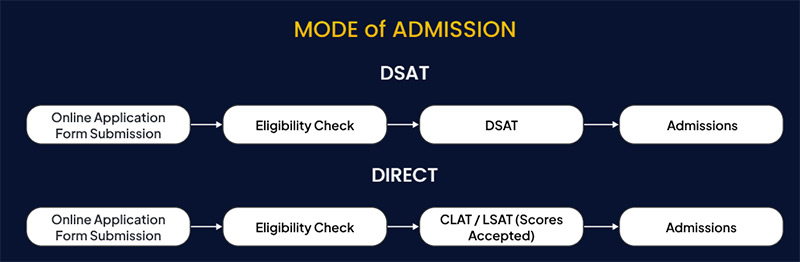
Appear for DSAT or submit scores from other accepted exams.
Participate in the personal interview and counseling sessions.
Seats are confirmed based on your performance and eligibility.
Fill in your details in the online application form.
DSAT stands for Dayananda Sagar Scholarship Admission Test, which is an entrance examination conducted by Dayananda Sagar University for admission to various programs such as B.Tech, M.Tech, B.A.LL.B., BBA. LL.B., and B.Pharm The test is designed to assess the knowledge and aptitude of the candidates in the relevant subject and is used to determine their eligibility for admissions. The scholarship test is based on multiple choice questions and the students who clear the threshold score are eligible for admission in University under scholarship quota.