IPMAT 2025 Question Paper With Detailed PDF Solutions
Get the complete IPMAT 2025 paper with answers and explanations
Download IPMAT Question Paper PDFGet the complete IPMAT 2025 paper with answers and explanations
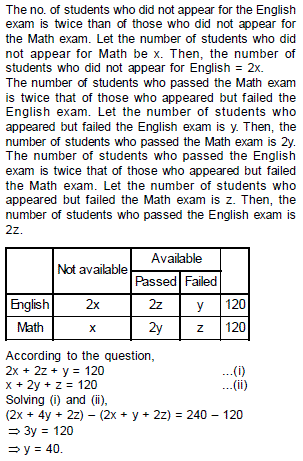
Download IPMAT Question Paper PDF36
4
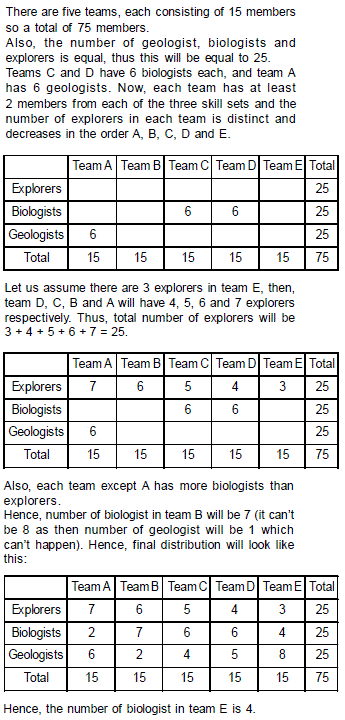
11
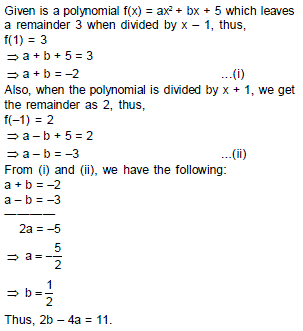
98
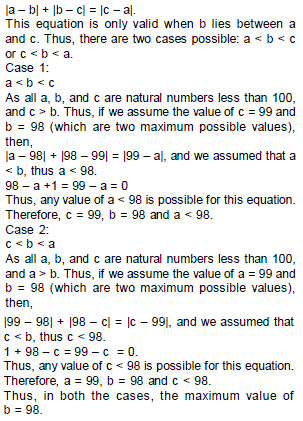
40
6
24
15
20
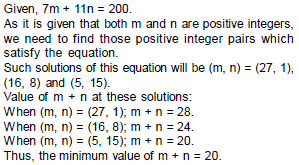
20
Note: As per the question, two answer can be derived, 20 or 24.
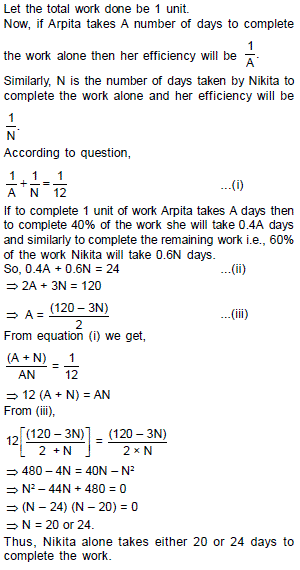
2
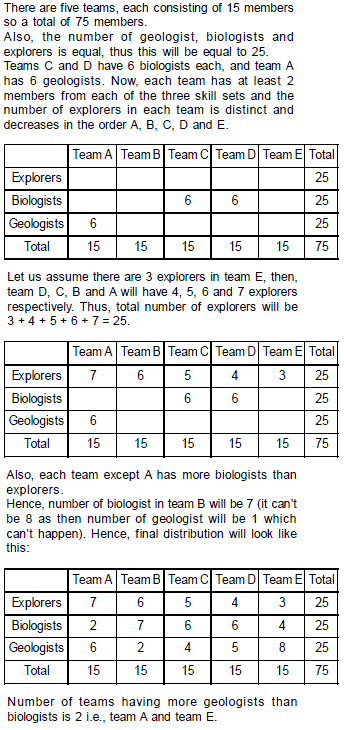
153
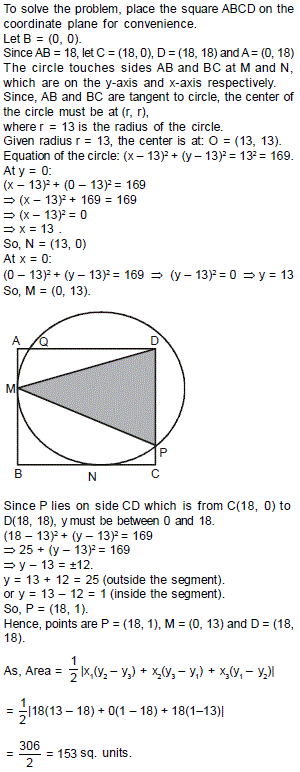
147
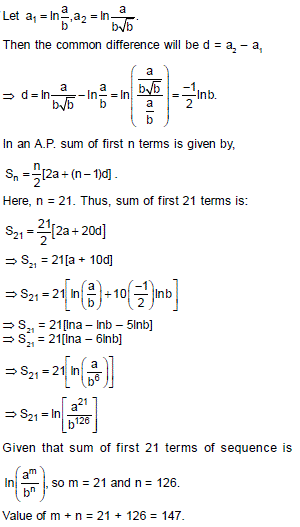
12
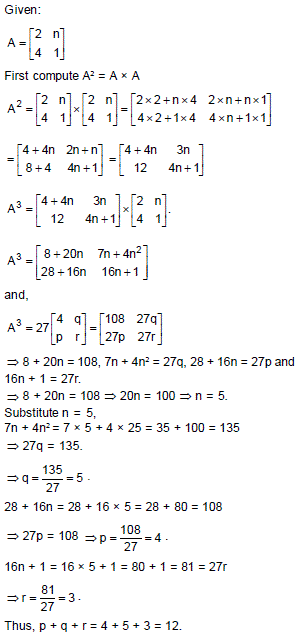
30
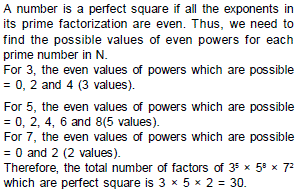
4
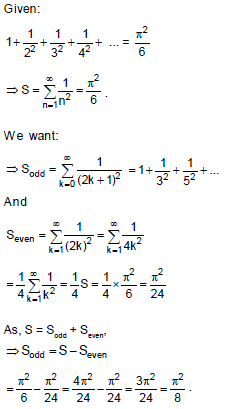
3
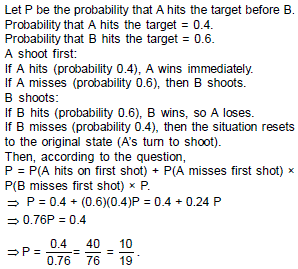
1
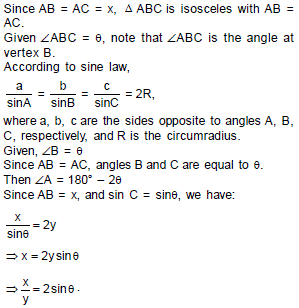
1
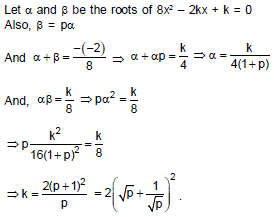
3
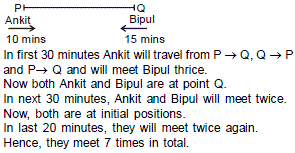
2
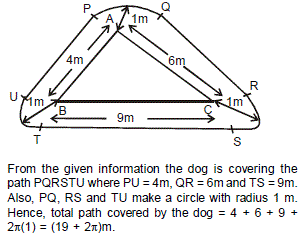
4
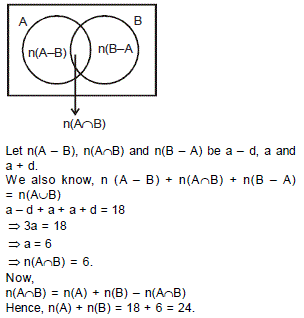
1
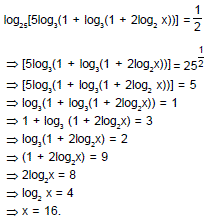
3
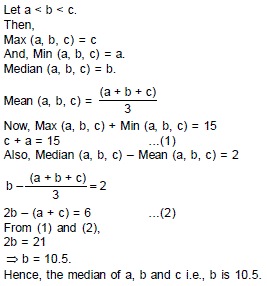
4
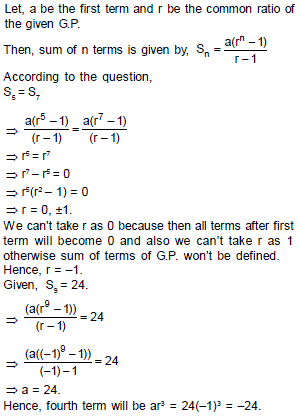
3
3
4
4
2
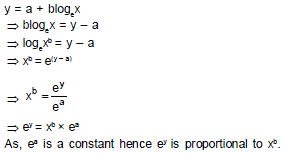
2
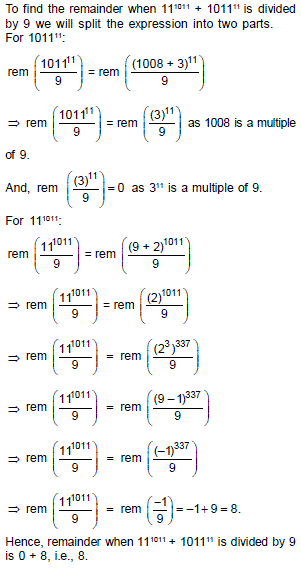
1
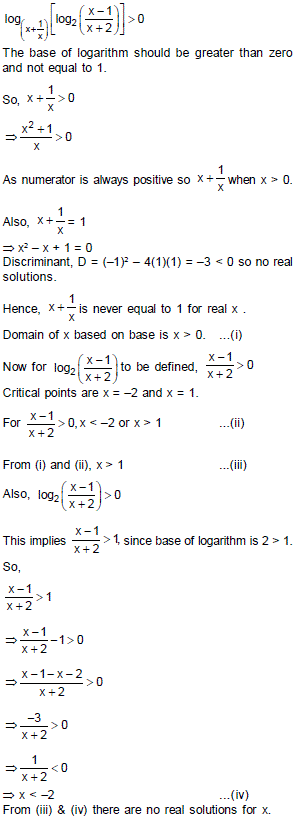
4
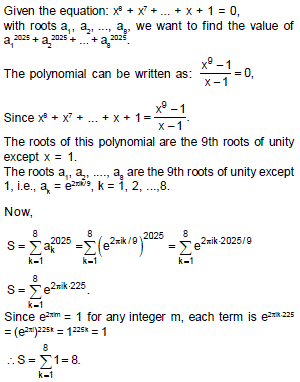
4
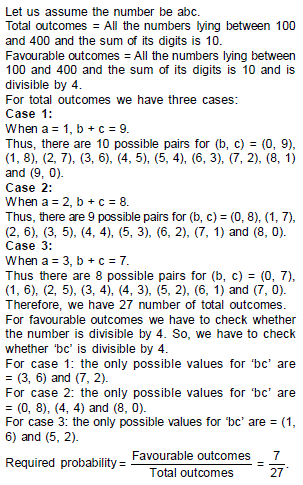
3
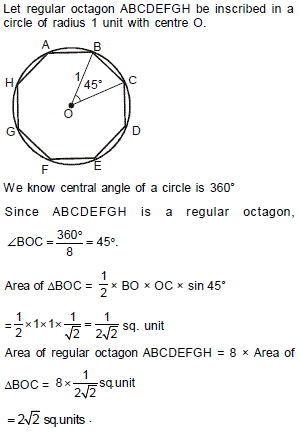
1
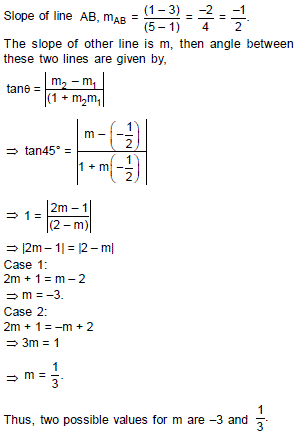
4
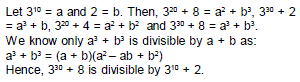
1
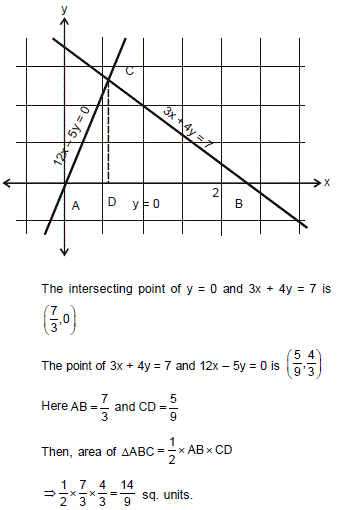
4
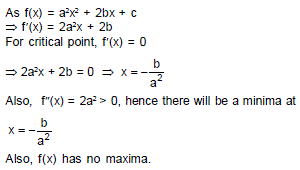
1
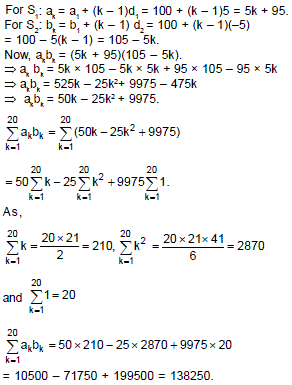
2
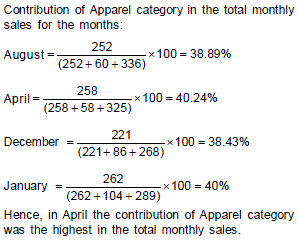
4
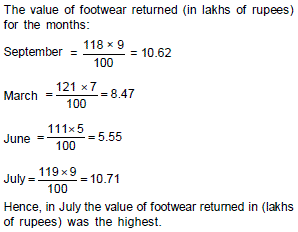
3
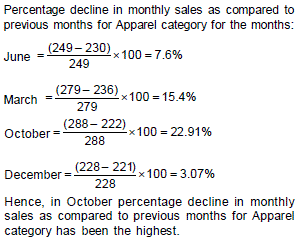
4
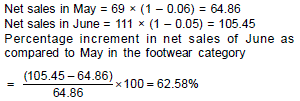
1
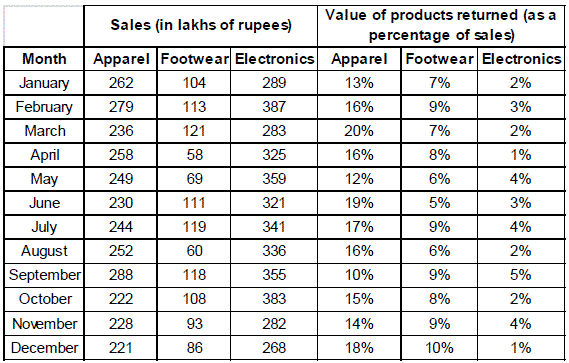
For both Apparel and Footwear the value of products returned (as a percentage of sales) increased for three consecutive months i.e., January to March for Apparel and October to December for Footwear.
4
The passage suggests that social media has control
over other forms of media due to its massive reach.
It implies that social media now controls how other
forms of media, like traditional outlets, interact and
engage with the public.
Incorrect options:
1. becoming independent of other media: This is
not true since social media relies on traditional
media for content and validation.
2. ignoring technology and artificial content: The
passage highlights that social media is deeply
influenced by technology and synthetic content.
3. finding alternative means for fact-checking:
Social media is moving away from traditional factchecking,
not finding alternatives.
3
The passage discusses how social media is now
the “connective tissue” for mass consumption of
entertainment, indicating its dominant role in
entertainment access.
Incorrect options:
1. remains unaffected by global debates amongst
lawmakers on misinformation: The passage does
not suggest that social media is unaffected by
these debates.
2. flourishes because it can publish any material:
This is incorrect as the passage critiques the
lack of content moderation, not the freedom to
publish anything.
4. is in a difficult position because it cannot adapt
to new policies: The passage does not focus on
this specific struggle in social media.
3
The writer connects the content and moderation of
social media to the policies of governments, especially
with regards to misinformation and content regulation.
Incorrect options:
1. the need for deregulation: The passage does
not suggest deregulation is the solution.
2. the individual’s right to free speech: While free
speech is mentioned, the focus is on government
policies affecting social media.
4. the global legal systems’ support of free speech:
The passage does not discuss global legal
systems supporting free speech as a key point.
2
The writer suggests that social media’s move towards
unfiltered content could drive users back to legacy
forms of media that have more reliable content
moderation.
Incorrect options:
1. uncensored content will always have more
appeal than controlled content: This is not implied;
the passage discusses how unfiltered content
may drive users away.
3. social media’s innate strength is the user’s inability
to fact check: The passage critiques this aspect,
not highlights it as a strength.
4. social media can never be discarded by its users:
The passage does not claim that social media is
indispensable.
4
The passage discusses how technologies are
shaping social media to further amplify its reach and
target specif ic audiences, hence enlarging its
influence.
Incorrect options:
1. accept the current trends as emphasised by
algorithms: The passage does not suggest
acceptance of trends, but rather that algorithms
shape and target content.
2. understand that algorithms cannot control its
content: This is not a point made in the passage;
it focuses on algorithms controlling content.
3. readjust its interaction with competitors: There’s
no mention of social media readjusting its
interaction with competitors, only its own
influence.
1
The passage mentions that social media amplifies
bias, suggesting that it contributes to the spread of
prejudice and misinformation.
Incorrect options:
2. does not address the problem of the digital divide:
The digital divide is not discussed in the passage.
3. reinforces existing objectivity among the users:
The passage argues that social media
exacerbates bias rather than reinforcing
objectivity.
4. results in unremitting expansion of freedom of
expression: The passage critiques the
unrestricted freedom of expression on social
media, not celebrates it.
3
Baudrillard argues that consumption is irrational
because consumers chase “signs” of happiness
rather than true fulfillment.
Incorrect options:
1. It is a utilitarian process: Baudrillard does not
describe consumption as utilitarian.
2. It is an egalitarian process: Consumption is not
described as equal or fair in Baudrillard’s
analysis.
4. It is a positive process: Baudrillard critiques
consumption rather than framing it as entirely
positive.
2
Baudrillard suggests that consumers should
recognize the relationship between production and
consumption to understand the true value of
commodities, rather than chasing “miracles.”
Incorrect options:
1. By rejecting colonialism and all other forms of
economic oppression: This is not the solution
that Baudrillard offers.
3. By recognising that commodities produce
miraculous change: This is what Baudrillard
critiques, not endorses.
4. By banning television commercials that promise
real happiness: This is not mentioned as a solution
in the passage.
3
Baudrillard uses the cargo myth to explain how
modern consumers chase false “miracles” of
happiness through consumption, similar to how the
Melanesians mistakenly believed they could attract
aeroplanes.
Incorrect options:
1. He uses it to describe the suffering of Indigenous
people: This is not Baudrillard’s focus.
2. He uses it to show that consumption is a blessing:
He critiques this view, not supports it.
4. He uses it to show that consumers should
consume more serious objects: Baudrillard does
not suggest consuming “serious” objects as a
solution.
1
Baudrillard argues that consumers chase “signs” of happiness (such as the latest products) rather than true fulfillment.
Incorrect options:
2. Melanesian people coped with the inequality of colonialism by creating myths: This is not Baudrillard’s point.
3. Production and consumption are magical processes: Baudrillard critiques the magical thinking surrounding consumption but does not equate production and consumption to magic.
4. Television commercials are at the heart of unhappiness experienced by consumers: While they play a role, Baudrillard focuses more on the unrealistic expectations of consumers.
4
Baudrillard argues that the pursuit of happiness through consumption is endless, as consumers constantly defer their satisfaction.
Incorrect options:
1. It comes with patience and waiting: This is not Baudrillard’s view, as he critiques the waiting game of consumerism.
2. It results from ethical consumption: Baudrillard does not suggest that ethical consumption leads to happiness.
3. It prioritises production over consumption: Baudrillard critiques consumption, not production.
3
Consumers are disappointed because they have unrealistic expectations of what commodities will provide, such as happiness.
Incorrect options:
1. Because they focus on improved functionality of commodities: This is not the reason given in the passage.
2. Because the Law of Diminishing Marginal Commodities comes into play: This is not discussed in the passage.
4. Because television commercials do not create enough hype about commodities: The issue is with consumer expectations, not the commercials themselves.
3
“Put up with” means to tolerate or endure something or someone unpleasant, which fits the context of Deepak’s unpleasant nature.
Incorrect options:
1. put along with him: This is incorrect; “put along with” is not a commonly used phrase in this context.
2. put him down: “Put him down” means to belittle or insult someone, which does not fit here.
4. put him aside: “Put him aside” means to disregard or ignore, which doesn’t fit the context of enduring someone’s behavior.
1
“Exacerbated” means to make a situation worse, which fits with the idea of the labourers making things worse by destroying machinery.
Incorrect options:
2. exaggerated their hardships: This would mean overstating their problems, not worsening the situation.
3. extenuated the circumstance: " Extenuated" means to make something seem less serious, which doesn't fit the context of causing more damage.
4. extended their troubles: "Extended" doesn't quite fit in this context, as it means to prolong rather than intensify the situation.
2
“To have it appraised” means to get the value of the jewellery assessed by a professional, which is the appropriate action in this context.
Incorrect options:
1. to get an approval: This would imply seeking permission, which is not relevant to determining the worth of the jewellery.
3. to get it appreciated: “Appreciated” implies an emotional reaction, not an assessment of value.
4. to have it apprised: “Apprised” means to be informed, which doesn’t f it the context of evaluating the jewellery’s worth.
2
“Itinerant lifestyle” refers to a lifestyle involving travel, which fits perfectly with the idea of the travel vlogger constantly moving around.
Incorrect options:
1. manage his iterative lifestyle: “Iterative” refers to repeating something, which is not related to travel.
3. manage his itinerary in his lifestyle: This is incorrect because “itinerary” refers to a planned schedule, not a way of life.
4. manage his itinerary lifestyle: This is grammatically incorrect and awkwardly phrased.
4
“ Bounding across” means jumping or leaping energetically, which fits with the context of the deer moving across the road.
Incorrect options:
1. foraging beneath the road: “Foraging” refers to searching for food, which is unrelated to crossing the road.
2. staggering with the road: “Staggering” refers to unsteady movement, which does not fit the description of the deer crossing the road.
3. jumping under the road: The phrase “under the road” is incorrect, as the deer are on the road, not under it.
2
“Usher in” means to bring about or initiate something, which fits with the hope of the government’s policies leading to economic growth.
Incorrect options:
1. turn up: This means to appear unexpectedly and does not fit the context of initiating growth.
3. set in: This implies something has begun, but “usher in” is a more appropriate phrase for starting something significant like economic growth.
4. set forth: This is typically used for presenting ideas or plans, not for initiating a period of growth.
1
“Silver bullet” refers to a simple solution to a complex problem, which is not the case here since conservation is also necessary.
Incorrect options:
2. silver lining: “Silver lining” refers to a positive aspect of a negative situation, which doesn’t fit this context.
3. red herring: A “red herring” is something meant to distract or mislead, which doesn’t apply here.
4. dead ringer: A “dead ringer” refers to an exact match, which is unrelated to the context of climate change.
3
“Negligible” means very small or unimportant, which fits the context of minimal damage to the car.
Incorrect options:
1. was negligent: This means the person was careless, which doesn’t fit the context of the car damage.
2. was neglecting: This is a verb form and doesn’t fit the sentence structure.
4. was neglectable: “Neglectable” is not a common word and is not appropriate in this context.
3
This is an example of the third conditional, which correctly uses “Had the President known” to indicate an unreal past condition.
Incorrect options:
1. If the President knew that his allies can let him down: “Can” is incorrect because it should refer to a past possibility.
2. Had the President knowledge that his allies would let him down: “Knowledge” is an awkward noun form here; “known” is the correct verb form.
4. If the President could know beforehand that his allies would let him down: “Could know” is not the correct conditional form for past speculation.
2
The correct sentence uses parallelism, ensuring that the verbs “increase,” “reduce,” and “enhance” are all in the same form.
Incorrect options:
1. increase eff iciency, reducing the costs and enhanced employee satisfaction: This is not parallel and incorrectly mixes verb forms.
3. increasing efficiency, reducing of costs, and enhancing of employee satisfaction: “Reducing of” and “enhancing of” are incorrect forms.
4. increase the efficiency, reduce the costs and enhancing employee satisfaction: “Enhancing” is not parallel to the other verbs.
2
“Had my brother feed” is the correct causative construction, indicating that the speaker arranged for their brother to feed the dog.
Incorrect options:
1. had my brother to feed my dog: The infinitive “to feed” is incorrect in this context.
3. had my brother giving food to my dog: This is grammatically incorrect, as it doesn’t fit the causative structure.
4. had my brother who fed my dog: This is incorrect because it introduces an unnecessary relative clause.
3
The phrase “regarded as” is correct to describe the discovery, and “discoveries” should be plural to match the plural subject “ one of the most significant discoveries.”
Incorrect options:
1. regarded for being one of the most significant scientific discoveries: “For being” is incorrect in this context.
2. regarded being one of the most significant scientific discoveries: This is grammatically incorrect.
4. regarded like one of the most significant scientific discovery: “Like” is incorrect here; “as” should be used.
1
This option logically follows from the idea that BMI is an unreliable measure and does not capture accurate health information.
Incorrect options:
2. Obesity is the end result of multiple factors and BMI can pinpoint the cause of the problem: This is incorrect, as BMI is not reliable for identifying the cause.
3. BMI reading can help the doctor to accurately prescribe the appropriate dosage to reduce fat: This is not supported by the passage.
4. Further, much of the information on diabetes, obesity or BMI available on social media is misleading: This does not align with the central argument of the passage.
1
This option logically supports the argument that language loss is more profound than just losing words; it involves losing a cultural worldview.
Incorrect options:
2. A potentially endangered language can sometimes appear to be thriving, or on the other hand, it can show signs of declining: This is irrelevant to the point being made.
3. Since evolution and change in languages is a part of history, most of the languages spoken today would be scarcely recognizable from what they were a few thousand or maybe even a few hundred years ago: This is a separate idea that doesn’t directly connect to the argument about language loss.
4. A certain school of thought regrets the demise of local languages but in recent times revival movements have emerged across the world, especially in India: This is unrelated to the main argument of the passage.
3
This option highlights the innovative and sustainable use of cow manure for hydrogen production, fitting well with the context of the passage.
Incorrect options:
1. This shows how Japan has always used technology to help animals: This is too narrow and not the focus of the passage.
2. The Indian government too, should replicate this, and use such technology to produce hydrogen: This is irrelevant to the main focus on Japan’s technology.
4. It is a case study of a certain animal that is useful in providing energy for several other animals: This is not the focus; the main point is the technology, not the use of animals.
3
This option ties into the passage’s focus on the challenges posed by increasing heat and its negative impact on health and the economy.
Incorrect options:
1. However, the people of these districts are given sufficient compensation for loss of life and property: This is not mentioned in the passage.
2. According to the Council, more than 20% of the population is not affected by climate change: This contradicts the data given in the passage.
4. The record-breaking heat of the summer of 2024 resulted in an unpredictable and delayed monsoon: This is not mentioned and does not fit with the passage’s focus.
4
“Maintain” fits with the idea of influencers keeping a consistent persona, “generate” works with the creation of unrealistic standards, and “trigger” fits with negative comparisons.
Incorrect options:
1. endorse; foster; provoke: “Endorse” is incorrect in this context; “foster” is too mild.
2. advocate; perpetuate; stimulate: “Advocate” doesn’t fit the idea of presenting a curated persona.
3. profess; inspire; release: These verbs do not align as well with the meaning in the sentence.
1
“Extended” fits with a long period of time, “physical” matches the context of endurance, and “resilience” is the correct term for mental strength.
Incorrect options:
2. extensive; dysfunctional; agility: “Dysfunctional” and “agility” do not fit in this context.
3. expanded; stern; acuity: “Stern” and “acuity” are incorrect for describing mental endurance.
4. explicit; stoic; integrity: “Stoic” is not appropriate for mental endurance, and “integrity” does not fit the context.
3
“Therapeutic” is the correct term for something that heals or provides emotional relief, and “enhance” fits with increasing self-awareness.
Incorrect options:
1. pleasing; decrease: “Pleasing” doesn’t fit with the idea of healing, and “decrease” contradicts the idea of improving self-awareness.
2. acceptable; disturb: “Disturb” is the opposite of what art aims to achieve.
4. avoidable; mitigate: “Avoidable” doesn’t fit with the concept of art as a therapeutic process.
3
“Premised” fits with the idea of personhood being based on more than genetic material, “organisation” relates to the structure of genetic material, and “consciousness” fits with the development of thought and moral agency.
Incorrect options:
1. interdependent; division; differentiation: These terms don’t fit the context of personhood.
2. dependent; disorganisation; deconstruction: These are incorrect in this context.
4. built; distribution; calibration: “Built” is not appropriate for this philosophical discussion.
1
“Ingredient” fits with curcumin being a component of turmeric, “inflammation” fits as a condition curcumin helps with, and “induce” means to cause negative effects when taken in excess.
Incorrect options:
2. alkali; infection; promote: “Alkali” and “infection” do not fit the context.
3. enzyme; abrasion; infuse: “ Enzyme” and “abrasion” are not relevant here.
4. alchemy; injury; cause: “Alchemy” and “injury” are incorrect terms for this context.
3
“Compromise” fits with weakening the immune system, “impair” fits with damaging overall well-being, and “counter” fits with mitigating the negative effects of stress.
Incorrect options:
1. endanger; preserve; decrease: “Preserve” and “decrease” are incorrect here; they don’t fit the context of managing stress.
2. undermine; elevate; impede: “Elevate” doesn’t fit the context of improving well-being.
4. paralyse; improve; diminish: “Paralyse” is too extreme for this context.
2
“Dynamism” refers to the constant change and movement within an industry, especially in terms of leadership and market positions.
Incorrect options:
1. the never-changing reliance on established and unchanging business practices: This is the opposite of “dynamism.”
3. the slow, gradual growth and morphing of established companies: “Dynamism” refers to rapid change, not slow growth.
4. the stability and predictability of traditional industries: This contradicts the idea of dynamism.
2
The “shuffle rate” measures the volatility and movement within industries, particularly the changes in market leadership, not the overall profitability of traditional industries.
Incorrect options:
1. Churn within the arena of competition: This is related to the “ shuffle rate,” which tracks changes within industries.
3. Volatility of market leadership: The “shuffle rate” measures how much market leadership changes, aligning with this option.
4. Relative change within an industry: The “shuffle rate” measures this by indicating how much movement occurs in industry positions.
1
The “arenas of competition” refers to categories or sectors where businesses compete, such as “wizard” and “muggle” industries.
Incorrect options:
2. physical locations where businesses compete: This does not match the meaning of “arenas of competition” in this context.
3. government regulations that control business competition: The term does not refer to regulations.
4. specific companies that are considered to be powerful competitors: “Arenas of competition” is about sectors, not specific companies.
2
The conversation emphasizes the growth and profit of newer, dynamic industries (“wizards”) compared to traditional sectors.
Incorrect options:
1. The global economy is shifting back towards traditional industries, as they offer more stable returns: This contradicts the main point, which highlights the success of newer industries.
3. Traditional industries are consistently more profitable than newer, “wizard-ish” industries: The conversation makes it clear that “wizards” outperform traditional industries in growth and profit.
4. The terms “wizard” and “muggle” are used to describe the magical elements of business success: This is an oversimplification and doesn’t capture the main idea.
1
“ W izard” industries are noted for their higher concentration of economic profit and a greater emphasis on research and development (R&D).
Incorrect options:
2. a reliance on traditional economic rules and practices: “W izard” industries do not follow traditional economic rules.
3. lower research and development spending: “Wizard” industries are more R&D intensive, not less.
4. a slower rate of market capitalization growth: “Wizard” industries grow more rapidly in market capitalization.
3
“Muggles” refers to industries that play by traditional economic rules, as opposed to the dynamic, rapidly growing “wizard” industries.
Incorrect options:
1. exhibit high levels of market capitalization growth: “Muggles” have slower growth compared to “ wizards.”
2. are characterized by rapid and frequent changes: This describes “wizards,” not “muggles.”
4. are primarily focused on technological innovation: “Muggles” are traditional industries, not those focused on rapid technological innovation.
25143
Sentence 2 introduces the setting of the robotics laboratory.
Sentence 5 explains how the robots were taught only a basic set of skills, setting up the context.
Sentence 1 talks about how AI improves the robots’ dexterity, supporting the earlier point about skills improvement.
Sentence 4 elaborates on how these robots perform tasks better than most.
Sentence 3 concludes with how, despite their abilities, the robots aren’t suited for catering careers.
52134
Sentence 5 introduces the Indus Valley Civilization
and its importance.
Sentence 2 provides further detail about their
architectural advancements and urban design.
Sentence 1 delves deeper into the specific cities,
Harappa and Mohenjo-Daro, and their significance.
Sentence 3 focuses on the civilization’s economic
foundations.
Sentence 4 concludes with the unresolved mystery
surrounding the decline of this civilization.
3142
Sentence 3 introduces the role of roots in plants’ interaction with soil to seek water.
Sentence 1 discusses how water depletes in drought conditions and its impact on plants.
Sentence 4 explains the role of abscisic acid in helping plants adapt.
Sentence 2 explains the study’s insight into how abscisic acid affects root growth to seek water.
1324
Sentence 1 introduces the countries most affected by climate change.
Sentence 3 explains the stance of high- income nations on climate responsibility.
Sentence 2 provides specific details about India’s impact from extreme weather.
Sentence 4 concludes with the argument from the developing world about the burden of climate crisis.
2431
Sentence 2 begins with how creativity is often perceived.
Sentence 4 then challenges the idea that creativity only arises from big ideas.
Sentence 3 illustrates how inspiration can arise from the mundane details of daily life.
Sentence 1 concludes by emphasizing that creativity is about finding beauty in the ordinary.