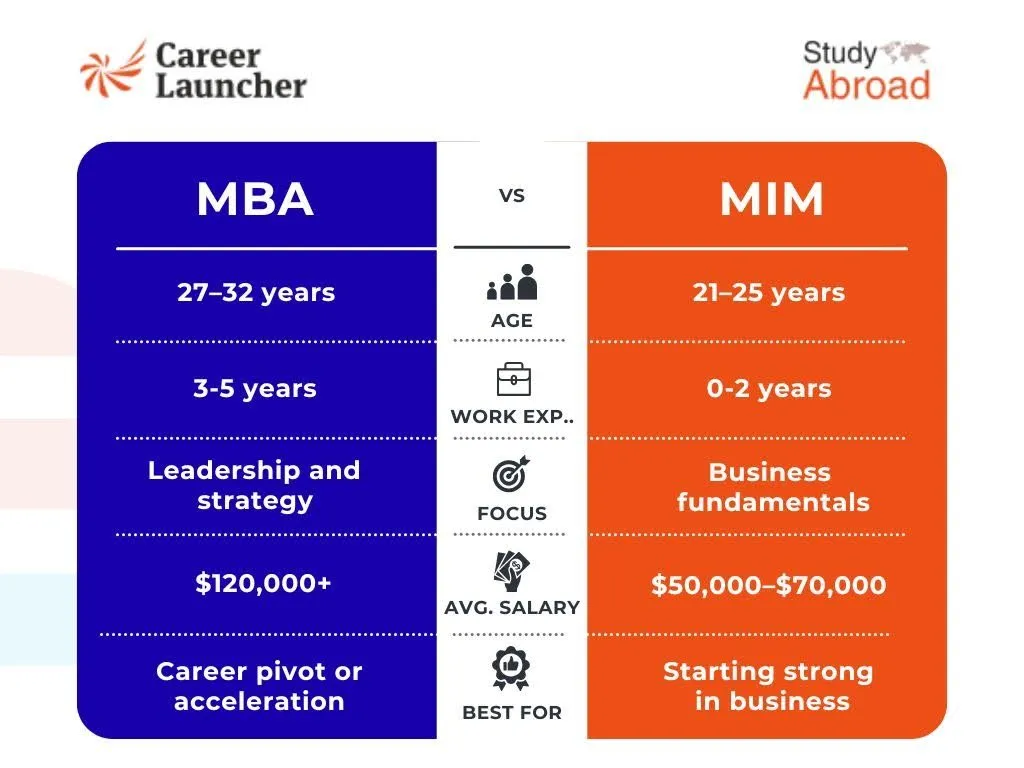
According to the GMAC Corporate Recruiters Survey 2024, the projected median starting salary for MBA graduates is $120,000 in the USA. Earning an MBA increases salary by an average of $41,000 compared to pre-MBA earnings, with top-program graduates seeing increases of 60-120%.
The same GMAC 2024 survey found that more than 25% of global employers plan to expand MBA hiring, with 46% maintaining steady hiring. Among consulting firms, 1 in 3 plan to hire more MBAs than the previous year. 93% of tech companies surveyed said they plan to recruit MBA graduates in 2025.
HEC Paris's Class of 2025 MBA Employment Report shows that 57% of graduates switched sectors, 54% changed function, and 64% secured positions outside their home country, demonstrating that an MBA abroad enables genuine career reinvention, not just incremental progress.
Most top MBA destinations offer post-study work rights: the USA offers up to 3 years OPT (STEM-designated MBAs), the UK offers a 2-year Graduate Route visa, Canada's PGWP allows up to 3 years, and Australia offers 2 to 4 years depending on location and institution.
Top schools bring together cohorts of 30-50+ nationalities. For example, HEC Paris's Class of 2026 had more than 60 nationalities, with 95% international students, meaning your network from day one is fully global.
Companies like Apple, Microsoft, Google, McKinsey, BCG, Bain, Goldman Sachs, and JP Morgan actively recruit from top MBA programs. Harvard Business School's 2025 employment report lists OpenAI and Anthropic among its newest MBA recruiters alongside traditional finance and consulting firms.
Both the MBA and MiM are management degrees. They teach business fundamentals, develop leadership skills, and open doors to corporate careers. But they are built for entirely different points in your professional journey.
The MBA is designed for professionals who already have experience and want to do something bigger with it. For instance, switch industries, move into senior leadership, or launch a venture. The classroom dynamic reflects this: your peers have lived through real business decisions, and much of the learning comes from that collective experience in the room.
The MiM, by contrast, is built for those at the starting line. GMAC’s Application Trends Survey found that 54% of MiM applicants have no work experience at all. The degree gives you the business language, frameworks, and early network to enter corporate life with a strong foundation. This is particularly true for Europe, where the MiM is the dominant postgraduate business qualification.
The simplest way to decide: if you're asking "how do I build a career in business?" — then MiM is your answer. If you're asking "how do I take my career to the next level?" — that's the MBA.
| QS Global MBA Rankings 2026 | School | Country |
| #1 | Penn (Wharton) | USA |
| #2 | Harvard Business School | USA |
| #3 | MIT Sloan | USA |
| #4 | Stanford GSB | USA |
| #5 | HEC Paris | France |
| #6 | London Business School | UK |
| #7 | Cambridge Judge | USA |
| #8 | INSEAD | France |
| #9 | Northwestern (Kellogg) | USA |
| #10 | Columbia Business School | USA |
| #11 | IE Business School | Spain |
| #12 | Oxford (Saïd) | UK |
| #13 | Yale SOM | USA |
| #14 | UC Berkeley (Haas) | USA |
| #=15 | Chicago Booth | USA |
| #=15 | IESE Business School | Spain |
| #17 | NYU Stern | USA |
| #18 | UCLA Anderson | USA |
| #19 | Imperial College | UK |
| #20 | SDA Bocconi | Italy |
Most international MBA programs look for a combination of academic credentials, professional experience, test scores, and demonstrated leadership. Here's what you'll need:
| Bachelor's Degree | A completed undergraduate degree from a recognised institution. Most programs do not require a business background. Degrees in engineering, sciences, humanities, or any field are accepted. |
| Work Experience | Top-tier programs typically require 3-5 years of full-time professional experience. Some mid-tier schools and European programs accept candidates with 1-2 years. Quality and progression of experience matter more than the number of years alone. |
| GMAT / GRE | Both exams are accepted equally by leading business schools for the 2026-27 intake. Schools do not prefer one over the other. A GMAT Focus score of 655+ is competitive for most programs; top schools (Wharton, Columbia, INSEAD). A GRE score of 310-325 is generally competitive for top MBA programs. |
| English Proficiency | IELTS: 6.5-7.5 (varies by school) TOEFL iBT: 100-110 PTE Academic: 62-75 Many programs waive this requirement if your undergraduate degree was taught in English. |
| Letters of Recommendation | Typically 2-3 LORs, usually from direct professional supervisors rather than academic references. Schools want evidence of your impact and leadership in a workplace context. |
| Statement of Purpose / Essays | Each school has its own essay prompts â usually around your career goals, leadership experience, and why this specific program. This is one of the most important and differentiating parts of the application. |
| Resume / CV | Should clearly demonstrate career progression, leadership responsibilities, quantifiable achievements, and any community or extracurricular involvement. |
| Interview | Shortlisted candidates are invited to interview either in person, on campus, or via video call. Interviews are evaluative and form part of the final admission decision. |
A strong MBA application cannot be built in a few weeks. Most successful applicants start 12-18 months before their target application deadline. Here's a realistic phase-by-phase breakdown:
Begin research. Explore programs, attend MBA fairs and webinars, review rankings, and start identifying schools that align with your career goals, not just by prestige or rankings, but by industry focus, location, cohort profile, and post-MBA recruiting outcomes.
Decide between GMAT Focus and GRE based on your target schools and your strengths. Register and begin structured preparation. Allow at least 3-4 months of dedicated prep time and build in a buffer for a retake if needed. GMAT score is valid for 5 years.
Shortlist 5-8 schools. Attend virtual or on-campus events, connect with current students and alumni, and begin building your application narrative â your "why MBA, why now, why this school" story. Start working on leadership examples that will feed your essays and recommendations.
Take your English proficiency test (IELTS / TOEFL) if required. Aim to complete this before you begin essay drafting so it's out of the way.
Draft essays. Identify recommenders - ideally direct supervisors who have observed your professional impact firsthand. Brief them well in advance and give them ample time. Update and refine your CV. Gather transcripts and supporting documents.
Submit applications. Round 1 is strongly recommended for international students as it gives you the best chance at both admission and scholarship consideration, and leaves time for visa processing. Most top schools have R1 deadlines in September-October and R2 in January.
Interview invitations go out. Prepare thoroughly, as MBA interviews are evaluative and play a role in the final decision.
Accept your offer, pay the deposit, apply for your student visa (3-4 months before your start date), arrange accommodation, and engage with your incoming class community.
The cost of an MBA abroad varies significantly based on the country, university, and program duration. Tuition is only part of the picture. You also have to think about living expenses, health insurance, and pre-arrival costs, which add substantially to the total investment.
| Country | Tuition Range (Full Program) | Program Duration |
| USA (Top schools) | $130,000 - $160,000+ | 2 years |
| UK | £45,000 - £95,000 | 1-2 years |
| France / Europe | €30,000 - €80,000 | 1-2 years |
| Canada | CAD 60,000 - 120,000 | 1.5-2 years |
| Australia | AUD 50,000 - 100,000 | 1.5-2 years |
| Germany (public universities) | Minimal / near-zero tuition | 1.5-2 years |
| Spain | €82,300 - €114,000 | 11-19 months |
| Italy | €62,000 - €82,000 (SDA Bocconi); €22,000-€45,000 (other schools) | 12-15 months |
Over 52% of MBA students globally receive some form of financial aid. Scholarships broadly fall into three categories: government-funded, university-specific, and India-specific external awards.
| Scholarship | Country | Coverage | Amount | Eligibility |
| Fulbright-Nehru Master's Fellowship | USA | Tuition + living + airfare | Full funding | Indian nationals; strong academic & leadership profile; ~1-2% acceptance rate |
| Chevening Scholarship | UK | Tuition + living + return flight | Full funding | Citizens of eligible countries incl. India; demonstrated leadership potential; 1-year programs only |
| DAAD Scholarship | Germany | Monthly stipend + travel allowance | €850-€900/ month + travel | International students at German universities; merit-based; ~8-10% acceptance |
| Commonwealth Scholarship | UK | Tuition + airfare + living allowance | Full funding | Citizens of Commonwealth nations incl. India; administered by Commonwealth Scholarship Commission |
| Australia Awards | Australia | Tuition + living stipend + travel | Full funding | Citizens of eligible developing countries; need + merit based |
| School | Scholarship | Type | Amount | Key Details |
| Harvard Business School | Need-Based Financial Aid | Need-based | Avg. ~$46,000/year | ~50% of HBS students receive aid; no merit scholarships; determined by demonstrated financial need via HBS financial aid application |
| Harvard Business School | Boustany Foundation MBA Scholarship | Merit-based (external) | $102,200 total ($51,100/year) | Open to all nationalities; preference for Lebanese heritage; awarded once every two years; apply separately to Boustany Foundation after receiving HBS admission |
| Stanford GSB | Knight-Hennessy Scholars | Merit-based | Full funding (up to 3 years) | Separate application required; up to 100 scholars selected per year across all Stanford graduate programs; based on independent thinking, purposeful leadership, civic mindset; 84 scholars selected in 2025 cohort |
| Stanford GSB | Stanford Reliance Dhirubhai Fellowship | Merit-based | 80% of tuition | Specifically for Indian students at Stanford GSB |
| Wharton (UPenn) | Wharton Fellowship Program | Merit-based | Partial tuition | All admitted students automatically considered; based on background, academic record, professional achievement, and community involvement |
| London Business School | Merit Scholarships (portfolio) | Merit-based | Varies | All admitted students automatically considered for all awards; LBS does not publicly disclose individual scholarship amounts â confirmed via LBS official fees page |
| London Business School | Laidlaw Women's Leadership Fund | Merit + need | Partial to full | For outstanding women who might not otherwise afford a top-tier MBA; no separate application required |
| INSEAD | Judith Connelly Delouvrier Scholarship | Merit-based | €20,000-€25,000 | Open to female applicants committed to advancing inclusion of women in business |
| INSEAD | L'Oréal Scholarship | Merit-based | Up to €25,000 | Open to any candidate committed to creativity, innovation through diversity, and entrepreneurial activity |
| INSEAD | Need-Based Scholarships | Need-based | Varies | Largely focused on students from emerging economies |
| HEC Paris | Merit & Need-Based Scholarships | Merit + need | €6,000-€24,000 | Admitted candidates must provide financial status details; both merit and need categories available |
| Scholarship | Coverage | Amount | Key Details |
| JN Tata Endowment | Loan scholarship | Varies | Interest-free loan for Indian students going abroad for postgraduate studies; among the most respected India-specific awards |
| Inlaks Shivdasani Foundation | Tuition + living | Up to $100,000 | For exceptional Indian students at elite global universities; highly competitive |
| Narotam Sekhsaria Foundation | Partial tuition + living | Varies | Merit-based; for Indian students at top international universities |
| National Overseas Scholarship | Tuition support | Up to ~$15,400 (INR 12.87 lakh) | Offered by Ministry of Social Justice & Empowerment; for students from economically weaker sections; must be under 35, 60%+ in undergrad |
Note: For government scholarships like Chevening, Fulbright, and DAAD, applications typically open and close 9-12 months before your intended program start date - often well before MBA application deadlines. Plan scholarship applications in parallel with, not after, your MBA applications.
Post-MBA salary outcomes depend heavily on the school, the industry you enter, and the country where you work. Rather than looking at one market, here's how compensation shapes up across the key MBA destinations.
| Country | Avg. Post-MBA Salary | Notes |
| USA | $160,000-$185,000 | HBS Class of 2025 median base: $184,500; MIT Sloan Class of 2024 average: $169,370 |
| UK | £91,928 (~$117,000) | LBS MBA Employment Report 2025; 88% placed within 3 months |
| Canada | CAD $90,000-$140,000 | Varies by school and industry; Toronto and Vancouver command highest packages |
| France | $180,000-$210,000 (3-yr weighted) | INSEAD weighted avg. salary: $209,992 (FT 2025); reflects global placement |
| Germany | €70,000-€100,000 | Strong demand in |
| Spain | €50,000-€70,000 (local roles) / $205,044 (3-yr weighted) | IESE & ESADE graduates often placed globally; local Spanish salaries are lower |
| Italy | $217,241 (3-yr weighted) | SDA Bocconi FT 2025 weighted salary; 124% avg. salary increase vs pre-MBA |
Getting a student visa is one of the final steps before you begin your MBA journey. While the process varies by country, the core requirements such as an admission letter, proof of funds, and valid documents remain largely consistent.
| Country | Visa Type | Post-Study Work Rights |
| USA | F-1 Student Visa | 12 months OPT; up to 36 months for STEM-designated MBAs |
| UK | UK Student Visa | 2-year Graduate Route Visa |
| Canada | Study Permit | 3-year PGWP for master's degree graduates |
| Australia | Student Visa (Subclass 500) | Temporary Graduate Visa (Subclass 485) |
| France | Long-Stay Student Visa (VLS-TS) | 1-year post-graduation work authorisation (APS) |
| Germany | National Visa (Type D) | 18-month job seeker visa post-graduation |
| Spain | Long-Term Student Visa | Up to 1 year job search authorisation post-graduation |
| Italy | Long-Stay Student Visa (Type D) | Up to 1 year job search authorisation post-graduation |
Note: Visa rules change frequently. Always verify current requirements on the official embassy or immigration website of your chosen country before applying.
With 30+ years of experience and 2,00,000+ students helped, Career Launcher supports you at every step - from first consultation to landing in your new country:
Yes. MBA degrees from internationally accredited universities, particularly those holding AACSB, EQUIS, or AMBA accreditation, are recognised by Indian employers and multinational companies operating in India. Most Fortune 500 companies and top Indian conglomerates actively recruit from global MBA programs.
There is no universal minimum, but a GMAT Focus score of 655+ is generally considered competitive for most programs. A GRE score of 310-325 is broadly equivalent. Both exams are accepted equally; schools do not prefer one over the other.
Most full-time MBA programs require 3-5 years of professional experience. Some European 1-year programs accept candidates with 2+ years. Executive MBA programs typically require 10-15 years. The quality and trajectory of your experience matters more than the raw number of years.
Total cost (tuition + living expenses) ranges from approximately $60,000 in Germany to over $230,000 for a two-year MBA at a top US school. Over 52% of MBA students globally receive some form of financial aid, which can significantly reduce the out-of-pocket investment.
Most full-time MBA programs require work experience. However, some programs, particularly in Australia and certain European schools, place greater emphasis on profile and potential, and may accept candidates with limited experience. If you have under 2 years of experience, a MiM (Master in Management) may be a better fit first.
MBA graduates from top international schools are recruited into consulting, investment banking, product management, private equity, corporate strategy, and technology. The GMAC 2025 survey found ~90% of global employers plan to hire MBA talent, with consulting, finance, and tech sectors showing the strongest demand.
It depends on your goals. USA for highest salaries and brand recognition; UK for 1-year programs and finance; Canada for affordability and PR pathways; Europe for international cohorts and lower cost; Australia for Asia-Pacific networks and flexible post-study work rights; Germany for near-zero tuition. There is no single best country â the right one aligns with your target industry, budget, and post-graduation plans.