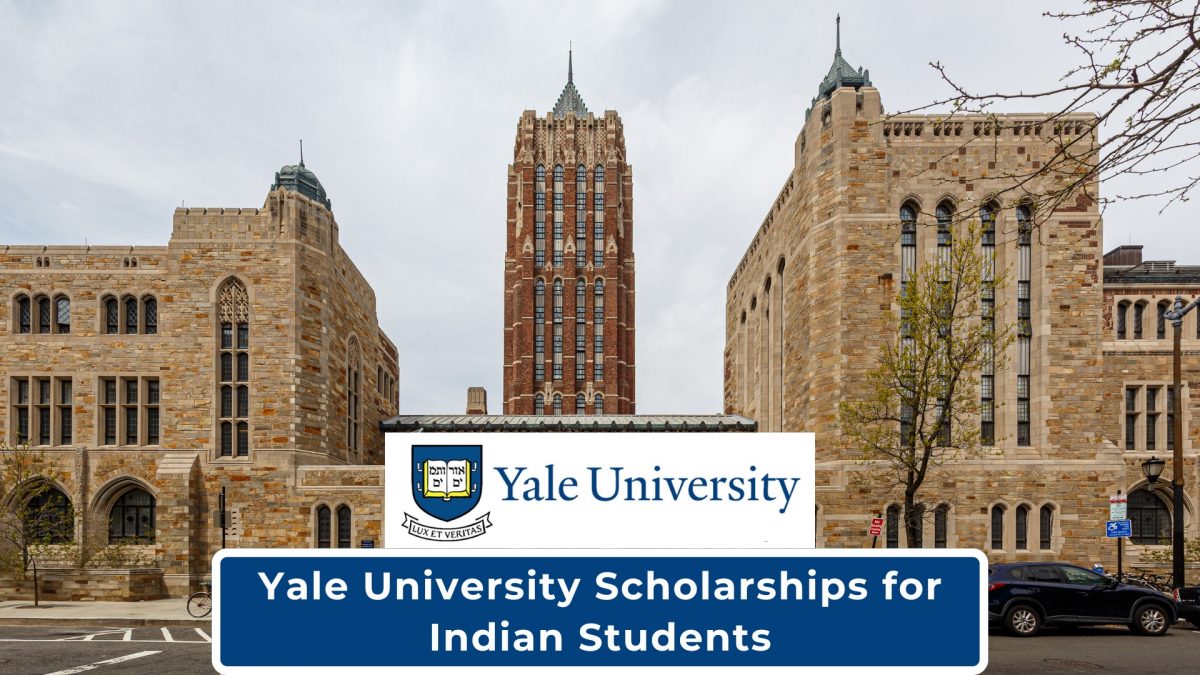
Search “Yale University scholarships”, and you’ll find dozens of blogs listing awards that don’t exist. Yale doesn’t hand out merit scholarships — its entire undergraduate aid model runs on demonstrated financial need, and understanding that distinction early will save you hours of misdirected research. This guide walks through exactly how Yale funding works, what international and Indian students can realistically expect, and how to apply.
Know more about Yale University in our complete guide covering top courses, tuition fees, application timeline, requirements, scholarships and more.
Table of Contents
What Yale University Scholarships Actually Are
Need-Based, Not Merit-Based
Yale University states plainly that all undergraduate financial aid is awarded on the basis of demonstrated financial need — there are no academic or merit-based scholarships at the undergraduate level. Every dollar comes as a Yale Scholarship, a grant that never needs to be repaid, calculated individually for each admitted student’s family circumstances.
Need-Blind Admission for All Applicants, Including International Students
Yale’s admissions process is need-blind for every applicant, regardless of citizenship or immigration status — meaning your ability to pay has no bearing on whether you’re admitted. Once you are admitted, your aid package is built entirely around your family’s demonstrated need.
Yale University Scholarships for International & Indian Students
Are International Students Eligible?
Yes. Yale’s financial aid policy for international applicants mirrors the policy for US citizens: need-blind admission paired with need-based aid that can meet 100% of demonstrated need, without requiring loans. Indian students applying to Yale go through the same core process as domestic applicants, just with a different needs-analysis framework.
How Yale Assesses Need for Applicants Outside the US
Because family income and cost of living vary widely across countries, Yale evaluates international applicants using a needs analysis that accounts for the relative differences between the US economy and the applicant’s home economy — rather than applying a flat US-based formula. If you’re weighing Yale against other Ivy League options, it’s worth reading up on how Yale compares with Harvard’s scholarship model before finalising your shortlist.

How Much Financial Aid Can You Actually Get at Yale?
Zero Parent Share Income Thresholds
Yale publishes clear income bands to help families self-assess:
- Families with annual income below $100,000 (with typical assets) generally qualify for a zero parent share award — this covers tuition and fees, housing, food, and travel in full, plus hospitalisation insurance and a $2,000 first-year start-up grant.
- Families with annual income below $200,000 (with typical assets) generally qualify for a need-based scholarship covering at least the full cost of tuition.
These thresholds apply consistently to international families once the needs analysis adjusts for local economic context.
Yale’s Cost of Attendance Breakdown
| Cost Component | 2026–27 Estimate (USD) |
| Tuition | $72,500 |
| Student activity fee | $185 |
| Housing | $12,080 |
| Food | $9,520 |
| Books & course materials | $1,000 |
| Personal expenses | $2,700 |
Your Yale Scholarship is calculated against this full cost of attendance, not tuition alone — which is why aid packages for lower-income families can end up covering nearly the entire bill.
How to Apply for a Yale Scholarship (Step-by-Step)
CSS Profile and Required Documents
- Indicate interest in financial aid on your Yale application; a personalised checklist then appears on your applicant portal.
- Complete the College Scholarship Service (CSS) Profile online — Yale’s CSS code is 3987.
- Submit signed parent and student tax documents (or a Non-Tax Filer’s Statement, where applicable) through the College Board’s IDOC service.
- Check your portal regularly, since additional documents may be requested during review.
- Submit everything by Yale’s stated deadlines to ensure your award letter arrives in time for your admission-reply deadline.
Deadlines to Track
Financial aid documents are due on a schedule tied to your admission plan — Single-Choice Early Action applicants have earlier document deadlines than Regular Decision applicants. Always confirm exact dates on Yale’s official financial aid site each admissions cycle, since they can shift year to year.
Graduate and PhD Funding at Yale
PhD Funding (Full Tuition + Stipend)
Yale’s PhD programs are structured to be fully funded: admitted doctoral students typically receive a fellowship covering full tuition, a 12-month living stipend, and comprehensive health insurance, regardless of citizenship.
Master’s and Professional School Funding Varies by Department
Unlike PhD funding, master’s-level and professional-school funding is set independently by each department or school rather than by the university as a whole. This means a Master’s in Global Business and Society at the Yale School of Management may have a very different aid structure than a master’s program in the Graduate School of Arts and Sciences. Always check the specific school’s funding page rather than assuming university-wide policy applies. If you’re specifically exploring Yale for graduate study, it’s worth browsing the dedicated Yale University page for program-level details before you apply.
Conclusion
Yale University scholarships aren’t something you compete for on merit — they’re a needs-based aid package that’s recalculated for every admitted student, and international applicants are evaluated on the same need-blind basis as US citizens. The real work is in preparing a strong CSS Profile, gathering accurate documentation, and applying early enough to meet Yale’s deadlines. If you’re building your Ivy League application strategy, it’s worth reviewing what actually counts as an Ivy League college and refining your college admission essay well before deadlines hit.
Want Free Personalised Guidance on Yale Application?
Recommended Reads
- Harvard Scholarships for Indian Students 2026
- MBA Scholarships in the USA for International Students
- Unlocking the Secrets of Winning Study Abroad Scholarships
- Scholarship Opportunities for International Universities
FAQs
Does Yale offer merit scholarships?
No. Yale’s undergraduate financial aid is entirely need-based; there are no academic or merit scholarships awarded directly by the university. Students seeking merit-based support typically look at external scholarship providers instead.
How much financial aid does Yale give international students?
It depends entirely on demonstrated need. Families with income below $100,000 (with typical assets) generally qualify for a zero parent share award covering the full cost of attendance, while those below $200,000 generally receive aid covering at least full tuition. Awards are calculated individually.
How do I apply for a Yale scholarship as an international student?
Indicate financial aid interest on your Yale application, then complete the CSS Profile (Yale’s code is 3987) and submit required tax documents through IDOC. Your personalised checklist appears on your applicant portal once you apply.
Is Yale’s admission need-blind for international students?
Yes. Yale states that its need-blind admission policy applies to all applicants, regardless of citizenship or immigration status — your ability to pay does not factor into the admissions decision.
Do Yale PhD students get full funding?
Generally yes. Yale PhD programs typically include a fellowship covering full tuition, a 12-month stipend, and health insurance for admitted doctoral students, regardless of citizenship.
What is the CSS Profile and why does Yale need it?
The CSS Profile is an online application used by Yale and other institutions to assess eligibility for non-federal, institutional financial aid. It’s required for all Yale financial aid applicants, alongside supporting tax documentation.