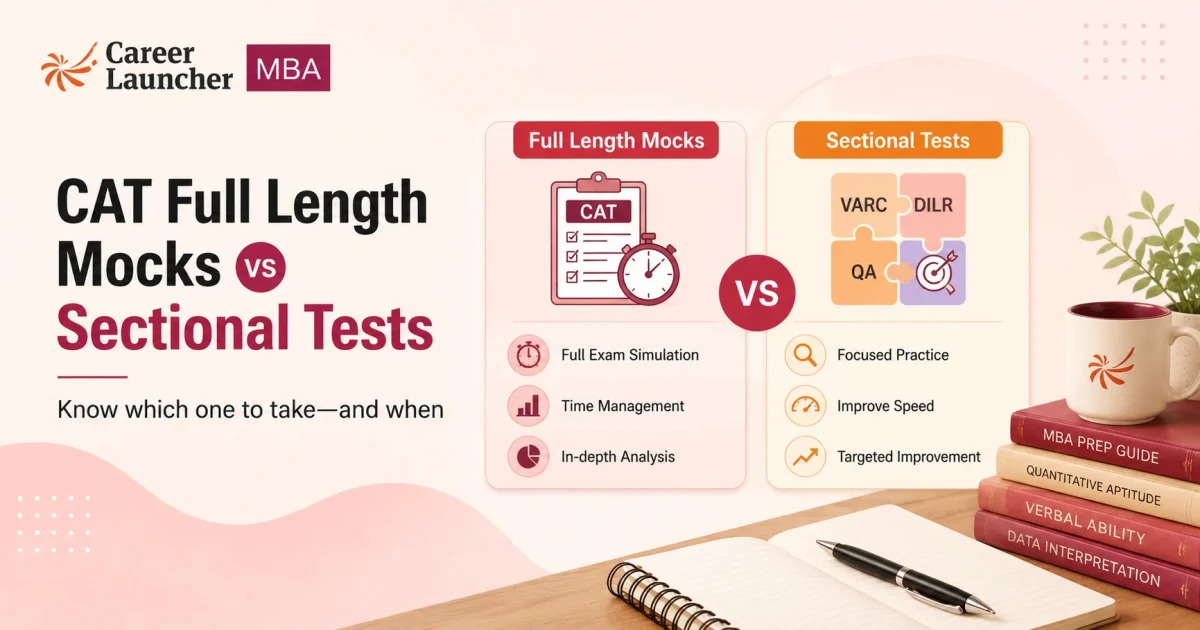
Most CAT aspirants hit a point in their prep where their CAT prep portal shows both sectional tests and full-length mocks in the same week, with no clear sense of which to attempt first. Our CAT expert answers this very directly: Take one full-length mock first, even before your syllabus is complete, to establish your baseline percentile. After that, run weekly sectional tests to fix specific weak topics, and shift to two to three full mocks a week as your exam date gets closer. In the CAT full-length mocks vs sectional tests debate, it isn’t about picking one over the other; full mocks and sectionals solve two different problems, and the order in which you attempt them matters more than which one you prefer.
Here’s exactly how to sequence them, and why.
Latest Updates – CAT 2026 Notification Released
Table of Contents
What’s Actually Different Between a CAT Mock Test and a Sectional Test
The gap between these two formats isn’t just length, it’s what each one is designed to reveal about your preparation.
Time commitment and mental endurance: A sectional test asks for roughly 40 minutes of concentration. A full-length mock asks for two straight hours. That difference sounds small on paper, but it isn’t. Staying sharp for the first 40 minutes of any test is manageable for most aspirants.
Staying sharp for the full two hours, especially past the one-hour mark, when fatigue sets in and the mind stops functioning as quickly as it did in section one, is a skill that only full mocks can train. Sectionals simply can’t expose this problem because they never ask you to sustain focus long enough for it to show up.
What each format is designed to test: Sectionals are a magnifying glass on one section; they tell you whether you’ve genuinely improved on a specific topic or question type. Full mocks are a systems test, they tell you whether you can manage time, energy, and strategy across all three sections back to back, under exam-like pressure.
| Sectional Test | Full Length Mock | |
| Duration | 40 minutes | 2 hours |
| Tests | Topic-level accuracy & speed | Endurance, strategy, time management |
| Best used for | Isolating weak sub-topics | Simulating actual CAT conditions |
| Ideal frequency | Weekly | 1/week (early stage) → 2–3/week (advanced stage) |
| Analysis time needed | Shorter, topic-focused | 2–3 hours, question-by-question |
To be CAT 2026 Ready, Attempt CAT Free Mocks
Why You Should Take One Full Mock Before Anything Else
Here’s the part most aspirants get backwards: even if your syllabus isn’t finished, your very first full mock should happen early, not after you feel “ready.”
CAT Expert Analysis: Think of it the way you’d book a cab. Before Uber or Ola can plan your route, they need your current location. Without it, there’s no way to calculate the distance, the time, or the fare to your destination. Your first mock works the same way. Until you take one, you have no idea whether you’re starting from a 0.2 percentile or a 25 percentile, and without knowing the gap, you can’t plan how to close it. Score doesn’t matter in this first mock. What matters is that you now know your starting point, and the rest of your prep can be built around bridging that specific gap.
Also read: CAT 2026 Question Paper

Where Sectional Tests Fit Into Your Weekly Routine
Once you have a baseline from your first full mock, sectionals become your weekly maintenance tool. Because they isolate one section at a time, they let you work on a specific weakness, say, a topic you keep getting wrong, without the fatigue variable of a two-hour paper clouding the result.
One sectional test a week is a reasonable minimum once you’ve started; if you’ve already been consistent, it’s fine to skip an occasional week, but don’t let sectional practice disappear entirely just because full mocks are also happening. Skipping consistency on any one section, even a section you’re already scoring well in, tends to backfire a couple of weeks later when new topics show up, and old ones quietly slip.
A Week-by-Week Sequencing Plan (June-November)
- June-August (early stage): One full mock per week, minimum, plus one sectional per week. This phase is about getting acquainted with the exam pattern, experimenting with attempt strategies, and improving accuracy, not chasing a score.
- September-November (advanced stage): Two to three full mocks per week, since this is closer to the exam and strategy should now be largely finalised.
- Gap weeks (no mock scheduled): If a full mock isn’t live in a given week, three sectional tests taken back-to-back can substitute for the mock experience, switching sections within a minute of each other, without pausing for detailed analysis, just to keep the transition-speed muscle active.
Common Mistake – Treating Both Formats the Same Way
The biggest sequencing error is analysing a sectional and a full mock with the same depth and expecting the same insight from both. A full mock deserves 2–3 hours of analysis, going question by question, because it’s revealing endurance issues, section-switching costs, and strategy breakdowns that a sectional simply can’t surface. This is also why taking a few full mocks from an actual test centre (rather than the comfort of your room) matters: real centres introduce the exact external, uncontrollable factors- unfamiliar rooms, background noise, travel time- that can derail performance on the actual CAT day if you’ve never practised managing them.
Also read: CAT Previous Year Papers
Turning This Sequencing Plan Into Action
Knowing the right sequence is only half the battle; you also need a source that actually gives you both formats in the right proportion. If your fundamentals are still shaky and you haven’t taken a mock yet, starting with CAT online coaching 2026 makes more sense than jumping straight into a mock schedule, since it builds the section-wise clarity your first baseline mock will end up testing.
If your prep window is short and you need to move fast, the CAT Crash Course 2026 is designed for exactly that pace: quick syllabus coverage paired with a fast ramp-up to 2–3 full mocks a week, rather than the slower one-mock-a-week build-up. And for most aspirants somewhere in between, the real need is consistency: a CAT 2026 test series gives you a scheduled mix of full-length mocks and sectional tests each week, along with the accuracy graphs, drill-down analysis, and booster analysis tools needed to actually act on what every mock reveals.
Conclusion
Sectionals and full mocks aren’t competing for your time; they’re solving two different problems. Take one full mock early to establish your baseline, keep a weekly sectional habit going to fix specific weaknesses, and shift toward more frequent full mocks as your exam date approaches.
Frequently Asked Questions
Q: What is the difference between a CAT mock test and a sectional test?
A: A sectional test runs for about 40 minutes and tests one section at a time, making it useful for fixing specific weaknesses. A full-length mock runs for 2 hours across all sections and tests endurance, time management, and overall strategy, things a sectional can’t reveal.
Q: How many CAT mocks should I take per week?
A: In the early stage of prep (roughly June–August), one full mock a week is the minimum, alongside one sectional. As you move closer to the exam (September–November), this should increase to two or three full mocks a week.
Q: Should I take sectional tests before full-length mocks?
A: No, take one full mock early, even before you feel ready, to establish your baseline. You can’t know how big the gap is until you’ve measured your current starting point. Sectionals then become your weekly tool for closing specific gaps.
Q: Is it okay to take a full mock even if I haven’t completed the syllabus?
A: Yes. Score doesn’t matter in your first few mocks; the goal is simply to see where you stand and how much of the paper you can navigate under real conditions. Waiting for the syllabus to be “complete” only delays getting that baseline.
Q: How much time should I spend analysing a mock vs a sectional?
A: A full mock deserves a longer, more detailed analysis, often 2 to 3 hours, going question by question to understand time spent, strategy breakdowns, and section-switching issues. Sectional analysis can be shorter and more narrowly focused on the one section tested.