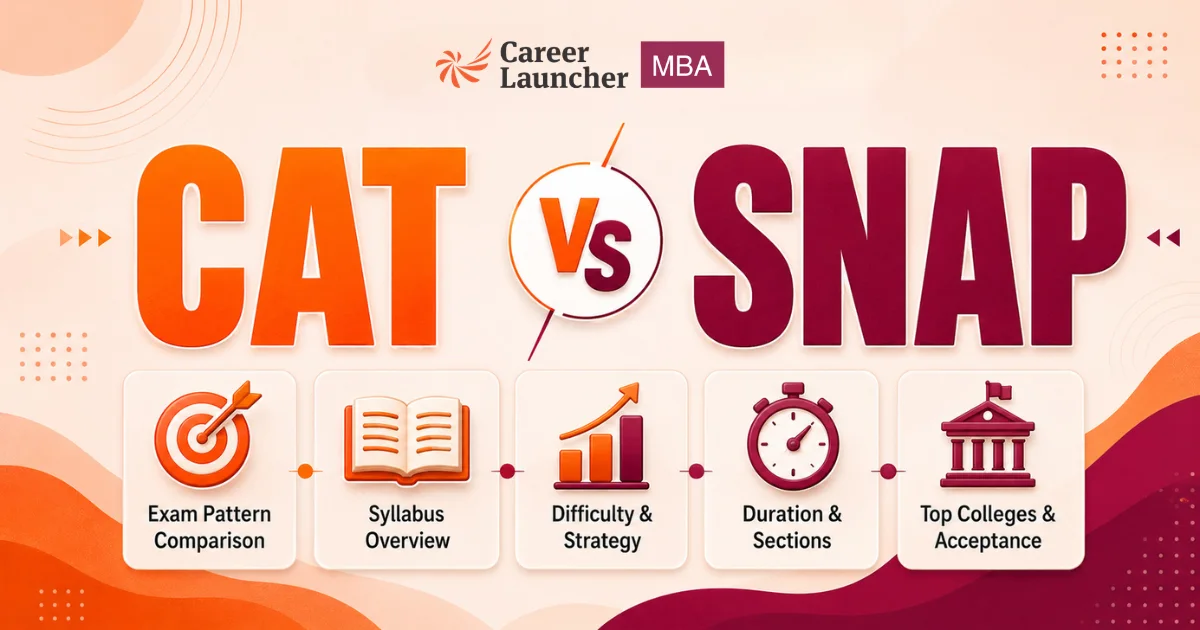
CAT Vs SNAP: CAT and SNAP are both national-level MBA entrance exams in India, but they differ significantly in format, difficulty, and the colleges they lead to. CAT is a 120-minute, 68-question exam conducted by IIM Indore for admission to the 21 IIMs and other top B-schools, while SNAP is a shorter 60-minute, 60-question exam conducted by Symbiosis International (Deemed University) for admission to its 17 constituent institutes.
CAT is harder and stricter: one attempt, sectional time limits, and a heavier -1 negative marking penalty. SNAP is more flexible, up to three attempts, no sectional time limit, and a lighter -0.25 penalty. The sections below break down the exact pattern, difficulty, eligibility, and college differences between CAT and SNAP.
Table of Contents
CAT vs SNAP Eligibility, Pattern, Difficulty
CAT is a 120-minute, 68-question exam with strict 40-minute sectional locks, while SNAP is a 60-minute, 60-question exam with no sectional time limit, CAT also includes TITA questions with heavier negative marking, SNAP consists entirely of MCQs, with a penalty of 0.25 marks for each incorrect answer. The full comparison is below.
| Feature | CAT 2026 | SNAP 2026 |
| Conducting body | IIM Indore | Symbiosis International (Deemed University) |
| Exam date | November 29, 2026 | Three sessions in December 2026 |
| Duration | 120 minutes | 60 minutes |
| Total questions | 68 | 60 |
| Sections | VARC (24), DILR (22), QA (22) | General English, Analytical & Logical Reasoning, Quant-DI-DS and Ethics, Morality and values |
| Sectional time limit | Yes, 40 minutes each, fixed order, no switching | No – free movement across sections |
| Question type | MCQ + TITA | MCQ only |
| Marking scheme | +3 / -1 on MCQs; no negative marking on TITA | +1 / -0.25 |
| Total marks | 204 | 60 |
| Attempts allowed | 1 per year | Up to 3 per year, best score considered |
CAT vs SNAP Difficulty Level
CAT is significantly harder than SNAP, due to tougher competition, a strict sectional time limit, and heavier negative marking; SNAP is comparatively easier thanks to free movement across sections, lighter negative marking, and up to three attempts.
CAT rewards depth, tricky Reading Comprehension passages, multi-step DILR sets, and QA problems that punish shortcuts. The strict sectional time limit means you can’t lean on your strongest section to compensate for a weak one, and the -1 negative marking on MCQs adds real risk to guessing.
SNAP tests a different skill: speed under a single composite timer. Since you can move between sections freely, strong time management can offset a weaker section. The negative marking is lighter (-0.25 versus CAT’s -1), and, critically, SNAP allows up to three attempts in December, with your best score counted. That flexibility alone makes SNAP meaningfully less stressful than a one-shot exam like CAT. SNAP 2026 however, introduced a new section this year, Ethics, Morality and Values, consisting of 10 marks, which changed the course of SNAP preparation 2026.
If you’re midway through CAT prep and want a structured push for the final stretch, Career Launcher’s CAT 2026 Sprint Programme is built specifically for this window.
Related Articles –

CAT Vs SNAP Eligibility Criteria & Attempts
CAT and SNAP require the same baseline eligibility, a bachelor’s degree with at least 50% marks (45% for reserved categories) and no age limit, but CAT allows only one attempt per year while SNAP allows up to three.
CAT 2026 eligibility:
- CAT Eligibility 2026 states that Bachelor’s degree from a recognised university with at least 50% marks (45% for SC/ST/PwD)
- Final-year students can apply, subject to submitting proof of graduation later
- No upper or lower age limit
- One attempt per admission cycle.
SNAP 2026 eligibility:
- SNAP 2026 Eligibility states that Bachelor’s degree with at least 50% marks (45% for reserved categories)
- Final-year students eligible, provided earlier academic years meet the marks criteria
- No age limit
- Up to three attempts in December, with the best score used for shortlisting
The multiple-attempt structure is SNAP’s biggest practical edge, a bad day doesn’t cost you the year.
Suggested Readings –
Colleges You Can Get Into – CAT vs SNAP
CAT scores are accepted by the 21 IIMs and other top B-schools like FMS Delhi, SPJIMR, MDI Gurgaon, and IIFT, while SNAP scores are accepted only by the 17 Symbiosis constituent institutes and JK Business School-Gurgaon, the two exams lead to almost entirely different college ecosystems.
| Exam | Colleges accepting the score |
| CAT | 21 IIMs, plus FMS Delhi, SPJIMR, MDI Gurgaon, IIFT, and other top B-schools |
| SNAP | 17 Symbiosis constituent institutes, including SIBM Pune, SCMHRD Pune, SIIB Pune, SIBM Bangalore, and SIBM Hyderabad, plus JK Business School-Gurgaon |
CAT is essentially non-negotiable if an IIM is the goal. SNAP, on the other hand, is your gateway specifically to the Symbiosis ecosystem, strong brands in their own right, particularly for HR, IT, and international business specializations, but not a substitute for an IIM call.
Note that SNAP selection does not end with the written test. Shortlisted candidates must generally appear for a Group Exercise and Personal Interaction, with additional assessments varying by institute and programme.
Should You Prepare for Both?
Yes, CAT and SNAP overlap heavily in syllabus, so if you’re already deep into CAT prep, SNAP prep is less about learning new concepts and more about adapting your speed and accuracy to a shorter, no-sectional-time format.
A realistic split in the last few months looks like this:
- Keep the bulk of your study time on CAT, since it’s the harder exam and the higher-stakes one
- Dedicate a few SNAP-specific mock tests closer to December to adjust to the 60-minute, no-sectional-lock format
- Use free CAT mocks to keep sharpening fundamentals without extra cost
If you want expert eyes on your prep gaps, it’s worth taking CAT-level mock tests designed to mirror the actual exam difficulty, and following up with a mentor conversation to fine-tune your last-mile strategy.
Conclusion
CAT and SNAP test similar fundamentals but reward very different strengths. If an IIM is the dream, CAT has to be your priority. But treating SNAP as a low-effort backup, given the syllabus overlap, is one of the smartest moves you can make in your final prep months. Ready to close the gap on both? Explore Career Launcher’s non CAT Test series and get a mentor to review your prep plan before results season arrives.
Frequently Asked Questions
Q: Is SNAP easier than CAT?
A: Yes, generally. SNAP has a shorter duration, no sectional time limit, and lighter negative marking (-0.25 versus CAT’s -1), which makes it more forgiving than CAT’s high-pressure, high-stakes format.
Q: Can I get into an IIM with a SNAP score?
A: No. SNAP scores are accepted only by the 17 Symbiosis constituent institutes and a few affiliated colleges like JK Business School, not by IIMs, which require a valid CAT score.
Q: How many times can I attempt SNAP in a year?
A: Up to three times, across sessions typically held in December, with the highest of your scores used for shortlisting.
Q: What is the difference between CAT and SNAP exam pattern?
A: CAT has 68 questions across three sectionally timed sections in 120 minutes with MCQs and TITA; SNAP has 60 MCQ-only questions in 60 minutes with no sectional timing.
Q: Which colleges accept SNAP score?
A: The 17 Symbiosis constituent institutes, including SIBM Pune, SCMHRD, SIIB Pune, SIBM Bangalore, and SIBM Hyderabad, along with JK Business School-Gurgaon.
Q: Is negative marking the same in CAT and SNAP?
A: No. CAT deducts 1 mark for wrong MCQ answers (TITA has no negative marking) against 3 for correct ones; SNAP deducts 0.25 marks against 1 for a correct answer.