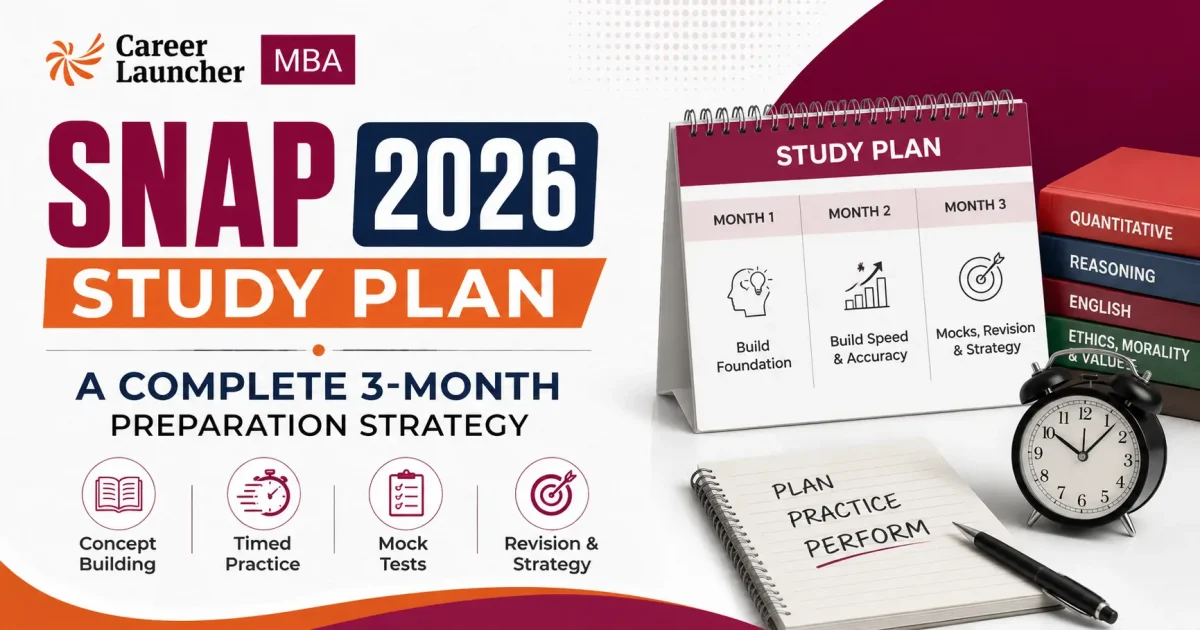
SNAP 2026 3 Months Preparation Strategy: If you are preparing for SNAP 2026, a well-structured three-month plan can help you strengthen your concepts, improve your speed and build greater accuracy. With the exam scheduled for December 13, December 19 and December 26, 2026, the focus should now be on consistent practice and developing a strategy that works within the 60-minute time limit.
This guide breaks down SNAP 2026 preparation week by week, covering concept building, practice, mock tests and revision while keeping the revised four-section pattern in focus.
Table of Contents
SNAP 2026 Exam Pattern
SNAP 2026 is a 60-minute, 60-mark test spread across three attempts, so knowing the pattern and every key date in one place makes prep and planning much easier.
| Section | Questions | Marks |
| General English | 10 | 10 |
| Analytical & Logical Reasoning | 20 | 20 |
| Quantitative, Data Interpretation & Data Sufficiency | 20 | 20 |
| Ethics, Morality & Values | 10 | 10 |
| Total | 60 | 60 |
Also Read: SNAP 2026 Exam | Dates Released, Registration, Syllabus, Exam Pattern & Preparation Tips
SNAP 2026 Exam Strategy: Master the Two-Sweep Approach
SNAP is largely a speed and question-selection game. It is not just about solving questions correctly, but also about solving them quickly and choosing the right questions to attempt. Knowing which questions to attempt, which ones to leave for later and how much time to spend on each is equally important in a 60-minute exam.
A two-sweep approach helps you prioritise questions based on their difficulty, avoid spending too much time on individual questions and assist in building SNAP preparation strategy.
- First Sweep: Start with questions that you can solve quickly and confidently. If you are unsure about the approach or find yourself spending too much time, move ahead and return to the question later.
- Second Sweep: Once you have attempted the questions you are most comfortable with, return to the marked questions and use the remaining time to work on them.
Make the two-sweep approach a regular part of your mock-test strategy so that your time management and question-selection skills are well established before exam day.


Month 1: Build Your SNAP 2026 Foundation
The first month should focus on becoming familiar with the updated SNAP 2026 syllabus and building a strong foundation across all four sections. Unlike longer exams such as CAT, SNAP requires a more focused approach. The objective is to understand different question types and develop enough conceptual clarity to solve standard questions without unnecessary delays.
| Week | Preparation Focus | What to Do |
| Week 1 | Understand the Exam & Start Fundamentals | Study the updated SNAP 2026 pattern and syllabus. Begin with core concepts in Quant, Analytical & Logical Reasoning and General English. Introduce Ethics, Morality & Values preparation instead of leaving the new section for the end. |
| Week 2 | Strengthen Core Concepts | Continue building fundamentals and solve basic-to-moderate questions. Focus on understanding different Reasoning question types and improving accuracy in English and Quant. |
| Week 3 | SNAP-Specific Practice | Shift from concept learning to SNAP-style questions. Start solving questions under time pressure and identify topics where you are either slow or consistently inaccurate. |
| Week 4 | Diagnostic Testing | Take your first full-length SNAP mock. Use it to assess your speed, accuracy, section preference and question-selection ability. Analyse the mock rather than focusing only on the score. |
By the end of Month 1, the goal is to have covered the fundamentals of all four sections and practised the major question types at least once. The objective is to build familiarity with the syllabus and question patterns before moving into intensive timed practice.
Month 2: Build Speed and Accuracy for SNAP 2026
The second month is when your preparation should shift from simply learning concepts to applying them under the 60-minute SNAP time limit. Begin incorporating timed sectional practice and full-length mocks, while making the two-sweep approach a regular part of your preparation.
| Week | Preparation Focus | What to Do |
| Week 5 | Timed Sectional Practice | Start regular timed sets for all four sections. Focus on solving familiar questions faster while maintaining accuracy. |
| Week 6 | Question Selection | Practise identifying questions that are worth attempting immediately and those that should be left for later. Apply the two-sweep method during sectional practice. |
| Week 7 | Full-Length Mocks | Start taking regular 60-minute SNAP mocks. Test different section orders because SNAP allows sections to be attempted in any order. |
| Week 8 | Mock Analysis & Improvement | Analyse every mock for time management, accuracy and question selection. Separate mistakes caused by lack of knowledge from those caused by rushing or poor time allocation. |
The key is to avoid letting any single question consume too much of your time. Your mock tests should therefore help you assess how effectively you select questions, not just how many questions you can solve.
Month 3: Mocks, Revision and Final SNAP 2026 Strategy
In the third month, your preparation should be dedicated largely to mock-based practice and revision. The focus is on identifying recurring gaps, refining your question-selection approach and developing a strategy that you can repeat confidently on exam day.
| Week | Preparation Focus | What to Do |
| Week 9 | Intensive Mock Practice | Increase full-length mock practice and continue refining your section order and two-sweep strategy. |
| Week 10 | Identify & Fix Weaknesses | Analyse recurring mistakes after every mock. Revise only the concepts that are actually affecting your performance instead of restarting the entire syllabus. |
| Week 11 | Strategy Consolidation | Take mocks under strict 60-minute conditions. Finalise your preferred section order and practise moving on quickly from time-consuming questions. |
| Week 12 | Revision & Exam Readiness | Revise formulas, vocabulary, grammar rules, Reasoning concepts, Ethics/Morality/Values notes and your mock-test error log. Avoid adding large amounts of new content. |
With three test dates available for SNAP 2026, candidates appearing for multiple tests should approach the first attempt as a serious exam simulation while using the experience to refine their strategy for subsequent tests. The higher score is considered when multiple tests are taken.
Also Read: XAT vs SNAP
Boost Your 3-Month SNAP 2026 Preparation With SNAP Online Classes
With just 3 months left, a structured and test-focused approach can help you prepare more effectively. Career Launcher’s SNAP Online Classes 2026 offer 45+ hours of live interactive sessions, 10+ strategy sessions, 10 full-length SNAP mocks, 12 sectional tests, 140+ recorded pre-class videos, and dedicated doubt-clearing through Telegram.
With expert guidance, regular practice, and SNAP-specific test strategies, you can work on your speed, accuracy, and weaker areas in a more focused way.
SNAP 2026 Last Two Weeks Preparation Plan
The final two weeks should focus on execution rather than expansion. At this stage, focus on strengthening the strategy you have developed through mock tests and avoid making major changes to your preparation.
- Take full-length mocks under the actual 60-minute time constraint to simulate exam conditions.
- Analyse each mock carefully to identify knowledge gaps, speed issues and question-selection mistakes.
- Revise your formulas, vocabulary, grammar rules and error log regularly.
- Continue practising the two-sweep approach so that skipping and returning to questions becomes natural.
- Finalise the section order and attempt strategy that works best for you.
- Avoid spending too much time on questions that are not progressing; learn to move on and return if time permits.
- Do not introduce large amounts of new material in the final days. Focus on strengthening what you already know.
- Keep the last few days light and revision-focused, with adequate rest before the exam.
Also Read: SNAP 2025 Question Paper | CAT vs SNAP 2026
Conclusion
A focused three-month SNAP 2026 preparation plan can help you cover the SNAP 2026 syllabus while improving the speed and accuracy required for the exam. Begin by strengthening your concepts and becoming familiar with different question types, then move into timed practice and mock tests. Use the final month for revision, mock analysis and strategy refinement. The goal is to enter the exam with an approach that you have already tested and are confident executing.
Since SNAP is a 60-minute exam with 60 questions, time management plays a key role. The key is to recognise the questions you can solve confidently, attempt them efficiently and avoid getting stuck on questions that take too long.
Frequently Asked Questions
- Can I prepare for SNAP 2026 in 3 months?
A. Yes. Three months is enough to build concepts, practise the important topics, take mocks and develop a suitable exam strategy with consistent preparation. - How many hours should I study for SNAP 2026?
A. The number of hours depends on your current preparation level. Instead of following a fixed number, maintain a consistent daily schedule covering concepts, practice, timed tests and revision. - When should I start taking SNAP 2026 mock tests?
A. Begin with sectional or topic-wise timed practice after building your basics. As your preparation progresses, introduce full-length mocks and focus on analysing your mistakes rather than only tracking your scores. - What is the best strategy for attempting SNAP 2026?
A. The Career Launcher strategy recommends a two-sweep approach: first attempt questions that can be solved confidently without spending too much time, then return to the questions marked for review. This helps manage the 60-minute time limit effectively. - Is the SNAP 2026 syllabus different from previous years?
A. Yes. SNAP 2026 has four sections, including the newly introduced Ethics, Morality and Values (EMV) section. Therefore, your preparation plan should include EMV from the beginning rather than relying entirely on previous years’ SNAP preparation patterns.