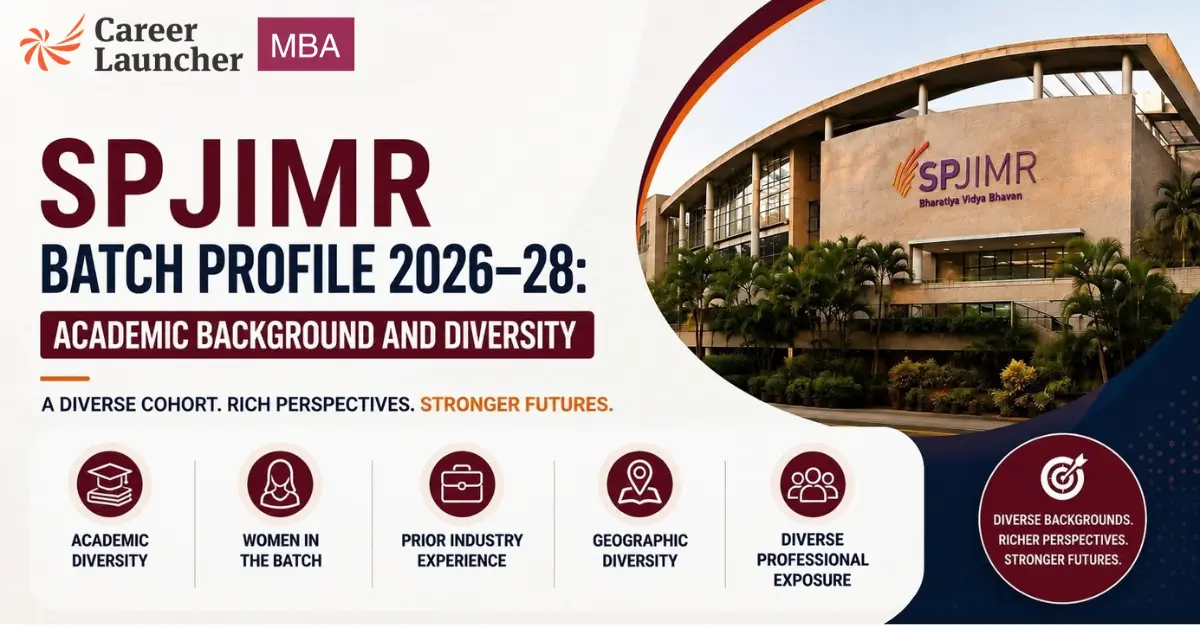
SPJIMR started its 2026–28 journey in June 2026, welcoming a new batch into its flagship PGDM and PGDM (Business Management) programmes. As one of India’s leading B-schools, This batch brings together students from diverse academic and professional backgrounds.
The SPJIMR Batch Profile 2026 provides a closer look at the students joining the programme, covering their academic background, work experience, gender diversity and geographical representation, giving students a better sense of the batch
Also Read: BLACKI IIMs Summer Placements 2026
SPJIMR PGDM & PGDM Batch Profile of 2026
Check the table below for PGDM and PGDM (BM) batch profile details
| Metric | PGDM | PGDM (BM) |
| Engineering background | 51% | Not specified |
| Non-engineering background | 49% | 42% |
| Women in the batch | 36% | 34% |
Also Read: IIM Bangalore Batch Profile | IIM Indore Batch Profile
SPJIMR Batch Profile 2026: Academic Background and Work Experience
At SPJIMR, the share of non-engineering students appears to be growing steadily, with the 2026–28 cohort now offering an almost 50-50 split between engineering and non-engineering academic backgrounds. The non-engineering cohort also brings a varied mix of degrees, spanning commerce, finance, humanities, and the sciences.
| Metric | PGDM | PGDM (BM) |
| Engineering background | 51% | Not specified |
| Non-engineering background | 49% | 42% |
| Prior industry experience (both programmes) | 85% | 85% |
This batch brings significant professional experience to the classroom, with 85% of participants having prior industry experience. This gives the cohort a fair amount of real-world exposure to bring into classroom discussions.

SPJIMR Gender Diversity 2026–28
Women represent 36% of the PGDM cohort and 34% of the PGDM (BM) batch, respectively. This batch reflects the broader trend across leading Indian B-schools, where female representation in the 2026–28 cohorts has been steadily increasing and moving closer to the 40% mark.
| Metric | PGDM | PGDM (BM) |
| Women in the batch | 36% | 34% |
SPJIMR 2026–28 Batch: Geographic Diversity
This batch comprises students from more than 130 cities across 24 states, reflecting a geographic diversity that extends beyond the metro-based pool. It also includes participants from 220+ organisations across different sectors, bringing together diverse professional backgrounds and perspectives and adding to the range of experiences shared in the classroom.
| Metric | 2026–28 Batch |
| States represented | 24 |
| Cities represented | 130+ |
| Sending organisations | 220+ |
| Sectors represented | Banking, consulting, FMCG, technology, manufacturing, analytics |
Conclusion
The SPJIMR batch of 2026–28 demonstrates a broad and diverse cohort, with an almost 50–50 split between participants from engineering and non-engineering backgrounds, students coming from across the country, and a large proportion bringing prior professional experience. SPJIMR’s PGDM and PGDM (BM) programmes bring together candidates from varied academic, professional and geographic backgrounds rather than following a single ideal applicant profile.
Frequently Asked Questions
Q: What percentage of the SPJIMR Class of 2028 has an engineering background?
A: In the PGDM programme, 51% come from engineering backgrounds and 49% from non-engineering disciplines. In PGDM (BM), 42% are from non-engineering backgrounds.
Q: What is the gender ratio in SPJIMR’s 2028 batch?
A: Women make up 36% of the PGDM cohort and 34% of the PGDM (BM) cohort.
Q: How many states and cities does the SPJIMR Class of 2028 represent?
A: The batch represents 24 states and more than 130 cities across India.
Q: How much prior work experience does the incoming batch have?
A: 85% of participants bring prior industry experience, drawn from more than 220 organisations across sectors like banking, consulting, FMCG, technology, manufacturing, and analytics.