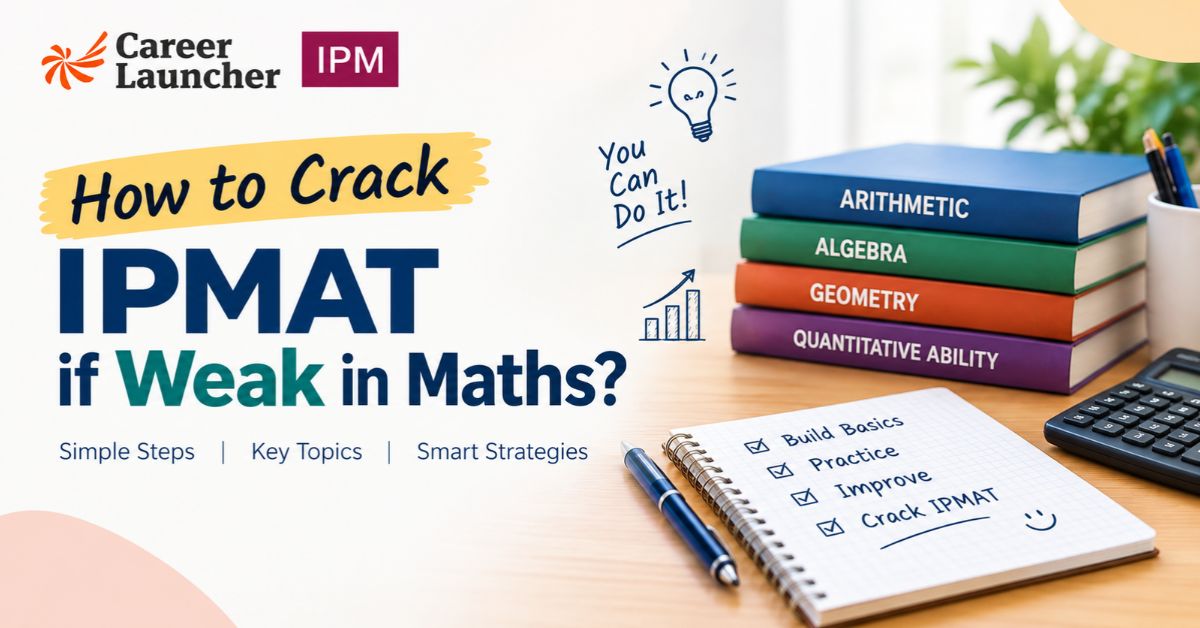
Maths can be a challenging section for students preparing for IPMAT, particularly for those who are not confident with the basics. However, a weak foundation does not mean that you cannot perform well. A focused strategy, regular practice and gradual improvement can help you strengthen your concepts, improve accuracy and build the speed needed to solve Mathematics conceptual-based Quantitative Ability questions.
This blog guides you through the key steps on how to crack IPMAT if weak in maths, important topics and practical strategies to improve your Maths and crack IPMAT.
Table of Contents
Why Is Maths Important for Your IPMAT Score?
The Quantitative Ability section is a core part of the selection process for the IPMAT exam. Since the exam is scored section-wise as well as overall, your Maths performance affects both your total score and your sectional result. A weak showing here can pull down an otherwise serious attempt in Verbal Ability.
The good news is that students weak in Maths do not need to master everything. They need to focus on three things:
- Accuracy: Fewer wrong answers means fewer negative marks.
- Speed: Faster calculation leaves more time for questions you can actually solve.
- Question selection: Knowing which questions to attempt and which to skip is a skill that can be trained.
A structured IPMAT preparation strategy helps you divide your time, strengthen weaker areas and keep building on stronger sections. Do not let Maths consume all your preparation time at the cost of Verbal Ability.
Steps to Start IPMAT Maths Preparation From the Basics
If you are starting from a weak base and wondering, how to crack IPMAT if weak in maths – follow the below mentioned steps in order. Begin by going through the IPMAT syllabus so you know exactly which topics are relevant, and avoid spending time on areas that are not tested.
Step 1: Assess your current Maths level. Attempt a short diagnostic test or a set of basic questions across topics. Note which areas feel comfortable, which feel shaky and which you have never studied.
Step 2: Strengthen basic concepts and formulas. Revisit school-level Maths, especially arithmetic, algebra and basic geometry. Make a formula sheet and revise it regularly instead of memorizing everything at once.
Step 3: Start with easier questions. Early wins build confidence. Solve simple, direct questions on each topic before moving to anything tricky.
Step 4: Move gradually to IPMAT-level questions. Once the basics feel stable, increase the difficulty step by step. Jumping straight to hard questions often leads to frustration and slows progress.
Step 5: Practice regularly. Short, consistent daily practice works better than occasional long sessions. Even one to two focused hours a day, kept consistent, adds up over months.
Step 6: Track and revise your mistakes. Keep a notebook or document of errors. Write down what went wrong, whether it was a concept gap, a calculation slip or a misread question, and revisit it weekly.

Prioritize These IPMAT Maths Topics
Not all topics need equal attention at the start. Begin with the ones that build confidence and carry strong scoring potential, then move to harder areas as your fundamentals improve.
| Priority | Topics to Focus On |
| High | Percentages, Ratio & Proportion, Averages, Profit & Loss |
| High | Time & Work, Time, Speed & Distance |
| High | Number System, Algebra |
| Moderate | Geometry, Mensuration |
| Later | Probability, Permutation & Combination |
Start with topics that help build basic confidence, such as Percentages and Ratio. Move to more challenging areas like Probability and Permutation & Combination only once your fundamentals are solid.
Follow These Steps to Improve Speed and Accuracy
Speed and accuracy are the biggest levers for students who feel weak in Maths. Work on them in this order:
- Build calculation skills first. Slow arithmetic is often the real problem, not the concept. Practice tables, squares, cubes and quick multiplication daily.
- Practice commonly used fractions, percentages and approximations. Knowing that 1/8 is 12.5% or that 1/7 is roughly 14.3% saves valuable seconds.
- Solve questions with a timer after gaining conceptual clarity. Timed practice makes sense only once you understand the method. Otherwise, it simply adds pressure.
- Learn to identify questions that can be solved quickly. Some questions have a shortcut or a clean setup. Spotting them in the first few seconds is a valuable exam skill.
- Avoid spending excessive time on one difficult question. If you are stuck, move on. A skipped question costs less than five lost minutes.
- Focus on accuracy before increasing speed. Speed built on shaky accuracy only leads to more negative marking.
How to Use IPMAT PYQs for Maths Preparation
Solving IPMAT previous year papers is one of the most effective ways to understand what the exam actually expects. Use them smartly:
- Solve PYQs after completing the basics. Attempting them too early can be discouraging.
- Identify recurring concepts and question types. You will notice that certain topics and patterns appear repeatedly.
- Understand the level and style of questions. This helps you calibrate how deep your preparation needs to go.
- Time yourself while solving PYQ sets. Treat them like mini exams to build exam temperament.
- Reattempt questions that you could not solve initially. Come back to them after a few days or weeks. If you can solve them now, your preparation is working.
Use Mocks to Track Your IPMAT Maths Progress
Regular IPMAT mock tests show you where you stand and how your preparation is progressing. A sensible progression looks like this:
- Start with topic-wise tests to check understanding right after finishing a topic.
- Move to sectional tests to practice managing the Quantitative Ability section on its own.
- Gradually introduce full-length mocks to build stamina and learn how to balance time across sections.
The real value of a mock lies in the analysis that follows. Review three categories of questions: incorrect, skipped and time-consuming. Understand why each happened, and maintain an error log that you revise regularly. Over time, patterns in your mistakes will tell you exactly what to fix.
Tips for How to Crack IPMAT if Weak in Maths
- Build strong fundamentals. Everything else rests on this.
- Prioritize important topics. Focus first on high-weightage, high-confidence areas.
- Use PYQs and mocks strategically. Treat them as learning tools, not just score checks.
- Analyze mistakes regularly. Your error log is one of your best study resources.
- Improve speed gradually. Do not rush it before accuracy is stable.
- Maintain balanced preparation across all sections. Maths matters, but so does the rest of the paper.
Conclusion
Being weak in Maths is not a barrier to cracking IPMAT. It is a starting point. With a clear plan, strong basics, topic prioritization, regular practice and honest analysis of your mistakes, you can steadily improve on how to crack IPMAT if weak in maths and ace your Quantitative Ability preparation. Stay patient, track your progress and keep refining your approach. Consistent effort over time makes a real difference.
Frequently Asked Questions
Can I crack the IPMAT if I am weak in Maths?
Yes. Many students start with weak Maths and improve through consistent practice. Focus on basics, accuracy and smart question selection rather than trying to master every topic.
How should I start IPMAT Maths preparation from zero?
Begin by assessing your current level, then revise school-level concepts and formulas. Start with easy questions and increase difficulty gradually as your confidence grows.
Which Maths topics should I study first for IPMAT?
Start with high-priority topics such as Percentages, Ratio & Proportion, Averages, Profit & Loss, Time & Work, Time, Speed & Distance, Number System and Algebra. Leave Probability and Permutation & Combination for later.
How much time should I spend on Maths for IPMAT?
This depends on your starting level and the other sections you need to cover. If Maths is your weakest area, give it a larger share of your daily study time, but keep regular time for Verbal Ability and the other sections too.
Are IPMAT PYQs useful for students weak in Maths?
Yes, but use them after completing the basics. They help you understand the exam level, recurring topics and question style, and they work well for timed practice.
How can I improve my Maths speed for IPMAT?
Build calculation fluency first through tables, squares, fractions and percentage conversions. Then practice with a timer and learn to spot questions that can be solved quickly.
How can I improve my accuracy in IPMAT Maths?
Practice concepts until they are clear, read questions carefully and maintain an error log. Analyze every mistake in your mocks and revise those areas regularly.
Should I attempt difficult Maths questions if I am weak in the subject?
Not at the cost of easier questions. Prioritize questions you can solve confidently and accurately, and skip the ones that look time-consuming. Return to them only if time remains.