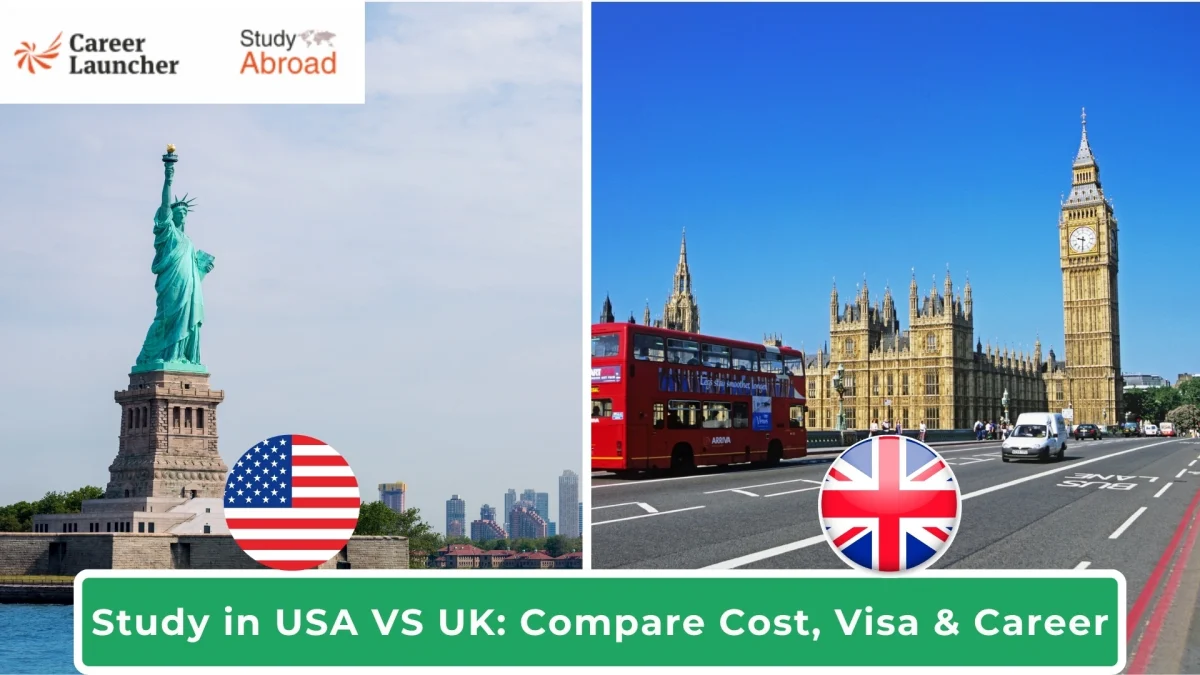
Two acceptance letters, one from a UK university and one from a US school, sitting in your inbox is a great problem to have and a genuinely hard decision to make. The study in USA vs UK debate isn’t about which country has “better” education; it’s about which system matches your budget, your subject, and where you want to build a career. This guide lines up the real numbers, so you can decide with data instead of guesswork.
Table of Contents
1. Study in USA vs UK: Degree Structure & Duration
The single biggest structural difference between the two systems is time. UK undergraduate degrees run 3 years (4 in Scotland), and master’s degrees are typically completed in just 12 months. US bachelor’s degrees run 4 years with a broader liberal-arts foundation before you specialise, and master’s programmes usually take 2 years.
How Long Are UK Degrees vs US Degrees
| Degree Level | UK Duration | USA Duration |
| Bachelor’s | 3 years (4 in Scotland) | 4 years |
| Master’s | 1 year (typical) | 2 years (typical) |
| PhD | 3–4 years | 4–6 years |
Popular Fields in Each Country
The UK’s course-led model suits students who already know their specialisation — law, medicine, and finance students commit to a subject from year one. The US liberal arts model suits students who want to explore before declaring a major, and its research funding advantages make it the stronger choice for STEM PhDs and lab-based research.
2. Cost of Studying in USA vs UK
Because UK courses are shorter, the total cost of a UK degree is often lower even when the US annual tuition looks comparable.
Tuition Fees Compared
| Cost Component | UK | USA |
| International tuition (per year) | £20,000–£40,000 (STEM often £25,000–£40,000) | $25,000–$65,000+ depending on institution |
| Typical monthly living cost | £1,000–£1,550 | $1,200–$2,500 (varies heavily by city) |
| Total programme cost (Master’s) | Lower overall due to 1-year duration | Higher overall due to 2-year duration |
A 1-year UK master’s can save students £15,000–£20,000 compared to an equivalent 2-year US programme, once accommodation and living costs across the extra year are factored in. That said, US financial aid and merit scholarships are often broader and more generous than what’s available to international students in the UK.
If funding is a deciding factor either way, it’s worth comparing education loan options for your UK degree before you commit.

3. Student Visa Requirements: F-1 vs UK Student Visa
Both countries run structured, well-documented visa systems, but the process and terminology differ enough to trip up first-time applicants.
| Requirement | USA (F-1 Visa) | UK (Student Visa) |
| Sponsoring document | Form I-20 from a SEVP-approved institution | Confirmation of Acceptance for Studies (CAS) from a licensed sponsor |
| Financial proof | Evidence of funds for tuition + living costs | Evidence of funds per UKVI’s course/living cost formula |
| Interview required | Yes, in-person visa interview | Not typically required for most applicants |
| Processing approach | Visa issued before travel; SEVIS fee applies | Online application via UKVI; biometric appointment required |
For a full breakdown of the UK side, including document checklists and timelines, see our UK student visa process in detail; for the US side, this step-by-step US undergraduate admissions guide serves as a roadmap that outlines every milestone on the journey to the college admission process in the USA.
4. Work Rights During and After Your Degree: USA vs UK
Part-Time Work Rules While Studying
- USA (F-1): on-campus work up to 20 hours/week during term; off-campus work only through CPT or OPT, tied directly to your field of study.
- UK (Student visa): up to 20 hours/week during term time for most degree-level courses, and full-time during official vacation periods.
Post-Study Work Visas: OPT vs Graduate Route
| Feature | USA (OPT / STEM OPT) | UK (Graduate Route) |
| Standard duration | 12 months | 2 years (bachelor’s/master’s), 3 years (PhD) |
| STEM extension | Up to 24 additional months (36 months total) | Not applicable |
| Job offer required | Work must relate to your field of study | No job offer required to start the visa |
| Path after this stage | Employer-sponsored H-1B (lottery-based) | Skilled Worker visa (employer sponsorship, points-based) |
This is where the two systems diverge most sharply. The US STEM OPT extension can give engineering, computer science, and data graduates up to three years of work authorisation, but transitioning to a long-term H-1B visa depends on an annual lottery. The UK’s Graduate Route is simpler and doesn’t require employer sponsorship upfront, though the government has confirmed it will shorten to 18 months for applications made on or after 1 January 2027 — students starting UK courses now should still qualify for the full 2-year route if they apply before that cutoff.
5. USA vs UK – Career Prospects & ROI
Salary Potential After Graduation
US salaries for STEM graduates tend to run meaningfully higher than UK equivalents, partly reflecting the broader tech and finance job market and a higher cost of living in major US hub cities. UK salaries are generally lower in absolute terms, but so is the cost of living outside London, which narrows the practical gap for many graduates.
Return on Investment
- USA: higher tuition and living costs, but the combination of STEM OPT and stronger entry-level salaries can produce a higher long-term ROI for STEM fields.
- UK: lower total programme cost due to shorter duration, making the breakeven point faster even with more moderate starting salaries.
- Calculate your own case using: (post-graduation earnings over your visa period) ÷ (total cost of the programme) — then compare the ratio, not just the sticker price.
Still weighing this against a third or fourth country? Our broader country-choice framework walks through the same trade-offs for other popular destinations.
6. Which Country Should You Choose?
Choose the USA If…
- You’re pursuing a STEM field and want the 3-year STEM OPT runway to find employer sponsorship.
- You want a broader undergraduate experience with flexibility to choose your major after year one.
- You’re targeting research-heavy programmes, PhDs, or fields with strong US industry ties (tech, finance).
Choose the UK If…
- You already know your specialisation and want to start it immediately, without a broad-based first year.
- You want to minimise total cost and time investment with a 1-year master’s.
- You value a clearer, sponsorship-free post-study work route through the Graduate Route.
Conclusion
There’s no universally “better” choice in the study in USA vs UK debate — only the better choice for your subject, budget, and career plan. The UK wins on speed, cost, and a clearer post-study work route; the USA wins on flexibility, research depth, and long-term STEM earning potential.
Not Sure Which University Is the Right Fit?
Book a free counselling session with Career Launcher Study Abroad to receive a personalised university shortlist based on your academic profile, budget, preferred course, and long-term career goals.
Recommended Reads
- UK Study Guide: Everything You Need to Know
- Study in USA: Top Universities, Fees, Visa, Career Scope & Student Life
- Step-by-Step Guide for UG Admissions in the UK
- Cost of Living in the UK for Indian Students
- How Global University Ranking Systems Work
Frequently Asked Questions
Which is better, USA or UK, for a master’s degree?
It depends on your priorities: the UK offers a faster, generally cheaper 1-year master’s with a simpler post-study work route, while the USA offers a longer 2-year programme with deeper specialisation options and a stronger STEM job market.
Is it cheaper to study in the UK or USA?
The UK is usually cheaper overall because its degrees are shorter — a 1-year UK master’s can cost £15,000–£20,000 less than an equivalent 2-year US programme, even though annual US tuition isn’t always higher.
How long does a master’s degree take in the UK vs USA?
A UK master’s typically takes 1 year, while a US master’s typically takes 2 years.
What is the post-study work visa difference between the UK and USA?
The UK’s Graduate Route offers 2 years of work rights (3 for PhDs) without needing a job offer. The USA’s OPT offers 12 months, extendable to 36 months for STEM graduates, but work must relate to your field of study.
Do I need IELTS for both UK and USA universities?
Most UK and US universities accept IELTS, TOEFL, or PTE Academic for non-native English speakers; some US universities also accept Duolingo English Test, so always check each university’s specific requirement.
Which country has better job opportunities after graduation?
The USA generally offers higher salaries, especially in STEM and tech, but requires a competitive H-1B lottery for long-term sponsorship. The UK offers a more predictable, sponsorship-free path via the Graduate Route, though salaries are typically lower.
Can I apply to both UK and USA universities at the same time?
Yes. UK applications go through UCAS with a mid-January deadline for most courses, while US applications go through the Common App or individual university portals with varied deadlines — many students apply to both systems in parallel.