3 Months Study Plan for IPMAT: Ace IPMAT 2026 in 90 days

IPMAT stands for Integrated Programme in Management Aptitude Test. It’s a crucial exam for students in India aiming for a career in management right after high school. Integrated Programme in Management, or IPM is a five-year program which combines a Bachelor’s in Business Administration (BBA) with a Master’s in Business Administration (MBA). This program is a one of a kind initiative by IIMs to give a chance to graduates to pursue a management education straight after class 12th. 

Cracking any competitive exam requires focus and strategy. Though it is extremely challenging to crack the IPMAT in 90 days, with a well-structured approach, even a 3 months study plan for IPMAT can be enough to crack the exam. This article will equip you with a strategic IPMAT preparation plan to maximize your score.

Get 3 Month IPMAT Study Plan PDF

IPMAT Exam Overview 

Before beginning your preparation journey using the IPMAT preparation plan, it is important to have a wholesome understanding of the exam. The number one step is getting thoroughly acquainted with the IPMAT Syllabus and IPMAT Exam Pattern. A brief overview of these is provided below. 

IPMAT Exam Pattern

Following is the IPMAT exam pattern for IPMAT Indore, IPMAT Rohtak and JIPMAT.

Exam

Sections

Duration

Mode

Total Questions

Marking Scheme

IPMAT Indore

Verbal Ability (MCQ), Quantitative Ability (MCQ), Quantitative Aptitude (SA)

120 minutes (2 hours)

Online

90

+4 for correct, −1 for incorrect (No negative marking for QA-SA)

IPMAT Rohtak

Verbal Ability, Quantitative Ability, Logical Reasoning (All MCQ)

120 minutes (2 hours)

Online

120

+4 for correct, −1 for incorrect

JIPMAT

Verbal Ability, Quantitative Ability, Logical Reasoning (All MCQ)

150 minutes (2.5 hours)

Online

100

+4 for correct, −1 for incorrect

IPMAT Syllabus

IPMAT Indore, Rohtak and JIPMAT test a candidate across the following sections- Verbal Ability, Logical Reasoning and Quantitative Ability. The questions are objective in nature, but IPMAT Indore also tests the candidate through subjective questions in the Quantitative Aptitude section. All three, IPMAT Indore, Rohtak and JIPMAT tests primarily 10-12th standard fundamentals, with a mix of concept-based and application questions. 

The brief topics included in the IPMAT syllabus are shared below. For an in-depth version of the syllabus, paper-wise- students must refer to the linked article. 

Quantitative Ability

The IPMAT Quantitative Ability syllabus covers fundamental math topics, including:

Verbal Ability

The IPMAT Verbal Ability syllabus tests a candidate’s english comprehension and usage, including: 

Logical Reasoning (IPMAT Rohtak & JIPMAT)

The IPMAT Logical Reasoning section aims to assess a candidate’s analytical and pattern-based thinking, including: 

Now, let’s have a look at the detailed IPMAT preparation plan.

How to prepare for IPMAT in 3 Months?

Here’s a comprehensive 3 months IPMAT study plan for IPMAT aspirants. Below mentioned are two different plans of preparation, one for students passing out from 12th, and other for students who have taken a gap year to prepare for IPMAT.

Phase I: February To March: Maximum Time Utilization

IPMAT Study Plan for Class 12 Aspirants:

Here’s the week-by-week IPMAT study plan for class 12 aspirants.

Phase

What is this phase about

Focus on

Before Boards (Feb to Mid-Feb)

Board exams take priority, light daily practice for IPMAT.

Establish consistency in IPMAT with short VA, QA revision, and light LR while fully focusing on boards. 

During Boards (Mid-Feb to Mid-March)

Focus on boards, just try to keep the momentum alive for IPMAT preparation. 

Revise and practice familiar question types in bits and pieces.

Post-Boards (Mid-March onwards)

Transition phase from boards to serious IPMAT preparation. 

Increase study hours and work on weak areas across QA, VA, and LR/DI. 

Let's understand this in detail.

Get the 90-day strategy as a PDF here!

Download Now

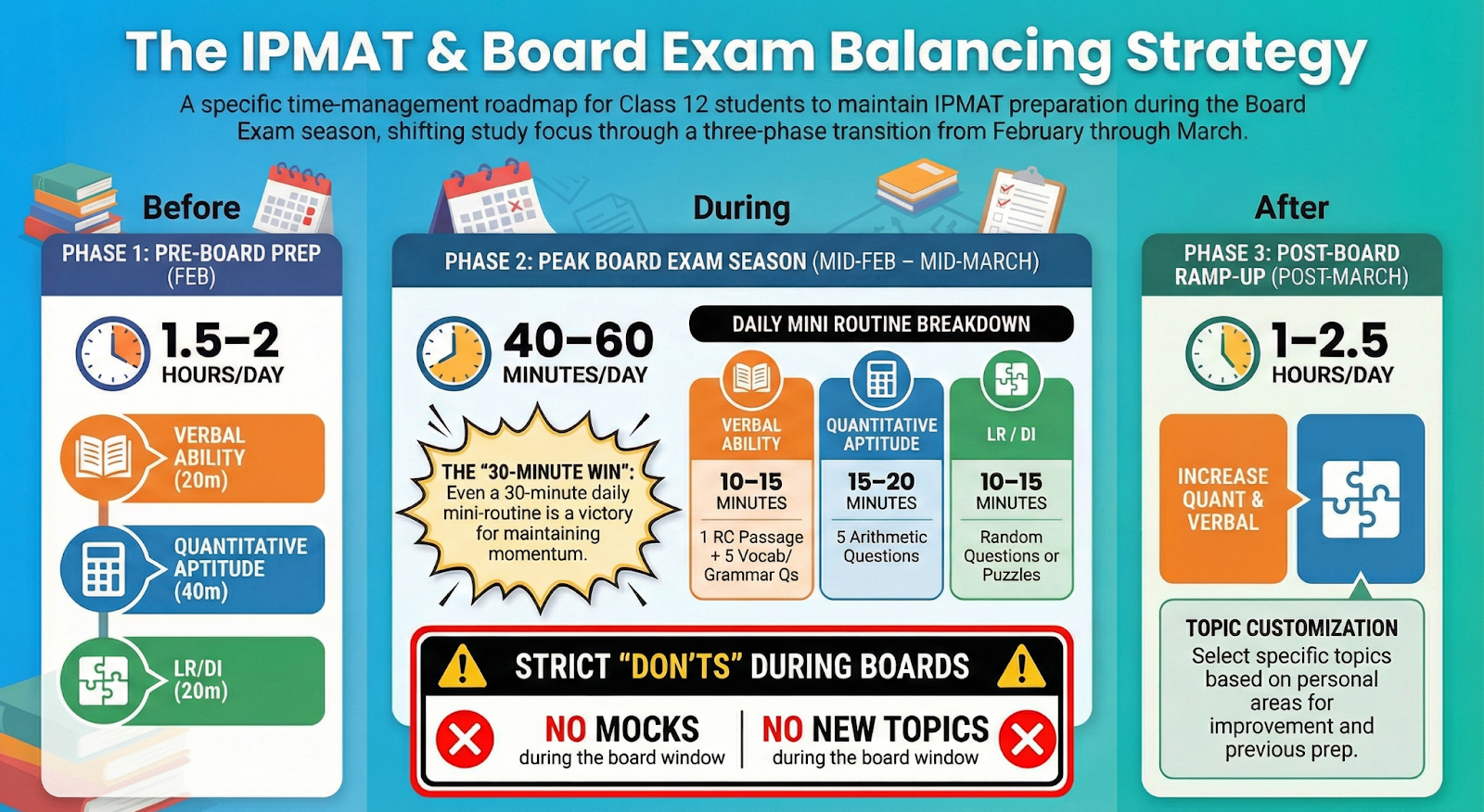
1) Before Boards

For class 12th aspirants, this phase is crucial as it determines how well they do in boards. So, board exams prep is non-negotiable. So, in this phase, board exams prep must take the front seat but IPMAT preparation should not be neglected completely either. 

At this stage, a student would have 1.5-2 hours a day maximum, to dedicate to IPMAT preparation. So, divide your time as follows.

Verbal Ability (15-20 minutes a day) 

Pick any (alternatively)

  • Reading Comprehension (One short passage/day)

Vocabulary (rotate daily)

  • Synonyms/ Antonyms 
  • One-word substitution
  • Idioms / Phrasal verbs
  • Subject- Verb Agreement
  • Tenses
  • Modifiers

Quantitative Aptitude (30–40 min/day) 

Revise; Refer to your notes/formula sheets 

8–10 mixed questions/day (accuracy focus) 

LR / DI (15–20 min/day)

Do: 1 sectional mock per week

Don’t take full-length mocks

Don’t start new topics

2) Mid-Feb to Mid-March (During Boards)

At this stage, students would have 40-60 minutes a day only. At this time, minimal preparation is okay. The focus should be on maintaining consistency, and revising what is already covered. 

 Daily Mini Routine: 

  • RC (10–15 min) → 1 passage 
  • VA (10 min) → 5 vocab/grammar Qs 
  • QA (15–20 min) → 5 arithmetic Qs 
  • LR (10-15) → random questions/puzzles 

Even 30 minutes a day is a win!

Do’s:

Solve mixed-topic questions for QA and LR/DI. Focus on VA (Verbal Ability-Vocabulary and Grammar) for 10/15 minutes a day by reading passages or solving 5 questions.

Don’ts:

Take mocks. 

Start any new topics.

3) Mid-March (Boards Ending) 

1-2.5 hours a day

  • Quant (60 min/day) 
  • Verbal (60 min/day) 
  • LR/DI (30 min/day) 

Pick the topics you need to focus on based on your strengths and weaknesses.

Get the 90-day strategy as a PDF here!

Download Now

IPMAT 3 Month Study Plan for Droppers

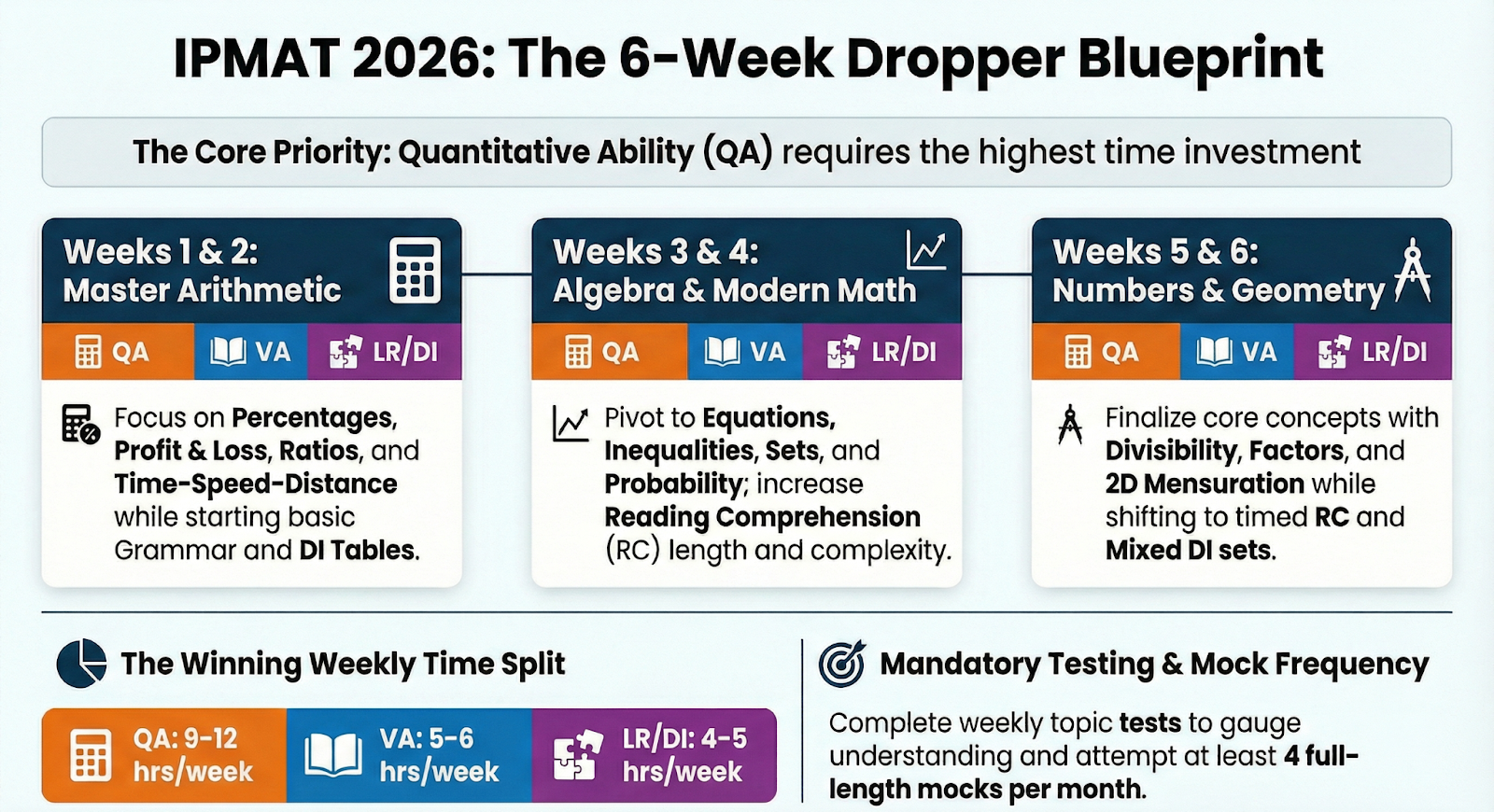
Students taking a drop year to prepare for IPMAT should have a laser focus from day 1 of starting their preparation. The focus should be on covering core principles, gaining speed and testing themselves from day 1. Let’s have a detailed breakdown of how to best divide time when following a 3-month IPMAT study plan. 

Time to be dedicated:

  • 3-4 hrs/day consistently
  • Equal time to all 3 sections

Daily Split

  • QA: 90 min
  • VA: 60 min
  • LR/DI: 45-60 mins

Weekly Split:

The following is the weekly split that a dropper must follow in order to prepare for IPMAT 2026.

Week

Section

Topics

Time Allocation

Week 1

QA (Arithmetic)

Percentages, Profit & Loss, Simple & Compound Interest

9–12 hrs/week (≈1.5 hr/day)


VA

Reading Comprehension (Short), Grammar Basics, Sentence Correction

5–6 hrs/week


LR/DI

Basic Puzzles, Series Completion, Intro to DI (Tables, Bar Graphs)

4–5 hrs/week

Week 2

QA (Arithmetic)

Ratio & Proportion, Mixtures & Alligation, Time–Speed–Distance

9–12 hrs/week (≈1.5 hr/day)


VA

Reading Comprehension, Para-Jumbles

5–6 hrs/week


LR/DI

Coding–Decoding, Blood Relations, 1 DI Set Daily

4–5 hrs/week

Week 3

QA (Algebra)

Linear Equations, Quadratic Equations, Inequalities

9–12 hrs/week (≈1.5 hr/day)


VA

RC (2–4), Synonyms/Antonyms, Sentence Completion, Grammar (Tenses, Prepositions)

5–6 hrs/week


LR/DI

Arrangements, Directions, DI (Pie & Line Graphs)

4–5 hrs/week

Week 4

QA (Modern Math)

Sets, Venn Diagrams, Probability, Permutation & Combination

9–12 hrs/week (≈1.5 hr/day)


VA

RC (Long), Para Completion

5–6 hrs/week


LR/DI

Syllogisms, Input–Output, Advanced DI

4–5 hrs/week

Week 5

QA (Number System)

Divisibility, Factors, Multiples, Base Conversions

9–12 hrs/week (≈1.5 hr/day)


VA

Mixed RC, Grammar, Vocabulary

5–6 hrs/week


LR/DI

Practice DI Sets

4–5 hrs/week

Week 6

QA (Geometry)

Lines, Angles, Triangles, Circles, Mensuration (2D)

9–12 hrs/week (≈1.5 hr/day)


VA

Timed RC, Grammar & Vocabulary Tests

5–6 hrs/week


LR/DI

Mixed Sets

4–5 hrs/week

  •  Attempt topic tests on a weekly basis to gauge the understanding level of all the topics covered in that week 
  •  Minimum 4 mocks per month 

*This time allocation is the minimum effort you should dedicate towards your prep, increase it as per your capacity.

Get the 90-day strategy as a PDF here!

Download Now

Phase 2: April to Mid-May 2026: Revise Refine & Repeat

(Common for All Aspirants)
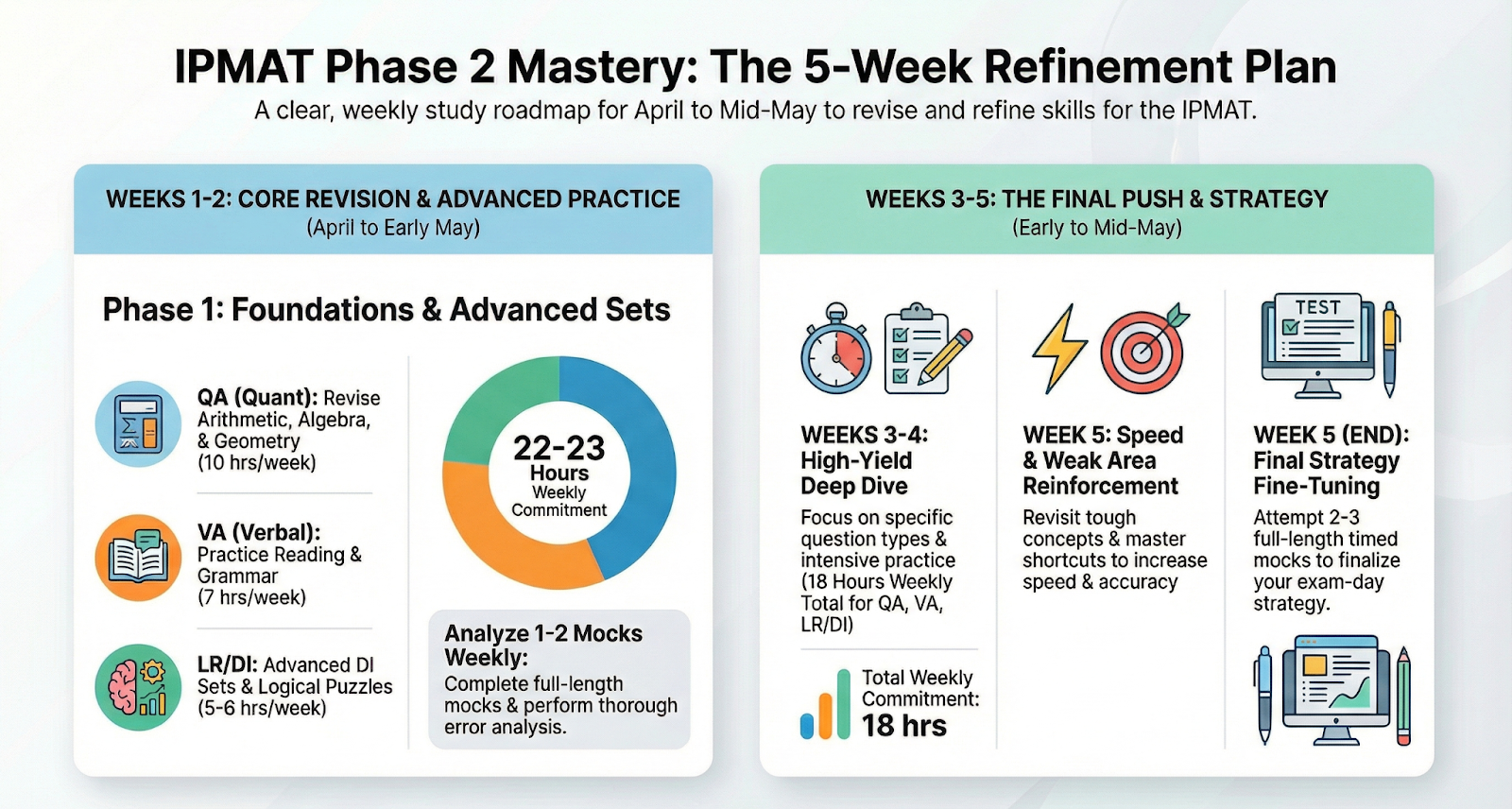
This phase is common to all aspirants, so this should be referred to for both droppers and class 12th aspirants.

Week

Section

Topics

Time Allocation

Week 1

QA (High Priority)

Revise Arithmetic, Algebra, Geometry; practice advanced-level questions

10 hrs/week (1.5–2 hrs/day)

Week 1

VA

Reading Comprehension, Para Jumbles, Vocabulary

7 hrs/week (1 hr/day)

Week 1

LR/DI

Caselets

Advanced DI Sets

5–6 hrs/week

Attempt 1–2 mocks + thoroughly analyse them.

Week 2

QA

Mixed sets (questions involving 2–3 topics)

10 hrs/week

Week 2

VA

Timed RC & Grammar & Vocabulary tests

7 hrs/week

Week 2

LR/DI

Advanced logical puzzles & DI sets

5–6 hrs/week

Take 1-2 mocks at least and analyse them.

Week 3–4

QA/VA/LRDI

  • High-yield topics deep dive
  • Focus on question types & practice

18 hrs/week

Minimum of 2 mocks.

Week 5

QA/VA/LRDI

  • Re-inforce weak areas
  • Revisit tough concepts
  • Shortcuts + speed techniques

18 hrs/week

Final full-length timed mocks (2–3). Fine-tune your strategy and review errors.

*This time allocation is the minimum effort you should dedicate towards your prep, increase it as per your capacity.

Conclusion

So, by following this week-wise IPMAT study plan, whether you are a dropper or an aspirant juggling boards with IPMAT, you will be in a good position to tackle IPMAT. The most important thing regardless of whatever IPMAT preparation plan you follow is to follow it consistently and diligently. Also, this is a generic study plan so tweak it according to your own strengths and weaknesses and the time you can dedicate to studying. 

For more preparation tips and insights from our IPMAT experts, download the full 90-day IPMAT preparation plan here.

IPMAT PYQs IPMAT Free Mocks IPMAT Test Series IPMAT 2026 Crash Course

What Our Students Say About Us..

10,111 total ratings with reviews

Laksh Saxena

Laksh Saxena

Converted: IIM Indore, IIM Rohtak, Ranchi


I feel CL's teaching faculty was a great backbone for my success in this, especially Abhinashi sir, he not only provides career counseling but also teaches exceptionally well. Another important part, especially for me, has to be the mocks. The online portal that Career Launcher provides is just amazing. I have often found myself, again and again, analyzing and re-analyzing mocks, and through that, I found my weaknesses.

Ankush Anand

Ankush Anand

Converted: IIM Indore


I joined the career launcher's express batch. CL teachers were always there to guide us and they gave us the strategy to attempt the paper. For example, they asked us to focus on what you know more. You have to work on the weakness after that. I attempted good number of mocks and the detailed mock-analysis of every question helped me prepare better.

Vanisha Gupta

Vanisha Gupta

Converted: IIM Indore


For my journey, I think the most important part was regular mock-taking. The Career Launcher Aspiration account provided me with a numerous number of mocks, which I was taking regularly along with my classes. I would like to thank my teachers, especially Raman sir, Avinash sir, and Doreen sir, who have really helped me in improving my quants and verbal ability, which was especially weak for me.

Khyati Singla

Khyati Singla

Converted: IIM Rohtak


I joined the online course with Career Launcher & was determined to get into an IIM. The Career Launcher mocks helped a lot in preparation by properly analyzing different chapters, which helped me identify my weak areas and strengths. Praveen Tyagi sir & Manu Bali sir, are great teachers. I have not seen such great teachers in mathematics & they helped me a lot in preparation.

Varsha Joshi

Varsha Joshi

Converted: IIM Rohtak


I am very grateful to God and CL of course for letting me achieve my true potential. Once I had set my mind on cracking the IPM exams; I completed all the CL modules and those were more than enough to build my concepts. My approach was practice-oriented, through timed question-solving and mocks. For the interview; I practiced with CL mentors to form a strategy and they helped me with every bit of it.

Khushpreet Kaur

Khushpreet Kaur

Converted: IIM Rohtak & IIM Jammu


As a student who recently got into IIM Jammu, I can say that my journey with CL was transformative. The teachers were fantastic—made everything understandable. Even when I was short on time; they took the time to help with the doubts. The study material was on point, cutting out the fluff & focusing on what I needed. The mock tests were a lifesaver, mirroring the real exam & helping nail my timing.