
Three months is the sweet spot for GMAT preparation — long enough to cover the full syllabus systematically, short enough to maintain sharp focus. Most people aiming for a competitive business school score study for between 3 and 6 months, and allowing yourself at least 3 months gives you an excellent opportunity to put in the time necessary to achieve your best possible score.
The current GMAT consists of three sections — Quantitative Reasoning, Verbal Reasoning, and Data Insights — totalling 64 questions in 2 hours and 15 minutes, with each section carrying equal weight. Unlike the older format, there’s no essay writing, no Sentence Correction, and no geometry. That’s genuinely good news: the scope is tighter and more predictable than ever.
This guide gives you a week-by-week study plan, section-specific preparation strategies, daily time targets, and a mock test schedule — built specifically for students who want to cover the GMAT exam syllabus in 3 months without burning out.
Table of Contents
Understanding the GMAT Exam Syllabus Before You Begin
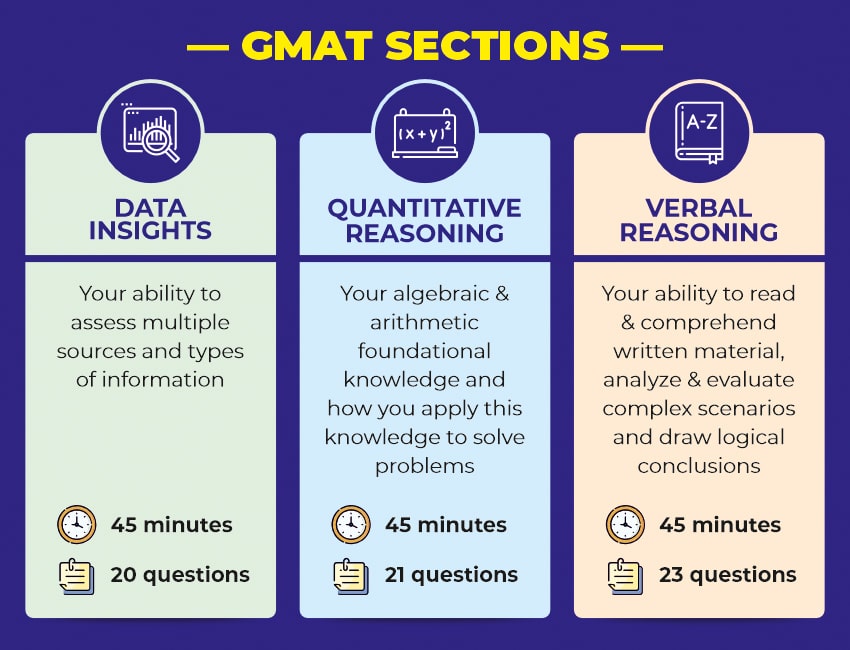
Before you schedule a single study session, you need to know exactly what you’re preparing for. The GMAT Focus Edition syllabus is divided into three sections — Quantitative Reasoning, Verbal Reasoning, and Data Insights — each designed to evaluate a different set of skills relevant to business and management education.
For a detailed topic-by-topic breakdown before you begin, refer to our complete GMAT Syllabus guide and GMAT Exam Pattern overview.
Section 1: Quantitative Reasoning (QR)
The Quantitative Reasoning section measures your algebraic and arithmetic foundational knowledge and how you apply that knowledge to solve problems. It consists of 21 problem-solving questions, completed in 45 minutes. No calculator is allowed.
Core topics to master:
- Arithmetic: Number properties, fractions, decimals, percentages, ratios, averages, probability, speed-time-distance, work-time problems
- Algebra: Linear and quadratic equations, inequalities, functions, exponents, permutations and combinations, progressions
Geometry has been removed from the current GMAT — so you no longer need to study angles, triangles, or coordinate planes. Focus your Quant energy entirely on arithmetic fluency and algebraic reasoning.
Tip: Most Indian students are strong in Quant fundamentals but lose time on Data Sufficiency-style logic. Even though DS questions now appear only in the Data Insights section, the underlying reasoning discipline must be practised throughout.
Section 2: Verbal Reasoning (VR)
The Verbal Reasoning section measures your ability to read and comprehend written material and to reason and evaluate arguments. It consists of 23 Reading Comprehension and Critical Reasoning questions, completed in 45 minutes.
Sentence Correction questions are no longer part of the Verbal section — the current GMAT only includes Reading Comprehension and Critical Reasoning, making the section more logic- and reasoning-based rather than grammar-focused.
- Reading Comprehension: Passages drawn from social sciences, business, and physical sciences. Questions test main idea, inference, logical structure, and application.
- Critical Reasoning: Short arguments (~100 words) where you must strengthen, weaken, evaluate, or draw conclusions from the argument. No specialist knowledge required — pure logic.
Tip for Indian students: Non-native speakers often read passages slowly and run out of time. Practice reading dense editorial content daily — The Economist, Harvard Business Review, and Scientific American are ideal. Aim to read a 500-word passage and answer questions within 8 minutes. For a targeted breakdown of techniques, see our dedicated Reading Comprehension Strategy guide.
Section 3: Data Insights (DI)
This is the newest and most underestimated section. The Data Insights section measures candidates’ ability to analyse and interpret data and apply it to real-world business scenarios. It assesses 20 questions across multiple formats — graphic, numeric, and verbal — in 45 minutes. An on-screen calculator is available.
Question types within Data Insights:
- Data Sufficiency: Determine whether given information is sufficient to answer a quantitative question
- Multi-Source Reasoning: Analyse information from multiple tabs — text, tables, charts — to answer questions
- Table Analysis: Sort and analyse tabular data to find what’s relevant
- Graphics Interpretation: Interpret scatter plots, bar charts, and other visual data
- Two-Part Analysis: Solve a problem that requires two simultaneous answers
Tip: Most 3-month study plans allocate too little time to DI. Budget at least 25–30% of your prep time here, especially if you’re unfamiliar with interpreting complex data formats under timed conditions.
Is 3 Months Enough to Cover the Full GMAT Syllabus?
Yes — with structure. Three months provide 120 to 180 total study hours, which is sufficient for most students to achieve a competitive GMAT score.
The GMAT Focus Edition has a shorter, more efficient format, and the defined scope of study makes it easier to tailor your preparation to the most impactful areas. The key variable is your starting point. Take a free diagnostic test from mba.com before Week 1 — your baseline score determines how aggressively you need to allocate time across sections.
Score benchmarks to guide your target:
Before locking in your goal score, it’s worth knowing what different programs actually expect. Here’s a quick reference:
- Top Indian B-schools (ISB, IIMs): The average GMAT score at top Indian programs sits in the 655 – 685 range. A score of 675+ is competitive but no longer enough to stand out in a strong applicant pool. See the full picture in our guide to GMAT Scores for Top Indian B-Schools (ISB, IIMs & More).
- Top global MBA programs: For schools like Harvard, Wharton, and Stanford, median scores sit at 685+. Our breakdown of GMAT Scores for Top Global MBA Colleges maps requirements across 20 programs.
- MiM programs in Europe: Master’s in Management programs often have lower score thresholds, but top schools like HEC Paris and London Business School are still competitive. Check our GMAT Scores for Top MiM Programs guide for the full list.
Set your target before you build your study plan. Your plan for a 605 looks different from your plan for a 705. If you’re still figuring out what qualifies as a strong score for your profile, our article on What is a Good GMAT Score? walks through this.

How Many Hours Per Day Should You Study for GMAT in 3 Months?
Plan to study 10 to 15 hours per week during your 3-month preparation. This breaks down to about 1.5 to 2.5 hours on weekdays and longer 2 to 3 hour sessions on weekends. Consistency matters more than marathon study sessions.
For working professionals:
- Weekday mornings (6–8 AM): 1–1.5 hours of concept study or targeted practice
- Weekday evenings (9–10 PM): 30–45 minutes of error log review or flashcard revision
- Saturday: 3–4 hours — mix of practice sets and one section review
- Sunday: 2–3 hours — error analysis, weak area focus, or a timed mini-mock
Give yourself 1 or 2 GMAT-free days each week; your brain needs recovery time to consolidate what it has learned. For a more tailored schedule if you’re balancing a job alongside prep, see our guide on How to Prepare for GMAT While Working.
The 3-Month GMAT Study Plan: Week-by-Week Breakdown
A practical approach is to divide the 3 months into two phases — spend the first 2 months learning concepts, question types, and strategies across all three sections, then use the final month for mixed timed practice sets, full-length mock tests, and deep review.
Month 1 (Weeks 1–4): Foundation Phase
Goal: Understand the exam structure, establish baseline, and build core concept knowledge across all three sections.
Week 1: Diagnostic + Orientation
- Take a free official practice test from mba.com (untimed, no pressure)
- Review your diagnostic report — note which sections and question types hurt you most
- Study the GMAT Focus Edition format: section order, timing rules, calculator availability, the Question Review & Edit feature
- Set a realistic target score based on your diagnostic and your target schools
Week 2: Quantitative Reasoning — Arithmetic
- Cover: number properties, fractions, decimals, percentages, ratios, averages, probability
- Work 15–20 OG Quant questions daily
- Build a formula sheet for quick reference (not memorisation — understanding)
Week 3: Quantitative Reasoning — Algebra + Problem Solving Strategy
- Cover: linear equations, quadratics, inequalities, functions, exponents, permutations
- Begin timing yourself — aim for under 2 minutes per question
- Focus on eliminating wrong answer choices when stuck
Week 4: Verbal Reasoning — Reading Comprehension + Critical Reasoning Intro
- Read one passage daily from a quality editorial source
- Practice identifying argument structure: premise, conclusion, assumption
- Work 10 RC and 10 CR questions daily from the OG
- Take your second full-length practice test at the end of Week 4 to measure foundation progress
Month 1 checkpoint: You should see a modest score increase from your diagnostic. If a particular section looks especially weak, increase time allocation for Month 2.
Month 2 (Weeks 5–8): Strategy + Section Mastery Phase
Goal: Deepen section-specific strategy, integrate Data Insights thoroughly, and begin timed practice.
Week 5: Critical Reasoning — Advanced Reasoning Skills
- Study the four CR skill categories: Analysis, Construction, Critique, and Plan
- Learn to identify argument types: assumption, strengthen, weaken, inference, evaluate
- Work 15 CR questions daily, focusing on accuracy over speed
- Begin keeping an error log: every wrong answer gets a note on why you chose it
Week 6: Data Insights — Data Sufficiency + Two-Part Analysis
- Learn the DS answer choices by heart (statement 1 alone / statement 2 alone / both / neither / either)
- Practice Data Sufficiency without solving the full problem — just determine sufficiency
- Work through Two-Part Analysis using a grid approach to eliminate impossible answer pairs
Week 7: Data Insights — Multi-Source Reasoning + Graphics Interpretation + Table Analysis
- Practice reading multi-tab questions carefully — the trap is over-reading data you don’t need
- Work on interpreting scatter plots, bar charts, and pie charts quickly
- Do 10 DI mixed questions daily under timed conditions
Week 8: Integration + Timed Mixed Practice
- Run mixed practice sets covering all three sections — do not silo by section any more
- Take your third full-length practice test at the end of Week 8
- Spend at least 3 hours reviewing the test: every question you got wrong and every question you took too long on
Month 2 checkpoint: Your score should be within 30–50 points of your target. If you’re still far off, identify whether it’s a concept gap (go back and study) or an execution gap (timing, strategy, guessing logic).
Month 3 (Weeks 9–12): Mock Test + Stamina Phase
Goal: Simulate real test conditions repeatedly, refine strategy, plug remaining weaknesses, and peak on test day.
Week 9: Weakness Targeting + Intensive Drilling
- Pull your error logs from Months 1 and 2 — group errors by question type and concept
- Spend 60% of study time this week on your two weakest question types
- Do short, timed drills (10 questions in 20 minutes) to build pacing instinct
Week 10: Full Mock Test + Deep Review
- Take your fourth full-length mock test under real conditions: timed, one break, no phone
- After the test, spend an entire study session (3+ hours) reviewing every question
- Record your pacing: were you rushing the last 5 questions in any section?
Week 11: Pacing + Test Strategy Refinement
- Practice the bookmarking and Question Review & Edit feature intentionally — it’s unique to this exam
- Develop your personal guessing strategy: if you’re stuck at the 1.5-minute mark, what do you do?
- Take your fifth mock test and aim for test-day conditions — same time of day as your actual exam
Week 12: Review + Pre-Test Stabilisation
- No new concepts. No new question types.
- Light practice only: 15–20 questions per day from familiar material
- Take one final short practice set 2–3 days before the exam
- Prioritise sleep, hydration, and a physical walk-through of your test centre (or home setup, if online)
For the 1–2 weeks before your test, focus on review and mindset — not cramming. This is the time to consolidate, not expand.
Section-Specific GMAT Preparation Tips
Quantitative Reasoning: How to Improve Your Score
The Quant section tests reasoning, not mathematical complexity. Conceptual understanding matters more than formula memorisation on the GMAT.
- Practise working backwards from answer choices on Problem Solving questions — it’s often faster than solving from scratch
- Build number sense: know your squares (1–25), cubes (1–10), and common fraction-decimal equivalents cold
- When you see a percentage or ratio problem, always identify what the base is before calculating
- For probability and combinatorics, draw a diagram or write out cases before applying formulas
Verbal Reasoning: How to Improve Your Score
- For Reading Comprehension, read the first and last sentence of each paragraph before diving into questions — you need the structure, not every detail
- For Critical Reasoning, identify the conclusion first, then find the evidence, then spot the assumption gap
- Wrong answers in CR are wrong for a reason — practise articulating exactly why each distractor fails
- Dedicate 10 minutes per day to reading analytically outside of GMAT prep: op-eds, scientific abstracts, business case summaries
Data Insights: How to Improve Your Score
- For Data Sufficiency, never solve the problem fully — practise stopping the moment you know whether sufficiency is reached
- For Multi-Source Reasoning, skim all tabs first to build a mental map, then answer questions
- The on-screen calculator is available in DI — use it for complex arithmetic, but don’t become dependent on it for straightforward calculations, as switching to it repeatedly adds up
- For Two-Part Analysis, eliminate impossible column combinations before considering the rest
How to Use Mock Tests Effectively
Mock tests are not just benchmarks — they’re your most valuable study tool.
Recommended mock test schedule:
| Week | Mock Test | Purpose |
| Week 1 | Diagnostic (Mock 1) | Baseline score + section mapping |
| Week 4 | Mock 2 | Measure Month 1 foundation progress |
| Week 8 | Mock 3 | Measure Month 2 strategy gains |
| Week 10 | Mock 4 | Full test-day simulation |
| Week 11 | Mock 5 | Pacing and strategy refinement |
| 4–5 days before exam | Optional Mock 6 | Confidence check only |
Every 3 to 4 weeks, plan to spend about twice the test duration reviewing your mock — roughly 4–5 hours of review per full test. Use that analysis to prioritise your study sessions in the following weeks.
What to review after every mock:
- Every incorrect answer: what was the concept? what was your reasoning error?
- Every question that took more than 2.5 minutes: is this a concept gap or a pacing gap?
- Section-level timing: did you rush the final questions? did you spend too long early?
GMAT vs CAT: Which Should You Prepare For?
If you’re an Indian student deciding between the two, the choice comes down to your target programs. CAT unlocks the two-year IIM flagship programs; GMAT opens the door to ISB, IIM executive programs, and the world’s top global MBA programs. The GMAT has a clearly defined syllabus and predictable question formats, whereas CAT has tougher quantitative sections, unpredictable question types, and no official syllabus.
For candidates considering both, our detailed GMAT vs CAT comparison covers the format differences, score validity, program eligibility, and which exam suits which career goal.
Similarly, if you’re weighing GMAT against GRE — particularly for MS programs or schools that accept both — see our GRE vs GMAT guide for a head-to-head breakdown.
Resources You Need for 3-Month GMAT Preparation
Official Resources (non-negotiable):
- GMAT Official Guide 2025–2026 — the single most important practice resource; all questions are retired real GMAT questions
- mba.com practice exams — two free full-length adaptive tests, plus paid additional sets
Career Launcher Structured GMAT Coaching Programs (for Indian students):
Self-study works for some candidates, but most Indian students covering the GMAT syllabus in 3 months benefit significantly from structured guidance — particularly on Data Insights and Critical Reasoning, where concept gaps are harder to self-diagnose. Career Launcher Study Abroad offers three coaching formats designed around different schedules and learning styles:
| Program | Best For | Key Inclusions |
| GMAT Online Live Classes | Students who want live instruction with flexibility to attend from anywhere | 65+ hours of live interactive classes, 2800+ practice questions, 7 full-length mocks with detailed analysis, one-to-one doubt clearing, hardcopy books (Verbal, Quant & Data Insights), access to class recordings |
| GMAT Online Live Comprehensive | Students who want maximum live support and personalised faculty access | Everything in Live Classes, plus one-to-one doubt clearing sessions with faculty and one-to-one mock analysis sessions |
| GMAT Self-Paced Comprehensive Program | Working professionals who can’t commit to fixed class timings | 150+ recorded videos, 2500+ practice questions, 7 full-length mock tests, hard copy study material, 6-month video access, 10 one-on-one doubt sessions |
| GMAT Online Private Tutoring | Students who need targeted, one-on-one score-gap coaching | 60+ hours of one-to-one concept building, unlimited one-to-one doubt clearing, 2800+ practice questions, 7 full-length mocks with analysis sessions, hardcopy books |
| GMAT Classroom Coaching | Students who prefer classroom teaching | 65+ hours of live interactive classes, 2800+ practice questions, 7 full-length mocks with detailed analysis, one-to-one doubt clearing, hardcopy books (Verbal, Quant & Data Insights), access to class recordings |
You can also access our Free GMAT Study Plan and take a GMAT Diagnostic Test to assess exactly where you stand before Month 1 begins.
Common 3-Month GMAT Preparation Mistakes to Avoid
Skipping the diagnostic test. Starting prep without a baseline means you’re guessing at where to spend your time. Take the free mba.com practice test on Day 1.
Treating Data Insights as secondary. The GMAT Focus Edition places equal weight on all three sections — DI is central to the exam’s design, not a bonus round. Neglect it and you leave significant score points behind.
Practising only by section. After Month 1, you must mix all three sections in every study session. The real exam demands cognitive switching between QR, VR, and DI, and that switch is itself a skill.
Reviewing only wrong answers. Slow correct answers are just as important — they reveal concept uncertainty that will cost you under pressure.
Not simulating test conditions. Practising in a noisy café with your phone nearby is not GMAT prep. At least once a week, study at a desk, under time pressure, with all distractions removed.
Over-studying in the final week. The week before your exam should be light and restorative. Your brain needs to consolidate, not cram.
[Visual suggestion: Insert a monthly timeline infographic showing the three phases — Foundation (Month 1), Strategy & Mastery (Month 2), Mock Tests & Stamina (Month 3) — with weekly milestones. Alt text: “GMAT 3-month study plan timeline showing week-by-week preparation phases for Indian students.”]
[Visual suggestion: GMAT Focus Edition section comparison table — section name, number of questions, time limit, question types, calculator availability. Alt text: “GMAT Focus Edition 2025 section-wise breakdown table for Quantitative Reasoning, Verbal Reasoning, and Data Insights.”]
Key Takeaways
- The GMAT Focus Edition has three sections — Quantitative Reasoning, Verbal Reasoning, and Data Insights — and 3 months is sufficient to master all three with a structured plan.
- Divide your 3 months into Foundation (Month 1), Strategy and Mastery (Month 2), and Mock Tests and Stamina (Month 3).
- Study 10–15 hours per week; consistency across 5–6 days outperforms weekend cramming every time.
- Data Insights is not a secondary section — budget 25–30% of your prep time there.
- Take 5–6 full-length mock tests and review each one thoroughly; that review process is where real score gains happen.
- Set your target score before you start, based on your specific schools’ averages — preparation without a number is preparation without direction.
Recommended Reads
FAQs
Can I cover the full GMAT syllabus in 3 months while working full-time?
Yes — with realistic time commitments. Dedicate 1.5 to 2.5 hours a day, 5 to 6 days a week over three months. Working professionals can split this into morning and evening slots. The key is non-negotiable daily consistency over weekend cramming.
How many total hours of study does the GMAT require?
Most people targeting a competitive score study for 80 or more hours, spread over 3 to 6 months. A 3-month plan at 10–15 hours per week gives you 120–180 total hours, which is the range associated with strong score outcomes.
What is the GMAT Focus Edition syllabus?
The GMAT has three sections: Quantitative Reasoning (21 questions, 45 minutes), Verbal Reasoning (23 questions, 45 minutes), and Data Insights (20 questions, 45 minutes), totalling 64 questions in 2 hours and 15 minutes. Scores range from 205 to 805. AWA, Sentence Correction, and Geometry have been removed from the current version.
Which GMAT section should I study first?
Start with Quantitative Reasoning in Month 1 — it builds foundational skills that cross over into Data Insights. Introduce Verbal in parallel from Week 3. Give Data Insights dedicated focus from Week 6 onwards. Never leave DI as an afterthought.
How many mock tests should I take in 3 months?
Plan for 5–6 full-length mock tests across your preparation period. In a 3-month plan, 5 well-reviewed mocks are more effective than 8 hastily completed ones. Each mock should be followed by a 3–5 hour review session.
Can I retake the GMAT if my 3-month score isn’t enough?
You can take the GMAT up to five times per year, with a minimum of 16 days between attempts. Most schools consider your highest score, so a retake with targeted preparation on your weak section is a sound strategy if you fall short.