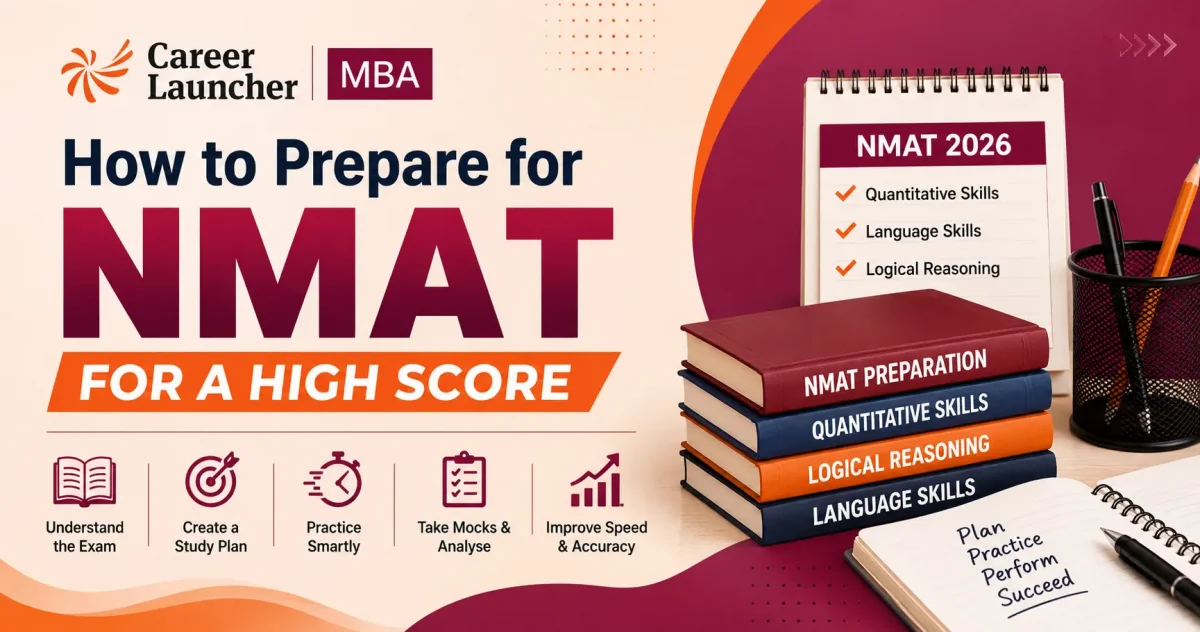
How to prepare for NMAT 2026: Preparation for NMAT requires a different approach from CAT or XAT. The 2026 testing window runs from November 2 to December 20, and candidates can take up to three attempts in a testing year, subject to the applicable retake rules. Since there is no negative marking and each section has a fixed time limit, NMAT places a strong emphasis on speed, accuracy, and effective time management.
This article offers a structured preparation strategy for NMAT 2026, covering everything from strengthening fundamentals and practising under time limits to using mocks effectively and developing the right exam strategy.
Table of Contents
NMAT 2026 Exam Pattern, Sections and Timing
Understanding the NMAT exam pattern helps you plan your preparation around the number of questions, sectional timings, and key areas tested.
| Section | Questions | Time | Key Focus Areas |
| Language Skills | 36 | 28 minutes | Reading Comprehension, Vocabulary, Grammar, Para Jumbles |
| Logical Reasoning | 36 | 40 minutes | Puzzles, Arrangements, Critical Reasoning, Venn Diagrams |
| Quantitative Skills | 36 | 52 minutes | Arithmetic, Algebra, Geometry, Data Interpretation, Data Sufficiency |
| Total | 108 | 120 minutes | — |

NMAT Preparation Strategy 2026: Expert Tips
A common mistake among aspirants is to approach NMAT as a simpler version of CAT. However, the two exams demand different approaches. Keep the following points in mind while preparing for NMAT:
- With 108 questions to answer in 120 minutes, managing the clock is as important as knowing the concepts.
- Fixed sectional timings mean time spent in one section cannot be used in another, so pacing is a key part of your strategy.
- The absence of negative marking gives you the flexibility to attempt questions, but it should not encourage random guessing.
- Regular timed practice is essential to improve your solving speed while maintaining accuracy.
- Strong fundamentals help you recognise familiar question types quickly and approach them with greater confidence.
- Consistent practice, mock tests, and proper analysis are key to building the speed and accuracy required for a high NMAT score.
Also Read: NMAT Syllabus 2026

When to Start and How to Phase Your NMAT Preparation 2026
Since NMAT allows up to three attempts across the testing window, it helps to think of preparation in phases rather than as one continuous, undifferentiated stretch.
- Foundation phase: Focus on concept-building across Quant, Language, and Logical Reasoning before introducing time pressure. This is where you build accuracy and familiarity with different question types.
- Timed-practice phase: Once your fundamentals are steady, shift to solving sets and sectional tests under the actual time limits, so pacing becomes more natural well before test day.
- Mock-intensive phase: In the weeks closer to your test date, prioritise full-length mocks and detailed analysis over fresh content, so your section order and time allocation are tested under pressure.
If you’re planning to use more than one attempt within the November 2–December 20 window, an early attempt can also serve as a diagnostic. It can help you refine your section order, pacing, and preparation strategy using real exam experience before a later attempt.
NMAT Section-Wise Preparation Strategy
Each section requires a slightly different approach, so your preparation should focus on the question types, skills, and time constraints specific to Quant, Language, and Logical Reasoning.
Quantitative Skills
With 36 questions to be attempted in 52 minutes, Quant requires candidates to balance calculation speed, accuracy, and efficient question selection.
- Solve Data Interpretation sets involving charts, tables, and graphs regularly so you become comfortable handling calculations under time pressure.
- Prioritise Arithmetic topics such as percentages, profit and loss, ratios, time-speed-distance, and time-work, while also covering Algebra, Geometry, and other areas included in the syllabus.
- Build calculation shortcuts and approximation techniques for DI and Arithmetic to reduce the time spent on lengthy calculations.
- Avoid calculator-dependent habits during practice and work on improving mental calculation and estimation skills.
Language Skills
With 36 questions to be attempted in 28 minutes, Language Skills requires candidates to balance reading speed with accuracy.
- Practise vocabulary and grammar questions regularly so you can solve familiar question types quickly and reserve sufficient time for Reading Comprehension.
- Experiment with different question orders in mocks and identify the sequence that allows you to manage the section most effectively.
- For RC, focus on understanding the central idea and the author’s argument rather than trying to remember every detail of the passage.
- Build vocabulary consistently through synonyms, antonyms, word usage, and commonly confused words.
- When two options appear close, eliminate the clearly incorrect choices first and make an informed attempt rather than leaving a question unanswered.
Logical Reasoning
LR includes several pattern-based question types, making focused and targeted practice particularly useful for improving familiarity and speed.
- Prioritize Arrangements such as linear, circular, and matrix-based sets, along with Critical Reasoning questions involving assumptions, inferences, conclusions, and arguments.
- Practise syllogisms and coding-decoding separately to become familiar with their underlying rules and patterns.
- Include data-sufficiency-style reasoning sets alongside puzzles so that your preparation covers a wider range of LR question types.
- If a puzzle is taking too long to set up, move on and return to it later rather than spending too much of the sectional time on one question.
- In Critical Reasoning, pay close attention to qualifier words such as “all,” “some,” “none,” “only,” and “unless,” as these can change the meaning of an argument.
- Use regular timed practice to improve your ability to recognise familiar patterns and select an efficient approach.
Mocks and Analysis
Section-wise practice builds your skills, but mocks help you test whether those skills hold up under realistic exam conditions and time constraints.
- Use full-length mocks to test different section orders, since NMAT allows you to choose the sequence in which you attempt the sections.
- Attempt every question where possible and use the absence of negative marking to make informed attempts on questions you cannot fully solve.
- After each mock, review:
- Questions that took disproportionately long compared with their difficulty
- Guesses that were correct and incorrect
- Whether your chosen section order worked under pressure
- Errors caused by concept gaps versus careless mistakes
- If you are planning a retake, use your first attempt as a source of real exam data and refine your section order, pacing, and preparation strategy accordingly.
Also Read: NMAT Preparation Expert Tips |
NMAT Online Classes: Structured Preparation for a High Score
Preparing for NMAT requires consistent practice, timed preparation, and regular mock-test analysis, especially because each section has a fixed time limit. CL’s NMAT Online Classes can provide a structured preparation plan with expert-led sessions, section-wise practice, strategy guidance, and mock tests. The programme can help candidates build their fundamentals, improve speed and accuracy, and become familiar with the exam format through regular practice.
The classes can be particularly useful for candidates who need structured guidance across Quantitative Skills, Language Skills, and Logical Reasoning. Along with concept-based preparation, candidates can use practice sessions and mock tests to assess their performance, identify weak areas, and improve their time-management strategy before the exam.
Conclusion
A strong NMAT score comes from consistent preparation, smart practice, and effective time management. Build a clear understanding of the concepts, practise each section regularly, and gradually shift your focus towards timed sets and mock tests.
Make sure to analyse your performance after every test and work on the areas where you lose time or accuracy. With a focused approach and consistent effort, you can strengthen your preparation and enter the NMAT with greater confidence.
Frequently Asked Questions
- How should I start preparing for NMAT?
A. Begin by understanding the exam pattern and strengthening your fundamentals in Quantitative Skills, Language Skills, and Logical Reasoning. Once your concepts are clear, move to timed practice, sectional tests, and full-length mocks. - How can I improve my speed for NMAT?
A. Practise regularly under time limits and focus on solving questions efficiently without compromising accuracy. Analyse your practice tests to identify areas where you spend more time than necessary. - How important are mock tests for NMAT preparation?
A. Mock tests are an important part of NMAT preparation. They help you assess your preparation, improve time management, and identify areas that need more practice. Analyse each mock to make your preparation more effective. - Is there negative marking in NMAT?
A. No, NMAT does not have negative marking. However, candidates should still focus on accuracy and use the additional flexibility to make informed attempts rather than relying on random guesses. - Can I choose the order of sections in NMAT?
A. Yes, candidates can choose the order in which they attempt the three sections. Since the time allotted to each section is fixed, it is advisable to decide and practise your preferred section order before the exam.