CAT 2026 Quant Last Minute Strategy: As CAT 2026 approaches, aspirants are often caught between revising old topics and exploring new ones. But in the last two weeks, strategy matters more than hours spent studying. The last two weeks should focus on high-weightage Quant topics, formula revision, and mock test analysis, and not starting fresh chapters.
If you want to maximise your CAT Quant score, follow this structured, smart plan tailored to the final preparation phase.
Latest Updates – Check CAT 2026 Exam Analysis on the CAT Exam Day, 29th November 2026
Also Check Slot-wise CAT Analysis Here –
Table of Contents
Quant Last-Minute Strategy For CAT 2026: Expert Preparation Tips
1. Revise Key Formulas and Properties And Avoid Anything New
At this stage, revision trumps new learning. Cramming new topics at the last minute can cause confusion and anxiety, while reinforcing what you already know improves accuracy.
- Spend 30–45 minutes daily revising formulas and properties.
- Try to maintain accuracy while solving quant questions.
💡 Pro Tip: Stick to what you’ve already studied. New concepts in the final week only disrupt focus and reduce recall efficiency during the exam.
Also Read – CAT Score Vs Percentile 2026
2. Practice Previous Year Questions (2021–2025) for Pattern Familiarity
If there’s one activity that gives maximum output for minimal input, it’s practising previous year CAT questions.
Why this matters:
- CAT follows a pattern-based evolution; hence, question types repeat with slight variations.
- It helps you identify frequent traps and conceptual twists.
- It builds confidence by simulating real exam-level difficulty.
How to approach:
- Solve 2–3 past CAT Quant sections (2021–2025) in a timed manner and thoroughly analyse them.
- Identify which topic categories consume more time.
- Revisit weak areas using short concept revision videos or notes.
3. Use Shortcuts for Speed: Fractions, Quadratic Roots & Ratios
Time is your most valuable resource during CAT. Learning a few universal shortcuts can make a huge difference.
Quadratic Roots Shortcut
If x2+(a+b)x+ab=0x^2 + (a+b)x + ab = 0x2+(a+b)x+ab=0, the roots are simply –a and –b. Spotting such patterns helps avoid manual solving.
Ratio Simplification
For ratios like 20:30, always reduce to the simplest form (2:3) to ease later calculations. When dealing with successive ratios, multiply corresponding terms directly.
4. Spend the Last Few Days on Mock Analysis + Weak Areas
Your final week should be more about reflection than exploration. Instead of taking too many mocks, analyse your past mock performance deeply and identify your strengths and weaknesses.
Checklist for the last 2 weeks:
- Revisit 3–4 sectional mocks and note your recurring mistakes; it might be linked to the foundational conceptual understanding.
- Identify 3 weakest subtopics and revise only those.
- Review questions you left unattempted due to time and practice similar ones to increase your speed.
- Track accuracy percentage in Arithmetic, Algebra, and Geometry.
5. Keep a Formula Sheet Handy for Daily 15-Minute Revision
In the final week, a well-organised formula sheet can be your most powerful revision tool.
How to use it effectively:
- Spend 15 minutes each morning revising formulas without any distractions.
- Highlight commonly used identities and conversions.
- Keep the list short and precise. Avoid making a thick booklet because it would be confusing during the last revision days.
- Include shortcut tricks and common values.
Focus on High-Weightage Topics: Arithmetic, Algebra & Geometry
In the final stage of CAT prep, prioritise topics that deliver the highest ROI (Return on Investment). These topics not only appear frequently but also offer concept-based questions rather than lengthy or tricky ones.
Arithmetic
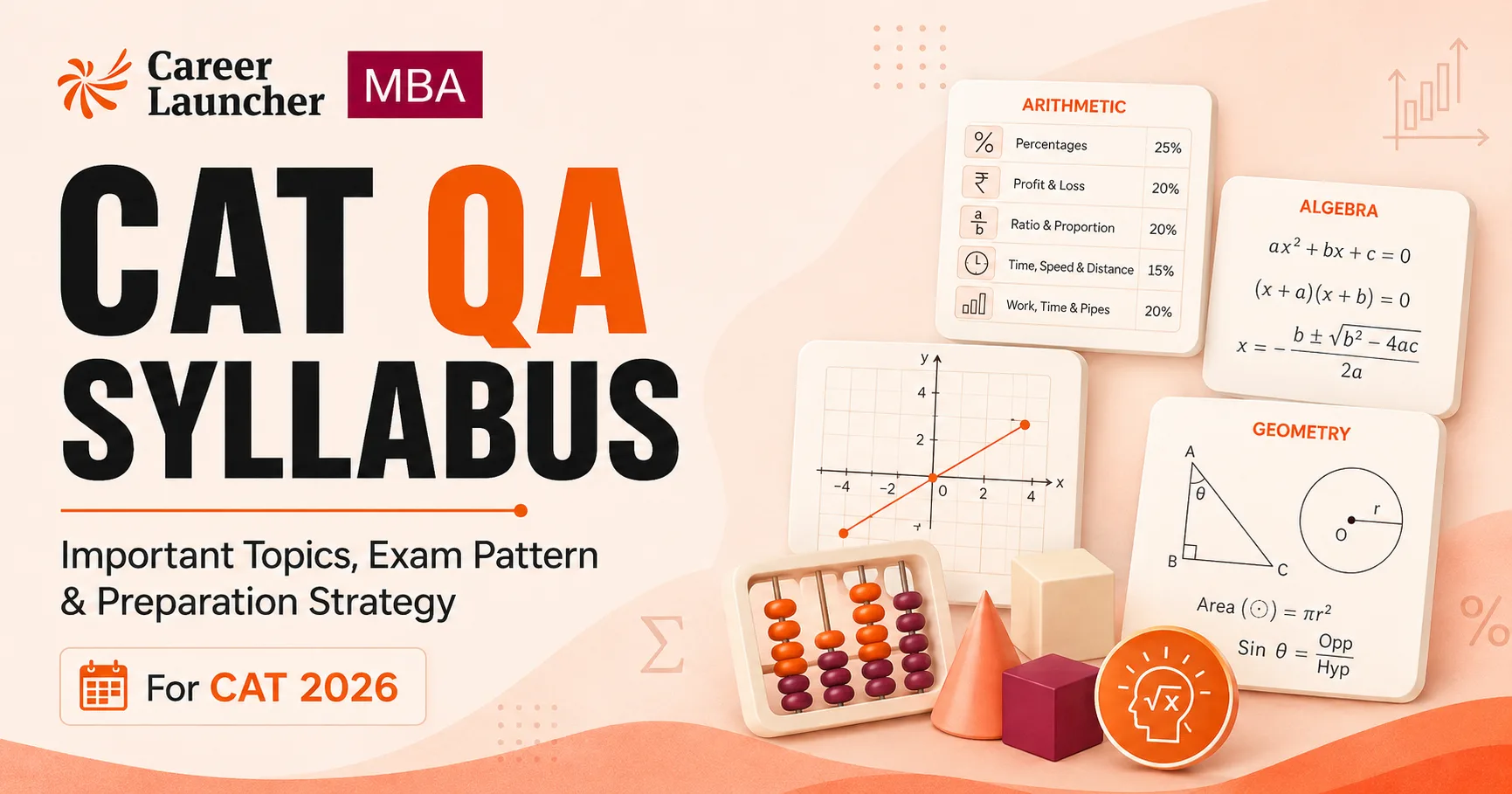
Arithmetic dominates the CAT Quant section with nearly 40–45% weightage. The topics rely on logic and basic math rather than formulas, making them perfect for quick and accurate attempts during the exam.
Preparation Tips:
- Practice at least 20 TSD and Ratio-based problems daily.
- Learn the Alligation shortcut method to solve mixture problems in seconds.
- Memorize percentage-to-fraction equivalents (e.g., 50% = ½, 25% = ¼, 20% = ⅕).
Algebra: Concept-Heavy but Rewarding
Algebra accounts for 25–30% of the CAT Quant section and tests your conceptual clarity.
Preparation Tips:
- Focus on quadratic equation roots and shortcuts for factorisation.
- Revisit AM–GM inequalities and basic graph transformations.
- Learn to visualise function-based problems — it saves time and reduces calculation errors.
Geometry: Revise Core Properties and Theorems
Geometry contributes 15–20% to CAT Quant and is often a mix of theoretical understanding and application-based problems.
Preparation Tips:
- Revise all important formulas:
- Area of a triangle = ½ × base × height
- Area of a circle = πr²
- Volume of cylinder = πr²h
- Memorise common Pythagorean triplets (3–4–5, 5–12–13, 8–15–17).
Don’t get stuck in complex diagrams and focus on symmetry and visualisation.
Also read: CAT 2023 Question Paper | CAT 2024 Question Paper

Conclusion
The last few days before CAT 2026 can truly be a game-changer if used wisely. Instead of learning new topics, focus on consolidating what you already know and revising key formulas, strengthening conceptual clarity, and analysing your mocks to fix recurring errors. Stay calm, maintain accuracy under pressure, and trust your preparation. A sharp, well-planned final strategy can make all the difference on exam day.
Frequently Asked Questions
Q1. What are the most important topics in CAT Quant 2026?
Arithmetic, Algebra, and Geometry are the key scoring areas.
Q2. How can I improve my speed in CAT Quant?
Practice mental calculation tricks, learn Vedic math methods, and use shortcuts for recurring question types.
Q3. Is it possible to improve CAT Quant in one month?
Yes, with focused revision, mock analysis, and time-bound practice, significant improvement is achievable.
Q4. How many questions should I attempt in CAT Quant?
Aim for 14–17 accurate attempts to reach a 95+ percentile (depending on difficulty).