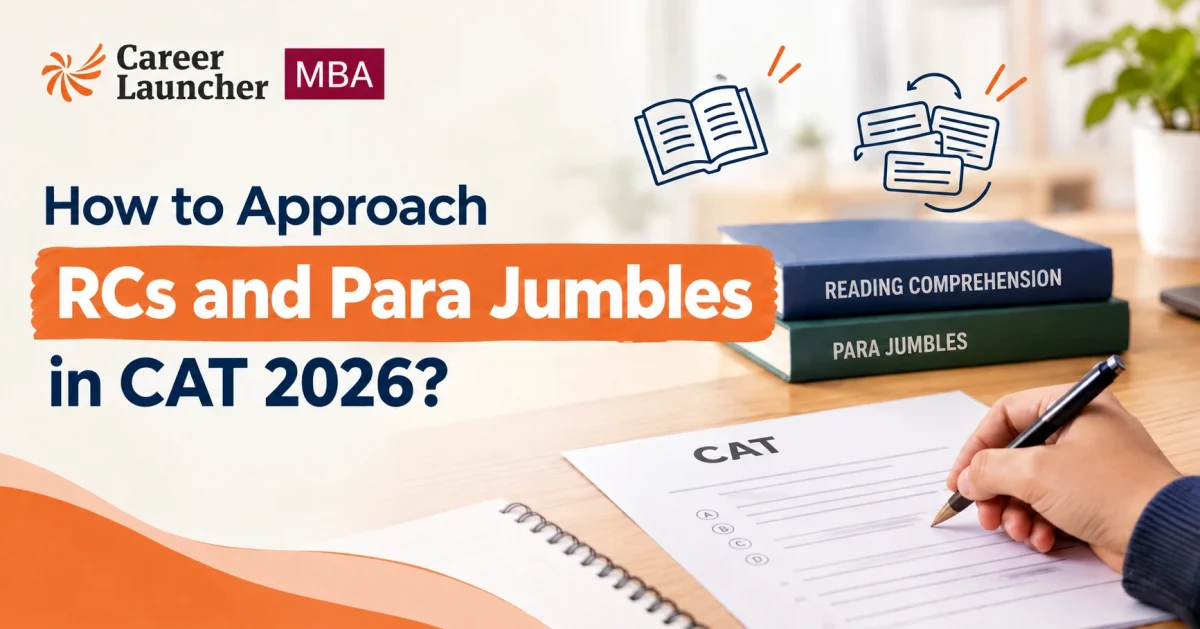
RCs and Para Jumbles in CAT 2026 require different approaches. A strong VARC strategy needs more than just regular practice. Reading Comprehension makes up the larger portion of the section, while Para Jumbles require you to piece together sentences and identify the most logical sequence. Since the two question types test different skills, approaching them in the same way can affect both accuracy and time management.
A clear approach can help you handle both question types more effectively. Here’s an approach you can follow for RCs and Para Jumbles to make your VARC preparation more structured and focused.
Table of Contents
CAT 2026 VARC Weightage: RC vs Verbal Ability
Reading Comprehension carries the larger share of VARC, making it an important area to prioritise during CAT 2026 preparation.
| VARC Component | Questions | Marks |
| Reading Comprehension | 16 | 48 |
| Verbal Ability | 8 | 24 |
| Total | 24 | 72 |
The recent score benchmarks also give an indication of the level of performance needed for a high VARC percentile. As per Career Launcher’s compiled CAT data, the raw score corresponding to the 99 percentile was 42 in CAT 2025 and 45 in CAT 2024. These figures may vary each year, so they are best used as reference points while setting your preparation targets.
Also Read: CAT 2026 Preparation For Non-Engineers
How to Approach Reading Comprehension(RC) in CAT 2026
A good RC attempt starts with understanding the passage and ends with choosing only the options that the passage supports.
1. Choose the Right Passage
- You do not necessarily have to attempt the RC passages in the order in which they appear.
- Evaluate the available passages first and choose one that you are more comfortable with before committing your time to it.
- A passage that appears lengthy or difficult at first glance may not necessarily be the best choice, so passage selection becomes an important part of your VARC strategy.
- The objective is to avoid spending too much time on a passage that is difficult for you when another passage may offer a better opportunity to score.
2. Read the Passage Carefully
- The objective is not to remember every sentence. Focus on understanding the argument and following how the ideas develop throughout the passage.
- Practise with passages covering areas such as economics, science and technology, culture, environment, psychology and philosophy to build familiarity with different styles of writing.
- Becoming comfortable with different styles and subjects can make it easier to follow the argument when you encounter a dense passage in CAT.
3. Understand What the Question Is Asking
- Not every RC question can be approached in the same way.
- Some questions can be answered directly from the passage, while others require an inference based on the information provided.
- For a direct question, use the relevant part of the passage to verify the answer.
- For an inference-based question, focus on what logically follows from the passage rather than looking for an identical sentence.
- An option may sound reasonable in isolation but still be incorrect if it is not supported by the passage.
4. Use the Passage to Eliminate Options
- Evaluate the answer options against the passage rather than your personal understanding of the topic.
- Be cautious with an option that goes beyond what the author has established.
- Eliminate options that change the meaning of an argument or introduce an idea that is not supported by the passage.
- Keep your focus on what can actually be established from the passage.
5. Practise and Analyse RCs
- Regular practice is important for developing your RC-solving ability.Working through CAT mock tests can help you assess your accuracy and time management in a timed setting.
- Do not stop at simply solving passages; use your attempts to understand where you are going wrong.
- Identify whether the problem lies in understanding the passage, interpreting the question or choosing between two close options.
- Look for patterns in your mistakes so that your practice addresses the specific areas where you need to improve.
Also Read: Important Topics for CAT VARC 2026

How to Approach Para Jumbles in CAT 2026
Para Jumbles test how well you can identify the logical relationship and sequence between sentences.
1. Look for the Opening Sentence
- The opening sentence introduces the topic or the central idea with which the paragraph begins.
- Look for a sentence that can stand independently and does not require an earlier reference to make sense.
- A sentence beginning with a pronoun or reference such as “this”, “they” or “such a system” may depend on an earlier sentence and is therefore less likely to be the opening sentence.
2. Identify Sentence Pairs
- You do not always have to arrange all the sentences at once.
- Look for sentences that clearly belong together.
- One sentence may explain, elaborate on, contrast with or provide an example of the sentence immediately preceding it.
- Identifying such relationships can help you establish mandatory pairs within the paragraph.
- Once a few relationships are fixed, arranging the remaining sentences becomes easier.
3. Use Connectors and References
- Words and phrases that show relationships between ideas can provide useful sequencing clues.
- Look for:
- Pronouns and references
- Cause-and-effect relationships
- Contrasts
- Examples and explanations
- Repetition of key ideas
- Transition words
- For example, a sentence containing “however” generally indicates a contrast with an idea introduced earlier.
- Similarly, a sentence beginning with “this” or “these” generally requires a previous reference.
- Use these clues along with the overall meaning and flow of the paragraph rather than relying on any single word or connector.
4. Identify the Closing Sentence
- Once you have established the opening sentence and some sentence relationships, look for the sentence that can logically conclude the paragraph.
- A concluding sentence should provide a natural end to the discussion rather than introduce a completely new idea that requires further explanation.
- The opening and closing sentences can therefore act as useful anchors while arranging the sentences in between.
5. Confirm the Complete Sequence
- Before entering your answer, read the complete sequence from beginning to end.
- Check whether the paragraph develops naturally and whether every sentence connects logically to the one before it.
- Do not finalise an arrangement simply because individual sentence pairs appear correct.
- The complete sequence should read as a coherent paragraph before you submit your answer.
RC and Para Jumbles in CAT 2026: What Should You Prioritise?
RC and Para Jumbles do not carry the same weight in CAT 2026 VARC Syllabus, so your preparation time should reflect that difference. .
| Reading Comprehension | Para Jumbles |
| Forms the majority of VARC | Forms a smaller part of VA |
| 16 questions based on the recent pattern | Around 2 questions in the recent pattern |
| Requires understanding of passages and questions | Requires understanding of sentence sequence |
| Direct and inference-based questions need different approaches | Sentence relationships help establish the sequence |
| Passage selection can affect time management | No answer options are available in CAT TITA questions |
An important point to keep in mind while preparing for Para Jumbles is that the quantity of practice alone does not necessarily determine performance. Instead of simply solving a very large number of questions, focus on understanding why a particular sequence works and which clues helped establish it.
Also Read: How to Prepare for CAT 2026 Along with NMAT, SNAP and XAT
Common Mistakes to Avoid in RCs and Para Jumbles
Avoiding a few common mistakes can help you improve accuracy and make better use of your time while solving RCs and Para Jumbles.
Reading Comprehension
- Attempting passages in a fixed order: Do not assume that the first passage should always be your first attempt. Evaluate the available passages before committing your time.
- Relying on outside knowledge: RC questions are based on the passage. Your personal knowledge of the subject should not replace what the author has actually stated or implied.
- Treating every question identically: Direct and inference-based questions require different kinds of reasoning, so avoid using the same approach for both.
- Choosing an option because it sounds correct: An option must be supported by the passage rather than simply appearing correct based on general knowledge or common sense.
Para Jumbles
- Trying to arrange all sentences at once: Look for anchors and sentence pairs first instead of attempting to establish the complete sequence immediately.
- Ignoring references: Pronouns and words such as “this”, “these” and “they” can indicate that a sentence depends on an earlier statement.
- Ignoring logical connectors: Words indicating contrast, continuation, explanation or consequence can provide useful clues about the sequence.
- Submitting without checking the complete paragraph: Even if individual pairs appear correct, read the complete sequence once to ensure that the paragraph flows logically from beginning to end.
How to Practise RCs and Para Jumbles for CAT 2026
Effective practice should focus not just on solving more questions, but on understanding how and why you arrive at an answer.
Reading Comprehension
- Practise different types of passages to improve your ability to understand arguments and interpret questions accurately.
- After each RC, analyse whether the difficulty came from understanding the passage, interpreting the question or choosing between close options.
- Review incorrect answers to understand why the correct option is supported by the passage and why the other options do not fit.
Para Jumbles
- Focus less on solving questions mechanically and more on identifying the clues that determine the sequence.
- After solving a question, review the sequence and ask:
- Why is this sentence the opening?
- Which sentences form a mandatory pair?
- What connects one sentence to the next?
- Why does the paragraph end with this sentence?
- Which clue helped eliminate the other possible sequences?
- This makes your practice more analytical and helps you understand the reasoning behind each sequence rather than focusing only on the number of questions solved.
| Suggested Reading | |
| Tricks to Improve Speed and Accuracy in CAT 2026 DILR Section | How to Improve Accuracy in CAT 2026 Quant Section |
Conclusion
RCs and Para Jumbles require different approaches in CAT 2026. Since Reading Comprehension contributes the larger share of VARC, it should form the core of your preparation. Focus on selecting passages carefully, understanding the author’s argument and distinguishing between direct and inference-based questions.
For Para Jumbles, focus on sentence relationships rather than guessing the complete sequence at once. Identify the opening and closing sentences, establish connected pairs and use references and logical flow to confirm the arrangement.
The objective is not simply to solve more questions. It is to develop a method that helps you make better decisions when the clock is running.
FAQs
1. How should I approach RCs in CAT 2026?
A. Start by evaluating the available passages and selecting one that you are comfortable attempting. Read to understand the author’s argument, identify what each question is asking and evaluate answer options against the passage.
2. How many RC questions are there in CAT?
A. Based on the recent CAT pattern cited by Career Launcher, VARC has 24 questions, of which 16 are based on Reading Comprehension.
3. How should I solve Para Jumbles in CAT?
A. Start by identifying a possible opening sentence and look for sentence pairs that have a clear logical relationship. Use references, connectors and the overall flow of the paragraph to establish the complete sequence.
4. Are Para Jumbles difficult in CAT?
A. Para Jumbles can be challenging because CAT presents them as TITA questions without answer options. Career Launcher’s preparation approach therefore focuses on identifying sentence relationships and establishing the sequence logically rather than relying on option elimination.
5. Should I prioritise RCs over Para Jumbles for CAT 2026?
A. RC should receive greater attention because it contributes a significantly larger share of the VARC section. However, Para Jumbles should not be ignored. A focused, method-based approach can help you make the most of the questions available in the section.