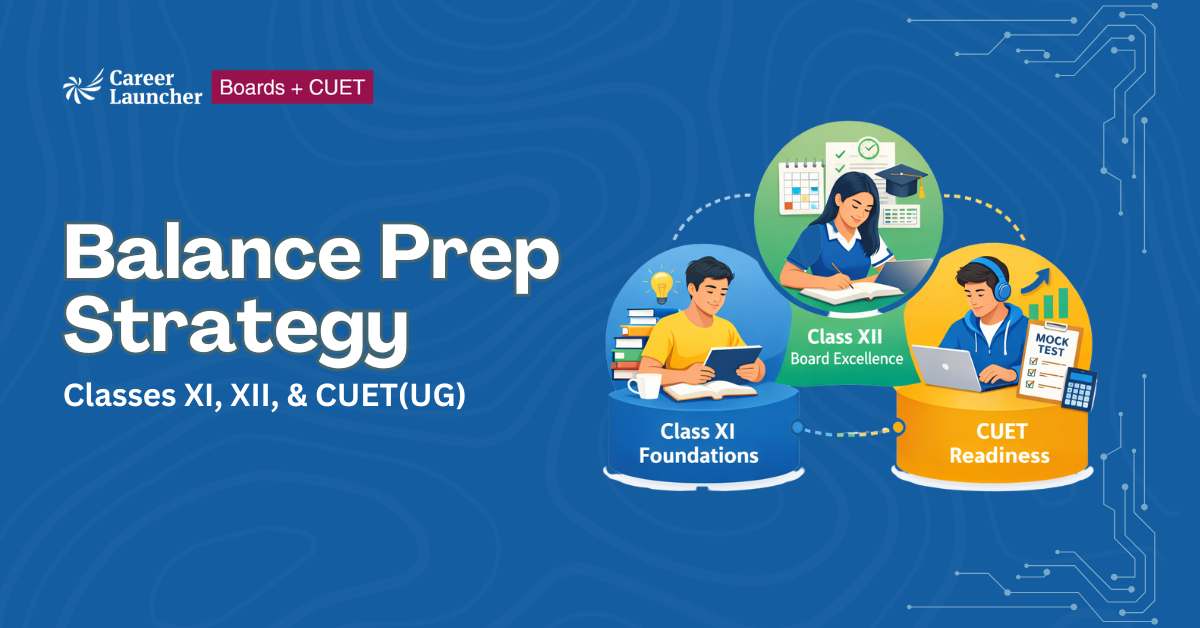
Preparing for Class 11, Class 12 Board exams and CUET UG together can sound overwhelming.
Different exams. Different question formats. Different preparation requirements. And, of course, school, assignments and everything else happening alongside.
But here’s the good news: you do not have to prepare for all three as completely separate exams.
For most students wondering – “How to Prepare for Class 11, Class 12 & CUET Together?“, the foundation overlaps significantly. Strong concepts, consistent school preparation and a smart introduction to CUET-specific practice can help you prepare for Class 11, Boards, and CUET without doubling your study hours.
Whether you are a Class 11 student targeting CUET 2028 or a Class 12 student preparing for CUET 2027, the key is to know what to focus on at your current stage.
This guide explains how to balance school, Boards and CUET preparation without turning your entire student life into one long study session.
Table of Contents
Why Class 11, Class 12 & CUET Preparation Can Be Combined
The biggest mistake students make is thinking: “I have to prepare for school, Boards and CUET separately.”
Not really.
Your school preparation builds the academic foundation. Class 12 Boards test your understanding and written presentation. CUET requires you to apply your knowledge in an objective, time-bound format.
| Preparation Stage / Exam | Primary Purpose | Main Focus | Preparation Approach |
|---|---|---|---|
| Class 11 | Build academic foundation | Concept clarity | Learn concepts thoroughly |
| Class 12 + Boards | Strengthen subject knowledge | Understanding + written answers | NCERT + revision + answer writing |
| CUET UG | UG admission to participating universities | Concepts + accuracy + exam practice | Relevant syllabus + MCQs + PYQs + mocks |
The goal, therefore, should not be to study three times more.
Instead:
Learn once → Strengthen concepts → Practice differently for Boards and CUET.
A strong academic foundation can support your Board preparation while also making your CUET preparation more manageable.
First, Understand What Your CUET Preparation Should Look Like
Before making a timetable for “How to Prepare for Class 11, Class 12 & CUET Together?“, understand one important thing:
CUET preparation should not look the same for a Class 11 student and a Class 12 student.
A student targeting CUET in 2028 has more time to build concepts and skills gradually. A student targeting CUET in 2027 needs to balance Class 12, Boards and CUET-specific practice more actively.
The Smart CUET Preparation Model
| Your Stage | Primary Focus | CUET Preparation Level |
|---|---|---|
| Class 11 | Academic foundation | Light and skill-based |
| Beginning of Class 12 | Strong NCERT preparation | Structured CUET preparation |
| Mid-Class 12 | Syllabus completion + practice | Active MCQs + PYQs |
| Pre-Boards / Boards | Board preparation | Light CUET maintenance |
| After Boards | CUET-focused practice | Intensive revision + mocks |
This approach prevents two common problems:
- Starting CUET preparation so early that you burn out
- Waiting so long that CUET-specific practice becomes stressful

Step-by-Step Strategy to Prepare for Class 11, Class 12 & CUET Together
Step 1: Build Your Academic Foundation First
Your first priority in Class 11 and the early stages of Class 12 should be understanding what you are studying. Do not rush through chapters simply to complete a syllabus.
For your school and Board subjects:
- Understand concepts thoroughly
- Read the prescribed textbooks carefully
- Complete important examples and exercises
- Clear doubts as soon as they arise
- Make short revision notes while studying
For CUET aspirants, this strong foundation will make the later transition to MCQs, PYQs and timed practice significantly easier.
How to Study a Chapter Smartly
Use this simple sequence:
Learn → Understand → Revise → Practice → Test yourself
For example:
- Learn the chapter in school or through your study material.
- Read the relevant prescribed text carefully.
- Make short notes of formulas, definitions, facts or important concepts.
- Practice questions appropriate to your school and Board preparation.
- Once comfortable with the chapter, solve CUET-style MCQs.
This ensures that CUET preparation builds on your academic preparation rather than competing with it.
Explore CUET FREE Preparation Resources
Step 2: Do Not Use the Same Study Strategy in Class 11 and Class 12
One of the most important parts of balancing Boards and CUET is changing your strategy as your academic stage changes.
If You Are in Class 11
Your priority should be:
School concepts first. CUET skills gradually.
You do not need to start taking frequent full-length mocks.
Instead, use this phase to:
- Strengthen your academic fundamentals
- Develop reading habits
- Improve English comprehension
- Build vocabulary gradually
- Improve basic reasoning and quantitative skills, if required for your target course
- Start exploring potential courses and universities
A Practical Class 11 Approach
Most of your academic effort should naturally go towards school and concept-building.
You can gradually add short CUET-focused sessions during the week for skills such as:
- Reading comprehension
- Vocabulary
- Logical reasoning
- Basic quantitative aptitude, where relevant
- Familiarity with the CUET exam structure
The goal is not to “finish CUET preparation” in Class 11.
The goal is to enter Class 12 with a strong academic base and fewer skill gaps.
If You Are in Class 12
Class 12 is where preparation becomes more structured.
Your focus should now move towards:
- Completing the relevant academic syllabus
- Revising concepts regularly
- Practicing CUET-style MCQs from completed chapters
- Understanding the requirements of your target courses and universities
- Introducing PYQs and tests gradually
At this stage, you are no longer just building a foundation.
You are gradually converting academic knowledge into exam readiness.
Step 3: Follow a Flexible Boards + CUET Time Division
There is no perfect timetable that works for every student.
Your preparation time should depend on:
- Your school workload
- Strengths and weaknesses
- Number of CUET subjects required for your target course
- Your current syllabus completion level
- Upcoming school or Board examinations
Instead of following one fixed ratio throughout the year, adjust your focus according to the stage of preparation.
| Preparation Period | Main Priority | CUET Preparation |
|---|---|---|
| Class 11 | School + concept building | Skill development |
| Early Class 12 | School + syllabus completion | Subject-wise practice |
| Mid-Class 12 | Boards + revision | MCQs + PYQs |
| Pre-Boards | Boards | Limited CUET maintenance |
| Board Exam Period | Boards | Light revision only, if manageable |
| After Boards | CUET | Primary focus |
The Golden Rule
Do not sacrifice strong Board preparation for unnecessary CUET practice.
Instead, identify the areas where both preparations overlap and build your CUET practice around them.
Step 4: Start CUET-Specific Practice After Building Chapter Understanding
A common student question is:
“Should I start solving CUET MCQs immediately?”
You can begin CUET-style practice after gaining a reasonable understanding of a chapter. For each completed chapter, follow this sequence:
Concepts → Board-style questions → CUET MCQs → Review mistakes
This is much more effective than waiting until your entire syllabus is complete.
What to Practice
Depending on your chosen CUET subjects and course requirements, gradually include:
- Chapter-wise MCQs
- Topic tests
- CUET Previous Year Questions
- Mixed-topic practice
- Sectional tests
The aim is to gradually improve:
- Accuracy
- Speed
- Question interpretation
- Recall
- Exam familiarity
Download CUET Previous Year Question Papers
Step 5: Know When to Start CUET PYQs
You do not necessarily have to wait until you complete the entire syllabus to look at PYQs. It can serve different purposes at different stages.
Early Stage: Understand the Exam
Look at PYQs to understand:
- What kind of questions are asked
- How concepts are tested
- The level of detail required
- Which topics require more careful preparation
Mid-Preparation: Practice Completed Topics
Once you complete relevant chapters, solve questions from those topics.
This helps you move from:
“I have studied this chapter”
to:
“I can answer questions from this chapter.”
Advanced Stage: Test Your Preparation
As your syllabus coverage increases, PYQs become useful for:
- Timed practice
- Identifying weak areas
- Improving question selection
- Strengthening recall
Step 6: Build English Skills Through Short Daily Practice
For students appearing for a CUET Language paper, English preparation should ideally become a habit rather than a last-minute task.
You do not always need long study sessions.
Even 15–30 minutes of consistent practice can help you develop reading and language skills over time.
Work On
- Reading comprehension
- Vocabulary
- Grammar concepts
- Sentence structure
- Word usage
- Question-solving practice
A Simple Daily Routine
- Read for 10-15 minutes.
- Learn a few useful words and understand their usage.
- Practice a small set of questions.
- Review mistakes instead of simply checking the score.
The goal is not to memorize hundreds of words overnight.
Consistency matters more than occasional long study sessions.
Step 7: Prepare for the General Aptitude Test Only If Required
One important mistake is preparing for sections simply because other students are preparing for them. Before adding any CUET subject or section to your preparation schedule, check the requirements of your preferred:
- Course
- University-wise eligibility
- Program-wise subject combinations required
- The final admission criteria
If the General Aptitude Test is required for your target options, gradually build the necessary skills.
Depending on the applicable syllabus and requirements, your preparation may include:
- Logical reasoning
- Analytical thinking
- Quantitative ability
- General knowledge and current affairs
Smart Approach
Do not attempt to study everything at once.
Start by identifying:
- Your strongest areas
- Your weakest areas
- Topics that require consistent practice
Then use short, regular practice sessions.
Check the Latest CUET Syllabus
Best Subject-Wise Study Strategy for an Effective Preparation
Boards and CUET may test your preparation differently. Use the same concepts, but change your practice method.
| Subject Type | Focus for Boards | Focus for CUET Preparation |
|---|---|---|
| Numerical subjects | Concepts, steps and presentation | Accuracy and efficient problem-solving |
| Theory-heavy subjects | Detailed understanding and structured answers | Recall, interpretation and MCQ practice |
| Fact-based subjects | Explanations and organized answers | Key facts, concepts and quick recall |
| English / Language | Writing and language development | Reading comprehension, vocabulary and language practice |
The exact preparation approach will naturally vary depending on your subjects.
Make Notes That Work for Both Boards and CUET
You do not necessarily need two completely separate notebooks for every subject. Instead, create layered notes.
Layer 1: Detailed Academic Notes
Useful for:
- School exams
- Boards
- Understanding concepts
Include:
- Explanations
- Important examples
- Diagrams
- Structured answers
Layer 2: Quick Revision Notes
Useful for:
- CUET revision
- MCQs
- PYQs
- Mock analysis
Include:
- Formulas
- Definitions
- Dates
- Key facts
- Common mistakes
- Frequently forgotten concepts
This approach saves time because you are not repeatedly rewriting the same chapter.
When Should You Start CUET Mock Tests?
Another common mistake is treating every test as a full-length mock. You can introduce testing in stages.
| Preparation Level | Best Type of Test |
|---|---|
| Beginning | Topic-wise practice |
| Chapter completed | Chapter tests |
| Multiple topics completed | Sectional / mixed-topic tests |
| Major syllabus covered | Full-length mocks |
| Final preparation stage | Regular mocks + detailed analysis |
Remember: Mock analysis is more important than simply increasing the number of mocks.
After each test, ask:
- What did I get wrong?
- Did I not know the concept?
- Did I misread the question?
- Did I run out of time?
- Was the mistake avoidable?
- What should I revise before the next test?
Keep an error log. Over time, this can become one of your most useful revision resources.
A Sample Weekly Study Strategy for Class 11 & Class 12 Students
Instead of following a rigid hour-by-hour timetable, divide your week by purpose.
| Day | Primary Focus |
|---|---|
| Monday | School subjects + short revision |
| Tuesday | Completed chapter practice + MCQs |
| Wednesday | School subjects + language / aptitude practice |
| Thursday | Revision + topic-wise CUET practice |
| Friday | Board-style answer practice |
| Saturday | PYQs, chapter test or sectional test |
| Sunday | Revision, planning and rest |
Adjust the Plan According to Your Stage
A Class 11 student may use Saturday primarily for:
- Skill practice
- Reading
- Topic-based exploration
A Class 12 student may use it for:
- MCQs
- PYQs
- Tests
- Weak-topic revision
The timetable should serve your preparation.
You should not feel guilty every time you cannot follow the timetable perfectly.
What Class 11 Students Should Avoid
If you are targeting CUET 2028, avoid making CUET preparation unnecessarily stressful.
Do not:
- Obsess over mock scores too early
- Neglect school concepts
- Follow an intensive Class 12-style timetable
- Collect too many books and resources
- Copy another student’s preparation routine
Instead: Build concepts early. Build skills gradually. Build confidence consistently.
What Class 12 Students Should Avoid
If you are targeting CUET 2027, avoid treating CUET preparation as something you can start only after Boards.
Do not:
- Wait until every chapter is “perfect”
- Ignore CUET-style MCQs completely
- Postpone PYQs indefinitely
- Start mocks without analyzing them
- Neglect your weaker subjects
Instead, gradually integrate CUET-specific practice with your ongoing Class 12 preparation.
Bonus Tips to Balance School, Boards & CUET Preparation
- Clear doubts before they pile up.
- Revise completed topics regularly.
- Focus on your own preparation gaps instead of comparing progress.
- Use PYQs to understand how your knowledge is tested.
- Keep short revision notes.
- Maintain a mistake log after tests.
- Take breaks without feeling guilty.
- Sleep properly, especially during intensive preparation periods.
- Check the eligibility and subject requirements of your preferred universities and courses before finalizing your CUET preparation plan.
Explore the CUET University List
The Biggest Mistakes Students Make While Preparing for Boards and CUET Together
1. Treating Boards and CUET as Completely Separate Exams
- This often leads to unnecessary workload.
- Look for syllabus overlap and build your preparation around common concepts.
2. Starting CUET Practice Too Late
- Do not wait for your entire academic year to finish before becoming familiar with MCQs and exam-style questions.
3. Starting Full-Length Mocks Too Early
- Full-length mocks are most useful when you have sufficient syllabus coverage.
- Start with topic and sectional practice.
4. Collecting Too Many Resources
- More books do not automatically mean better preparation.
- Use a limited set of resources consistently.
5. Ignoring Revision
- Completing a chapter once does not mean it is permanently prepared.
- Build regular revision cycles.
6. Comparing Your Timeline With Other Students
- One student may start earlier. Another may learn faster.
- Your preparation should be based on your: Starting point, Strengths, Weaknesses, and Target course requirements
Final Takeaway
Preparing for Class 11, Class 12, Boards and CUET together does not mean studying for three completely different exams. The smarter approach is:
Build → Practice → Test → Analyse → Revise
If you are in Class 11 and targeting CUET 2028, focus on building a strong academic foundation and developing relevant skills gradually.
If you are in Class 12 and targeting CUET 2027, focus on completing your academic preparation while steadily adding CUET-specific MCQs, PYQs and tests.
You don’t necessarily need to study longer hours. You need a preparation strategy that ensures the work you do for one academic goal also supports the others.
Stay consistent, revise regularly and gradually shift from learning concepts to applying them under exam conditions. Your preparation for Boards and CUET can move together – provided you give each stage the right focus at the right time. For students looking for a more structured preparation approach, a comprehensive CUET online coaching program can also help bring school preparation, CUET practice, doubt-solving and test preparation into a more organized routine.
Balanced Class 11, 12, & CUET Prep FAQs
1. Can I prepare for CUET along with Class 11?
Yes. Class 11 students can start building a strong foundation for CUET by focusing on school concepts, reading skills, vocabulary and other relevant aptitude skills without putting unnecessary pressure on themselves.
2. How do I balance Class 12 Boards and CUET preparation?
Focus on the common syllabus first and gradually add CUET-specific MCQs, PYQs and practice. This helps you prepare for Boards and CUET together without treating them as completely separate exams.
3. When should I start preparing for CUET?
The best time depends on your current academic stage. Class 11 students can focus on building concepts and skills, while Class 12 students should gradually combine syllabus preparation with CUET-specific practice.
4. Should I start CUET preparation in Class 11 or Class 12?
You can start in either Class 11 or Class 12. Starting in Class 11 allows you to build concepts gradually, while Class 12 requires a more structured approach that combines Board preparation with CUET practice.
5. How many hours should I study for Boards and CUET together?
There is no fixed number of hours for every student. Focus on completing your school syllabus effectively and add regular CUET-specific practice based on your preparation level and target course requirements.
6. Is NCERT enough for CUET and Board preparation?
NCERT and the prescribed syllabus should form the foundation of your preparation. For CUET, students should also practice MCQs, PYQs and mock tests to improve accuracy and familiarity with the exam format.
7. When should I start solving CUET PYQs?
You can start exploring CUET PYQs once you understand the exam format and begin solving questions from chapters you have completed. PYQs help you understand how concepts are tested in the exam.
8. When should I start giving CUET mock tests?
Start with topic-wise and chapter tests after completing relevant concepts. Move to sectional and full-length mocks as your syllabus coverage increases and focus on analyzing your mistakes after every test.
9. Can I prepare for CUET without compromising my Board marks?
Yes. A well-planned strategy can help you prepare for both together. Build strong concepts for your school and Board syllabus first, then add CUET-specific MCQs, PYQs and timed practice gradually.
10. How should Class 11 students prepare for CUET 2028?
Class 11 students targeting CUET 2028 should focus on strengthening academic fundamentals, developing reading and reasoning skills, and understanding their preferred courses and university requirements. Intensive full-length mock preparation is usually not necessary at this stage.